
World & consciousness
Aristotle: Form, Matter and the Explanation of a Thing
Aristotle’s matter, form, composite and two senses of actuality: explaining a thing and a living whole, with bounded comparisons to Plotinus.
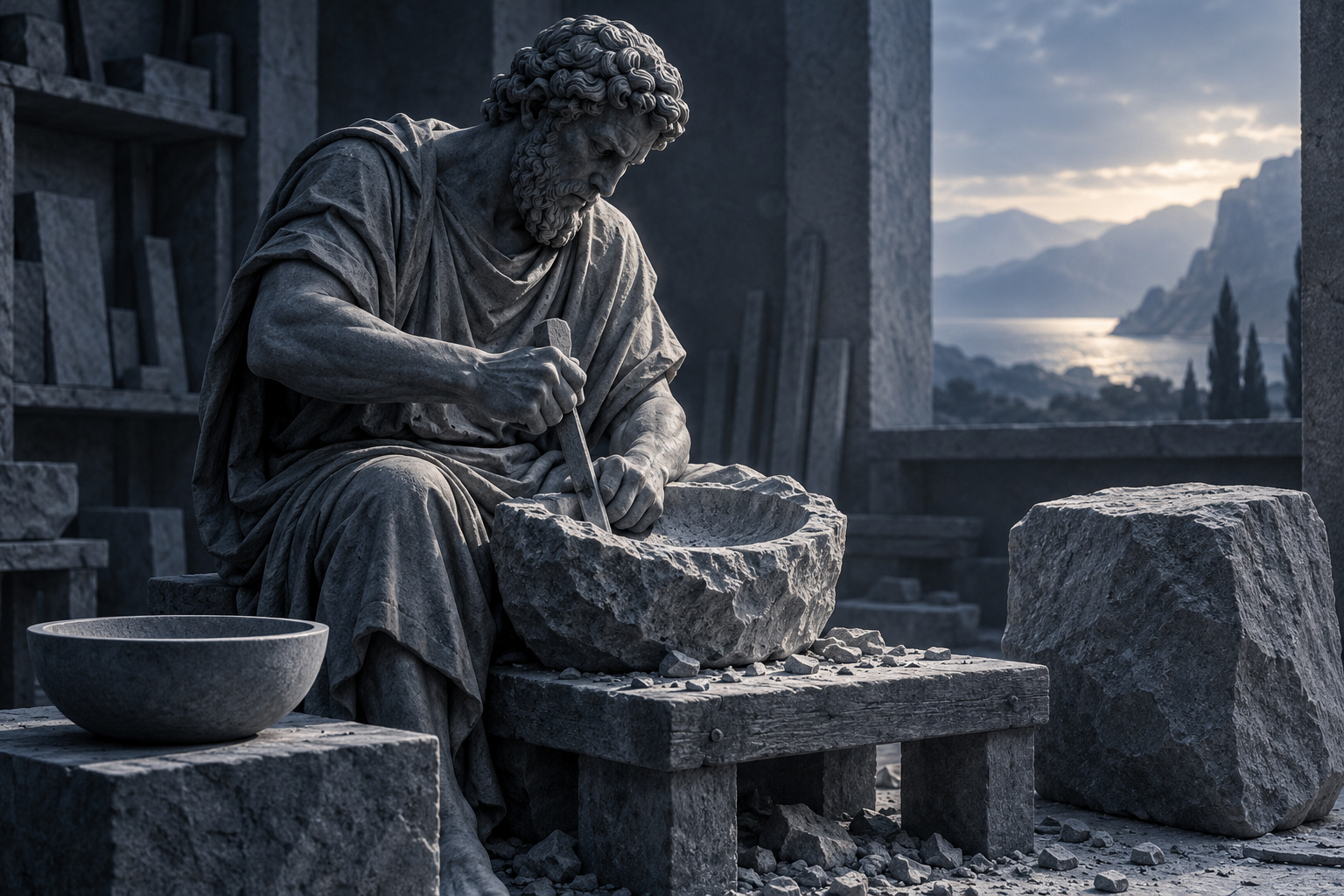
Epigraph
“Now matter is potentiality, form actuality”.
Aristotle, On the Soul, Book II, Part 1. Exact clause before the semicolon in the displayed English translation by J. A. Smith. Primary text, opening paragraph on matter, form and the composite; two senses of actuality follow. The Russian companion uses United Wisdom’s own translation from English, rather than directly from Greek.
What this article is about
An accurate answer about what a thing is made of may still leave unexplained what it is. Wood can be a table, a door or a remaining piece of material; naming a substance does not show why its arrangement matters. Aristotle’s distinction between matter and form helps pose this second question. We will examine matter’s relativity, the production of a composite, different senses of cause and the particular case of a living body. The sphere, wax, tool and eye remain examples in an ancient philosophical argument, rather than contemporary physiology. Comparison with Plotinus will show how familiar words can work within another metaphysical construction. The task is to understand what form explains and why it is more than an outline or a separate component inside an object. This reading helps select a question about a particular thing without turning philosophical categories into a universal technical instruction or judgement of human worth.
I. Material leaves the question of what a thing is open
Matter and form answer connected but distinguishable questions. Someone shown several wooden components may correctly name the material while not knowing what is to be assembled. Seeing a completed table makes another explanation possible: how the components form an object of a particular kind. This invented example distinguishes identifying composition from understanding arrangement. It does not make the material insignificant: its properties constrain possible production.
In Physics II, Aristotle considers nature and distinguishes understanding it through matter and through form. Form concerns what a thing is alongside how it appears to an observer. Asking about it moves us from a list of components towards their determination. If an answer only names wood and fastenings, we have not yet explained why the object is a table rather than another thing with similar components.
Correctly naming an object is nevertheless insufficient. A name can conceal misunderstanding as easily as a material list. We need to ask which relations make the components significant to a whole. In our example, a surface and supports are arranged in a particular way; their connection allows discussion of intended use. A drawing with a similar outline supplies different material and possibilities, although a resemblance may be visible.
The question of form therefore works between two extremes. We neither reduce an object to formless substance nor detach its explanation from what it is made of. Content arises within a relation: what counts as the matter of this particular thing, and what determination makes it the matter of an object of this kind? This question matters more than quickly declaring form superior. Aristotle’s distinction requires a more detailed explanation rather than assigning one word all the work of another beforehand.
II. Matter is relative to the object being explained
Aristotle explicitly calls matter a relative term in Physics II.2. This does not mean substance is invented or its properties depend on our mood. Something is called matter in relation to a particular form and explanatory task. One object can occupy different positions in different accounts. Material consequently needs a further question: the material of what, and in which respect?
In an invented workshop, a board already has a determinate form. It has been made from wood, given dimensions and had its edges finished. When assembling a table, however, that board can be considered material for a further whole. An earlier result of production now becomes part of another process. Relativity removes neither its earlier arrangement nor the properties of wood. It changes the question in relation to which the board is considered.
This helps avoid an endless search for one ultimate material supposedly capable of explaining every thing without reference to its arrangement. Contemporary study of composition can be necessary for a particular task. A more detailed description of substance nevertheless does not by itself say what makes something a table. In Aristotle’s philosophical analysis, the direction of explanation depends on the thing and change under discussion. The smaller scale of a component does not always provide a more sufficient answer.
The example has another side. If a board cannot support an intended load, its position in a plan does not remove the material constraint. An unsuccessful result cannot be explained away by saying an ideal form has already provided everything. Material and arrangement need examination together. Matter’s relativity helps do this: it connects properties with the object being explained, rather than dissolving properties in arbitrary naming or declaring form independent of every particular bearer.
III. Potentiality has a determinate relation to actuality
Potentiality for Aristotle does not mean that every material can become anything whatsoever. The epigraph connects matter with potentiality and form with actuality within an account of the composite. Understanding the connection requires naming the potentiality at issue. A pile of components, a separate board and a completed table occupy different positions relative to the finished object. Their shared wood leaves differences of arrangement significant.
Imagine two tasks: making a low stand and making a tall, narrow cabinet. One stock of boards might suit the first while being insufficient for the second without further components. Possible relates to particular conditions, rather than an imagined description alone. This is our example for posing a question, not historical evidence for Aristotle’s metaphysics. It shows why possibility needs grounds and why wishing to see an object finished does not create it.
Aristotle also distinguishes natural and made things in Physics II.1. His argument draws attention to a principle of change belonging to a natural thing, as distinct from production within a particular craft. Workshop examples are therefore useful without exhausting an account of nature. A table’s arrangement is explained through a maker’s activity; the ancient text poses the question of a plant’s life differently. Each feature of one case cannot silently be transferred to the other.
Readers can now examine their own explanation: have I identified a capacity, a condition or an accomplished action? Knowing how to assemble an object does not mean it has been assembled. A suitable material does not establish that production occurred. Distinguishing potentiality and actuality helps prevent a plan being treated as a result. It also leaves unfinished plans open to explanation through missing conditions, rather than automatically turning them into deficiencies of a person. Those conditions need naming and checking separately.
IV. Four senses of cause are not four competing forces
Aristotle discusses several ways to answer why in Physics II.3. A thing can be explained through material, form, the origin of change and an end. These senses of cause concern different aspects of explanation. They are not presented as four measured forces pushing an object in turn. Mixing that physical picture with the philosophical distinction would obscure why one answer can be an arrangement and another a purpose.
In an invented case of a manufactured bowl, saying it is clay identifies material. Describing its arrangement explains what was made. The maker’s work concerns the origin of production. Intended use adds a question about what the object was made for. The answers can be compatible. Naming a maker does not refute the material; naming the material does not explain every decision by the maker. Several causes in this sense can concern one thing without competing for an exclusive right to count as the real cause.
Compatibility must nevertheless keep an explanation precise. Every answer needs a question to which it responds. If a bowl leaks, an account of its purpose cannot replace checking its particular arrangement and material. If the question concerns why those dimensions were chosen, the maker’s name may be insufficient. Listing four categories matters less than showing the work each performs in this case. Otherwise the classification remains the external shape of a school answer.
An end also needs careful clarification. In our manufactured example it relates to intention and use. This does not turn every natural change into the outcome of a human plan. Aristotle’s natural philosophy has its own framework; the opening parts considered here cannot replace a separate examination of his full teleology. We can preserve a question about purpose in a particular example without declaring a general design of nature proved. Precision comes from matching a question with its answer.
V. A composite is produced, rather than form as a second object
Aristotle considers a thing’s coming to be in Metaphysics VII, especially Parts 7–8. His bronze sphere distinguishes producing a particular composite from producing form as though it were a further object. The maker makes a determinate thing from material. If the sphere’s form itself must be produced separately, a new question arises about what it is made from and how. The explanation risks repeating the original task instead of resolving it.
This does not deny real production. It changes what we consider its object. Bronze becomes a determinate thing; naming its form explains which thing. Our invented bowl needs no further miniature bowl discovered inside its clay to confer bowlhood. We need to explain the composite’s arrangement and the process that produced it. Form does explanatory work without automatically becoming an additional component.
In Part 7, Aristotle discusses form in the maker’s thought and the movement from a plan towards actions. This lets us ask what makes a plan determinate. Wanting a good object does not yet provide a method of making it. Specifying relations between parts and the necessary conditions makes questions about material and work available. A human plan remains sequential and may need revision; it cannot immediately be identified with another philosophical system’s eternal Intellect.
The distinction also helps explain mistakes. If the outcome differs from the intention, several cases are possible: the task was defined poorly, the material was unsuitable or an action did not match the plan. An appeal to form does not select an answer beforehand. It requires specifying where a determinate project and the produced thing diverged. The philosophical question of what is made can consequently deepen a practical explanation instead of adding another uncheckable hidden object.
VI. Material parts and explanatory parts need not coincide
A list of parts depends on what we are examining. In Metaphysics VII.10–11, Aristotle considers the relation of parts to a definition and to a composite thing. Breaking an object into pieces produces material remains, but not necessarily parts of the explanation of what it was. This helps show why a detailed list following destruction may fail to preserve the meaning of a whole’s arrangement.
Suppose an invented bowl is broken. The fragments derive from its material, and some may provide information about its manufacture. Listing fragments is nevertheless different from describing a bowl as an object with a determinate form. A fragment’s accidental size does not explain the role that area of surface had before the break. That question requires reconstructing the relations that made the thing a whole. Material analysis and explanation of arrangement can support one another while remaining different operations.
The distinction also shows the limits of resemblance. Two things may look alike while differing in properties relevant to a task. If one bowl holds liquid and another is a picture of a bowl, a shared outline gives different answers about what we have. The kind of object and the relations included in an explanation need specification. Naming form grants no licence to ignore a particular bearer’s properties.
We can consequently clarify what this is by asking what kind of examination we mean. Are we considering material remains, an object’s arrangement, its origin or its possible use? A distinction may be irrelevant to one answer without being insignificant altogether. Aristotle’s analysis requires selecting grounds for distinctions rather than habitually treating the description with the smallest components as the deepest. Explanatory precision sometimes requires naming a connection that dividing things into smaller pieces does not itself reveal.
VII. First actuality differs from exercising a capacity
At the opening of On the Soul II, Aristotle distinguishes two senses of actuality through knowledge and its exercise. Possessing knowledge differs from thinking at this moment. This qualification matters to his definition of soul as the first actuality of a particular living body. Removing it would produce an excessively simple scheme in which matter is inactive and form always means visible performance. The text offers a more precise distinction.
Someone who knows a rule may not be using it now. In our limited example, this separates having a capacity from a particular activity. Absence of visible performance does not yet prove absence of the capacity. Yet claiming a capacity does not establish that the required action has been accomplished. Discussing a particular result requires seeing that result. A conversation can quietly move between questions about possession and questions about performance.
Aristotle connects the distinction with a living body already being a determinate whole. Sleep and waking enter his argument; soul is not defined as a separate action that must be added again every minute. This is a philosophical explanation of life rather than a way of assessing an actual patient’s condition. The example’s logical role matters: a living whole and a particular exercise of its capacity cannot automatically be treated as the same object of explanation.
The implication for ordinary reasoning is limited too. A tool lying unused allows separate questions about whether it is usable and what someone is currently doing with it. If a person does not answer, we need to establish what information or conditions are missing before declaring them incapable. These examples establish no medical or psychological criteria. They show why ready, capable and acting need different grounds, even when they concern the same person or object.
VIII. A tool, an eye and wax clarify what form means
The examples in On the Soul II.1 connect form with what makes an object an object of a particular kind. Aristotle asks us to imagine a tool as a living being, discusses an eye through sight and compares the unity of matter and form with wax and an impression. Each example has a task of its own. They should not be assembled into one literal picture in which soul is simultaneously a separate blade, an eye and a stamped seal.
The tool raises a question about significant activity. Resembling an axe does not exhaust an explanation of what an axe is in the respect considered. The eye moves attention towards a living part’s capacity. Wax and its impression, meanwhile, help question unity without presenting matter and form as two completed objects that first existed separately and then happened to meet. The scenes clarify different aspects of one difficulty.
Aristotle nevertheless preserves a question about the possible separateness of some capacities. At the end of Part 1 he also mentions an unresolved relation comparable to a sailor and a ship. We cannot therefore declare the entire question of soul settled by saying that soul is the body’s form. The definition works within an argument that has further difficulties of its own. Keeping the qualification means reading more precisely, rather than artificially making the text uncertain.
The examples should also not become contemporary judgements of human worth. Differences in sight or limitations on action do not determine someone’s dignity. The article examines ancient philosophical explanations rather than creating a standard of human worth. A narrower conclusion is useful: form can signify organisation and capacity relevant to understanding a thing, alongside its outward appearance. Addressing an actual organism, contemporary technology or assistance to a person requires information appropriate to the task that these analogies cannot replace.
IX. Familiar words perform different work in Plotinus
Matter, form and soul appear in Plotinus without making him a repetition of Aristotle’s explanation. Plotinus considers Soul as receptive relative to Intellect in V.1 § 3. A relative position permits the language of matter although neither wood nor clay is at issue. Soul is considered as the source of bodies’ life and unity in § 2. The scale of the question differs from explaining a particular living body.
A substantial similarity remains: both authors require a relation between what determines and what receives determination. Aristotle’s composite unity and Plotinus’ order proceeding from the first nevertheless have different commitments. Erasing the difference creates an apparent agreement that can then confirm itself. More precise comparison asks what receives form in each argument, which principle explains that, and what role a body plays.
Aristotle considers form in a maker’s thought in Metaphysics VII.7. Plotinus describes Intellect with simultaneously present intelligible content in V.1 § 4. Both connect determination with thought, but a plan for particular work unfolds differently from Plotinus’ eternal Intellect. A human maker checks conditions, acts sequentially and can be mistaken. Shared words do not automatically grant access to another level of reality.
Comparison therefore helps when it clarifies a question rather than increasing a list of supposedly agreeing authors. Matter’s relativity becomes more visible beside Plotinus’ unusual recipient. Distinguishing particular manufacture from nontemporal origin clarifies different meanings of coming to be. A living whole’s unity and the connection of hypostases retain different scales. We obtain several determinate relations, each open to discussion. Historical influence or one scientific theory of organisation does not follow from the pairings themselves.
X. Form clarifies a task without choosing it for us
Matter and form become useful distinctions when they make a question about a thing more determinate. If an object does not fit a task, we need to establish what is unsuitable: its material, arrangement, production or chosen purpose. Saying its form is disrupted can combine entirely different cases and make correction harder. Aristotle’s concepts have explanatory value insofar as we continue beyond naming them.
Suppose a table is adapted for another room. Dimensions might need changing while some material remains; the material might be replaced while the arrangement stays; or an earlier object may no longer suit its new use. These invented possibilities show why identity and suitability for a task cannot be settled in one phrase. We must specify what remains and what changes. The answer depends on the particular relation we want to explain.
A purpose nevertheless passes no final verdict on an object, still less a person. Failure in one task does not establish someone’s overall uselessness. Confusing a limited question about action with a general judgement of a person becomes especially tempting when philosophical words acquire a solemn tone. We can discuss a task’s structure, available conditions and result without declaring a person material to which someone must give the correct form. That transfer would require entirely different ethical justification.
We began with wood that did not by itself say what we had before us. We can now see that form does not finish an explanation by itself either. It directs attention towards determination, relations and exercise. Matter remains significant, possibility differs from a result and different causes find their respective places. Reading Aristotle may conclude with one precise clarification in a familiar situation. That is more modest than a universal formula for the world’s structure, while showing why made of what and what exactly are connected questions rather than interchangeable ones.
What this means in practice
Choose a familiar manufactured object that requires no risky test: a bowl, a bookshelf or an empty box. Write two separate answers: what it is made of, and what makes it an object of this particular kind for your task. Go beyond a name. Relations between walls, a base and available interior space may matter for a box; discussing a picture of a box would pose another question. You can clarify the answers without immediately trying to construct an entire philosophical system.
Then consider one element. Does it have an arrangement of its own while serving as material for a whole? This shows the relativity of the description. A shelf can be both a manufactured result and a cabinet’s part. Moving between questions does not make its properties arbitrary. If material information is unavailable, record the gap; a philosophical term does not supply an absent observation.
Next choose one why question and clarify the answer you seek. Does it concern composition, arrangement, the origin of manufacture or purpose? Several answers can be written while keeping them distinct. If an object is later used differently, name its initial end and the present action separately. No one question needs to be declared always primary: its significance depends on the task considered.
Finally, distinguish possibility from accomplishment. What makes the object suitable for the task, and what shows the task has actually been performed? Avoid testing strength dangerously or transferring the example to judgements of health or personality. To examine Aristotle’s living whole, return to the opening of On the Soul II and write down his two senses of actuality alongside the remaining qualification about separability. Understanding a text is the task here.
You can stop when one useful distinction has been found. A description of composition might be sufficient for choosing material while insufficient to explain arrangement. Or the task may have changed while the object remained. This is a voluntary examination of concepts and a particular question, rather than a validated programme for developing thought. Its possible value lies in naming the answer sought and the grounds still needed more clearly.
Key quotation
“matter is a relative term”.
Aristotle, Physics, Book II, Part 2. Exact internal clause after Again in the displayed English translation by R. P. Hardie and R. K. Gaye. Primary text, paragraph connecting particular matter with form and an end. This is a sentence fragment rather than a complete aphorism. The Russian companion uses United Wisdom’s own translation from English.
Relativity concerns the thing being explained and its form; it does not declare material properties imaginary.
Connections between traditions
1. Relative matter and an unusual recipient. Aristotle’s Physics II.2 defines matter relative to the form of the thing explained. Plotinus’ V.1 § 3 considers Soul as receptive relative to Intellect. The similarity concerns a recipient’s position in relation to determination, rather than one substance in all things. Plotinian Soul does not become Aristotelian wood or flesh here; shared terminology establishes no common doctrine.
2. A living whole and the source of bodies’ life. Aristotle defines soul as the first actuality of a particular organised body in On the Soul II.1. Plotinus explains bodies’ life and unity through a Soul distinct from them in V.1 § 2. Both question what makes the living a whole, but relate an organising principle to a body differently. Aristotle’s qualification about some capacities’ separateness is preserved; neither account is presented as contemporary physiology.
3. A maker’s plan and Intellect’s content. Form in a maker’s thought enters Aristotle’s explanation of production in Metaphysics VII.7. Plotinus describes Intellect’s simultaneously present content in V.1 § 4. The particular connection relates determination and thought. Sequential human work with possible mistakes differs from eternal Intellect; a craft skill is not presented as direct experience of Plotinus’ level of reality.
4. Manufacturing a sphere and nontemporal origin. Aristotle distinguishes production of a particular bronze sphere from form as a separate object in VII.8. Plotinus explains dependence without temporal change in the first in V.1 § 6 and V.2 § 1. The comparison clarifies whether coming to be concerns changed material or an order of being. These are different explanations rather than versions of one technological process.
5. Form as an answer and the derivative’s determination. Form is one sense of cause in Physics II.3. Plotinus connects Intellect’s determination with its turning towards the first in V.2 § 1. Both require an explanation of determination alongside identifying material. An answer about a particular thing differs from the origin of an intelligible level; the corrupt V.1 § 7 passages are not used for this pair.
6. An animal’s unity and distinguishable levels. Aristotle’s wax and impression, eye and sight examples in On the Soul II.1 clarify unity of matter and actuality. Plotinus preserves levels’ differences while relating them to the first in V.2 § 2. The similarity lets us ask which relation unity means and what it preserves. A living whole and the order of hypostases have different scales and commitments; no shared model of consciousness or historical influence is claimed.
Primary sources
- Aristotle, Physics, Book II, English translation by R. P. Hardie and R. K. Gaye. Primary natural philosophy. Fully read and used Parts 1–3 concern nature, matter relative to form and senses of cause. The remaining book and Greek text are not claimed as read.
- Aristotle, On the Soul, Book II, English translation by J. A. Smith. Primary philosophical psychology. The adopted Part 1 was read fully, including two senses of actuality, examples and the closing qualification concerning separability. This is an ancient argument rather than established contemporary physiology.
- Aristotle, Metaphysics, Book VII, English translation by W. D. Ross. Primary metaphysics. Fully read Parts 7–11 on production, form and parts are used. The whole book is not claimed as read; the web carrier’s clipped ending is not used as a complete argument.
- Plotinus, Enneads V.1–V.2, English translation credited to Stephen MacKenna and B. S. Page. Both tractates were read fully for bounded comparisons of matter, Soul, Intellect and origin. Different philosophical constructions remain distinct; corrupt V.1 § 7 passages are not used.
Tags
Aristotle, Physics, Metaphysics, On the Soul, matter, form, composite, potentiality, actuality, first actuality, exercise, nature, production, craft, plan, causes, material, arrangement, end, change, definition, parts, whole, function, soul, living body, Plotinus, Intellect, relativity of matter, scale of explanation, analogy, distinction
About the authors
Andrey Zarinsh is the author and founder of United Wisdom. He explores inner transformation, the unity of traditions, intercultural dialogue, and contemporary spiritual discipline. Instagram: @andrey.zarinsh.
Maria Evilkut is a co-author of United Wisdom. Alongside her research, she seeks to test these ideas in practice and observe how principles of unity and mutual understanding work in real life between people and cultures. Instagram: @ilkutki.
Keep what resonates with you.