
World & consciousness
Latin American Philosophy of Liberation: Who Has the Right to Ask Questions?
The heterogeneous philosophy of liberation is explored through historical dependence, Dussel’s exteriority, Freire’s problem-posing education, Schutte’s feminist project and Rivera Cusicanqui’s critique of appropriation. Authorial hypothetical scenes distinguish presence, voice, representation, changing criteria and substantive participation.
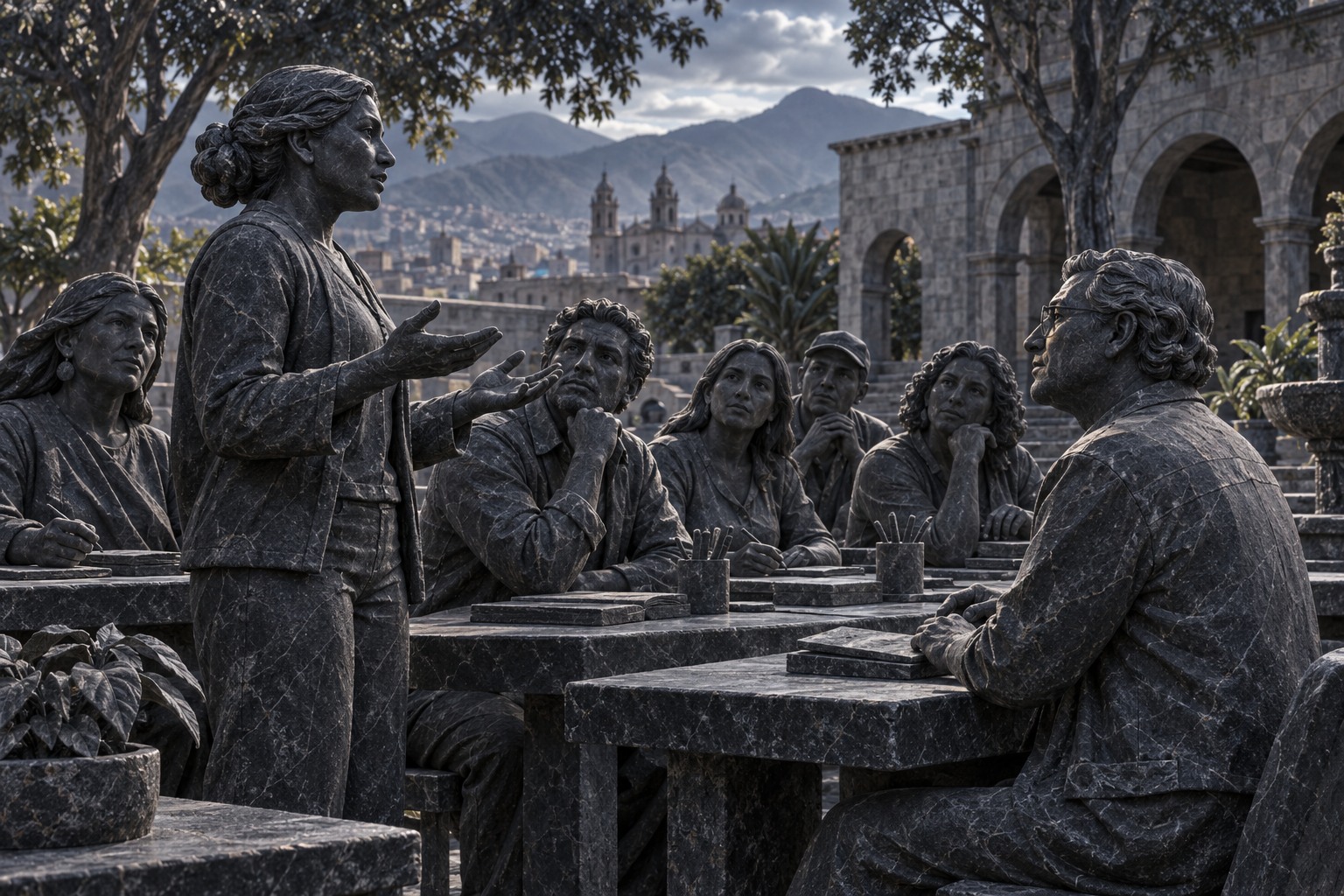
Imagine a hypothetical public discussion about a city. Experts propose redeveloping a neighbourhood. The screen shows schedules, investment, and the streets’ future appeal. A resident asks where her family will live during construction and whether she can return. The moderator replies, “That is a separate social question; right now we are discussing development.” Formally, she was allowed to speak. Yet her question was denied the right to change what development itself means.
Philosophy of liberation draws attention to this turn: someone can be present in a system yet represented only as an obstacle, resource, or recipient of someone else’s decision. Adding their story to a ready-made theory is not enough. We must ask who defined the initial task, whose consequences count, and who may challenge the criteria of success.
What this article explores
We will consider Latin American philosophy of liberation as a heterogeneous movement formed around dependence, oppression, and the possibility of independent thought. Enrique Dussel receives particular attention, together with his concept of exteriority: another person is not exhausted by the function assigned to them within a system.
Yet “liberation” gives nobody automatic authority to speak for everyone. Alongside Dussel, we will therefore ask about pedagogical dialogue in Paulo Freire, Latin American feminisms’ methodological autonomy in Ofelia Schutte, and Silvia Rivera Cusicanqui’s critique of academic appropriation. We will distinguish these lines and their historical tasks. Contemporary scenes are our hypothetical examples for examining arguments. The article does not reduce social oppression to personal thinking, call every unpleasant demand colonialism, or promise that a correctly framed question will itself change material conditions.
1. Philosophy from a particular place
Philosophy of liberation asks not only which answer is true but from which historical situation it arises. The academic overview “Philosophy of Liberation,” §§1.2–2, connects the movement’s emergence with Latin American discussions of dependence and philosophical authenticity; an important moment was the Argentine philosophical congress of 1971. The movement included different authors, methods, and political disagreements.
This historical specificity matters. It is not an attractive name for any work on oneself. Economic dependence, state power, cultural hierarchy, and excluded people’s circumstances are social questions. Replacing them solely with “think more freely” changes the problem’s scale without explanation.
Attention to place does not, however, make an argument local in the sense of irrelevant to others. Someone encountering a particular structure may discover a problem that general language conceals. The question’s significance can exceed its origins. That requires arguments, rather than declaring one group’s experience a universal truth.
Our city example shows the mechanism. A planner evaluates investment. A resident introduces the possibility of returning. If her question is taken seriously, the calculation’s subject changes: the former success becomes insufficient. This does not make every option she proposes technically feasible. But consequences for her become part of the task.
Situatedness means nobody begins from an entirely empty point. The expert also has an institutional role, chosen indicators, and a commission. Making grounds visible to every side therefore helps. Philosophy of liberation becomes interesting where this disclosure allows one position’s claim to a neutral view from everywhere to be examined.
2. Dependence and the right to think independently
The dispute between Augusto Salazar Bondy and Leopoldo Zea concerned the possibility of authentic Latin American philosophy. According to the overview, §1.2, Salazar Bondy connected its absence with intellectual dependence; Zea’s response became part of the subsequent agenda. Even here we see a debate rather than one answer from every thinker in the region.
For our contemporary reflection, imagine a university assessing every local work solely by how closely it repeats an acknowledged foreign school. Such evaluation may discriminate argumentative quality, but can also perpetuate the role of an eternal pupil. An author joins the conversation on condition that they ask someone else’s questions in the approved way.
The opposite extreme treats borrowing itself as lost autonomy. Yet philosophical thought often develops through translation, criticism, and reworking. Using a concept does not make its user a copy of an earlier thinker. Whether they can examine its suitability for their task matters more.
Suppose a local researcher uses an economic model developed abroad and discovers that it neglects a particular kind of work. They may alter the model, identify limits, or offer a competing explanation. Their independence appears in that work, not necessarily in a complete absence of outside influences.
A distinction emerges between a tool’s origins and the subordination of judgement. Someone can use another’s theory independently. Someone can coin a term in a local language while still following another’s agenda. A word’s source does not automatically decide the matter.
For our reading, liberation of thought means being able to ask whether an accepted question fits what is happening and having the right to present grounds for an answer. This is not yet political liberation in its full sense. Without that possibility, however, intellectual work risks serving a description within which some life is already deemed insignificant.
3. Dussel: another person exceeds their function
In Philosophy of Liberation, §§2.4.1–2.4.4, Dussel develops exteriority. Another person is not exhausted by their place in our world of instruments; they can address us and question the system assigning them a particular function. Their exteriority to a system must not be understood simply as physically standing outside an organisation: the author himself warns of the spatial metaphor’s ambiguity.
Our example is a hypothetical courier represented in a work report as a unit of delivery. This representation may help calculate a route. But it does not encompass the whole person. They have their own life, may refuse an assignment, report a risk, or demand reconsideration of conditions.
The system need not deny their existence. It may record their name, address, and productivity. Yet detailed records do not mean recognition of an independent voice. If a report of risk is treated solely as reduced efficiency, new information passes through the old criterion without being allowed to change it.
The difference between being informed and relating ethically becomes clear. We can know much about someone and still treat them as a means. We can have incomplete knowledge and recognise their right to challenge how we frame the task.
In our application, exteriority asks which part of another person our chosen model cannot contain. The answer need not require abandoning calculations altogether. It may require adding a constraint, changing an indicator, or acknowledging a right to refuse. But if a system admits only information confirming its previous goal, it loses an important way of detecting its own injustice.
Dussel’s category remains philosophical. Particular working conditions must be investigated separately. A metaphysical proposition does not automatically establish facts about an organisation or replace the voices of people working there.
4. When consequences change the criterion of success
If someone’s voice is recognised as independent, the next question concerns which arguments can change operating rules. Hearing a report of risk while leaving the former efficiency criterion as the sole basis of decision is insufficient. We must examine what that criterion reveals and which consequences it hides.
This reading does not make an outside interlocutor infallible. Someone may misidentify the cause of their difficulty or propose a solution that worsens others’ circumstances. Before examining their argument, however, we must let it appear as an argument. If an objection is excluded from permissible questions in advance, debate about its quality has not begun. The difference between a right to be heard and the correctness of an answer matters to any practice of liberation.
In our counterexample, an employee requests a more convenient schedule, but the proposed version deprives another of necessary rest. We cannot automatically call the first request a voice of liberation and the second objection a defence of domination. Both people’s circumstances and alternatives must be reconstructed. Otherwise, recognising an excluded person quickly becomes another way to exclude inconvenient participants.
Exteriority matters as more than a requirement of politeness. It allows a question about the limits of a shared assessment. If a successful system harms some people in ways its indicators treat as insignificant, the indicators themselves need examination.
Consider a hypothetical project to improve urban transport. Average journey time falls, but a new route no longer passes near people with limited mobility. The general indicator is correct: journeys have become faster on average. But it does not answer how this group’s ability to travel has changed.
Here we develop our own argument: a measurement’s truth and a criterion’s sufficiency differ. Correcting an evaluation does not declare all numbers false. We need to establish which question they answer and whom they leave outside it. An average may be useful if distribution and significant exceptions are visible alongside it.
This also does not mean every negative effect prohibits every change. Alternatives sometimes have costs too. Roads, hospitals, schools, and workplaces require allocation of limited resources. Ethical attention must therefore move to actual options and comparisons of consequences rather than stop at declaring injustice.
Comparison differs from exclusion, however. If affected people are declared outside the discussion’s remit in advance, their losses never enter it. A system then appears successful because of a framework that prevents an inconvenient question.
In our reading, philosophy of liberation requires the possibility of challenging that framework. This may be unpleasant for people who have already invested effort in a project. Acknowledging a new consequence need not mean acknowledging malicious intent. Sometimes it means discovering an error in description. Once discovered, however, the error requires a response; a good initial intention does not cancel new knowledge.
5. Freire: questions must not remain the teacher’s privilege
In Chapter 2 of Pedagogy of the Oppressed, Freire criticises the “banking” model of education: students become containers into which a teacher deposits content. The alternative, problem-posing education, involves participation in investigating reality. This is an independent pedagogical line connected with liberation, not identical to Dussel’s metaphysics.
Our hypothetical example is training employees in a new procedure. An instructor demonstrates it, and a participant notes that one step is impossible in their work area. If the comment is treated only as insufficient training, practical experience never becomes a source of questions. The participant may repeat the rule, but cannot investigate its suitability.
Dialogue here is more than a teacher’s warmer manner. What matters is whether the information received can change the training’s content. If every reply is followed by the former instruction, questions merely decorate participation.
Joint inquiry does not abolish differences in expertise. A beginner in electrical safety does not become equal to a specialist in every matter merely by having a right to speak. But a specialist can examine information about particular conditions and explain grounds for a restriction. The authority of knowledge and a monopoly on framing every question differ.
Genuine dialogue need not lead to pleasant agreement. It may show that a goal is unattainable or that participants disagree about acceptable costs. This is harder than mechanically transmitting correct content. Otherwise, people remain objects of instruction even while answering many questions.
For practical reading, distinguish informing, teaching, and deciding together. Each has a place. Trouble begins when the first is called the third without giving participants influence over the question or the answer’s consequences.
6. Who speaks for those being liberated?
Participation becomes especially difficult under time limits. Organisers of a hypothetical public discussion must decide on a project by a certain date. They cannot await every possible opinion indefinitely. Yet this real difficulty does not make all forms of participation equivalent. They can announce beforehand what remains open, offer several ways to respond, and explain how disagreements will be considered. They can also hold a meeting after the final decision and call it consultation. Outward resemblance conceals the interlocutors’ different roles.
Ask not only how many attended but whether a decision could change. Which proposals could affect the result? Were options beyond the initial project possible? What happens to a minority-supported objection? An unchanged decision does not necessarily prove participation pointless: arguments may have been examined and rejected on intelligible grounds. Those grounds must be accessible, however; otherwise “we considered it” cannot be distinguished from politely ending a conversation.
There is also a right not to participate in the required form. Someone may decline to tell a personal story to an audience while agreeing to send written comments. They may distrust a representative and be unable to attend themselves. Refusal should not automatically be treated as consent or lack of interest. Sometimes a format’s openness is tested precisely by admitting a response that does not fit an attractive scene of collective dialogue.
The central internal difficulty of any liberatory project is representation. Who determines what is needed by people whose lives are declared philosophy’s starting point? Can they disagree with someone speaking in their name?
Our hypothetical example is a tenants’ rights organisation. Its leadership sees lower rent as the central demand. Some members agree. Others fear eviction more; still others want to manage repairs themselves. All face constraints, but their priorities differ. “The oppressed” does not create one ready-made wish.
If a leader presents their programme as everyone’s authentic voice, a dissenter may be excluded in the very process of liberation. Previously they were told they obstructed development; now they are told they misunderstand their own interests. The justification changes, but their question again loses force.
We develop our own critical examination here. Representation requires grounds: who authorised speech, for how long, on which matter, and how can the authority be revoked? Large movements cannot secure individual consent for every action. That does not make the possibility of objection unnecessary.
Supporting someone’s demand also differs from replacing their judgement with one’s own. A researcher can supply data, a lawyer explain options, and an activist organise a forum. Each can help without claiming the right to define another’s life.
Representation’s test also applies to this article. We can present arguments, but do not call the text the voice of all Latin Americans, all women, or all Indigenous peoples. Substantive respect requires room for people who define the problem, use concepts, or assess proposed liberation differently.
7. A feminist objection: differences within a shared “we”
In “Engaging Latin American Feminisms Today,” opening of the article, 2011, Ofelia Schutte asks about methodological conditions for an independent Latin American feminist philosophy. She examines how dominant ways of representing knowledge constrain recognition of women thinkers and theory’s connection to local social circumstances. This is her own project; we do not reduce it to a footnote to Dussel.
For our reflection, a question matters: does a movement criticising external domination see internal domination? In a hypothetical organisation, women join the common struggle but are left to service meetings and cannot set the agenda. The external goal may be just; the internal distribution of voice remains a separate object of criticism.
“The people” can unite but also conceal different positions. Who has time to participate? Whose duties are taken as natural? Who is invited to speak? Which experience is called private when it does not fit the central story?
This criticism need not destroy solidarity. It may change the conditions under which solidarity forms. Unity requiring silence about internal inequality is paid for chiefly by those bearing it.
Differences must not automatically be considered insurmountable either. People with different experiences can act together if they clarify goals and do not present limited agreement as complete convergence. A particular demand can be supported while disagreement remains elsewhere.
Here is a valuable possibility for philosophy: seeing how a shared language of liberation opens some questions and closes others. This can be examined through the actual distribution of participation rather than a slogan’s grandeur. Who changed a decision? Which argument was examined? Who may say that the proposed solidarity remains insufficient for them?
8. Indigenous authors are not material for another’s system
A strong objection also comes from authors whose work academia may turn into convenient raw material. In Ch’ixinakax utxiwa, pp. 101–104 of the English publication, Silvia Rivera Cusicanqui criticises the economy of academic recognition and the conversion of Southern ideas into material for a Northern canon. Her objection also reaches discourses that call themselves decolonial.
Our hypothetical example is an international conference. A local researcher has worked with a particular community for years, but enters the central discussion only after translating her experience into a fashionable term used by an invited theorist. The subject gains recognition while its independent history of development remains shadowed.
Translation and appropriation must be distinguished. Translation can expand access to a work; a shared concept can make comparison fruitful. Appropriation begins where an argument’s origins disappear, its author becomes an informant, and theoretical authority belongs to the intermediary.
Adding several Indigenous names to a bibliography is insufficient too. An author’s presence there does not mean their argument can change our framework. If we take convenient phrases and ignore objections, diversity in the list conceals the old monopoly on meaning.
This risk directly concerns our text. Rivera Cusicanqui appears as a thinker with a particular critique, not a representative of all Indigenous peoples. She cannot automatically be placed in one harmonious school with thinkers she challenges.
Preserving differences makes the picture less smooth. Yet philosophy of liberation deserves serious reading precisely when it admits a difficult question about itself: does it reproduce the exclusions it seeks to criticise?
9. What this means in practice
Here the difference between liberation and wanting everyone to share one image of a good life becomes visible. If the outcome is settled already, participants can only learn to desire correctly. Even a benevolent project then reproduces a monopoly on questions. A harder possibility is to recognise that an interlocutor may change both the means of achieving a goal and our confidence in the goal itself.
This recognition does not prohibit defending our values. It requires presenting them as grounds open to discussion rather than proof that the conversation is already finished. Differences may remain. A practice of liberation need not end in unanimity to matter. Its modest but significant result may be that an affected person ceases to be merely an object of a decision and acquires influence over its subject, constraints, and later reconsideration.
This discussion yields no universal personal recipe for liberation. We can, however, borrow questions about framing a task where appropriate. Our practical application preserves the original philosophy’s social scale rather than explaining every difficulty through a psychological cause.
In a hypothetical project, we can first examine who defined success, then who is affected and which consequences have not entered the description. After that, we can ask whether a new question can change the decision or whether participants may only express an impression.
Such inquiry need not start with accusation. “Our calculation omits relocation costs” is more precise and testable than “you always ignore people.” But if the omission of a significant consequence is confirmed, a substantive response is needed. Polite listening cannot replace reconsideration.
Distinguish levels of participation. Receiving information, providing feedback, proposing an alternative, and taking part in a decision are different possibilities. Naming them directly can matter more than declaring a process open. Someone can agree to consultation while understanding its limits; they should not be promised shared governance that does not exist.
Finally, a right to ask questions does not cancel a right to withhold a personal story. Challenging an unjust criterion does not always require a detailed display of one’s pain. Data, an argument, and a description of a consequence can also suffice. Respect for an excluded voice must not become a demand to keep proving vulnerability to those controlling discussion.
The question’s content, the answer’s grounds, and actual authority remain subject to examination. No philosophical term establishes them beforehand.
10. A question’s right to change the conversation
At our hypothetical city meeting, the resident gains no automatic right to stop every project. Yet her question about returning cannot be dismissed as irrelevant merely because it disrupts a convenient presentation. If development is meant to improve life, whose life belongs within the concept must be established.
Philosophy of liberation asks us to take this moment seriously. Another person can be the source of a question that changes our description of a system. They are not reducible to a function, a grateful recipient of help, or confirmation of someone else’s theory.
Liberation must endure the same examination. Who may challenge the liberator? How are internal differences represented? Can a woman, Indigenous author, worker, or movement member object without losing the right to participate? The stronger a project’s moral claim, the more significant these questions.
The lines considered do not merge into one teaching. Dussel offers a philosophical category of the other. Freire criticises a pedagogical arrangement. Schutte examines conditions of feminist knowledge production. Rivera Cusicanqui challenges an academic economy of appropriation. Their comparison interests us through different tasks and possible collisions.
A modest criterion suffices for our conclusion: a voice is substantively recognised if what it says can become grounds for changing a question, criterion, or action. This does not require agreement with every demand. It requires a response to the problem presented rather than simply returning someone to a predetermined role.
The right to ask questions is therefore deeper than the right to be present. It concerns participating in defining what needs an answer at all. Here a conversation about liberation begins testing its own honesty, in the fate of an inconvenient question after it has been asked.
Sources used
- Eduardo Mendieta. Philosophy of Liberation, Stanford Encyclopedia of Philosophy, §§1.2–2. Historical context, the Salazar Bondy–Zea dispute, and the movement’s heterogeneity.
- Enrique Dussel. Philosophy of Liberation, English edition 1985, §§2.4.1–2.4.4, printed pp. 39–43. The other’s exteriority and limits of instrumental representations of a person.
- Paulo Freire. Chapter 2 from Pedagogy of the Oppressed, English translation by Myra Bergman Ramos, republication 2009, pp. 163–174. Banking and problem-posing education; relevant passages were used.
- Ofelia Schutte. Engaging Latin American Feminisms Today: Methods, Theory, Practice, Hypatia 26(4), 2011. Opening of the article: methodological conditions and the cultural situatedness of philosophical voice.
- Silvia Rivera Cusicanqui. Ch’ixinakax utxiwa: A Reflection on the Practices and Discourses of Decolonization, translated by Brenda Baletti, South Atlantic Quarterly 111(1), 2012, pp. 95–109. Pp. 101–104 were used: academic hierarchies and appropriation of theoretical authorship.
Keep what resonates with you.