
World & consciousness
Vedanta: Why Advaita Does Not Exhaust the Tradition
Vedanta is presented as a family of competing interpretations of shared texts. The article distinguishes Shankara's Advaita, Ramanuja's Vishishtadvaita, and Madhva's Dvaita: the identity of atman and Brahman, the reality of dependent differences, and an irreducible distinction between dependent and independent realities. Analogies involving belonging, intimacy, and responsibility are contemporary authorial readings, not proofs of metaphysics.
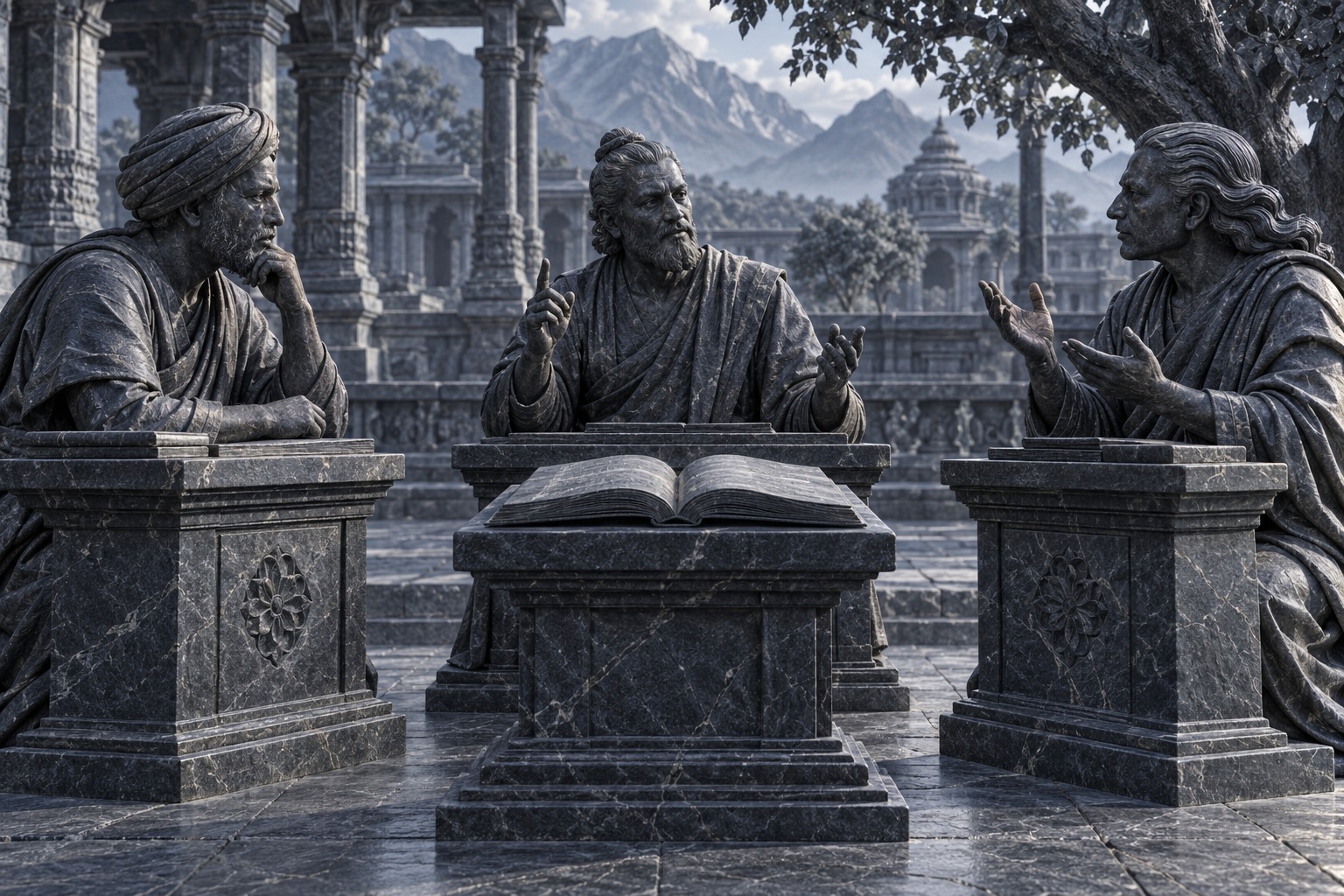
Imagine a hypothetical scene. After a difficult conversation, someone opens a book on Indian philosophy and finds a promise: all separateness is a mistake; at depth, we are one. It sounds liberating. Perhaps there is no need to defend one's place so painfully. Yet another question arises alongside it: if the difference between me and another person is only appearance, what happens to their own voice, to my responsibility, and to love, in which I address them as someone other than myself?
This question need not be directed against Vedanta. It arises within it. Behind the familiar image of a single wisdom lies a dispute over what unity means and what reality differences possess.
What this article explores. Vedanta is a family of traditions that discuss Brahman, human beings, the world, and liberation through a shared body of texts. Shankara's Advaita, Ramanuja's Vishishtadvaita, and Madhva's Dvaita give different answers. We will examine several central distinctions and ask why these answers cannot be turned into successive rungs of a single ladder. For a contemporary reader, this is also a discussion of belonging without erasing another person, and of exploring a spiritual idea without using it to close an uncomfortable question. Historical claims below draw on the listed sources; the everyday scenes and reflective questions are our contemporary reading, rather than instructions from the ancient authors.
1. A Shared Name Does Not Mean a Single Answer
What unites Vedanta is chiefly a task of interpretation, rather than a settled answer. The Upanishads, the Bhagavad Gita, and the Brahma Sutras form its shared textual horizon. Its schools dispute how statements about unity should be reconciled with statements about difference, action, and God. The academic account of Ramanuja identifies precisely this common subject and the genuine doctrinal disagreements. Shyam Ranganathan, “Rāmānuja,” §2a.
It is useful to pause over the word “interpretation.” If two readers accept the same text, they do not necessarily understand its central words in the same way. “Everything depends on a single ground” can have several meanings. It can assert one ultimate reality. It can describe a whole in which real differences exist in dependence on God. Or it can indicate the only independent source while maintaining an irreducible difference between that source and dependent beings. A shared vocabulary can conceal very different structures of thought.
We know a similar difficulty in ordinary life. The imagined members of a team call it “a single whole,” but one means a common result, another a single decision by the manager, and a third mutual respect among autonomous people. The dispute begins later, when one of them demands agreement. They discover that they accepted the same phrase without accepting the same arrangement of relationships.
This analogy does not explain Vedanta's metaphysics or turn a philosophical school into a model for managing a company. It shows only the risk of premature agreement: a familiar word creates the impression that a thought has already been understood. When reading Vedanta, we should ask not only “Does this author speak of unity?” but “Unity of what, in which respect, and with what status for differences?” The subsequent disagreement then acquires substance. We stop measuring a position's depth by how few differences it leaves intact.
2. Advaita: We Can Be Mistaken About Who We Are
Advaita connects liberating knowledge with the removal of ignorance concerning the identity of atman and Brahman. Atman cannot simply be identified here with a biographical character or a familiar image of one's “self,” without further explanation. Shankara discusses the superimposition of properties of object and subject; the classic example of error is mistaking a rope for a snake. Academic presentations of Advaita distinguish ultimate reality from ordinary experience, which requires reinterpretation. Sangeetha Menon, “Advaita Vedānta,” §§2–3a.
It does not follow that any experience can be dismissed by saying “You do not exist.” Such a phrase neglects the question of exactly which meaning of “you” is being discussed. Someone in pain is not obliged to settle the metaphysical problem of the subject in a single conversation. Their report of pain, what happened, and how they are subsequently treated remain questions of ordinary life.
Take another hypothetical example. After making a professional mistake, someone says, “I am a failure.” A particular action has become a description of their entire person. We might offer a more precise description: “I misjudged the deadline; now I need to establish the consequences.” This change in language helps distinguish an event from a complete definition of oneself. But it is not a proof of Advaita. That a person is more than their mistake does not establish that atman is identical with Brahman. A modest everyday conclusion and a major metaphysical claim have different grounds.
A reader may find in Advaita a reason to examine their own identifications. It is especially important, however, not to replace that inquiry with a new self-assessment: “Now I am someone who understands unity better than other people.” An old desire for superiority thereby acquires a more solemn vocabulary. Contemporary caution consists in asking which identification has actually become less rigid and which has merely changed its name. This is a question about our application of the idea, rather than an established historical diagnosis of the school's adherents.
The rope example has a more demanding implication: error is not equivalent to the complete absence of an event. Fear really arose, although the supposed snake was absent. The correction concerns what was credited with existence; it does not require declaring that the fear itself never occurred. “You were mistaken” therefore does not yet tell us what was mistaken: the object, a property of it, the cause of the reaction, or the description of oneself afterward.
This helps frame the philosophical problem more precisely. If ordinary experience requires revision, on what grounds is that revision made? It is not enough to oppose a weak belief with stronger confidence. We need to explain why the new understanding corrects the old one, rather than merely changing its mood. An imagined person feels certain of someone else's hostility today and of complete friendship tomorrow. The change in confidence alone establishes the truth of neither answer.
Likewise, liberating knowledge in the position under discussion cannot be reduced to the pleasant thought that “everything is fine.” It claims to correct a fundamental error, so the question of its grounds remains central. Readers may usefully distinguish the consolation they actually received from the knowledge claim they still need to understand. This allows us to take Advaita more seriously: neither reducing it to a helpful phrase nor treating that phrase's helpfulness as proof of its metaphysics.
3. Ramanuja: Belonging Can Preserve Difference
Ramanuja's Vishishtadvaita affirms a unity within which real souls and the world depend on Brahman without losing their differences. In his Shri Bhashya on Brahma Sutras II.1.9, he defends the relation of the world to the highest Self as that of a body to its inner ground and ruler. The image expresses dependence, rather than a simple identity of all the parts. Ramanuja, Shri Bhashya, II.1.9, translated by George Thibaut, pp. 422–424.
Why does this answer matter for our subject? Because it challenges a familiar either/or: either everything is one and differences disappear, or differences are real and there is no unity. Ramanuja works with another possibility. A part can possess reality precisely in its relation to the whole. Dependence does not in itself mean illusoriness.
For a contemporary reader, this opens a separate question about belonging. An imagined person has tended a family garden for years. They did not create the climate or invent plants, and they draw on the labor of earlier generations. Yet the dependence of their actions on many conditions does not mean they do nothing. Their participation is real, although it is not the self-sufficient beginning of everything that happens. We can acknowledge the grounds that sustain us without turning our lives into a blank space.
This is a limited analogy: a family garden is not Brahman, and gratitude does not make someone part of a theological organism. Still, it helps us distinguish two familiar extremes. The first says that I must be the sole source of my life, or it is not mine. The second says that since I am dependent, none of my decisions matters. Between them lies a space for real participation without a claim to absolute independence.
In relationships, this thought may be fruitful when freely accepted. But the image of the body cannot be mechanically transferred to a family, a state, or a spiritual organization. Religious dependence on a perfect ground does not give another person the right to demand total submission. Here the analogy reaches its limit, and that limit must be preserved.
4. Madhva: Encountering God Need Not Become Identity
Madhva's Dvaita insists on a real distinction between God, souls, and the material world. Only Brahman is independent; other realities are dependent. The five differences distinguish God from a soul, God from matter, a soul from matter, different souls from one another, and different material things from one another. For Madhva, devotion to God retains its meaning precisely because a human being cannot be reduced to God. Valerie Stoker, “Madhva,” §§1–3.
This answer is particularly awkward for the popular picture in which the whole history of spirituality moves toward the same experience of merging. If we accept that picture in advance, Dvaita inevitably appears to stop halfway. But this judgment is built into one of the competing positions. From Dvaita's own perspective, removing difference can destroy the very object of the relationship we need to understand.
We can ask a contemporary question: must intimacy grow deeper as differences diminish? In an imagined couple, one person says, “If you love me, you should feel exactly as I do.” The other wants closeness but experiences events differently. Their difficulty will not disappear if difference is declared a defect. Sometimes a relationship becomes possible because the other person is not identical with me and nevertheless addresses me.
Again, love between human beings does not prove Dvaita. It only helps us sense why preserving the other can be a meaningful value, rather than a sign of superficial knowledge. Learning to see this possibility is useful even before choosing a religious position. Otherwise, we will judge every teaching about difference by the rules of a teaching about identity.
There is also a difficult aspect. The reality of differences does not itself guarantee equality, reciprocity, or freedom. Stoker's account notes a hierarchy of souls and a teaching about their different final destinies within Madhva's system. These cannot quietly be turned into a modern theory of equal human dignity. Reading philosophy attentively means seeing not only the motif that resonates with us but also the positions that require separate discussion.
5. Three Positions Are Not Three Temperaments
It is tempting to say that Advaita suits contemplative people, Vishishtadvaita sociable people, and Dvaita devoted people. Such a scheme is easy to grasp and explains almost nothing. It turns claims about reality into preferences of character. Yet someone can value relationships and accept a nondual metaphysics; someone else can be drawn to solitude and remain a religious dualist.
A more precise comparison begins with what the positions themselves dispute. What makes a difference real? Can knowledge of ordinary experience be revised by knowledge of another order? How should we understand a text that speaks both of unity and of addressing God? What exactly is liberated, and what remains after liberation? These questions cannot be settled by a test of personal style.
We can offer an imagined reader a thought experiment. Let them choose the statement “I belong to a greater whole,” then try three continuations: “therefore my separateness is not ultimate”; “therefore my reality exists in dependence and relationship”; “therefore I depend on that with which I am never identical.” These continuations are not full definitions of the schools. Their purpose is to show that an identical beginning does not establish an identical conclusion.
The moment of inner resistance matters in this experiment. The reader may notice that the first continuation threatens a loss of personality, the second seems unclear, and the third evokes distance. These reactions deserve attention, but they do not replace an argument. Fear of an idea does not prove it false, and relief does not prove it true. A reaction tells us how we encounter a position; philosophical examination concerns why it should or should not be accepted.
Keeping both strands in view is difficult. Yet this is precisely how we can avoid both a cold classification and a hasty spiritual choice based on a pleasant feeling. A reader need not believe a school in order to try to understand its argument from within.
Another check helps prevent these differences from becoming a catalogue of convenient identities. Let us ask about the cost of each answer. If my separateness is not ultimate, how do I explain the experience of addressing another? If differences belong within a single whole, what connects them without making the connection an empty metaphor? If dependence preserves irreducible separateness, how is liberation possible, and what does it change? These are not objections devised to make all positions appear equally weak. They are a way of restoring each position's own difficulty.
An imagined reader may notice that they readily demand a detailed answer from someone else's position while allowing their favorite idea to remain indefinite. For the latter, the word “depth” is enough; opponents must explain every concept. This asymmetry makes reading predictable: we repeatedly find confirmation of our initial preference. To improve our reading, we can ask our favorite answer the same question that seems indispensable for the others. For example, what exactly does it deny, and what must it explain after that denial?
There is no need to abandon faith in this exercise. A conviction may withstand a detailed question and become clearer. But something else may emerge: what mattered to the reader was not the school's position, but the feeling of security surrounding it. Then it is more honest to name the need directly. “The thought that I am not alone helps me” is a meaningful statement about life. “Therefore all schools actually teach the same ontology” is a historical assertion for which relief alone is insufficient.
Finally, choosing a philosophical school need not be completed after one comparative article. We can remain attentive readers: I now know which questions exist and can see which require further reading. This is no less valuable a result than quickly adopting a name. When the subject is the ultimate nature of reality, the right to understand slowly is particularly valuable.
6. What Is Lost When the Whole World Is Called an Illusion
“The world is an illusion” creates many mistakes when said without clarification. It can mean that the world does not exist at all; that it exists differently from the way it appears; that it cannot be treated as independent and ultimate; or that a particular interpretation is mistaken. These meanings are far apart. In Advaita, mistaken superimposition cannot be reduced to an ordinary invention. Menon, “Advaita Vedānta,” §3a.
An imagined employee encounters a broken promise. Someone tells them, “Let it go; it is all a play of forms.” Perhaps the speaker wanted to help. But the employee still needs to know whether they will be paid, whether agreements can be trusted, and whether to continue the job. The spiritual phrase does not answer these questions. It changes the level of the conversation without the participant's consent.
Contemporary application therefore needs a simple distinction: what am I exploring now, my ultimate understanding of reality or a particular breach of agreement? We can discuss both questions, but one does not automatically cancel the other. Even if someone believes their deepest Self is untouched by an event, their practical obligations and actions remain matters for a clear conversation.
The objection is obvious: are we impoverishing a spiritual tradition by limiting it to everyday responsibility? That is possible if we reduce it to a useful habit alone. But distinguishing levels does not require that reduction. It allows the metaphysical claim to remain substantial while refusing to present it as a ready answer to every situation. A teaching may claim more than everyday assistance; precisely for that reason, it should be applied more accurately, rather than more arbitrarily.
The opposite mistake is also possible: rejecting all of Advaita because of a single inappropriate piece of advice. An unfortunate remark by a contemporary interlocutor is not yet an argument against the historical school. We can criticize an application without pretending that we have thereby examined its foundations.
7. Why a Shared Text Does Not End the Dispute
A shared text has no button that produces the same metaphysics for every competent reader. Interpretation requires decisions: which statements are decisive, which should be read in the context of others, where words are used directly, and where they require qualification. Studying Vedanta reveals this work quite clearly.
We might compare it with interpreting an agreement in an imagined family. “We always support one another” does not settle whether relatives must fund any project. One person understands support as practical help, another as an honest refusal to endorse a dangerous decision. The parties may sincerely accept the shared phrase and understand its implications differently. They need a conversation about meaning and grounds, rather than louder repetitions of the promise.
A philosophical dispute is far more complex than the family example. Nevertheless, the example shows that respect for a common ground does not make disagreement dishonest. We can reject an interpretation without rejecting the subject itself. Sometimes it is precisely the recognition of a shared subject that makes a prolonged, detailed dispute possible.
An important question for the reader arises here. Are they demanding a unanimity from this tradition that they do not demand from their own culture? We are accustomed to European philosophy containing incompatible positions, yet sometimes expect India to offer one wisdom with local variations. That expectation denies Indian thinkers their own philosophical conflicts.
Once we abandon it, disagreements cease to obstruct spiritual reading. They show which questions remain difficult even when texts receive close attention. Not every dispute must end with our choice of a winner. Sometimes the useful result is a more precise understanding of why a simple formula cannot answer several different questions at once.
8. Similarity Can Be Acknowledged Without Reducing Everything to One
All three approaches considered here discuss liberation and Brahman, but a shared subject does not imply identical answers. If we call the different positions merely languages of a single experience, we need to prove that their differing assertions are immaterial. A good intention to bring people together cannot replace that proof.
There is a less controlling path to dialogue. We can first acknowledge the difference, then seek an area of shared work. Two imagined interlocutors disagree about the ultimate nature of consciousness, yet both consider attentive reading and respect for an opponent important. Their cooperation is possible without a metaphysical agreement. They need not declare the other's position an early form of their own.
This also applies to comparisons with Buddhism. The denial of an unchanging, independent Self in a number of Buddhist traditions does not become identical with Advaita's atman merely because both use similar language about overcoming selfishness. “Do not cling to your image of yourself” is still too broad a description to establish that the teachings coincide. A similar practical question can belong within different pictures of reality.
Readers may usefully distinguish three outcomes of comparison. First, a similar motif has been found. Second, a specific historical connection has been established. Third, an identity of positions has been demonstrated. These outcomes require different kinds of work. The first does not automatically yield the second or third. And the absence of the third does not devalue the first: a conversation between different traditions may matter precisely because they do not coincide.
This way of reading does not prohibit a personal belief in a deep unity. It asks us to distinguish that belief from an account of what a particular author maintains. Respect begins when we can allow the other their own words and their own question.
9. What This Means in Practice
For voluntary reflection, take a sentence that has recently brought relief: “We are one,” “I am part of a whole,” or “Everything depends on something greater.” Then write down which particular decision it helps you see and which question it leaves open. If it helps prevent a professional mistake from becoming a complete description of yourself, that is one outcome. If it makes you disregard a broken promise, that is another.
The next step is to examine the hidden inference. Does belonging really imply submission? Does dependence imply an absence of responsibility? Does closeness imply an identical opinion? Each question can be answered separately, without choosing a religious school for an immediate everyday effect.
In an imagined conversation, instead of “Deep down we are the same, so stop arguing,” we might try “I want to preserve our connection and understand where we differ.” This is a contemporary communicative formulation, not a translation of Ramanuja or Madhva. Its merit is more modest: it leaves room for the other person's answer.
Another voluntary exercise is to read a short account of each school and try to formulate its strongest objection to your favorite idea. If you feel closer to Advaita, you might ask why the reality of the individual soul is defended so insistently. If Dvaita is closer to you, you might ask which identifications Advaita regards as mistaken. The aim is not to unsettle a conviction at any cost, but to see that it answers a real question and that the alternative also has grounds.
None of these exercises promises liberation or replaces religious practice. You can stop after reading, retain your disagreement, or return to the sources later. The ability to refrain from treating a first impression as a final understanding already changes the quality of our encounter with a tradition.
10. A Unity That Does Not Take Away Other Voices
We began with someone consoled by the thought of unity and troubled by the possible loss of the other. After encountering several approaches within Vedanta, their question need not disappear. But it no longer seems too simple or insufficiently spiritual. Vedanta itself offers a space in which unity and difference are examined through competing answers.
A reader may accept one position, reject another, or make no choice. More precise language is now available, however. Advaita is not the whole of Vedanta. Vishishtadvaita is not a softened psychological version of Advaita. Dvaita need not turn into nonduality after sufficient inner development. These differences are part of the content we came to read.
For contemporary life, we can draw a question rather than a universal rule: what kind of connection am I offering the person beside me, and what room am I leaving for their difference? If unity requires depriving them of the right to answer, perhaps we should examine our use of the word. And if separateness requires denying all dependence and gratitude, that too deserves inquiry.
Serious reading of spiritual philosophy may begin with agreement, but need not end there. Sometimes it ends with a more clearly framed question. Unity becomes more precise when we stop using it to finish the conversation in advance.
Sources Used
- Shyam Ranganathan. Rāmānuja. Internet Encyclopedia of Philosophy. §§2a and 2c used: Vedanta's shared subject and the reality of differences in Vishishtadvaita.
- Sangeetha Menon. Advaita Vedānta. Internet Encyclopedia of Philosophy. §§2–3a used: atman, Brahman, ignorance, superimposition, and cognitive error.
- Rāmānuja. The Vedānta-Sūtras with the Commentary of Rāmānuja, II.1.9. Translated by George Thibaut, Sacred Books of the East 48, 1904, pp. 422–424. A primary passage on the world as Brahman's body.
- Valerie Stoker. Madhva. Internet Encyclopedia of Philosophy. §§1–3 used: dependent and independent reality, the five differences, devotion, and the hierarchy of souls.
Keep what resonates with you.