
World & consciousness
The Sikh Tradition: Remembrance of God, Equality, and Service
The article connects remembrance of God, equality, and service within the independent Sikh tradition. It examines the authority of the Guru Granth Sahib and Panth, nam, lived truth, langar as an institution, seva, and sant-sipahi. It distinguishes an ideal from its actual realization, dignity from sameness, and help from control. Contemporary scenes are hypothetical, and outside readers retain their own worldview.
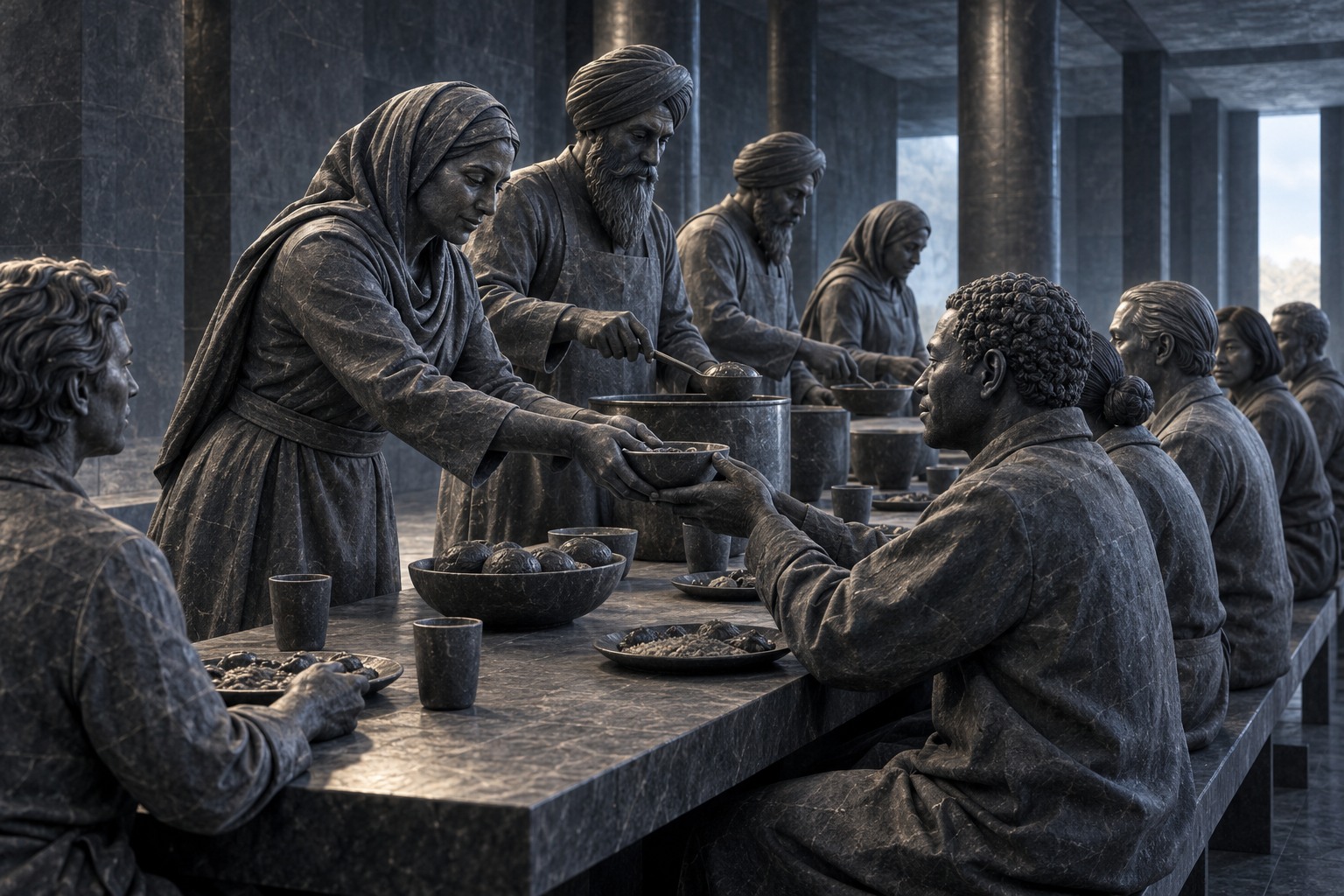
1. Equality at a Shared Table
Imagine a visitor to a gurdwara, a Sikh place of worship. They have come out of curiosity, do not know the prayers, and are unsure where to stand. After learning the arrangements for visiting, they are invited to eat with others. No one asks about their wealth or origins. This hypothetical scene begins with a simple question: what changes when equality is expressed not only in words but in the arrangement of a shared space?
What this article explores. We will consider the connection between three themes in the Sikh tradition: remembrance of God, human equality, and service. Religious attention here should not close itself within an inner experience. It continues in the character of work, the treatment of a neighbor, and communal institutions. The Sikh tradition nevertheless has its own sources and history; it cannot be explained as “a mixture of Hinduism and Islam.”
We should distinguish the ideal from a description of every existing community at once. A teaching of equality does not mean every adherent always acts justly. A religious norm supplies grounds for assessing and correcting actions. Declaring it already fully realized deprives people of the possibility of discussing discrepancies. Declaring it meaningless because of any violation confuses the promised direction with people's ability to follow it.
A shared table also does not erase differences among participants. Someone has come for the first time; someone else knows the whole routine. One prepares food; another needs help. Equal dignity does not mean identical knowledge and capacities. The question is whether differences become grounds for excluding someone from shared life. An imagined visitor may not share the faith, but their hunger does not thereby matter less.
This is the article's initial tension: if God is understood as present in life, a spiritual relationship cannot be wholly separated from how an encounter with another person is arranged. Yet religious life is not reducible to a useful social program. The shared table has a theological meaning that an outside reader can study while retaining their own worldview. We can begin with an action; understanding it fully without reference to faith and sources is no longer possible.
2. A History and Authority of Its Own
The Sikh tradition traces its origins to Guru Nanak, born in Punjab in 1469, and a succession of ten Gurus. In the Sikh Coalition's contemporary self-description, authority is connected with the Guru Granth Sahib and the Guru Khalsa Panth, the community of initiated Sikhs. Sikh Coalition, “History,” opening sections.
The historical environment matters, but it does not replace a tradition's identity. People live among neighboring religions, use familiar languages, enter disputes, and inherit cultural forms. Yet connections do not make one tradition the arithmetic sum of two others. Such an explanation leaves it only borrowed features and fails to notice its own principles of selection, interpretation, and authority.
An ordinary analogy can clarify this. A new language may contain words from several neighboring languages, but its grammar does not arise through simply mixing dictionaries. The analogy is limited, yet shows the mistake: the origins of some elements do not exhaust the whole's structure. Religion additionally involves a community's self-definition, the status of texts, and a discipline of life.
It is also useful to distinguish respect for others from abandoning one's own belonging. If a community acknowledges people of other faiths as possessing dignity, its own sources do not thereby become immaterial to it. A gurdwara's open door and a definite religious commitment can coexist. A guest need not declare themselves Sikh, and a Sikh need not dilute their identity for hospitality.
A reader may fear that emphasizing independence increases separation. Yet precise distinction sometimes makes dialogue possible: the parties no longer have to pretend to be identical. Respecting an interlocutor includes letting them name their own tradition. A conversation becomes substantive when one participant can say “This is our norm” and another “I understand its meaning, although I do not accept every premise.”
Our subsequent comparison of remembrance, service, and equality will therefore remain within the Sikh framework. We will not derive it from Advaita, identify the Guru with any spiritual teacher, or translate its God into an indefinite “energy of the world.” Such substitutions make acquaintance easier at the cost of making its very subject disappear.
3. Divine Oneness and Human Dignity
In the Sikh Coalition's “Beliefs,” oneness and equality are connected through the divine's presence in every person. This community self-description supplies a theological ground for rejecting discrimination based on sex, caste, and origin. The same source relates love to the spiritual goal and a way of life. Sikh Coalition, “Beliefs,” paragraphs on oneness and love.
We should not turn this into a claim that all teachings are literally identical. Someone can regard the divine as one while acknowledging differences in human interpretations. Human equality also does not depend on people's ability to formulate the correct theological definition. Otherwise, dignity would again become a reward for membership in an informed group.
It helps to distinguish equal dignity from equal correctness. Someone may err, cause harm, or make an unjust decision. Acknowledging their dignity does not require agreement with their action. It limits the manner of disagreement: we can demand accountability for a particular action without declaring the person inherently less valuable because of birth or origin.
Take a hypothetical work situation. Two employees complete tasks of differing quality. A fair assessment may differ; demanding identical assessments would undermine the work's meaning. But if one is presumed incapable because of a surname or social status, the action is no longer what is assessed. Difference becomes an inherited hierarchy of dignity. The theological principle of equality opposes such a hierarchy, although it does not itself supply every rule for managing a team.
An outside reader may agree with equality without sharing its religious ground. That does not make the ground superfluous to Sikh life. For a believer, it connects treatment of a neighbor with a relationship to God: excluding someone from moral attention becomes a spiritual problem. Secular and religious arguments can meet in action while remaining different in explanation.
Difficulty begins when a beautiful conviction must be applied to an inconvenient person. It is easy to acknowledge the dignity of someone grateful who never argues. It is harder with someone asking an uncomfortable question or needing unfamiliar help. Equality therefore matters as a demand upon relationships, rather than only an inscription above an entrance. The next question concerns what sustains that demand in everyday life.
4. Remembrance of God and Scattered Attention
Remembering the divine name, nam, cannot be understood only as an exercise for increasing concentration. In his historical study, Louis Fenech connects nām with orientation toward the divine through repetition of the name and considers it alongside social justice. This is a religious meaning, rather than a promise of medical or psychological effects. Fenech, “The Evolution of the Sikh Community,” p. 41.
What does it mean to remember something one has not forgotten as information? We can know a friend awaits a reply and still act all day as though no friend exists. Remembrance then means not recovering lost information but preserving a relationship in action. This hypothetical analogy helps us examine religious attention: a conviction about God may be recorded in the mind without determining how someone listens, works, and allocates time.
Repetition can return someone to an accepted meaning, but mechanical performance is also a risk. They pronounce familiar words while considering how to evade an obligation. The number of repetitions alone does not allow an outsider to measure fidelity. The relation between remembrance and action therefore cannot be replaced by the arithmetic of practice. A word's significance is retained only alongside the question of what it directs life toward.
Another simplification demands continuous emotional intensity. If remembrance is defined solely by a strong feeling, an ordinary morning becomes a spiritual failure. Yet a sustained commitment is not always accompanied by a vivid experience. Care for someone may continue through fatigue; religious practice need not produce a special mood every time either. This is our analytical distinction between life's direction and the strength of a present emotion, rather than an assessment of someone else's spiritual experience.
A reader may ask how orientation toward the divine can be distinguished from autosuggestion. This article offers no universal external measure. But we can distinguish the subjects of assertions. Someone reports an experience, accepts a theological position, and performs an action: these are three different events. The last can be discussed through its human consequences without exhausting the religious meaning of the first two. Such caution allows remembrance to be taken seriously while retaining the limits of what we actually know.
5. The Guru's Word and Listening Together
In Sikh self-description, the Guru Granth Sahib has supreme authority. Its compositions are written in verse, with much of the text connected to music; its authors include the Gurus and other South Asian spiritual figures. The text occupies a central place in worship. Sikh Coalition, “History,” paragraphs on scripture.
Calling it merely a collection of wise sayings is therefore insufficient. An aphorism can be taken from a book, placed on a card, and made to confirm one's thought. Scripture as Guru has another status: the reader comes not only to select what they like but to encounter guidance capable of questioning their habitual desires. For an outside researcher, this describes religious authority rather than an obligation to acknowledge it personally.
The musical form matters too. Shared listening unfolds in time, where voice, repetition, and the order of performance direct attention. Yet a musical impression is not equivalent to understanding the text. A guest may be moved and still not know the content. Honest acquaintance permits this difference: beauty can be acknowledged and study continued without declaring a feeling the final interpretation.
The inclusion of works by different spiritual authors cannot automatically be read as permission to place any book in the same position. Openness to particular voices exists within a compiled canon and its interpretation. It does not destroy the tradition's criteria. Similarly, hospitality in a home does not mean the home no longer has an arrangement and rules: accepting another does not require abandoning one's own center.
A question of intermediaries arises. The absence of an exclusive priestly caste does not mean an absence of teachers and people able to read and perform the text. Learning language and practice requires work. Yet competence need not become an inherited monopoly on spiritual access. This distinction matters for the relation between authority and equality: we can acknowledge someone's greater preparation without treating them as a higher kind of being.
For a visitor, this means simple attentiveness. It is better to ask what is being read or sung and where to find a reliable translation than immediately extract a universal slogan from unfamiliar sounds. A community member faces a harder question: does listening actually allow an encounter with the text's demand, or has the familiar routine become a convenient way not to hear it?
6. Honest Living and the Meaning of Work
Fenech refers to Guru Granth Sahib, Ang 62, when discussing the precedence of lived truth over merely declaring truth. He also considers work as a space of Guru Nanak's religious life, rather than an obstacle to it. The primary motif here was read in academic discussion, rather than in a complete, independently checked translation of scripture. Fenech, “The Evolution of the Sikh Community,” p. 40.
We can sense the difference between knowing the truth and living truthfully without a complex definition. An imagined seller acknowledges that buyers should receive accurate information. Yet when accuracy obstructs a sale, they conceal a product's defect. Their conviction remains but did not determine the action. The question of honest living begins precisely in this gap, where advantage contests an acknowledged norm.
Work does not become worthy merely because it requires effort. Effort can also go into deception. The work's content, treatment of participants, and means of earning income require examination. Someone who considers earnings proof of divine approval risks no longer asking at whose expense those earnings arose. An undertaking's success and its moral assessment do not automatically coincide.
Conversely, a modest result does not make work spiritually empty. Care, cleaning, and maintaining ordinary arrangements are often invisible, although shared life collapses without them. If work's value is measured only by the worker's fame, service acquires again the hierarchy equality opposes. The religious question helps reconsider a familiar scale: which work sustains others' lives even when it is hard to turn into prestige?
A serious objection also arises: an appeal to serve may force someone to accept exploitation. Honest living therefore includes examining working conditions. Asking for fair payment and safe arrangements does not necessarily mean abandoning spirituality. If one participant endlessly gives their strength while another exploits their religious conscience, the relationship deserves change. Self-giving and appropriating another's labor are different things.
The Sikh connection between spiritual and everyday life lets us frame the question this way: how does my work express what I consider true? The answer is not limited to a prayer before beginning. It includes words in an agreement, a kept promise, and the possibility of acknowledging an error afterward. There, conviction ceases to be merely a statement about oneself.
7. Langar: An Institution, Not Only a Good Deed
The Sikh Coalition describes langar as communal preparation, serving, and sharing of food, open to all. The shared meal embodies equality regardless of caste, religion, sex, and origin. Its qualification “for those who are able” about sitting on the floor matters: equality does not require ignoring bodily capacities. Sikh Coalition, “FAQ,” “What is langar?”.
An individual good deed depends on the giver's wish today. An institution creates a more sustained possibility: someone knows there is a place where they can be received. A shared kitchen requires food, time, task allocation, and repeated work. Equality therefore becomes an organizational question. Who cooks? Who cleans? Can a newcomer understand the arrangements? What happens when resources are scarce?
An imagined benefactor can feed people while positioning themselves above them. They decide who may approach and expect gratitude as payment. The shared table has another meaning: another's need is acknowledged without an obligation to affirm the giver's dignity. This does not make every role disappear. But roles need not become a ladder of human value.
We should also avoid romanticizing a shared meal. The fact of eating the same food does not prove every social difference eliminated. Someone can sit beside another while retaining prejudice. Yet the institution creates a repeatable action capable of questioning habitual distance. If the ideal is violated, it can be invoked as a norm: why was this guest served differently? Why are particular people denied access to responsibility?
Accessibility helps clarify equality's meaning. If someone cannot sit on the floor, refusing them a place for outward uniformity would betray the shared meal's purpose. Identical arrangements sometimes require different conditions of participation. This logic concerns more than bodies: explanations for newcomers, clear signs, and an absence of humiliating checks may also determine whether an open door became a real possibility.
For an outside reader, langar is interesting because it connects a theological principle with material infrastructure. It does not first ask someone to prove they deserve food. Yet its meaning exceeds distributing calories: the community repeatedly arranges an encounter in which acknowledged equality takes form. It becomes many people's work and therefore requires shared responsibility.
An institution also allows the workload to be distributed. If everything depends on one enthusiast, openness may disappear with their fatigue. An imagined community needs to transmit knowledge, allow changes of role, and notice the labor behind a shared celebration. This is the organizational dimension of repeated service. It does not diminish the kitchen's religious meaning; instead, it clarifies how much particular care is needed for a theological idea to continue taking form tomorrow. Participants' equality includes attention to those who make their encounter possible.
8. Seva and Responsibility in the Face of Injustice
In Sikh self-description, seva is service inspired by love and gratitude toward the divine; inner attention is connected with participation in the world through the ideal of sant-sipahi. Sikh Coalition, “Beliefs,” paragraphs on seva and the saint-soldier. This connection helps distinguish service from a closed concern for one's own spiritual reputation.
Service does not always mean agreeing to a request. An imagined person asks for help concealing a deception. Fulfilling the request serves a wish but not necessarily a good. Help therefore requires distinguishing its object and consequences. An intention to be kind does not remove the question of who will be worse off because of our participation.
In another hypothetical situation, someone suffers humiliation and is advised to pray in order to experience it more calmly. Prayer may have its own meaning for them, but the advice should not replace examining an unjust action. Inner life and changing external conditions may require different steps. One need not make the other unnecessary.
The saint-soldier ideal can be translated neither into compulsory aggression nor into a decorative metaphor without real responsibility. It poses a difficult question about resisting injustice while retaining a spiritual direction. This article derives no ready answer for every conflict and gives no instructions for using force. Particular action requires facts, capacities, and consideration of consequences.
The objection about a desire for power remains serious. Someone certain they defend justice can stop hearing criticism. A moral goal therefore does not make every means permissible. An imagined defender must ask whether they really protect someone vulnerable or use that person's story for their own victory. Service cannot be measured entirely by the confidence of the person serving.
Another check is useful here: can the participant accept help in return? If they regard themselves solely as a savior, the other remains an eternal recipient without a voice. Acknowledging mutual dependence changes the relationship. Someone may contribute more at a particular moment without possessing permanent superiority. Seva then expresses gratitude through action while preserving the dignity of the person with whom the shared work is done.
9. Communal Discipline and Freedom of Acquaintance
The Sikh code Rehat Maryada defines belonging through belief in one God, the ten Gurus, the Guru Granth Sahib, their teaching, and aspiration to initiation into the Khalsa. The Sikh Coalition reproduces this definition and separately acknowledges differing observance of discipline. It also explains that the community has trained Granthis/Gianis, rather than exclusive priestly access to spiritual life. Sikh Coalition, “FAQ,” “Definition of a Sikh,” “Clergy,” “Initiation”.
This allows distinctions between several positions: a guest, an interested person, a community participant, and an initiated person. They need not be forced into one. Hospitality makes an encounter possible; initiation involves a definite commitment. Sharing a meal does not turn a visitor into a follower, and respect for a religion does not oblige immediate acceptance of its discipline.
Freedom of acquaintance does not mean a right to disregard the community's space, however. A guest enters a place with an order and meaning. Asking about rules and following them is ordinary respect. Yet respect differs from pretending to agree with a faith. Someone can be an attentive visitor and honestly say they understand only part of what is happening.
The opposite mistake is assessing an unfamiliar person's belonging through one external detail. Visible practice has religious significance, but personal histories and degrees of observance may differ. A popular explanation does not entitle an outsider to deliver a final verdict on another's identity. It is better to ask the person, if they are willing to answer, than turn observation into a classification test.
For the community itself, a tension arises between openness and sustained commitments. Remove every definition and there is no longer a way to say what directs shared life. Reduce a person to a formal check and their own path and dignity may disappear. The code, teacher, and personal participation perform different functions; none can automatically replace another.
This distinction matters to interreligious dialogue too. It does not require a shared oath that every tradition coincides. A particular norm of service can be discussed, a specific text read, and existing disagreement acknowledged. An honest boundary sometimes makes an encounter warmer: each retains the right to participate without substituting another name for their own. The Sikh tradition's independence and openness to a visitor do not contradict one another here.
10. What This Means in Practice
A reader can voluntarily choose one question where remembrance, equality, and action actually meet. For example: whom do I usually fail to notice in shared work? There is no need to begin with a large public project. We can notice the labor of someone maintaining order, clarify their need, or change the division of a familiar duty. The help should answer a real situation, rather than only our wish to consider ourselves useful.
For a reader close to the Sikh faith, their own practice has meaning within its sources and community. An outside reader need not imitate initiation or borrow a religious name for an ordinary exercise. They can study the connection proposed by the tradition: a conviction about human dignity takes form in how someone receives a place, a voice, and access to shared work.
If you wish to visit a gurdwara, it helps to read its public rules beforehand and ask there about participation. The hypothetical opening scene does not promise identical arrangements in every community. Learning about a particular place respects both guests and hosts. Declining participation is also permissible: acquaintance should not become a test of spiritual maturity.
For reflection on service, consider three distinctions: request and good, help and control, equal dignity and identical conditions. If an offer of help cannot be declined without punishment, there is a problem to recognize. If shared arrangements are inaccessible to some participants, equality requires discussion of conditions. If religious language conceals a breached obligation, we must return to the action itself.
Finally, read a reliably identified scriptural passage or community explanation and note what you actually understood. An unfamiliar language, ambiguous translation, and unfamiliar religious authority are limits to understanding, rather than reasons to fill gaps with familiar philosophy.
The Sikh tradition connects spiritual orientation with participation in the world. This does not guarantee every adherent's perfection or replace particular decisions. It sets a demand: remembrance of God should be compatible with acknowledging another's dignity and acting responsibly. A small form of that demand can be seen at a shared table. Its meaning remains when acquaintance continues through attention to people, sources, and differences.
Sources Used
- The Sikh Coalition. Beliefs: oneness, love, seva, sant-sipahi, daily principles. A religious community's self-description.
- The Sikh Coalition. History: the ten Gurus, Guru Granth Sahib, Guru Khalsa Panth, and the scriptural text's verse and musical form.
- The Sikh Coalition. FAQ: “Definition of a Sikh,” reproducing the primary Rehat Maryada code; “Clergy,” “Initiation,” “What is langar?” A contemporary community explanation.
- Louis E. Fenech. “The Evolution of the Sikh Community,” in Pashaura Singh and Louis E. Fenech, eds., The Oxford Handbook of Sikh Studies. Oxford University Press, 2014, pp. 35–46; pp. 40–41 used. Publisher's preview PDF. Primary locator: Guru Granth Sahib, Ang 62, in the author's discussion.
Tags: Sikh tradition, Guru Nanak, nam, langar, seva, equality.
Keep what resonates with you.