
Daily life, work and reconnecting
Rest, creativity, movement and pleasure without a duty to become your former self
After any war, former ways of resting may become inaccessible, uninteresting or difficult. Place, body, safety, people and opportunities change. Music need not bring its former pleasure, and returning to movement should not test character. Present participation can be explored without reproducing your former self.
Epigraph
“A time to weep, and a time to laugh; a time to mourn, and a time to dance;”
Ecclesiastes 3:4, complete verse, King James Version. A historical distinction between times, without a grief calendar or a deadline for moving towards joy.
What this article is about
After any war, former ways of resting may become inaccessible, uninteresting or difficult. Place, body, safety, people and opportunities change. Music need not bring its former pleasure, and returning to movement should not test character. Present participation can be explored without reproducing your former self.
This article distinguishes rest, creative activity, ordinary movement and professional help. It prescribes no exercises, rehabilitation programme or treatment and promises no removal of war's consequences through hobbies. Desire, access and medical suitability are different questions; absent pleasure alone establishes no diagnosis.
Immediate danger, serious deterioration or inability to maintain safety requires appropriate available local urgent help. Do not postpone it until rest or a creative meeting ends.
I. Rest need not be earned by completing every task
Imagine Leonid, a fictional person. Before war he rested after a finished working day. Now tasks never end: documents, caring for relatives, finding resources. When free time appears, he wonders whether he has done enough. This establishes no diagnosis or judgment of responsibility. It shows how “everything first, rest afterwards” may become impossible. An indefinite queue offers no moment when life itself grants permission to pause. The need for rest can be acknowledged without dismissing unresolved matters or promising that they will resolve themselves.
A pause is not identical to abandoning actual responsibilities. A child, dependent adult or necessary treatment may require attention. Possible help and redistribution matter alongside the wish to forget everything briefly. Another person is no unlimited resource, and a child is no adult family organiser. If nobody can take over, that obstacle is real. It does not prove Leonid cannot relax. Practical participation may be needed; tiredness can be acknowledged before perfect material circumstances permit complete withdrawal from every concern.
Rest need not be a separate expensive event. Yet appreciating small things creates neither quiet, accessible space nor safety. Sometimes the need is time without further demands, war discussion or useful output. Solitude is no universal recommendation: chosen company may matter instead. Formats can differ. This article prescribes no hours or compulsory routine. A pause need not demonstrate improved productivity before becoming part of life, rather than a reward reserved exclusively for successfully finished work.
Rest itself need not become another examination. A short pause without calm, clarity or good mood signifies no incorrect performance. What was accessible and what remained difficult can be noticed. Choosing a pause cancels neither medical restrictions nor necessary help; complete indefinite rest cannot be prescribed for everyone. The narrower point is that continuous usefulness does not determine human worth. Present needs can be discussed without promising to finish every task and become convenient for others first.
A request might be: “I need time without additional tasks. Could you take this particular responsibility, and what is manageable for you?” This fictional conversation guarantees no agreement. Willingness, an actual arrangement and the opportunity to rest differ. Without an arrangement, the matter cannot be treated as resolved or continuing fatigue blamed solely on failing to use supposedly available freedom.
II. A former interest can change without abandoning yourself
Leonid once enjoyed music and long walks. Now one recalls loss, while the other is inaccessible because of his body and surroundings. Lack of desire, lack of access and medical restrictions should be distinguished. Each may look like “he stopped doing it”, but the questions differ. The cause need not be immediately clear. A changed interest is not automatically a symptom, and persistence cannot guarantee former pleasure. Present preferences deserve attention without concluding that war destroyed an entire identity and exhausted every future possibility.
Remembered pleasure may feel warm and painful simultaneously. Neither immediate resumption nor permanent abandonment is required; the question can remain open. An old hobby is no debt to your former self or relatives. If music is unsuitable now, that proves neither ingratitude nor an unwillingness to live. If it suits, improvement need not be announced to everyone. One chosen moment has its own meaning without declaring that war's consequences have ended and every former demand can resume.
A new interest need not compensate for loss either. Drawing replaces no former team, place or person. Curiosity can exist without a grand project for a new life. Trying something is optional: energy, time or suitable materials may be missing. Not trying does not mean surrender. Wanting something remains possible before access appears. Actual missing conditions should not be replaced with an attractive account in which merely permitting pleasure necessarily removes every internal obstacle afterwards.
If lost interest persists, causes concern, or interferes with everyday life, it can be discussed with an appropriate professional. NIMH includes lost interest among changes deserving attention alongside other difficulties and functioning. This is no home diagnostic test. Trying every old hobby or waiting for a deadline imposed here need not come first. What changed and became inaccessible can be described. Professional assessment promises no particular hobby's return, but seeking it does not remove the choice of ordinary activities, rest and human participation within available limits.
III. Creativity can remain an activity without becoming a war story
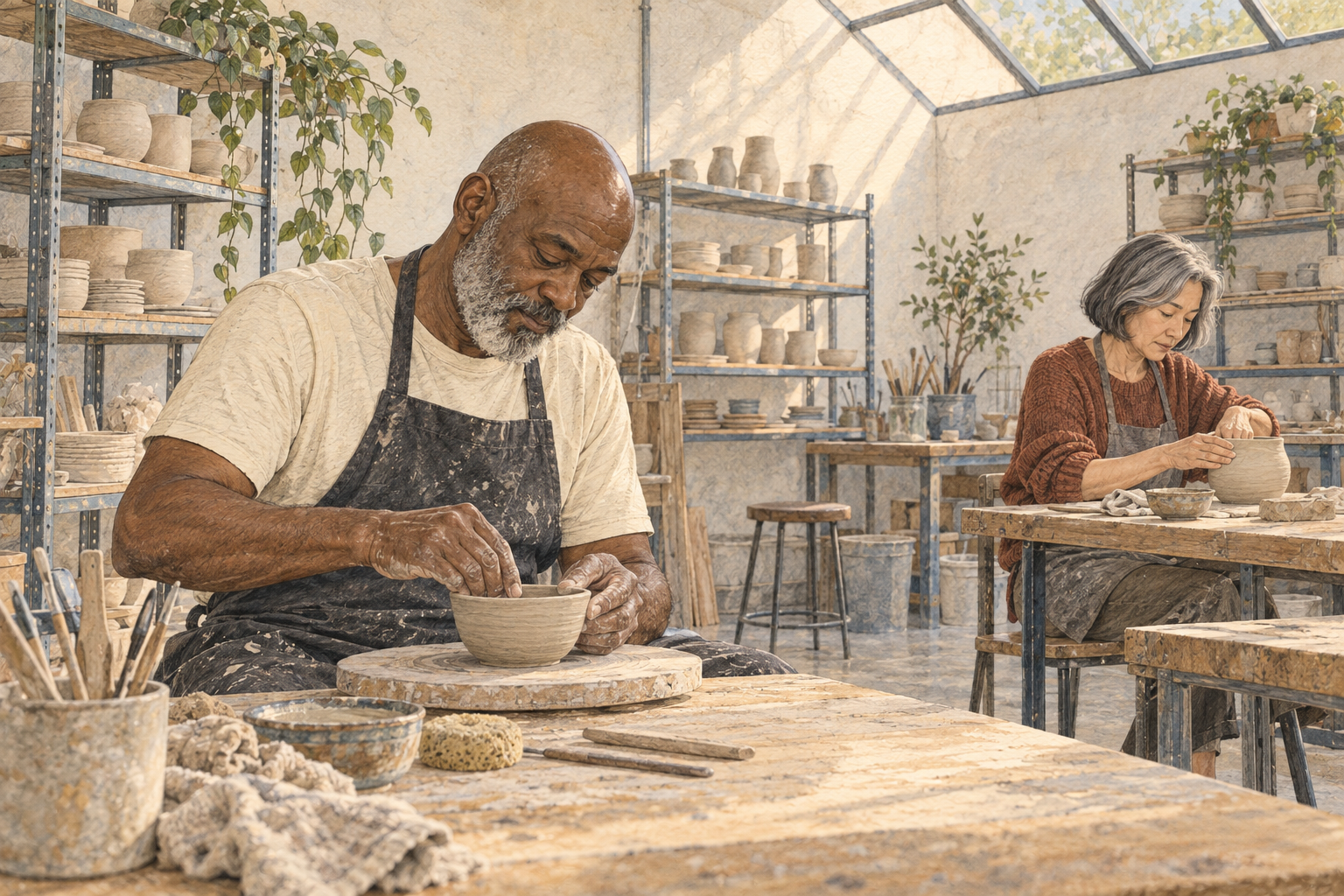
Leonid may want to draw objects, hear music or make something. None requires a war narrative, detailed memories or an explanation of an image. WHO considers arts in relation to wellbeing and care, but an institutional overview establishes no specific activity's effect on a particular person. Ordinary creativity, organised programmes and professional therapy differ. Drawing is not automatically treatment, and pictures cannot be used here to diagnose, recover hidden memory or measure recovery. A chosen subject matters without a verified therapeutic result.
Participation requires neither publication nor a quality judgment. Unfinished work does not necessarily signify giving up on life; beautiful work proves no absence of difficulty. A hobby need not become a career, income or public testimony. Sharing is a separate decision about particular work and an audience. Joining an activity should not automatically imply consent to every publication of personal history. This article determines neither each organisation's rules nor local law. Actual conditions should be clarified before sensitive material is shared.
A group may offer company, materials and teaching, but its name confirms neither qualifications nor confidentiality. What happens, what does it cost, can personal discussion be declined, and how are photographs used? Questions help identify the offer's role without requiring universal suspicion. Complete disclosure need not prove openness; pressure need not purchase creative development. Unwanted disclosure and humiliation may warrant suitable support. Continuing need not become a compulsory test of courage or readiness for change.
Some subjects and sensations may be difficult. This article proposes neither self-directed processing of traumatic memories through art nor continued participation until relief arrives. Stopping and discussing difficulty with a suitable professional are possible where help is needed. A strong response does not itself establish benefit, while difficulty alone does not determine that a programme caused harm. Actual assessment is needed. Creativity may remain small and ordinary without finding great meaning, demonstrating resilience or turning war into a useful product for others.
Materials and formats can also be chosen without a large story. Someone may prefer listening without performing, or making something privately. These are questions for an organiser, without a promise that every rule permits them. Personal work need not become compulsory public testimony. Other people's photographs and private histories should not be treated as freely available materials merely because the activity is called creative.
IV. Movement and rehabilitation require attention to your present body
WHO's general information includes domestic activity, getting around and chosen recreation alongside sport. Participation therefore need not be reduced to former records. General benefits nevertheless authorise no particular exertion after injury, illness or surgery. Wanting to complete a former route does not establish medical suitability. Restrictions or uncertainty call for individual clarification with an appropriate medical or rehabilitation professional. This article selects no exercises, intensity, duration or equipment and treats lack of movement as no moral fault.
Rehabilitation may concern a meaningful action and changed conditions alongside former performance. WHO describes assessment of functioning, jointly defined goals, possible assistive products and environmental adaptation. That promises no particular service's availability. Leonid may want a favourite activity, but a suitable approach depends on actual condition and resources. A general article cannot select or adjust a prosthesis or prescribe a recovery routine. A different format neither diminishes participation nor makes speed and distance measures of human worth.
Pain, pronounced fatigue and new deterioration should not become willpower tests. This article establishes neither their cause nor individual urgency. Suitable medical assessment has its own task; immediate danger requires appropriate available local urgent help. Dangerous exertion or returning to an unsuitable place should not test capacity. Nor should prescribed treatment be stopped independently for activity. Even enjoyable movement cancels no restrictions. One positive day provides no medical clearance for every subsequent job, sport or journey.
Access includes space, transport, cost, assistance and suitable conditions. Not every park or sports group is accessible or safe after war; remote formats solve only some obstacles. Specific participation questions may be asked without first proving that barriers exist. A missing resource may require practical help rather than a compulsory change of attitude. Comparisons with a former body or others' achievements replace no individual decision. A different form and scale may retain chosen meaning without promising complete functioning or progress at every attempt.
A professional question might concern an action: “I would like to join this activity. What restrictions and conditions should I consider in my situation?” That invites clarification rather than supplying a programme. A desired action, received recommendation and available arrangement differ. Naming a suitable device does not mean it has been obtained, fitted and made safe for this particular person's use.
V. Opportunities for pleasure also depend on actual circumstances
Advice to find something enjoyable assumes time, space and choice. After war these may be missing. Noise, crowded conditions, danger, limited money and caring responsibilities affect access. WHO's activity information also recognises social, cultural, economic and environmental conditions. Circumstances cannot explain a person's entire state, but every obstacle cannot reasonably be attributed to thinking either. Leonid may want rest while lacking a workable format. Practical participation can be needed alongside his own search for a suitable way to spend time.
A particular need can replace the general instruction to relax: materials, a suitable place, organisational assistance or permission to avoid personal disclosure. Naming a need does not obtain a resource. A promise is not delivered help; an organisation's interest is not confirmed safety. This article verifies no offers, prices or rules. Pleasure need not become another purchase where money is limited. Taking on debt or abandoning necessary treatment should not prove that someone finally cares for themselves correctly or invests enough in recovery.
Safety matters separately. A walk, concert or social activity requires no dangerous route or return to an actual threat. This is not ordinary shyness to overcome through repetition. This article supplies no personal protection plan or assessment of each address. Another format may be sought if one exists. Neither home nor public space carries an automatic guarantee. Addressing a current threat precedes seeking pleasure. Rest should not require ignoring circumstances or pretending that internal readiness has already changed the actual situation.
Relatives' help may be specific and limited: clarify conditions, bring materials, provide company. Willingness and capacity cannot be promised in advance. Their limits do not invalidate Leonid's need. Other participation can be sought without assigning the whole task to one acquaintance or child. Care need not become permanent entertainment provision. Adults' needs and capacities can be discussed together. Where individual solutions are insufficient, social, medical and practical assistance matter alongside personal attempts to create suitable surroundings after war.
Choices may involve imperfect formats: a shared room, available time without company or delayed replies from a facilitator. No option must suit everyone. What is offered and what remains missing can be clarified. Registration is not actual access; a free event may still involve transport, assistance and materials costs. These distinctions support discussion of conditions without accusations of insufficient gratitude.
VI. Pleasure neither cancels grief nor justifies what happened
A brief pleasure may prompt the question: am I allowed this when others suffer and important things were lost? This article judges no feeling and demands no immediate removal of guilt. A pleasant moment, concern for others and an assessment of war are different matters. Music and laughter do not proclaim violence beneficial. Remembering requires no continuous renunciation of living. Equally, pleasure does not become compulsory evidence of resilience. Sadness and chosen activity may coexist without one correct mixture of feelings for everyone.
Relatives may understand appropriate rest differently. This permits no assignment of blame or universal family rules here. A distinction might be named: joining does not mean forgetting; today I do not want to participate. Others have their own reactions. Discussion may be possible under acceptable conditions, but threats and humiliation need not become the price of memory. Grief requires neither proof through details nor submission to coercion. Relationship and safety support have separate tasks, beyond simply respecting every possible expression of feeling.
Pleasure may be incomplete and coexist with difficulty. One pleasant conversation requires no entirely happy evening. Stopping does not mean everything was ruined. Nor must sadness deliberately be sought to make pleasure morally permissible. This article prescribes no emotional exercise and promises no change merely from granting permission. Different experiences have room. Leonid can value a small moment without making it evidence of correct recovery, war's useful lesson or a swift return to his former life in every other area.
Spiritual and cultural traditions may join this discussion by choice. Care and respect should not depend on faith, compulsory forgiveness or gratitude for suffering. A shared ceremony establishes no readiness for every activity. Loss need not be transformed into growth or presented as an uplifting public story. Convictions and questions can coexist. Present pleasure settles no historical meaning. It remains part of human life without needing justification in violence or a promise that everything painful must ultimately have been for the best.
VII. Missing pleasure may deserve help without a home examination
When nothing feels enjoyable, hobby advice can sound like another duty. This should establish neither laziness nor a diagnosis. Present experience, remembered duration and effects on ordinary tasks can be described. NIMH recommends attention to serious, persistent difficulties and disrupted everyday functioning. This international article replaces no professional assessment. A perfect account, restored interest and demonstrated discipline need not precede asking for help. Absent pleasure deserves consideration together with actual life circumstances and other changes in how someone is feeling.
A professional conversation may concern health, sleep, pain, medicines and circumstances where relevant. This article establishes no cause and proposes no independent treatment changes. Share current information and questions with an appropriate professional as needed. A creative group need not receive your full history. Medical and social help may have different tasks. Referral does not automatically remove practical barriers. Assessment, accessible space and human participation may all be needed without choosing one explanation for every consequence of war or relinquishing other needs.
An ordinary activity may coexist with care where suitable and permissible. It is no compulsory preliminary stage to pass before treatment. Walks, music and creativity cannot be promised as replacements for professional intervention. Conversely, receiving care requires no permanent abandonment of pleasure and initiative. Actual conditions and assessment matter. Leonid may ask about suitable formats without promising immediate results. One unsuitable experience neither proves every activity pointless nor requires another forced attempt at precisely that activity to demonstrate sufficient effort or openness.
Immediate danger, serious deterioration or inability to maintain safety requires appropriate available local urgent help. Do not wait for interest to return, a group to finish or a self-imposed observation period to pass. This article provides no national numbers or personal crisis route. Further care and available activities can be discussed after the necessary first action. Urgent care is no failure of rest or character. Its task cannot be assigned to a hobby, one relative or a promise to learn pleasure independently before deserving assistance.
VIII. Present life may have a different rhythm and content
Ecclesiastes distinguishes weeping, laughter, mourning and dance; the Taoist vessel image concerns a limit to filling. These are different historical traditions, without medical guidance or a universal emotional calendar. They determine neither when grief should end nor movement after injury. They may offer conversation about life's variety and limits of effort. Neither requires enduring danger, abandoning necessary care or feeling satisfied with every condition. Wisdom replaces no actual safety, resources or individual help needed in someone's present situation.
Leonid need not become an exact copy of himself before war. Nor must he abandon the past for a compulsory new identity. Former interests may remain, change or stay uncertain. One available participation format does not determine a whole biography. Wanting more can coexist with acknowledging a limit. This promises neither full functioning nor a romantic account of restrictions. Human worth does not depend on former achievements. Participation can matter without competing with an old photograph or expecting everyone else to understand every change immediately.
A modest account may be: music became accessible, a movement question was clarified, practical participation appeared, or an old activity currently feels unsuitable. Perhaps none has happened yet. This is no rating or compulsory result list. Naming actual circumstances matters more than an attractive progress report. Pleasure diaries and daily checks of sufficient recovery are unnecessary. Changes can be discussed when useful without turning life into continuous measurement of correct rest, mood and readiness to resemble a former self again.
Conditions differ after any war. Rest need not justify itself through productivity, creativity through public testimony, movement through records or pleasure through proving everything is fine. Necessary responsibilities, medical assessment and real limits still matter. Available participation and suitable help can leave room for memory, difficulty and ordinary things. Life need not await completely restored capacities; neither must someone immediately display joy for present life to count as meaningful. Attention and dignity remain deserved where a suitable activity and clear future have yet to appear.
What this means in practice
Distinguish desire, actual access and medical suitability. A present need may be named: rest without output, materials, an appropriate place or professional clarification of exertion. This is no compulsory homework or treatment plan.
Creativity requires neither a war story, publication nor high quality. Movement should not test character through danger or pain. General benefits provide no individual clearance after injury. Groups and friendly tones guarantee neither competence, privacy nor safety.
Pleasure neither justifies what happened nor cancels grief. Its absence need not be forcibly corrected. Persistent difficulties interfering with life can warrant suitable help without trying every hobby first. Immediate danger, serious deterioration or inability to maintain safety requires appropriate available local urgent help.
Key quotation
“It is better to leave a vessel unfilled, than to attempt to carry it when it is full.”
The Tao Teh King, 9.1, complete first sentence, translated by James Legge. A historical image of limits, without prescribing exertion, rest duration or withdrawal from care.
Connections between traditions
| Area | Useful distinction | Limit |
|---|---|---|
| Ecclesiastes 3:4 | Different times and feelings | Sets no grief calendar |
| The Taoist vessel | Limits of effort | Prescribes no medical exertion |
| Rest | Need and unfinished tasks | Human worth need not be earned |
| Creativity | Personal activity and professional therapy | Promises no treatment through hobbies |
| Movement and rehabilitation | Desire, functioning and individual suitability | General benefits replace no assessment |
| Pleasure and memory | Pleasant and difficult experiences may coexist | Justify no war |
| Practical and clinical help | Different needs | Require no successful enjoyment first |
An editorial comparison, without a claim of therapeutic equivalence.
Primary sources and research
- Ecclesiastes 3, King James Version, verse 4. The complete chapter was read; source of the epigraph.
- The Tao Teh King, translated by James Legge, Chapter 9. The complete chapter was read; source of the key quotation.
- WHO. Physical activity, 26 June 2024. Different forms of movement and access conditions; no individual programme after injury.
- WHO. Rehabilitation, 30 September 2024. Individual goals, assessment, environment and meaningful participation.
- WHO. Arts and health. The initiative's general overview was read; the complete efficacy research corpus was not read.
- NIMH. Caring for Your Mental Health, reviewed April 2026. Manageable care and seeking help for difficulties.
- NIMH. Coping With Traumatic Events, reviewed May 2024. Realistic expectations and suitable support.
- NHS. Where to get urgent help for mental health. An urgency framework without exporting national numbers or routes.
International editorial material for adult readers, without medical clearance, rehabilitation or arts-therapy programmes. New sources were checked on 18 October 2026; exact reading limits are retained in the research record. Particular activities, services and places were not verified.
Tags
consequences of war, rest, creativity, movement, pleasure, former interests, changed life, present capacities, safety, injuries, accessibility, rehabilitation, medical restrictions, meaningful participation, pauses, unfinished tasks, actual conditions, practical help, professional support, grief, memory, mixed feelings, personal choice, privacy, creative groups, spiritual traditions, dignity, uncertainty, international context, United Wisdom
About the authors
Andrey Zarinsh is the author and founder of United Wisdom. He explores inner transformation, the unity of traditions, intercultural dialogue, and contemporary spiritual discipline. Instagram: @andrey.zarinsh.
Maria Evilkut is a co-author of United Wisdom. Alongside her research, she seeks to test these ideas in practice and observe how principles of unity and mutual understanding work in real life between people and cultures. Instagram: @ilkutki.