
Alcohol
Alcohol and sleep: why falling asleep does not answer every question about rest
“It was easier to fall asleep, but I do not feel rested in the morning.” This hypothetical statement contains two reports that can both be true. Understanding them does not require denying relief.
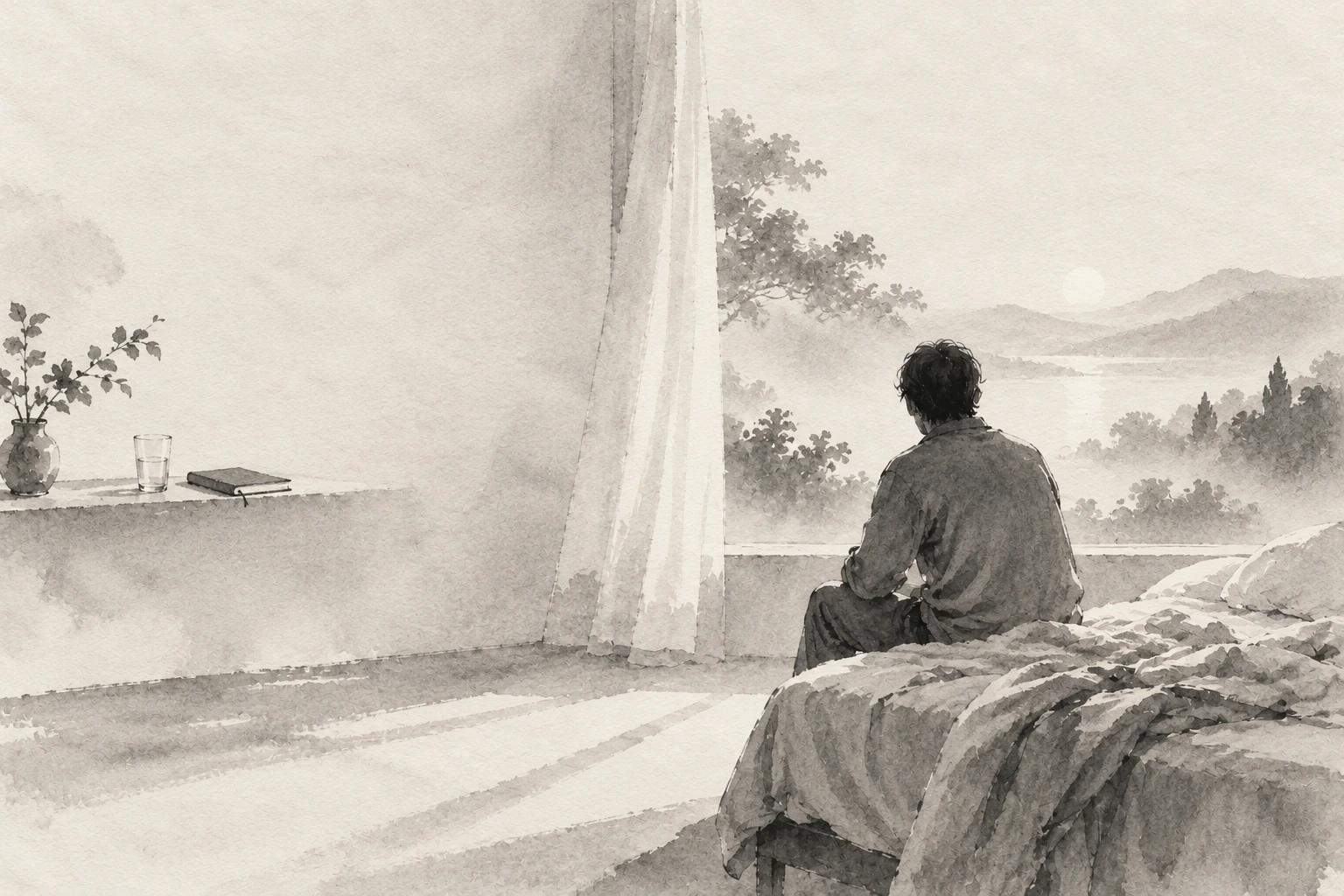
“It was easier to fall asleep, but I do not feel rested in the morning.” This hypothetical statement contains two reports that can both be true. Understanding them does not require denying relief. Falling asleep, the course of the night, the sense of rest, and daytime condition need separate consideration.
This article is for adults concerned about sleep in relation to alcohol, and for people close to them. It helps prepare an assessment while preserving distinctions between acute effects of drinking, recovery from alcohol use disorder, withdrawal, and another sleep problem. It does not prescribe an alcohol amount, timing, or a home trial across nights. In acute danger, help matters more than analyzing sleep.
Four different questions about one night
You may experience genuine relaxation or notice that you fell asleep faster. This reports an experience, rather than automatically measuring every sleep process. Work completed the next day is not imaginary either, but does not in itself establish restorative rest or drinking safety.
Distinguish how difficult falling asleep was, what is known about awakenings, how you felt on getting up, and what happened during the day. These answers may differ. You need not choose one overall verdict, “good sleep” or “bad sleep,” before seeking help.
In guidance on assessing insomnia, NHLBI separates information about falling asleep, awakenings, feeling rested, and daytime condition. These are questions for professional consideration, rather than a diagnosis from a few answers. NHLBI: assessing sleep.
What is known about alcohol's acute effects
Gardiner and colleagues' systematic review and meta-analysis examined subsequent sleep in healthy adults. The abstract reports delayed REM sleep onset and reduced REM duration. Effects on total sleep time, sleep efficiency, and wakefulness after falling asleep remained uncertain. Gardiner and colleagues, 2025.
This is limited support for distinguishing sleep initiation from other measures. It does not allow the same result to be declared for everyone, a finding to be applied to any amount, or all insomnia to be explained by alcohol. The full paper and all included studies were not read here; an abstract does not establish an individual forecast for a night.
Morning recollection does not determine REM duration. Experiencing relief is different from demonstrating a restorative effect. But one difficult night does not establish its cause either. If measurement or an examination is needed, discuss that need with a professional instead of arranging new drinking to test it.
Acute effects, withdrawal, and recovery are different contexts
Describe the context of what has already happened. Sleep after a single drinking occasion, complaints within a recurring pattern, the condition after a change in use, and recovery from established alcohol use disorder cannot be assumed identical processes. A sleep complaint does not itself establish alcohol use disorder.
NIAAA notes that sleep difficulties may persist after stopping or reducing drinking during recovery from alcohol use disorder. This is not a promise of improvement on a particular schedule or proof that every new symptom is safe or caused by recovery. NIAAA: supporting recovery.
If drinking has already changed and sleep becomes concerning, tell a clinician what happened and which symptoms are known. Do not confirm an explanation yourself by returning to alcohol, increasing the amount, or abruptly stopping. New severe manifestations require their own level of help; they should not automatically be treated as a stage to endure.
Why other explanations need room
Establishing that sleep is concerning and establishing its cause are different tasks. NHLBI assessment considers health history, medicines, use, and signs of other sleep problems; investigations may help identify sleep apnea or sleep rhythm disorders, for example. NHLBI.
This does not mean every reader needs all investigations or that snoring establishes a diagnosis. Bring information about how long the difficulty has existed, what is known about night and day, which prescriptions are taken, and what changed in drinking. There is no need to wait for a perfect diary or prove a single cause independently.
If a sleep problem existed before, continues in different circumstances, or interferes with daytime responsibilities, discuss it as a task in its own right. This does not cancel consideration of alcohol. Help should not become an argument requiring a choice between “everything is caused by alcohol” and “alcohol has nothing to do with it” before assessment.
Medicines and combinations are considered separately
Treatment for sleep or another condition is not a moral defeat. However, tell the prescriber or pharmacist the medicines' names, their purpose, and the circumstances of drinking. A medicine's usefulness and a combination's safety are different questions.
NIAAA identifies the danger of alcohol with opioids and benzodiazepines, including respiratory suppression and overdose risk; additional risks are also described for Z-drug sleeping medicines. These are specific classes, rather than identical effects of all pharmaceuticals. NIAAA: interactions.
For antidepressants, RCP distinguishes physical dependence or adaptation from addiction. Difficulty stopping alone does not establish addictive behavior. RCP. This distinction does not permit combining a particular medicine with alcohol. Do not independently change or stop a prescription to prove “pure sleep” or independence, and do not test a combination on yourself.
Which help to discuss
Begin with a primary care clinician or the professional already treating your condition. If there are alcohol problems, discuss them too; if a sleep assessment is needed, ask about the relevant specialist and examination. Check local availability and access conditions for specific care.
NHLBI describes cognitive behavioral therapy for insomnia, CBT-I, as a usual first option for long-term insomnia. This is specific work with a professional, rather than advice simply to think positively. NHLBI: insomnia treatment. This article does not turn its program into a home sleep-restriction schedule, prescribe treatment duration, or promise identical outcomes.
Ask: “What assessment do my complaints need? How should alcohol, changes in use, and prescriptions be considered? Which options fit the established condition?” Perfect rest, complete meaning in life, or a final resolution of motivation need not come first. These questions can be discussed alongside receiving help.
When a condition cannot be treated as simply sleep
If someone loses consciousness after alcohol, has slow or irregular breathing, seizures, or suspected poisoning, immediate local emergency help is needed. Do not wait for them to “sleep it off” or leave them alone while awaiting help. NHS: alcohol poisoning.
With physical dependence, abruptly stopping alcohol independently can be dangerous. Seizures, hallucinations, or severe shaking during withdrawal require immediate emergency medical help. Sleep complaints are not grounds for a home withdrawal regimen. NHS: alcohol support.
A loved one can participate willingly and within their capacity, but does not become the sole person providing treatment or a night-time monitor. A child must not be tasked with watching an adult's sleep, breathing, or drinking. Violence and threats require safety; love does not require tolerating them for someone else's recovery. Emergency help does not wait for notes, confession, or the end of a conversation.
Five fields before a consultation
If it is safe now and you want to prepare, write five answers about what is already known. This is an original aid, rather than a clinical scale or an experiment with drinking and sleep:
- The complaint. What is concerning separately: falling asleep, the night, getting up, daytime condition? What was actually noticed and what was assumed?
- The context. What is known about drinking and changes that have already occurred? When did the difficulty appear? Do not change amount, timing, or substance to test the answer.
- Other information. Which prescriptions and health circumstances need naming? Which facts about sleep are known? Do not diagnose yourself from one sign.
- Safety. Is there current danger that requires putting notes aside? Do not test withdrawal, medicine combinations, or sleep deprivation.
- The question and contact. Who can discuss assessment, care options, and safe changes? What should be asked first, and which limited support can be agreed?
After contact, clarify what was explained, what remains unknown, and when to reconsider the plan if the condition changes. Bring an unresolved question back into conversation instead of selecting your own “working dose for sleep.” Genuine relief belongs in the account of experience; it should not become the sole basis for a health decision.
Sources and limits
- Gardiner C. and colleagues — The effect of alcohol on subsequent sleep in healthy adults. Sleep Medicine Reviews, April 2025; Epub November 19, 2024. Complete official abstract and metadata previously personally read; not the whole paper, an individual forecast, or a drinking regimen.
- NHLBI — Insomnia: Diagnosis. March 24, 2022. Main section and date read; professional assessment, rather than diagnosis from an aid or a mandatory set of investigations.
- NHLBI — Insomnia: Treatment. March 24, 2022. Main section and date read; CBT-I as an option for long-term insomnia, with no home program or promised outcome.
- NIAAA — Support Recovery: It’s a Marathon, Not a Sprint. Revised May 8, 2025. Previously personally read fragment on sleep difficulties during AUD recovery; not an improvement timetable or explanation of all symptoms.
- NIAAA — Alcohol-Medication Interactions: Potentially Dangerous Mixes. Revised May 8, 2025. Previously read specific-class interactions; not all medicine labels or an individual prescription.
- Royal College of Psychiatrists — Stopping antidepressants. March 2024. Previously read distinction between adaptation and addiction; no independent stopping or permission to combine with alcohol.
- NHS — Alcohol poisoning. Page review date stated by NHS: June 4, 2026. Previously read urgent guidance; no foreign numbers or home procedures.
- NHS — Alcohol support. Page review date stated by NHS: August 17, 2026. Previously read dangerous abrupt stopping and severe withdrawal; no doses or detoxification regimens.
The statement and five fields are the authors' work. They are not a real personal history, sleep test, treatment or controlled-use regimen, or compatibility test.
Tags
Alcohol and sleep, falling asleep, restorative rest, REM sleep, insomnia, daytime condition, alcohol use disorder, recovery, withdrawal, medicines, help, safety.
About the authors
Andrey Zarinsh is the author and founder of United Wisdom. He explores inner transformation, the unity of traditions, intercultural dialogue, and contemporary spiritual discipline. Instagram: @andrey.zarinsh.
Maria Evilkut is a co-author of United Wisdom. Alongside her research, she seeks to test these ideas in practice and observe how the principles of unity and mutual understanding work in real life between people and cultures. Instagram: @ilkutki.
Content reviewed: October 14, 2026. Language version: English.