
Controlled and continuing use
Managed Alcohol Programs
“Managed alcohol program” may sound like advice for a person to choose a safe drinking schedule on their own. That reading is mistaken.
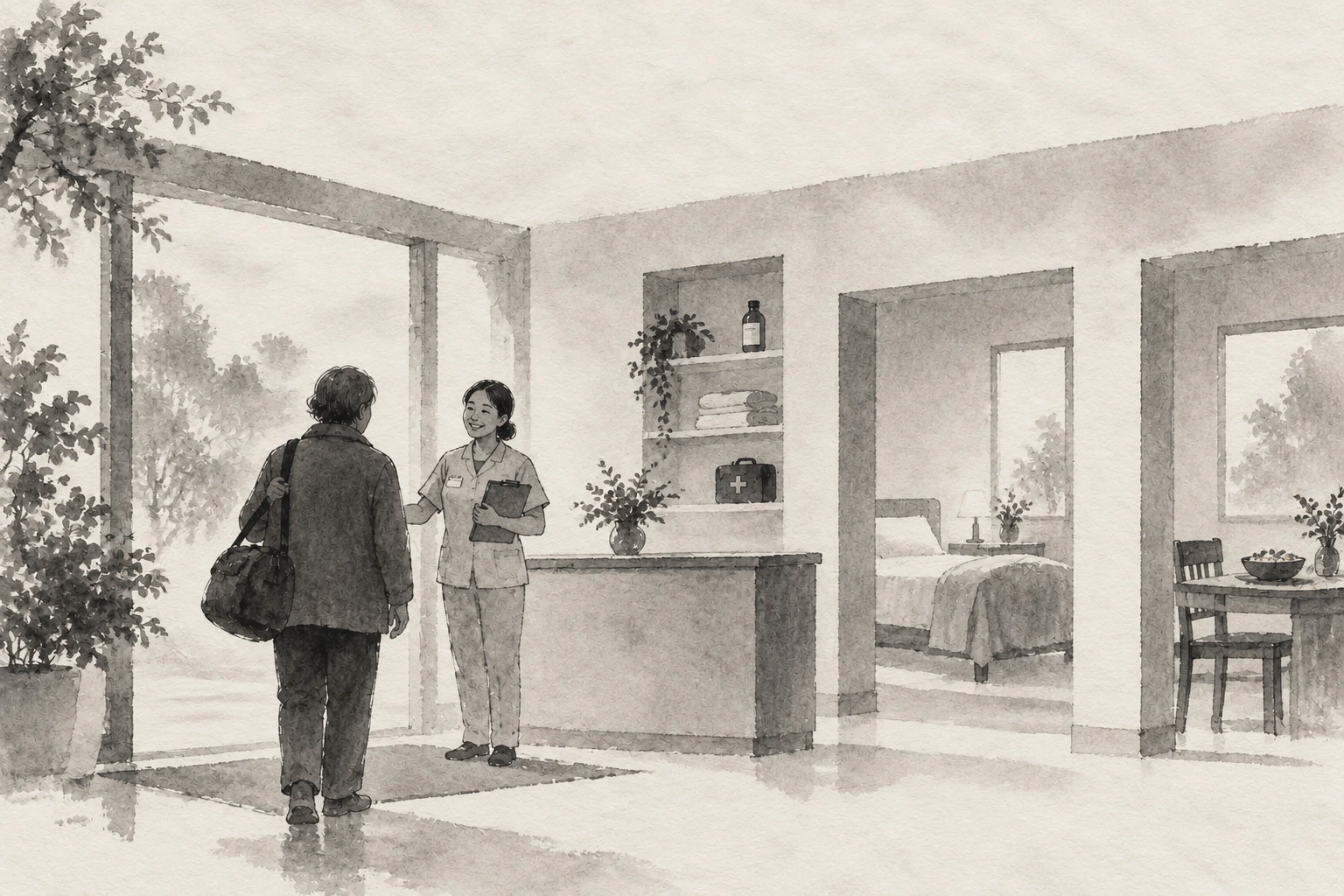
“Managed alcohol program” may sound like advice for a person to choose a safe drinking schedule on their own. That reading is mistaken. In these programs, an organization provides alcohol as one part of specialist support for selected people with severe alcohol problems and substantial barriers to ordinary care. Housing, meals, healthcare, and social services may be part of the setting. This does not establish that alcohol is safe or that a household can treat withdrawal with it.
If the description resembles someone's situation, a useful first step is to ask a qualified local alcohol or housing service whether such a program exists nearby and who can actually enter it. There is no need to copy a published provision pattern or change one's use to “test” the approach. Suspected poisoning, a severe medical condition, dangerous withdrawal symptoms, or immediate risk of harm to oneself or another person calls for local emergency medical help. After prolonged heavy drinking, a planned change or abrupt stop should be discussed with a clinician in advance: withdrawal can be dangerous for some people.
I. What the term names
The Canadian research initiative CRISM describes managed alcohol programs (MAPs) as part of care for severe alcohol use disorder, especially when poverty, unstable housing, and other barriers make familiar treatment options inaccessible or ineffective. An organized service combines provision of beverage alcohol with support. Its aims may include reducing some immediate harms of unstable use, preventing dangerous withdrawal, replacing nonbeverage alcohol, and connecting people with healthcare and social services. This describes Canadian services and their intended population, not a rule for every country or everyone who drinks.
Programs vary. Some are tied to housing and daily support; others operate in healthcare settings. A particular service determines eligibility, staffing, supervision, clinical access, and safety arrangements. The word “managed” does not mean that a participant has gained complete control over a disorder or that the program promises abstinence. It also does not remove a person's right to discuss their own goals and other forms of care.
II. Why housing and social conditions matter
In the Canadian settings studied, people often lacked stable housing, and some consumed nonbeverage products containing alcohol. This brought additional risks and made regular care harder to access. In one evaluated program, housing, food, and contact with a healthcare worker came alongside organized access to alcohol. The outcome of that package cannot show with certainty which component produced each change.
Those circumstances do not describe everyone who continues drinking, and homelessness is not a required sign of alcohol use disorder. One person may most need housing; another may need a health assessment, a connection to treatment, or protection from a different risk. Another group's experience should not become a label or proof that the same model suits everyone.
III. What a small study observed
In Vallance and colleagues' pilot study, 18 participants in one program in Thunder Bay, Canada, were compared with 20 potentially eligible people at a nearby shelter. Assignment was not random; everyone in both groups identified as Indigenous. Program participants reported fewer days of nonbeverage alcohol use than controls. Records also showed fewer detoxification episodes than controls and fewer hospital admissions during program periods than periods outside the program. Not every difference in service use was statistically persuasive.
These are observations from a small local sample, not a trial of a particular dose or proof that providing alcohol alone caused the changes. Housing, meals, and contact with staff also altered daily life. Alcohol consumed outside the program was incompletely recorded; the authors could not confidently say total consumption declined. Drinking days remained frequent for some people followed. Positive findings therefore neither make alcohol harmless nor transfer automatically to other communities.
IV. What a larger cohort adds
In Zhao and colleagues' retrospective Canadian cohort, researchers examined 205 people who had participated in programs and 128 local controls. According to the published abstract, periods while participating were associated with a lower probability of death and emergency-department attendance than participants' periods outside a program. But comparing people who had ever joined a MAP with the control group as a whole showed no statistically clear difference in death or emergency attendance. The MAP group had more alcohol-related and fewer non-alcohol-related emergency presentations than controls.
These results cannot be compressed into “the program saves everyone” or “the program does nothing.” The study used existing records rather than random assignment; health and housing may have changed alongside participation. “While enrolled versus outside” and “ever enrolled versus local controls” answer different questions. Together they show potential benefit and important uncertainty, not an individual forecast for a new participant.
V. Benefit does not erase alcohol's risks
A stable place, food, and access to professionals, together with less use of nonbeverage alcohol, can change everyday safety and the opportunity to receive care. These are consequential outcomes for the people studied. Yet WHO explains that alcohol carries health risks and can harm other people; circumstances and individual condition matter. A harm-reduction program does not make consumption harmless or replace treatment of other conditions.
Programs have limits of their own: not everyone is eligible, support depends on local resources, and transitions between hospital, housing, and the street may be difficult. Potential benefit in one institution does not promise the same organization, price, or legal status in another country. Those conditions need to be checked with a real local service rather than inferred from the program name.
VI. Why the program cannot be moved into a home
A service assesses eligibility, has staff who hold responsibility, and can respond medically and socially to complications. In the research, housing and support may have mattered at least as much as provision of alcohol. Copying an amount or timing from a professional document does not create those conditions at home. This article offers no distribution table, withdrawal schedule, or instruction to “treat” oneself or a loved one with alcohol.
A personal goal to reduce drinking is a separate question. It can be discussed with a clinician and may involve other care options. NIAAA describes different ways of treating alcohol problems and the need to find a suitable fit. MAP is not a required stage for every person and does not make an unsupervised experiment safe. Prescribed medicine should not be stopped independently for a new plan; changes belong in a clinical conversation.
VII. Finding out what help actually exists
When severe alcohol problems occur alongside unstable housing, a person can ask a local medical, social, or housing service whether an operating MAP or another suitable option exists and how eligibility is assessed. It is useful to check age rules, language, cost, waiting time, privacy, clinical access, and what happens if housing changes. A booked appointment is not yet care received. If a program is unavailable, the next contact must be one that can actually be reached.
Someone in different circumstances who wants to discuss reducing use need not reshape their story to fit another service's criteria. A qualified health assessment and discussion of goals can happen separately. A loved one may help look for information with an adult's consent but need not become a guard, secretly take alcohol, medicine, money, or passwords. Children must not be monitors. With violence or coercion, the affected person's protection and independent local support are separate from any discussion of MAP.
VIII. A practical conclusion without a home protocol
“Could MAP suit me?” is a question about already known needs and actual nearby services, not another person's doses. A person may tell a professional what is most concerning now: health, possible withdrawal, housing, or inability to access prior care. They can then ask what options exist locally and how to obtain help beyond a formal booking. Immediate danger requires help now, before any form or optional question.
Research supports discussing MAP as a serious approach to reducing certain harms for a particular group. It does not justify presenting alcohol provision as universal treatment, a private instruction for a family, or a guarantee of safety. Respecting a person means seeing their needs and choices alongside the real service conditions that a name alone cannot recreate.
Appendix: five optional prompts for a service conversation
These are original questions about facts already known, not a diagnostic scale or a home experiment. Any can be skipped. Dangerous withdrawal, suspected poisoning, a severe condition, or an immediate threat to oneself or another calls for local emergency medical help first; violence calls for independent protection.
- Which known problems with health, housing, or care access make specialist support relevant?
- What medical and social help is the person receiving now, and what is missing?
- Is there an actual MAP or another option locally, who assesses eligibility, and what are the access conditions?
- Which implications for treatment, housing, and essential expenses need discussion with a qualified professional before a plan changes?
- What one local contact is reachable now in terms of language, cost, waiting time, and privacy, without asking a child to monitor an adult?
Not having ready answers does not remove the right to ask for help.
Sources and limits of application
- Canadian Research Initiative in Substance Matters. Managed Alcohol Programs. Canadian operational-guidance page, July 2023; describes the target population and specialist service, not availability, eligibility, or legality in every country.
- Vallance K. et al. Do managed alcohol programs change patterns of alcohol consumption and reduce related harm? A pilot study. Single-city Canadian observational pilot, 9 May 2016; 18 program participants and 20 nearby-shelter controls, uncertainty about total consumption and limited transferability.
- Zhao J. et al. Participation in Canadian Managed Alcohol Programs and Associated Probabilities of Emergency Room Presentation, Hospitalization and Death. Retrospective cohort abstract, 12 March 2022; 205 MAP participants and 128 controls. Enrollment-period associations do not establish causation or personal prognosis.
- National Institute on Alcohol Abuse and Alcoholism. Treatment for Alcohol Problems: Finding and Getting Help. Official U.S. guide to treatment and support options; page date not stated, content checked 14 October 2026. It does not guarantee service access elsewhere or provide a home withdrawal plan here.
- World Health Organization. Alcohol. Fact sheet of 28 June 2024 on alcohol risks to health and other people; not a MAP evaluation or an individual safe limit.
Topics
alcohol; managed alcohol programs; harm reduction; specialist support; housing; nonbeverage alcohol; research; evidence limits; health; withdrawal; care choice; safety.
Authors
Andrey Zarinsh — author and founder of United Wisdom. He explores inner transformation, the unity of traditions, intercultural dialogue, and contemporary spiritual discipline. Instagram: @andrey.zarinsh.
Maria Evilkut — co-author of United Wisdom. Alongside her research, she seeks to test these ideas in practice and observe how principles of unity and mutual understanding work in real life between people and cultures. Instagram: @ilkutki.
Content review date: 14 October 2026. Language version: EN.