
Different circumstances and groups
People Without Stable Housing
What this article is about. Someone spends some nights with friends and others in a shelter. A proposed appointment falls during the time they must find a place to sleep, and their phone loses power before a service replies.
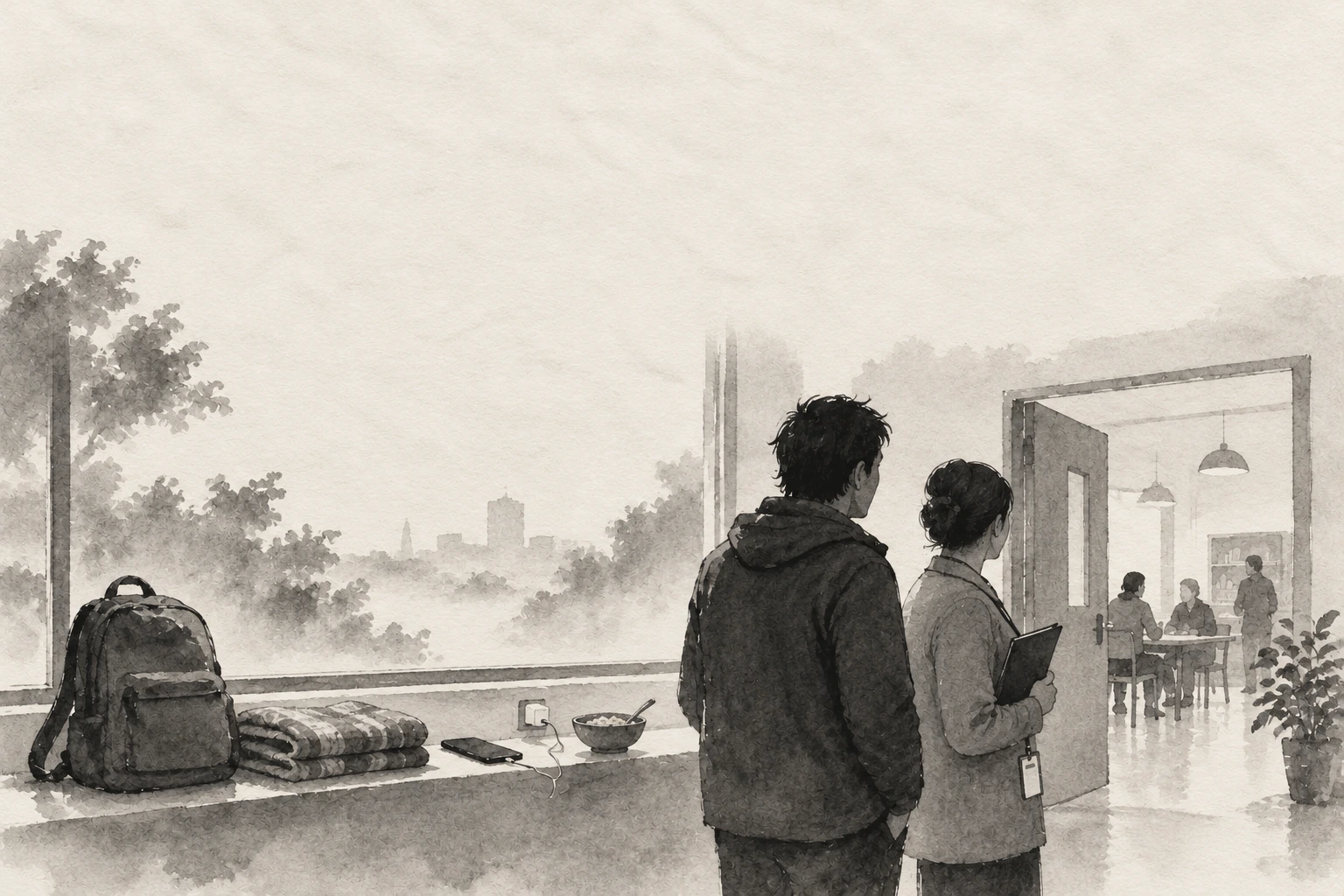
What this article is about. Someone spends some nights with friends and others in a shelter. A proposed appointment falls during the time they must find a place to sleep, and their phone loses power before a service replies. Another person has a room but fears staying there. These are different circumstances; none alone establishes addiction or that a person is dangerous. If substance use has become a problem, it makes sense to connect care with food, safety, communication, and a place to sleep. Without those conditions, even a useful plan may be impossible to follow. This article offers ways to start from actual conditions, without waiting to “hit bottom” or achieve ideal sobriety, and without assuming that any service will certainly accept everyone.
I. Immediate danger and a place to stay tonight
New sudden confusion itself calls for immediate contact with a local emergency medical service for assessment. Do not wait for it to become “severe,” for the person to lose orientation, or for a second sign; there are several possible causes (NHS on sudden confusion). If poisoning is suspected from alcohol, medicine, or another substance, also contact a local emergency medical service immediately, before symptoms appear: signs can be delayed (NHS on poisoning). Do not delay contact to find documents, identify a substance, wait for sobriety, complete questions, or establish where the person lives. Do not arrange withdrawal, a dose, or a treatment substitution at home.
If there is violence, threat, or coercion, seek a separate safe local protection route; a family conversation with the threatening person should not come before protection. If a child is present, establish which actually available capable adult or local service will provide care now. A promise by phone, an appointment, or asking a child to “keep watch” does not replace an adult who has actually arrived. If a child faces immediate danger, seek urgent local protection. Outside an emergency, start with a simple question: where can the person safely stay, eat, and charge a means of communication today? “I do not know yet” is a reason to seek help with basic conditions alongside medical care, not a reason to postpone it.
II. “No stable housing” is not one life situation
A night outdoors, a shelter place, a temporary sofa with friends, and a room that is unsafe make different demands. In one place belongings can be stored; in another they cannot. One place may remain available after an appointment; another may not. UK government guidance distinguishes several forms of housing insecurity, but its definitions and entitlements belong to a UK context. It can help to state a concrete constraint — “the doors close after eight” or “I cannot keep medicine safe” — instead of accepting someone else’s label. Housing status or visible exhaustion cannot replace professional assessment of substance use, illness, injury, or care needs.
III. Why a good plan may fail under real conditions
A 9 a.m. medical appointment is of little use if the journey takes two hours and travel money is needed to reach a night shelter. Advice to keep medicine “at home” does not explain what to do without a secure place; a registration address is not necessarily one where a message can be received. In a qualitative study at three San Francisco organizations, 28 clinicians and service workers interviewed in 2021 described barriers for unhoused adults with opioid use disorder: identification requirements at some pharmacies, medicine storage, theft risk, and gaps between services. Those are workers’ observations in one city and about one treatment category, not every person’s story.
This suggests a practical question for a professional: “How can I carry out this particular plan with my current place to sleep, transport, and way of being reached?” A different available appointment, collection point, contact method, or social worker might help; those options must be checked, not assumed. Ask the prescriber or pharmacist about prescribed medicines, their storage, and what to do if you miss taking a prescribed medicine, in light of the actual medicine and setting. Do not stop, change a dose, or substitute a medicine on your own.
IV. Asking for help need not wait for ideal sobriety
A person can ask for medical assessment, help with substance use, food, a place to sleep, and protection even if use continues and the goal of care is still under discussion. For diagnosed opioid use disorder, US CDC guidance for clinicians does not treat limited access to psychosocial services as a reason to delay discussing medication treatment. This is not a prescription for every substance or a promise of access in another country. CDC guidance on prevention programs places harm reduction alongside treatment and recovery support; specific measures and services depend on local rules and availability.
No one needs to prove they have “hit bottom” before asking for help, and no one must treat every offer as suitable. If one service requires sobriety, a document, or a permanent address, ask about its actual requirements and another possible route. A US federal agency has noted that some shelters have sobriety, fee, or entry-time rules. This illustrates varying conditions in the US, not a rule for all shelters. If a person is physically dependent on alcohol, abruptly stopping on their own can be dangerous; the NHS advises discussing stopping with a medical professional. Prescribed medicines and physical adaptation to them do not by themselves mean substance use disorder.
V. What Housing First shows, and what it does not
In a US USICH explanation, Housing First avoids making sobriety or completed treatment a blanket precondition for housing and combines housing with support. That describes a program approach; it promises neither a particular home nor an absence of local rules. In a Canadian randomized trial, 1,198 adults without stable housing who had mental illness and moderate support needs in four cities received housing with rent supplements and intensive case management or usual services. Over 24 months the housing group had greater housing stability; other measures of quality of life and health-service use did not improve consistently. The study does not prove that every substance use disorder was cured, and its results cannot simply be transferred to another country, population, or program without support.
Housing may create time, safety, and a way to reach treatment; treatment and support may still be needed after moving in. Likewise, a person need not wait for permanent housing to first seek medical help. The next step is to connect two real lines of support, not to choose a perfect theory or substitute one line for the other.
VI. Two contacts instead of one impossible sequence
If there is no emergency from section I, choose one accessible medical contact — local primary care, a clinic, a substance-use professional, or a pharmacist for a specific condition or medicine — and one contact about basic conditions: a local social or housing service, shelter, food assistance, or safety support. An adult participates in decisions about non-emergency help and what details to share. They can give what is needed to make a request and ask what information the service records or passes on. Confidentiality, mandatory reporting, and entry rules differ by place; absolute secrecy cannot be promised.
A short phrase may help with each contact: “I need help with [specific need]. Today I am in [area or circumstances I can safely describe]. I have/do not have a phone and documents. What step is actually available, when, at what cost, and what do I need to bring?” A person does not need to announce their housing status to everyone or publicly tell their substance-use history. If safer, ask an adult of your choice to help call or accompany you with your agreement. With violence, use a safe contact channel and protection route first; a joint conversation with an abuser is not a condition for help.
VII. Check access, not just a service address
Before traveling, or after a first reply, check whether the service is open today; whether it accepts someone of this age and circumstance; whether an ID, appointment, address, or payment is needed; the language offered; transport and waiting time; whether a reply is possible without a permanent phone; and where it is safe to wait and keep belongings. For prescribed medicine, ask the prescriber or pharmacist what storage is appropriate for the actual medicine and what to do when there is a barrier. Do not invent a universal rule for a medicine or shelter. If the sleeping place is unsafe, tell a chosen safe service worker without first confronting the threatening person.
Check the actual outcome: was the person seen, given a definite time, helped with travel, or provided a working alternative contact — or was only a message left? An online address, paper referral, and expected callback are not a place to sleep, an examination, or care. If the first route is closed, ask about another working route and what can happen before an appointment. If necessary care has no one to provide it now, seek an actually available capable adult or local medical/social help. A child is not a courier, monitor, medicine keeper, or substitute adult.
VIII. When circumstances change, revise the plan
A sleeping place falls through, a phone is lost, a service changes entry rules, or travel money runs out. None proves a “lack of motivation.” Tell the clinician or social service which specific part is no longer possible and ask to revise the route. There is no need to remain in an unsafe place, stop prescribed treatment, or attend a risky meeting to prove effort. Discuss concerns about use or withdrawal with a medical professional; do not try a home regimen. If new sudden confusion or suspected poisoning arises, the immediate local emergency medical route in section I applies regardless of the housing plan. For violence, seek separate safe protection.
IX. Five optional questions and one next step
These questions are for an adult about already known circumstances, not a self-diagnostic form. Skip any of them; do not complete them before seeking emergency help.
- Where can I safely be today, and who can actually help if I cannot stay there?
- Which one circumstance now blocks care: transport, phone, ID, language, cost, entry time, or something else?
- What medical question do I want to ask without diagnosing myself or changing treatment?
- What information am I willing to share with a service, what does it require, and how will I check its local data rules?
- Who will provide real adult care for a child or dependent person while I attend an appointment, and how will I know the support actually happened?
The next non-emergency step is one safe contact for health and one for basic conditions, recording each actual reply and an alternative route. It is possible to start small while long-term housing and treatment remain unresolved. Housing, sobriety, and admitting a diagnosis should not become preliminary moral tests; available services and professional decisions still need to be checked locally.
Sources and limits
- UK Government: Health matters — rough sleeping. UK official guidance updated 11 February 2020; housing distinctions, not a universal entitlement.
- USICH: Four Clarifications about Housing First. US federal policy explanation, 18 June 2014; program principle, not a trial of a clinical outcome.
- USICH: Encampment Guidance release. US release, 28 April 2024; possible shelter-entry barriers whose actual rules require a local check.
- Stergiopoulos et al., JAMA randomized trial. Original study online 3 March 2015; Canadian adults with mental illness, 24-month housing-stability outcome, not proof of SUD cure.
- Masson et al., Journal of Urban Health. Qualitative study published 27 March 2025; perspectives of 28 workers at three San Francisco organizations in 2021 on opioid care, not a survey of all patients.
- CDC: Opioid Use Disorder — Treating. US clinician guidance, 9 April 2024, for diagnosed opioid use disorder; not self-treatment instructions.
- CDC: Overdose-prevention interventions. US program overview, 15 August 2025; types of support, not a local service directory.
- NHS: Sudden confusion. UK urgent guidance reviewed 28 May 2024; sudden confusion requires immediate help.
- NHS: Poisoning. UK urgent guidance reviewed 12 June 2025; suspected poisoning should not wait for symptoms.
- NHS: Alcohol-use disorder. UK clinical information reviewed 24 April 2026; risk of abruptly stopping with physical alcohol dependence, not a home plan.
The sources do not establish a diagnosis or the cause of events for an individual, local prices, a right to housing, shelter criteria, treatment availability, data rules, or child-care law. Their country, population, and observed outcome are stated above; a longer-term route needs local professional assessment.
Tags
housing instability; homelessness; substance use; access to care; basic needs; shelter; safety; Housing First; harm reduction; medical care; social support; autonomy.
About the authors
Andrey Zarinsh — author and founder of United Wisdom. He explores inner transformation, the unity of traditions, intercultural dialogue, and contemporary spiritual discipline. Instagram: @andrey.zarinsh.
Maria Evilkut — co-author of United Wisdom. Alongside her research, she seeks to test these ideas in practice and observe how principles of unity and mutual understanding work in real life between people and cultures. Instagram: @ilkutki.
Content date
15 October 2026. English version.