
Religions, spiritual traditions and communities
Judaism: wine in ritual, sobriety in life, and a place for care
Wine has a visible place in Jewish poetry and in some ceremonies. Jewish texts also contain a form of chosen abstinence, strong criticism of intoxication, and disagreements about ritual practice.
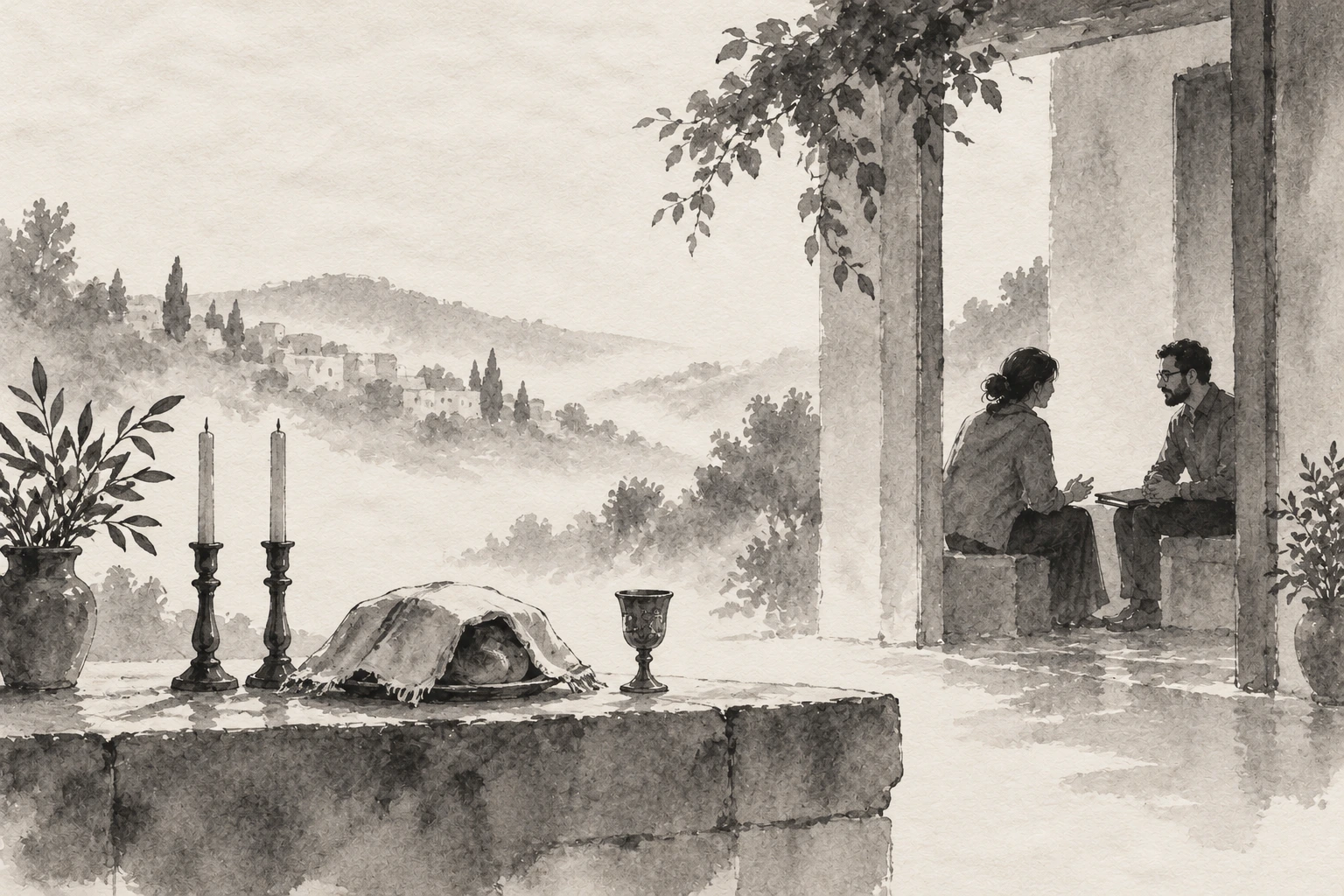
“Wine gladdens the human heart” — our brief translation from the Hebrew of Psalm 104:15. A poetic line is not advice to drink.
What this article examines
Wine has a visible place in Jewish poetry and in some ceremonies. Jewish texts also contain a form of chosen abstinence, strong criticism of intoxication, and disagreements about ritual practice. Tension appears when one festive line is made into an obligation for every person, or when a warning against drunkenness is used to claim that someone experiencing addiction need only try harder. Neither move answers the questions of health, dignity, and access to help.
Here we consider named passages of the Hebrew Bible, Maimonides, the Shulchan Arukh with Rema’s gloss, and specific contemporary Reform and Orthodox voices. They differ in era, genre, and authority within particular communities. A clinical source answers a different question: when professional assessment matters, and when medical help cannot wait. Faith and community may matter deeply to a person, but they cannot be prerequisites for treatment or substitutes for emergency care.
I. Name the kind of source before announcing a rule
A psalm is poetry. The Nazirite vow in the Torah belongs to an ancient legal and ritual setting. Maimonides is a medieval codifier who addresses ethical conduct in one chapter and Sabbath ceremony in another. In a printed section of the Shulchan Arukh, Yosef Karo’s main text and Moses Isserles’s, or Rema’s, gloss can point in different directions. A modern responsum answers a specified question; a pastoral article speaks for its named writer. “Judaism says” obscures these differences.
That precision matters when someone tells a person in recovery, “Wine is on the festive table, so you must drink.” Which text, occasion, community, personal risk, and choice justify that conclusion? The reverse overreach is also harmful: “A text condemns drunkenness, so this person’s disorder and their family’s difficulties prove moral failure.” An ethical warning cannot diagnose substance use disorder, establish its cause, or assess someone’s worth. If the person wants to discuss the ceremony, a rabbi in their chosen community may be relevant. A qualified health professional addresses medical risk. Neither role should be treated as expertise in everything.
II. Poetic joy does not require an individual to drink
Psalm 104:15 places wine in a poetic picture of life’s gifts. That helps explain why wine became a symbol of celebration and blessing. It does not say who should drink, how much, or whether alcohol is safe for a person who has experienced harm. The same drink may be connected to loss of control, a feared return to use, a medicine interaction, or a distressing memory. The poem does not settle these circumstances.
Nor is joy contained in one liquid. Someone may value Sabbath rest and belonging while declining alcohol. Relatives can keep a festive meal without testing that decision or making a guest’s treatment history public. This is not a universal religious ruling that any object may be substituted in any ceremony. Local ritual rules can differ. The narrower point is that a poetic description does not grant others permission to impose risk or demand a private explanation.
III. The Torah also contains chosen abstinence
Numbers 6:2–4,20 describes the Nazirite vow, which a man or woman could take. Wine and other grape products are excluded during the vow; the text also describes its end. It does not make every Jew a Nazirite. It is not an ancient treatment program for addiction: the passage belongs to another ritual world and offers no clinical assessment or promised outcome.
Yet this source complicates the claim that Jewish belonging necessarily requires drinking. An honoured form of abstinence appears in the ancient canon. A person today need not take that vow to earn respect for declining alcohol. If they wish to discuss their participation in a ceremony, the conversation can concern the form of participation rather than a public test of religious authenticity. A medical risk and a ritual vow are not interchangeable, and the person does not owe every guest a diagnosis.
IV. Sabbath: words, a cup, and the limits of a code
In Mishneh Torah, Hilchot Shabbat 29:1, 6, 9 and 17, Maimonides distinguishes sanctifying the Sabbath in words from ritual blessings associated with a cup. He discusses wine for Kiddush, particular circumstances involving bread, and fresh grape juice. The precise reference is offered to clarify his text, not to turn a medieval code into a do-it-yourself ritual or medical protocol. Even within this one account, the meaning of the day and its material ceremonial form are not identical.
It would be another error to infer that because bread or juice appears somewhere in a code, every person in every community may automatically make any substitution. Nor does juice resolve every personal risk. Some people find it acceptable; someone else may want to avoid its taste, smell, or association. In the modern wedding case below, the person declines juice too. If a ceremony is important, the person can choose to ask a local rabbi what forms are possible there and whether they personally need to consume anything. A clinician, rather than the ritual text, should address health concerns. No celebration requires someone to test the danger by drinking.
V. Condemning intoxication is not diagnosing a person
In Mishneh Torah, Hilchot Deot 5:3, Maimonides sharply criticises intoxication in a discussion of how a scholar should behave. This is an ethical text. It can challenge the idea that losing judgement is a spiritual achievement. It cannot measure a modern person’s substance use disorder, how hard they have tried to change, or the treatment that would help. Moving its severe language directly onto someone who is ill would erase their particular health and social circumstances.
Acknowledging harm still matters. Relatives may name a concrete action, protect a child, set limits around money or time, and seek support. They need not publicly shame or force a confession. Medical assessment, boundaries at home, and a religious conversation answer different questions. A person does not become less eligible for care because a historical text condemns drunkenness; one episode does not diagnose or blame their family. Someone who has no interest in religious language may still seek clinical or social support.
VI. Purim has an internal tension, not a home drinking test
In Shulchan Arukh, Orach Chayim 695:2, Karo’s main text presents an obligation associated with festive intoxication; the attached gloss by Rema gives a more limited understanding. Quoting only the first line could falsely suggest an uncontested instruction. But the gloss is not a modern safety protocol either. No quantity, sleep instruction, or experiment to see what one can tolerate should be derived from it for a person facing addiction, medicine risks, or violence.
The online Hebrew transcription used here is itself marked unreviewed by its platform, which is another reason to identify the exact passage and limit the claim. Its distinction is consistent with the discussion in the named contemporary Orthodox article below. A person can ask a chosen community, “How can I mark Purim without exposing myself to risk?” That question need not become a public account of their diagnosis. A rabbi can address the local ritual question; the response cannot promise alcohol is medically safe. Guests should not turn a refusal into an examination of religious commitment.
VII. Specific contemporary voices make room for caution
Rabbi Dr Tzvi Hersh Weinreb, writing for the Orthodox Union on 12 February 2014, warns against making Purim a route to loss of control or harm from excess alcohol. His is a named pastoral argument on an Orthodox organisation’s site, not a vote by every Orthodox rabbi or a study of treatment outcomes. It does show that knowledge of a classical festive text does not rule out a contemporary warning against drunkenness.
Kelly Hershberg’s article on the Union for Reform Judaism site, undated on the page checked, asks others to respect a decision not to drink on Purim. This is a community-facing article, not a binding Reform responsum. Together, the two pieces illuminate a practical pressure that can be lost in a theoretical dispute: “for the holiday” can become a way of denying someone room to say no. A host can offer participation without alcohol, asking for no medical explanation and making no promise about anyone’s recovery.
VIII. A Reform responsum takes even a refusal of juice seriously
CCAR responsum 5755.16, “Substitutes for Wine Under the Chupah”, concerns a wedding. The groom, in recovery from alcohol dependence, is offered grape juice rather than wine. He says even juice might be an unwelcome test for him. The authors examine the wedding ceremony and a non-alcoholic solution while taking his concern seriously. They do not begin by asking him to demonstrate the strength of his will. Here a ritual question is considered alongside a particular person’s risk, rather than above it.
The limits are as important as the example. This is an archived Reform rabbinic answer to a particular wedding inquiry, identified by its Hebrew-year code 5755.16 (1994/95); the exact date of posting was not visible. The archive cautions that older responsa may not reflect present CCAR policy. It is not a binding answer for every Reform congregation, still less for Kiddush, Purim, or other Jewish movements. Nor is it a clinical trial of substitute beverages. It demonstrates that a religious conversation can take seriously a refusal of both wine and a similar drink without excluding the person from a celebration. The actual ceremonial form must be discussed locally if the person wants that conversation.
IX. Medical urgency follows a separate path
Neither wine at Kiddush nor its absence diagnoses addiction. Yet spiritual comfort should not conceal physical risk. The NHS page on alcohol-use disorder warns that abrupt unsupervised withdrawal can be dangerous with physical dependence. Someone may seek medical assessment even before achieving abstinence or settling their plans for a holiday. This is a UK page, not proof of an identical service in the reader’s country. The practical point is to discuss use, symptoms, and goals with a qualified professional, without devising a home withdrawal schedule or a dose.
Prescribed medicines require their own care. The UK medicines regulator MHRA warns about dependence and withdrawal involving the classes it names and advises against stopping a prescription without medical advice. Taking a prescription, or developing physical adaptation, is not automatically a substance use disorder; risk still merits discussion. Questions about changing a medicine belong with the prescriber or another qualified professional, not with a festive table or a home experiment.
Some events cannot wait for a spiritual conversation or a routine appointment. New sudden confusion itself calls for immediate contact with a local emergency medical service for assessment, without waiting for disorientation, another severe sign, or sobriety; see the NHS sudden-confusion page. If poisoning or overdose is suspected, contact a local emergency medical service immediately, even before symptoms appear; see the NHS poisoning page. The UK phone numbers and home procedures do not transfer to an unknown location. Violence or coercion calls for a separate safe local protection route before a joint conversation with a partner, family, or religious leader.
X. Community support has real conditions
A conversation with a rabbi or a way to celebrate without alcohol may be meaningful for some people. Others do not want religious involvement or find a particular setting unsafe; they too can ask about medical, psychological, or social help. None of these sources measures the effectiveness of a particular community program or guarantees it exists nearby. A possible first question is: “I want to participate without an alcoholic drink. Is there a way to do that without explaining my health history to everyone?” A separate question to a care service might be: “I want to discuss alcohol risk and treatment. What are the booking, cost, language, and data rules?” Answers have to come from the actual service; absolute confidentiality or uniform legal exceptions cannot be promised.
A relative may seek support for themselves even if another adult is not ready to engage. That adult’s participation in non-emergency care remains voluntary, and disclosure should not be used to shame them. A relative can name what they can realistically do and what is unsafe or beyond their means; they cannot control every drink or guarantee a treatment outcome. Children must not be asked to monitor use, hold medicines, negotiate treatment, translate complex care conversations, or keep a dangerous secret. If an adult cannot currently provide needed care, another actually capable adult or the appropriate local service must take responsibility; being reachable by phone is not the same as providing care.
The person may keep a ceremony with an agreed change of form, pause their participation, or speak with a clinician before deciding about a holiday. None of these paths guarantees recovery or measures faith. A later conversation may change with health and safety. Pressure to resolve everything at once is unlikely to make either the ritual or the treatment decision more honest. The two decisions touch the same life, but each needs the right conversation and competent help.
What this means in practice
If the immediate question concerns a ceremony, name it: Kiddush, Purim, or a wedding. Ask what participation without alcohol and without public medical disclosure would mean in the actual community. Do not test wine, juice, or a holiday amount as a test of loyalty. If use, symptoms, or prescribed medicine are the concern, seek a qualified medical discussion and check the real language, cost, wait, transport, and data conditions. Do not stop prescribed medicines or attempt withdrawal at home. Community support may accompany care when the person chooses it. New sudden confusion, or suspected poisoning or overdose, requires immediate local emergency medical contact; suspected poisoning requires it even before symptoms. For violence, seek a separate safe protection route first. Ritual practice and medical care can both matter without making either one a test of the person’s worth.
Key quotation
“non-alcoholic beverages are not to be thought of as inferior alternatives to wine for ceremonial purposes” — CCAR responsum 5755.16 on a wedding under the chupah. This is the argument of that Reform answer, not a ruling for every community or rite.
Connections among traditions
These comparisons concern named passages, not a single rule shared by all communities.
| Named passages | Point of connection | Essential limit |
|---|---|---|
| Psalm 104:15 and Numbers 6:2–4,20 | The ancient canon contains both poetic wine imagery and a form of chosen abstinence. | Neither gives a present-day medical instruction or a ruling on every ceremony. |
| Maimonides, Shabbat 29 and CCAR responsum 5755.16 | Both examine the relationship between an object and a ritual’s meaning. | A medieval Sabbath code and a modern Reform wedding response concern different ceremonies and communities. |
| Shulchan Arukh, Orach Chayim 695:2 and Weinreb for the OU | Purim appears in both a classical passage and a modern warning about drinking. | Neither establishes a personally safe amount or a home test. |
| Weinreb for the OU and Hershberg on the URJ site | Two different contemporary voices resist pressure to drink. | Neither speaks for all Orthodox or Reform Jews or proves a treatment outcome. |
Sources and limits
- Psalm 104:15, Hebrew Masoretic text — ancient poetry; page date not established. The epigraph is our brief translation, not health advice.
- Numbers 6:2–4,20, Hebrew Masoretic text — ancient passage about a Nazirite vow; page date not established, not an addiction program.
- Maimonides, Mishneh Torah, Hilchot Deot 5:3 — medieval ethical text in Hebrew; page date not established, not a clinical diagnostic scale.
- Maimonides, Mishneh Torah, Hilchot Shabbat 29:1,6,9,17 — medieval code in an accessible English translation; page date not established, not binding on every community.
- Shulchan Arukh, Orach Chayim 695:2, Karo and Rema’s gloss — early modern text, in an online Hebrew transcription marked unreviewed; the webpage’s 14 February 2023 edit date is not the composition date.
- CCAR responsum 5755.16, “Substitutes for Wine Under the Chupah” — archived Reform answer to a wedding question, Hebrew year 5755/1994–95; posting date not visible, earlier answers may not reflect current CCAR policy.
- Rabbi Dr Tzvi Hersh Weinreb, Orthodox Union — pastoral argument about Purim, 12 February 2014; neither universal law nor clinical research.
- Kelly Hershberg, Union for Reform Judaism — community article on declining alcohol at Purim; page date not found, not a responsum.
- NHS, Alcohol-use disorder — UK public health page reviewed 24 April 2026; not a promise of local access.
- MHRA, medicine dependency and withdrawal warning — UK regulator news release, 8 January 2026, on named medicine classes; no individual prescription.
- NHS, Sudden confusion — UK page reviewed 28 May 2024; the urgent assessment principle does not export a UK phone number.
- NHS, Poisoning — UK page reviewed 12 June 2025; suspected exposure needs urgent help before symptoms, without a copied home protocol.
The indicated passages of primary pages were checked, not the entire classical canon, every community’s practice, or the effectiveness of a religious program. Scripture, an archived responsum, a pastoral article, and UK clinical pages have different scopes. No full translations, prayers, pages, forms, scales, or tables are reproduced. Local rights, confidentiality, prices, and availability need local verification.
Tags
Judaism, wine and ritual, sobriety, Purim, Kiddush, Nazirite vow, addiction, community support, medical care, free choice, family, safety
About the authors
Andrey Zarinsh is the author and founder of United Wisdom. He studies inner transformation, the unity of traditions, intercultural dialogue, and contemporary spiritual discipline. Instagram: @andrey.zarinsh.
Maria Evilkut is a co-author of United Wisdom. Alongside her research, she aims to test these ideas in practice and observe how the principles of unity and mutual understanding work in real life among people and cultures. Instagram: @ilkutki.
Content date
15 October 2026. English adaptation.