
Religions, spiritual traditions and communities
Hindu traditions: desire, discipline, and devotion without the myth of a “strong mind”
How can we speak about a substance when someone connects it with prayer, concentration, or belonging to a community? Two quick answers pull in opposite directions. One calls any use a sign of spiritual weakness.
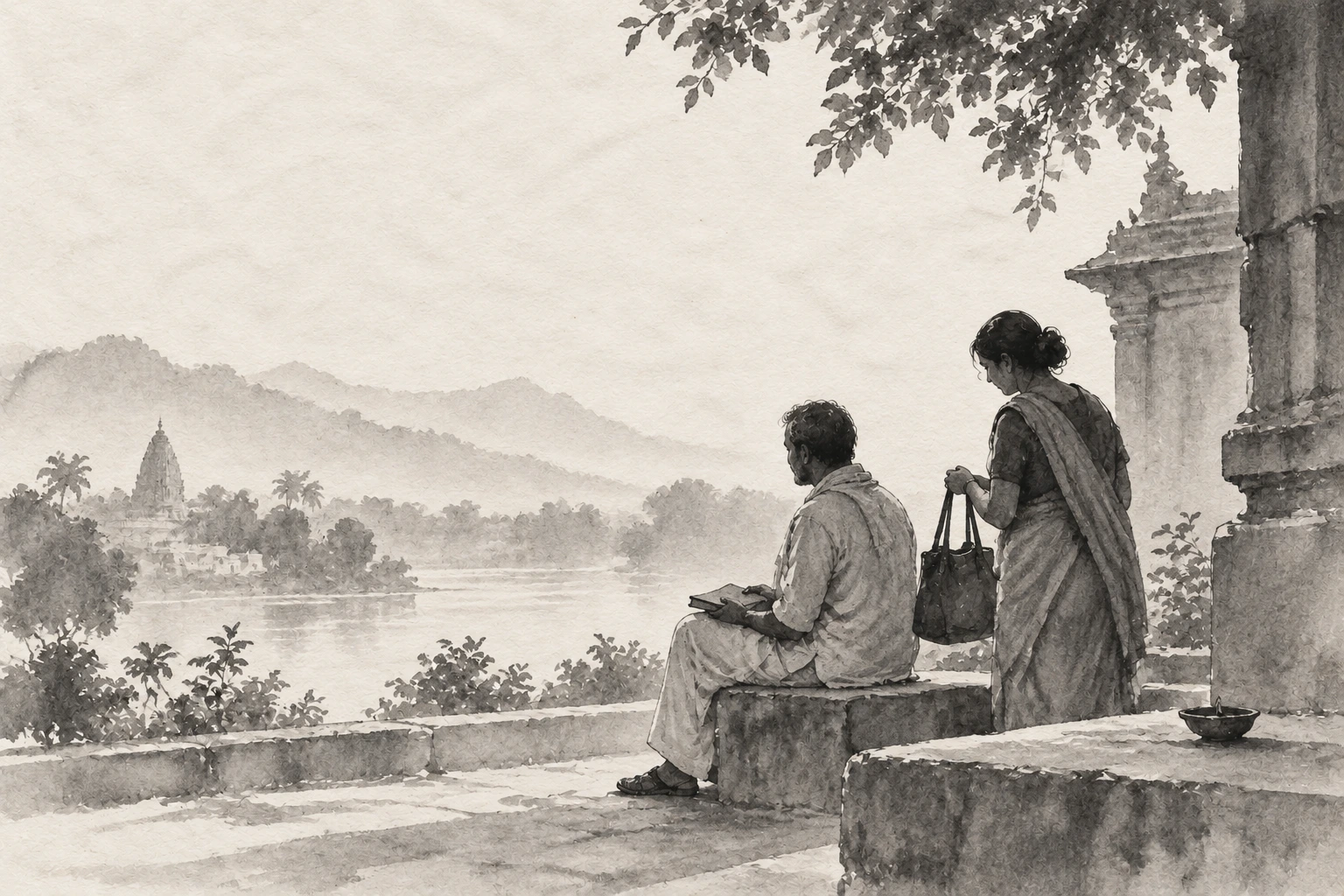
“Restless senses, O Arjuna, forcibly carry away the mind” — short exact excerpt from Bhagavad Gita 2.60 as published in English by Gita Society. The translator and date of this web edition were not identified in the passage checked.
What this article is about
How can we speak about a substance when someone connects it with prayer, concentration, or belonging to a community? Two quick answers pull in opposite directions. One calls any use a sign of spiritual weakness. The other invokes an old custom and promises that the “right” mindset will prevent harm. Both bypass the questions that matter: which substance and form are involved, what is actually happening to the person, which relationships and duties are affected, whether medical help is needed, and whose rule is being cited.
Hindu traditions are not one school with one position on desire or intoxicants. Here we consider specified verses of the Bhagavad Gita, two pages of a colonial report about bhang, differing voices in a community magazine from 2013, and an internal oath of ISKCON’s governing body. These materials differ in time, genre, audience, and authority. They can sharpen a discussion of meaning and limits. They cannot diagnose a substance-use disorder or establish one person’s medical safety. That requires facts about the person’s condition and qualified assessment. Faith may support access to such care; faith is not an admission requirement.
I. Ask first who is speaking, and about what
“Does Hinduism allow cannabis?” bundles several distinct questions. A text about attending to desire addresses an ethical or spiritual task. A description of a ritual reports what some people did, or thought they should do, at a particular time and place. An organization’s rule addresses its members. A person’s report that use makes prayer feel easier describes that person’s experience. None of these alone answers whether a substance is safe for them, whether their control over use is impaired, or whether a prescribed medicine should be changed.
The distinction makes respectful conversation possible. We can ask, “What does this practice mean to you?” without endorsing a claim that it treats a health problem. We can respect someone’s account of their religion while noticing lost time, money, attention, or a threat to a child’s safety. Those effects can be discussed without calling the person a “bad believer.” If it is hard for someone to speak inside their community, they may seek professional help elsewhere. They do not have to choose devotion or treatment before taking the first step.
Precision starts with the substance itself. In the historical material, bhang may be a drink or an offering made from the plant; ganja and charas name other forms, while the modern interview also mentions tobacco. Routes of exposure and risks differ. “Ritual cannabis” blurs those differences and can exaggerate the unity of the custom. Participation in a rite, or a single episode, does not prove a disorder; a religious purpose does not rule harm out.
II. What the Bhagavad Gita offers—and what it does not measure
In Gita Society’s publication of chapter 2, verses 2.60–2.64 present a sequence of reflection. Verse 2.60 includes even a person striving for wisdom among those whose senses may pull their mind away. Verses 2.62–2.63 connect dwelling on sense objects with attachment, desire, anger, and impaired judgment. Verse 2.64 does not portray discipline as hatred of every sensory object; it speaks of a relationship free from captivity to attraction and aversion. The webpage inserts modern commentary between verses. That commentary must not be silently quoted as an ancient verse. The translator and date of this web edition were not identified in the checked passage.
This ethical sequence can give a person language for asking, “What holds my attention and shapes my decisions?” It is not a scientific account of the origins of substance-use disorder. Attachment, pain, anxiety, physical dependence on alcohol, and material constraints may coexist. Nothing in these verses shows that willpower, meditation, or prayer alone makes it safe to stop using a substance. They offer no scale by which a relative can sort people into “strong” and “weak” minds.
Someone may freely use this language as a personal reference point: notice decisions made in fear or craving, and name what they want to protect. But changes in attention, sleep, memory, or the ability to meet responsibilities also deserve consideration of medical explanations. Agreement with a spiritual reading cannot be a condition for that conversation. A person to whom the text has no meaning has the same right to help.
III. A colonial report: offering is not the same as consuming
The National Library of Scotland catalog places the Indian Hemp Drugs Commission’s investigation in 1893–1894 and the report’s publication in 1894. This is a colonial administration document shaped by its questions, language, and selection of testimony. We have not read the multivolume report. On the available OCR page numbered 251, in J. M. Campbell’s note, the writer describes some offerings of bhang to Shiva and explicitly says that not every devotee makes them. He also reports disagreement among the authorities he cites about whether the person making an offering should drink its remainder. Even this one historical description resists the claim that everyone did the same thing.
It helps to distinguish three actions: offering a substance, consuming it, and attributing a spiritual or healing purpose to consumption. One does not automatically follow from another. A person today may describe a family or temple custom without using the substance themselves; someone else may use it outside a rite and later describe the act in religious terms. Respect for tradition in either case means asking about the actual action instead of filling it in for them. The historical author also lists claims of healing. Their appearance in the report does not make them established medicine.
On the adjacent OCR page numbered 252, the narrator attributes to some ascetics and poets the idea that bhang or ganja helps focus thought on the divine. That is a report of attributed purpose and experience, not a measured improvement in attention or a recommendation to a modern reader. We checked the library OCR, not the page images, the full note, its underlying witnesses, or the exact volume binding of these two pages. Two pages therefore cannot stand for “the proven position of Indian culture,” and an archive cannot be used to tell someone that their personal experience has already been settled.
IV. Contemporary voices within a practice disagree
Hinduism Today’s article of 1 July 2013 interviews particular sadhus at the Kumbh about the chillum. Published by monks of Kauai Hindu Monastery, it is community reporting, not a survey of all sadhus or a formal statement of every Hindu school. It describes mixtures involving ganja, charas, and tobacco. Their presence in one device does not make them the same substance, and a ritual setting provides no personal test of safety.
Sri Mahant Ganeshananda Saraswati of Taponidhi Shri Ananda Akhara in Nashik describes the chillum as one aspect of his naga sadhus’ sadhana, related in their account to directing the mind toward God. This is evidence of the meaning claimed within a named circle. On the same page, Sri Mahant Divya Puri, head of the women’s wing of Juna Akhara, says the practice should end today. Neither “all Hindus approve” nor “authentic spirituality always forbids it” does justice to these voices. The magazine’s closing generalization does not erase the disagreement it records.
This need not become a contest in which one speaker defeats another. For someone seeking help, four levels are more useful: what their own community actually requires; what people in it do; what the person experiences; and what is happening to health and relationships. If those levels conflict, they can speak with a religious adviser of their choosing and, separately, a qualified health professional. Help should not become a demand for public disclosure; confidentiality and rules for sharing information depend on the locality and service.
V. An abstinence rule also has a specific audience
On the official ISKCON Governing Body Commission oath page, members of that body commit to the society’s rules, including no intoxication. This is a clear normative text for a particular Gaudiya Vaishnava institution and role. It does not show how every participant lives, automatically bind all Vaishnavas, or stand for every Hindu tradition. The checked page gives no date for this edition.
This illustrates the difference between ethics and treatment. Someone may freely adopt a community rule and find it helpful to their way of life. But “this is our rule” supplies no medical process for stopping a substance and does not establish whether abrupt change in current use or prescriptions is safe. In the specific case of physical dependence on alcohol, the NHS warns that suddenly stopping can be dangerous; medical advice is needed before trying to stop. This UK source is about alcohol, not all substances or the availability of services in every country.
If someone fears that seeking help will be treated as a breach of a vow, the questions can be separated. They may choose to discuss the vow’s meaning with their community if that is safe. A clinician needs the facts relevant to safety, including substances and medicines actually taken. Medical care does not require first proving loyalty to a group, achieving perfect abstinence, or making a public confession.
VI. Feeling clear is not a measure of safety
A person may honestly say, “It feels easier to focus afterward.” There is no need to ridicule that experience. But a sense of clarity and the actual ability to remember, judge risk, work, or care for another person need not coincide. The US CDC overview dated 15 February 2024 describes effects of cannabis on attention, memory, coordination, and decisions. Effects vary with factors such as strength, frequency, age at first use, and use of other substances. The overview did not study these particular ritual participants and does not diagnose anyone who reports a spiritual experience.
The careful response is neither “tradition has proved the benefit” nor “every account of concentration is false.” Rather, a subjective experience does not establish a clinical outcome. If prayer feels easier but duties are missed, time is lost, fear or conflict grows, or child care becomes unsafe, both parts of the picture matter. If harm has not yet been noticed, that does not prove immunity either. Comparing oneself with supposedly “strong” ascetics, or shaming oneself for a “weak mind,” adds moral labels, not clinical categories.
The reverse mistake matters too. A list of possible risks cannot establish this particular reader’s condition without conversation and assessment. Professional contact aims to learn what is happening—including sleep, health, prescriptions, other substances, and context—not to confirm a moral story decided in advance. A traditional word about discipline may support a voluntary decision to seek care; it cannot replace the assessment.
VII. Prescribed medicines and different meanings of dependence
The word “dependence” often makes people combine every medicine, feeling unwell after a missed dose, and substance-use disorder into one thing. They are different questions. Royal College of Psychiatrists patient information about antidepressants illustrates this for a specific prescribed class: possible withdrawal symptoms and the need for an agreed treatment change do not automatically mean addiction. This example cannot be applied mechanically to every medicine or substance. Decisions for an individual belong in a conversation with the prescriber.
This distinction matters when the language of purity or discipline becomes an order to “remove all chemicals.” Someone may take medicine for a clinical indication while reflecting on spiritual practice. They do not have to prove devotion by stopping abruptly. If treatment is troubling, adverse effects occur, or there are concerns about adaptation, discussing them with the prescriber is a concrete next step. This article offers no home dose plan, taper, or detoxification.
Classes of substance use should not be combined either. The NHS warning about dangerous alcohol withdrawal is not a ready-made protocol for cannabis or a prescribed medicine. Benefits of a prescription, physical adaptation, impaired control, interactions, and safe changes to treatment require different information. Neither membership in a community nor its prohibition substitutes for that information.
VIII. Devotion and relationships without spiritual coercion
For someone, devotion may mean prayer, ritual participation, a conversation with a teacher, a moral commitment, or care for others. None of these has to involve a substance. Avoiding a substance does not automatically bring someone closer to the meaning they seek. If a spiritual setting helps them restore relationships and daily structure, it can be valuable as chosen support. But “treatment only through us” or “earn help by having the right faith first” exceeds the community’s role.
Relatives need not become judges of spiritual authenticity either. Instead of arguing over whether a practice is “real tradition,” they can name observable facts: who is caring for a child, who can pay for housing, which arrangements have failed, and who can actually help someone get to an appointment. If care must be transferred, another capable adult must really take it on. A service number or referral alone does not supervise a child. Children are not medication keepers, interpreters, monitors of use, or messengers between adults.
Threats, coercion, or violence call for a separate safe route to available local protection. A joint spiritual conversation or public “reconciliation” need not come first. Whether information can be disclosed, how confidentiality works, and what duties services have depend on local rules. This article cannot promise absolute secrecy or the same outcome everywhere.
IX. Help begins with an actual contact, not perfect motivation
For a first conversation, the facts already known are enough: what was taken, when the concern arose, and what has changed in sleep, work, memory, relationships, or care. No home “willpower test” or admission of the “correct” cause is needed. A clinician or appropriate service can help assess the situation and discuss options. Someone can value a rite, feel uncertain about change, and still receive professional assessment. Agreement with one spiritual interpretation or flawless abstinence is no prerequisite.
Access must be checked in practical terms: does a chosen service take people of this age and with this concern, in which language, at what cost, with what waiting time, and under which data rules? What happens if there is a refusal or delay? A booking, referral, or phone number is only a step. Check whether contact really occurred and the service can provide care. If the person wants to retain spiritual support, its place alongside medical care can be agreed without claiming that it has proved a clinical outcome.
Some situations cannot wait for a routine appointment. If poisoning is suspected, contact a local emergency medical service immediately, even before symptoms appear; a ritual discussion or search for proof must not delay the call. New sudden confusion alone is enough to contact a local emergency medical service immediately—do not wait for it to become severe or for another sign. NHS poisoning guidance and NHS sudden-confusion guidance describe medical routes, not spiritual ones; the actual number and access must be determined locally. A child is not responsible for the call or for monitoring an adult.
X. Disagreement leaves room for a person’s own decision
The coexistence of an old account of bhang, opposing voices among contemporary sadhus, and a strict rule for one governing body does not require readers to select any one of them as a final verdict on Hinduism as a whole. They can ask which community actually matters in their life, and why. They can leave a practice that has become unsafe without declaring every other rite false. They can keep prayer and relationships without taking a substance. They can step away from group pressure and still seek help. They can discuss addiction without agreeing that it proves moral or spiritual inferiority.
Such decisions are not made in a vacuum. Someone may have duties to family, little money, insecure housing or status, fear of data disclosure, and few accessible clinicians. “Just leave the community,” “just stop,” and “just trust the teacher” are not universal routes. A useful next step fits actual resources and medical risk: ensure necessary care, find a safe channel to a qualified person, and confirm a real appointment. If there is a threat, protection comes first; if there is a medical emergency, emergency contact comes first.
The readings support a modest but useful conclusion. Discipline can mean more than flawless inner strength. It can mean distinguishing verse from commentary, custom from obligation, experience from outcome, and help from loved ones from clinical care. That distinction lets us respect someone’s spiritual language without leaving them alone with risk or turning faith into a test of their right to treatment.
What this means in practice
If there is no emergency, an adult can begin with one voluntary conversation. It may help to name an observed change and a personal aim: “I want to keep this part of my life, but I notice that after use I miss work / cannot reliably care for a child / fear withdrawal. I want to discuss the risk and my options.” This is not a required confession script or a diagnostic test. Seeking help without involving family or a community may be safer, subject to local rules.
Five optional questions can help prepare that contact: 1) Which specific substance or prescribed medicine is involved, and what is actually known? 2) Which of my tasks, relationships, or duties are affected, and what is still unknown? 3) Is there a child or another person who needs a capable adult caring for them right now? 4) Who could safely help me reach an actual professional contact? 5) What do I need to check about language, cost, waiting time, and use of my information? These questions support a conversation; they do not diagnose anyone or determine eligibility for care.
For threats or violence, seek a safe local protection route before negotiations. For suspected poisoning or new sudden confusion, contact local emergency medical help immediately without waiting for answers, for symptoms to disappear, or for family readiness. For possible physical dependence on alcohol and questions about prescribed medicines, do not make a home plan to stop abruptly; discuss changes with a qualified professional. A religious adviser can remain alongside the person if they wish, but cannot replace actual care or medical assessment.
“I do not think chillum is needed today” — short exact excerpt from Sri Mahant Divya Puri, head of the women’s wing of Juna Akhara, in Hinduism Today, 1 July 2013. This is her view in the named interview, not a decision for every Hindu community.
Connections among traditions
The comparison covers only the named passages and speakers; similar language does not give them the same authority.
| Named texts or voices | A point of comparison | The limit |
|---|---|---|
| Bhagavad Gita 2.60–2.64 and ISKCON GBC oath | Attention to desire and self-discipline may have spiritual value. | Verses and an oath for leaders of a specific organization offer neither one medical process nor a rule for every school. |
| 1894 note, page 251 and page 252 | The historical narrative distinguishes offering, consuming, and an attributed spiritual aim. | A colonial retelling is not universal practice or proven benefit to attention or health. |
| Hinduism Today: Ganeshananda Saraswati and Divya Puri | Two named contemporary voices assess the chillum differently within the practice discussed. | Interviews do not represent every sadhu; neither tolerance nor refusal establishes another person’s clinical risk. |
| CDC cannabis overview and religious accounts | A reported meaning can be respected while attention, memory, and safety are considered separately. | The public-health overview did not study these people or this rite; feeling clear does not confirm safety. |
Sources and limits
- Gita Society, English chapter 2, verses 2.60–2.64 — a modern translation page with commentary; translator and page date were not established in the passage checked. The epigraph is a brief exact excerpt of 2.60, not a clinical model.
- National Library of Scotland, Indian Hemp Drugs Commission catalog — colonial commission, investigation 1893–1894, publication 1894; catalog metadata do not imply reading every volume.
- NLS OCR, printed page 251, J. M. Campbell’s note — historical description of some offerings and disagreement about consumption; not verification of healing claims.
- NLS OCR, printed page 252 — continuation on an attributed spiritual purpose; facsimile and exact volume binding were not checked, and recipes or unsupported “cures” are not reproduced.
- Hinduism Today, “The Chillum Question” — community reporting with named interviewees, 1 July 2013; not a representative survey or current legal guide. The key quotation is a brief exact excerpt from Divya Puri.
- ISKCON GBC, Oath of Allegiance — official oath for members of the named governing body, page date not shown; neither a rule for all Hindus nor a treatment protocol.
- CDC, Cannabis and Brain Health — US public-health overview dated 15 February 2024; not an individual assessment of ritual participants.
- NHS, Alcohol-use disorder — UK patient page reviewed 24 April 2026; its warning about abrupt withdrawal concerns physical dependence on alcohol.
- RCPsych, Stopping antidepressants — patient information about prescribed antidepressants, published March 2024; neither a universal rule for medicines nor a home stopping plan.
- NHS, Sudden confusion — UK page reviewed 28 May 2024; new sudden confusion alone warrants immediate local emergency medical contact.
- NHS, Poisoning — UK page reviewed 12 June 2025; suspected poisoning warrants immediate emergency contact before symptoms.
Only the named parts of the primary pages were checked: not every Indian school, not the entire colonial report, its witnesses, or the studies behind the CDC overview. No full protected translations, pages, tables, forms, scales, medical recipes, or access workarounds are reproduced. Historical claims are not current law or medical proof. Local rights, data disclosure rules, price, language, waiting time, and actual access to care require checking where the reader lives.
Tags
Hinduism, desire, self-discipline, devotion, Bhagavad Gita, bhang, sadhus, cannabis, addiction, medical care, community, safety
About the authors
Andrey Zarinsh is the author and founder of United Wisdom. He studies inner transformation, the unity of traditions, intercultural dialogue, and contemporary spiritual discipline. Instagram: @andrey.zarinsh.
Maria Evilkut is a co-author of United Wisdom. Alongside her research, she aims to test these ideas in practice and observe how the principles of unity and mutual understanding work in real life among people and cultures. Instagram: @ilkutki.
Content date
15 October 2026. English adaptation.