
Freedom, meaning and philosophy
Service, creativity, and participation: support without renewed exhaustion
Helping at a meeting, returning to music, or making something with neighbours can offer connection and a rhythm to the day. The same activities can hide a new demand: “I am needed, so I cannot rest.” What matters is how the activity fits a particular life.
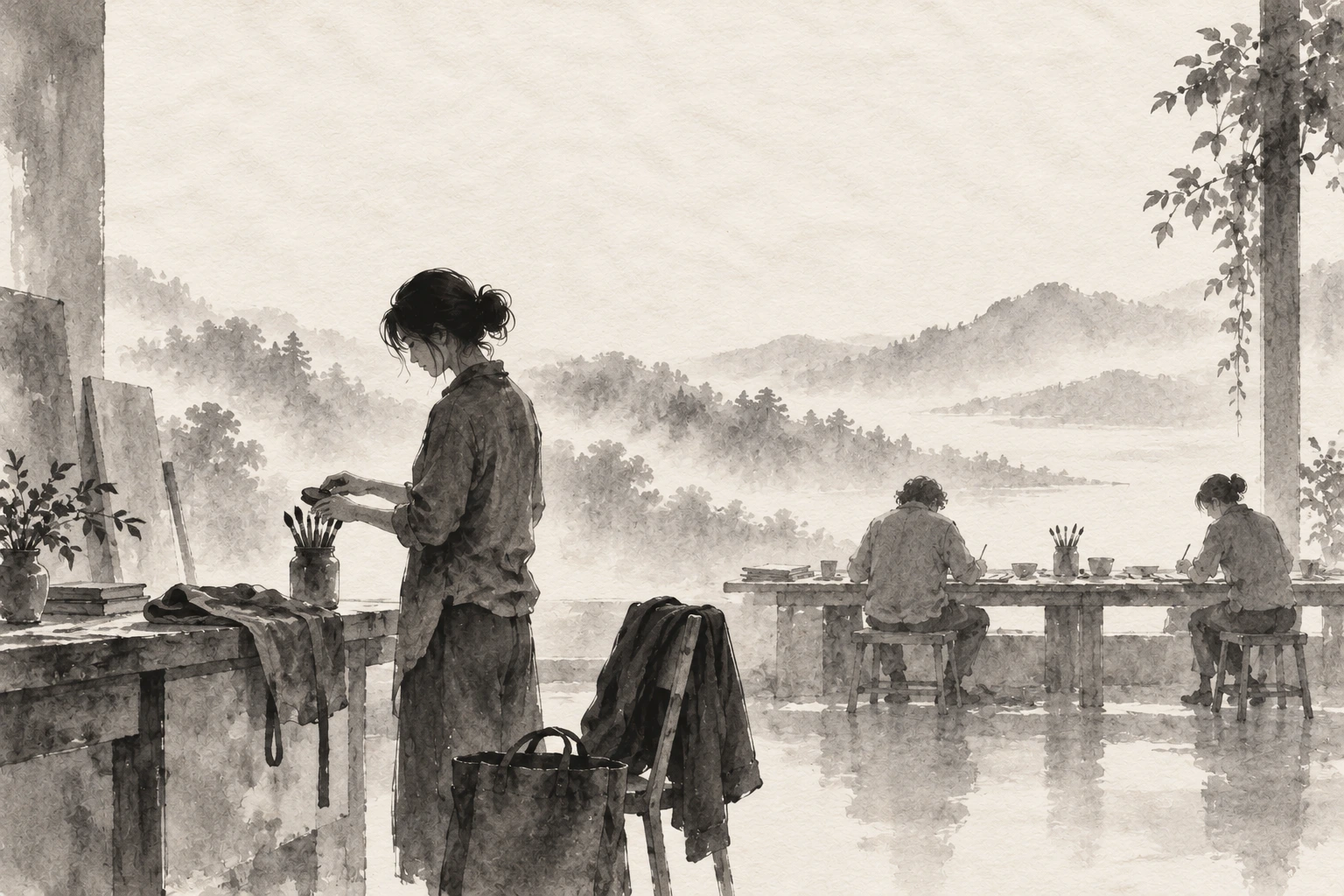
“a handful, with quietness” — Ecclesiastes 4:6, World English Bible British Edition. This is an image of proportion, not a rule about how much anyone must work or give.
What this article addresses
Helping at a meeting, returning to music, or making something with neighbours can offer connection and a rhythm to the day. The same activities can hide a new demand: “I am needed, so I cannot rest.” What matters is how the activity fits a particular life. Is there room for choice, sleep, food, care, dependants, and a genuine “not today”? Service, creativity, and participation can be supports. They are neither payment for human worth nor a treatment for substance use disorder by themselves.
Three kinds of source appear here: older ethical images of action and restraint, a group's account of its own volunteer roles, and research on specific interventions. They do different jobs. Finding meaning in an activity does not show that substance use is safe, an illness has ended, or everybody should follow the same path. Medical care, housing, safety, rest, and the right to decline do not have to be earned by becoming useful.
I. Being needed does not make a person obligated
Service might mean opening a room, listening, or setting out chairs. Creativity might be a song no one hears, a drawing, a recipe, or a repair made with someone else. Participation need not mean leadership, performance, or a public recovery story. These scales matter because “being useful” can become a verdict on a person: as though not helping today proved a lack of effort in recovery. It does not. A person can seek help before a first act of service, during a pause, and after giving up a role; service is not something they must do to deserve care.
Ecclesiastes 4 places toil beside quiet and asks who endless labour is for; later it depicts mutual support. This is not a universal instruction to work less. Some people must work to obtain food or shelter, and for others an activity helps the day move again. A better question is whether participation leaves enough for life, and what support could change the load if it does not. A relationship that supports someone must allow receiving as well as giving.
II. A group can offer a role, not a clinical outcome
On its service page, Recovery Dharma describes forms of participation such as showing up and listening, helping with a meeting, reading, and facilitating. This is one contemporary group's account of voluntary roles. Another meeting may differ in rules, language, access, or response to absence. The group's page does not test whether any participant's use or health changed because of taking such a role.
A person can ask what membership or agreement is expected, whether there is a fee, what the role involves, how to decline a shift, and who could take over when health changes. “No” is not ingratitude. Attending without a role is also participation. If someone promises that service replaces treatment, that promise is not medical evidence. When a meeting suits someone, it can sit alongside professional care without obstructing it.
III. What was observed among helpers, and why it is not a command
A secondary analysis of the US Project MATCH included 1,501 people with follow-up data after treatment for alcohol problems. At three months, 120 people, about 8%, reported helping others through sponsorship or Step 12 activity. After the 12-week active treatment period, helpers were less likely to have a first drink over the following 12 months; the outcome was time to first drink, not the frequency of drinking episodes. But participants were not randomly assigned to become helpers. Those already doing better or receiving more support may have found it easier to take on a role. Other life circumstances could influence both helping and the outcome.
This association raises a research question; it does not establish “become a sponsor and you will recover.” The sample was mostly male, the measure of helping was narrow, and the study concerned alcohol in a particular treatment context. It cannot be exported to all substances, creative activities, cultures, or people. Someone for whom helping is supportive may choose it. Someone for whom it is too much now has not thereby failed a test of motivation.
IV. Personal creativity is different from music therapy
Clay may occupy a person's hands, an instrument may bring a friend into the room, and writing may give shape to a day. That experience is real as the person's account, but it cannot be converted automatically into a diagnosis or clinical result. A 2022 Cochrane review examined something narrower: music therapy added to standard care for people with diagnosed substance use disorders in treatment settings. Across 21 randomised trials, the reviewers found possible short-term changes in craving and motivation for treatment, while several other outcomes remained uncertain. These were not trials of casual drawing or playing music at home instead of receiving care.
A creative activity can be small and private, shared without a diagnosis, and left unfinished. It can also create pressure to perform, sell, or turn suffering into an appealing public story. Declining to publish or explain a piece is a valid boundary. Creativity need not be marketable or clinically measurable to carry personal meaning; personal meaning is not proof of remission.
V. Three older images, with three different limits
In Edwin Arnold's poetic Bhagavad Gita, Chapter III, action is discussed together with one's relation to its fruits. This is a historical religious and philosophical work, not guidance on treatment of substance use disorder. It can invite reflection on judging every act by applause. Its language of duty must not be turned into an order that someone who is exhausted, coerced, or short of food and rest should work harder.
In Aristotle's Nicomachean Ethics I.7, one swallow does not make a whole summer: a single day does not settle an entire life. That image checks both “one good meeting cured me” and “one missed meeting erased everything.” It says nothing about an individual's clinical course. Ecclesiastes raises a question of measure and companionship. These are philosophical, biblical wisdom, and religious voices with different settings. Together they are neither a single clinical technique nor a universal duty to serve.
VI. When a useful role begins to consume the person
Hours alone do not locate the boundary. Paid work, volunteering, care for a relative, and creative work have different obligations and costs of refusal. A reason to revisit a role arises when it repeatedly displaces sleep, food, safe shelter, necessary appointments, time for dependent children, or the ability to say no. Debts and donations “for the cause” deserve attention too. This is not a home diagnostic checklist. Poverty, employment terms, or another person's control may leave few immediate choices. The question is what real options and support exist.
WHO's ICD-11 explanation confines the term “burn-out” to the work context and does not call it a medical disease. “Exhaustion” is more precise here than diagnosing every volunteer. If someone says “everything will collapse without me,” ask who allocates tasks and whether there is a substitute, rather than debating their character. If an organiser answers a request for a pause with shame, a threat of exclusion, or an instruction to hide problems, safety needs separate attention.
VII. Felt relief does not establish that a substance is safe
Someone may say, “Cannabis makes it easier to draw and socialise; therefore it is safe, and I have recovered.” The first part reports an experience. The conclusion does not follow from it. The US CDC cannabis FAQ describes effects that vary by person, product, and combination with other substances, as well as potential harms. It is a US risk source, not a worldwide legal rule or a diagnosis of this reader. Neither taking part in an exhibition nor being able to work after use establishes clinical remission or safety.
Equally, having meaningful activities does not turn a prescribed medicine into a “substitute addiction.” Substance use, prescriptions, adverse effects, and worries about them deserve assessment with a competent professional in the person's actual circumstances. There is no need to test willpower by stopping medication, experimenting with a substance, or disclosing one's history publicly. Valuable activities and a need for medical care can exist together.
VIII. Care and prescriptions do not await a perfect sense of purpose
The NHS page on alcohol-use disorder describes medical and social care and the risk of dangerous withdrawal for some people. “Stay busy instead of receiving treatment” is therefore unsafe advice; this article offers no home withdrawal or dose plan. The Royal College of Psychiatrists on stopping antidepressants helps distinguish physical adaptation from addiction: symptoms after stopping a prescribed medicine do not by themselves establish SUD. Discuss changes with the prescribing clinician, rather than making them a test of spiritual or creative discipline.
Finding suitable help may be hard because of waiting times, cost, language, travel, ways to make contact, care duties, service rules, and personal-data practices. A safe first contact with a local medical or social professional can clarify what is actually available, what information is needed, and what local confidentiality limits apply. No group, clinician, or public service can be promised to admit everyone immediately. When there is no emergency, an adult's participation in a group is their own decision; a relative can seek support for themselves.
IX. When to set aside the service discussion
New sudden confusion by itself calls for immediate contact with a local emergency medical service for assessment, without waiting for severe signs, sobriety, or a second symptom; the NHS sudden-confusion guidance supports this boundary. Suspected poisoning or overdose also calls for immediate contact with a local emergency medical service even before symptoms appear, as described by the NHS poisoning guidance. Work, rehearsal, and discussion of purpose can wait; an emergency medical response cannot. No home protocol, dose, or foreign telephone number is given here.
Threats, violence, or coercion call for a separate safe route to help and protection for the person and children, before a shared service discussion with the threatening person. The NHS domestic-abuse page describes danger in its UK context; it does not establish worldwide rights or local services. Children must not become monitors of substance use, interpreters, medicine keepers, comforters by obligation, or caregivers for an adult. If an adult cannot provide care, there must be an actually available capable adult or local emergency protection. A telephone answer is not supervision.
X. A negotiated load rather than a heroic feat
A helpful role can have a start, a limit, and a review. Imagine someone facilitating a meeting monthly and then noticing that it costs necessary treatment appointments and sleep. They need not prove they are “insufficiently recovered.” The shift can be handed over, reduced, or paused while they find out why care became inaccessible. If refusal is unsafe because of threats, financial dependence, or control by another person, “just set a boundary” is inadequate; safe outside support matters.
Another person writes music privately and declines to perform. The activity is no less valuable. A third can only attend and listen for now. A fourth helps a child but needs a real transfer of care to another capable adult in order to visit a clinician; the child must not arrange that transfer. The question is not “how much did you give?” but “what does this activity offer, what does it cost, and what remains for your safety and life?” Answers change over time. Taking a pause does not erase dignity.
What this means in practice
If there is room to choose today, name one activity you want to do and one boundary: an end time, a right to miss a session, a specific capable adult who could take over a task, or a way to participate without disclosing personal history. Then check ordinary needs: sleep, food, prescribed care, money for essentials, and actual care for children. If they are squeezed out, the aim is not to “earn more willpower” but to reduce the load and discuss available support. Before agreeing to a role, check the meeting's conditions, language, cost, travel, waiting, data rules, and how responsibilities can be transferred. Concerns about prescribed medication or substance use belong in a conversation with a competent medical professional, not a self-directed medication change.
This is an option, not a test of correct recovery. A person may choose rest, treatment, practical support, or solitary creativity. For medical or protection emergencies, use the separate route in section IX first. No tradition, organisation, or successful day guarantees an outcome. Participation is valuable when choice and real support remain available.
Key quotation
“one swallow does not make a summer” — Aristotle, Nicomachean Ethics I.7, translated by W. D. Ross. The short quotation limits what can be inferred from one day; it is not a medical criterion for remission.
Connections among traditions
- Ecclesiastes 4 and Aristotle I.7. The wisdom text observes toil without measure and mutual help. Aristotle cautions against judging a whole life by one day. They raise different questions: what a task costs now and what one good action cannot prove. Biblical imagery and a philosophical argument are neither one religious rule nor clinical evidence.
- Arnold's Bhagavad Gita and contemporary Recovery Dharma service. Chapter III of the poetic translation discusses action without fixation on its fruits; the modern group names concrete voluntary roles. The historical text does not set that group's rules, and its self-description does not establish treatment outcomes. Traditions and people may have different reasons to participate or decline.
- The map's boundary. Shared words such as “action,” “measure,” and “help” do not create a universal spiritual treatment. Illness, coercion, and lack of basic resources call for medical, protective, and social responses whether or not a person accepts any of these traditions.
Sources and limits
- World English Bible British Edition, Ecclesiastes 4: marked public domain on the page; page date not established. Verses 4:4–12 were read; short epigraph from 4:6. Wisdom imagery, not clinical guidance.
- Aristotle, Nicomachean Ethics I.7, W. D. Ross: ancient text and named translator; web-edition date not established. Short located key quotation, not a SUD outcome study.
- Bhagavad Gita, The Song Celestial, Edwin Arnold, Chapter III: poetic 1900 edition, Gutenberg 2000/2013; brief original account of a chapter segment, not a claim for all Hindu schools or a treatment method.
- Recovery Dharma, Service: group's own page, page date not established, footer CC BY-NC 4.0; brief original description only, not a commercial translation licence or efficacy evidence.
- Pagano et al., Project MATCH secondary analysis: 2004 US study, 1,501 with data, 120 helpers under a narrow measure. Helping was not randomised; selection and reverse causation remain possible.
- Cochrane, Music therapy for people with substance use disorder: review published 9 May 2022, search through 1 February 2021; 21 randomised trials of added music therapy in care settings, not any creative activity.
- WHO, burn-out in ICD-11: official explanation, page date not established; occupational scope of the term, not a volunteer's diagnosis.
- CDC, Cannabis Frequently Asked Questions: US overview updated 31 January 2025; a felt effect does not establish general safety, and US regulation is not a worldwide rule.
- NHS, Alcohol-use disorder: UK page reviewed 24 April 2026; withdrawal risks and routes to care, not a universal SUD regimen.
- Royal College of Psychiatrists, Stopping antidepressants: UK professional material published March 2024; physical adaptation versus addiction, no stopping schedule.
- NHS, sudden confusion: UK page reviewed 28 May 2024; new sudden confusion alone requires immediate medical assessment.
- NHS, poisoning: UK page reviewed 12 June 2025; urgency on suspicion even before symptoms, without exporting a UK number or home protocol.
- NHS, domestic violence and abuse: UK page reviewed 23 June 2026; separate safety route for threats, not worldwide rights or local service access.
Only two short verified quotations and brief original syntheses are used; no full modern pages, abstracts, tables, forms, or scales are reproduced. Ethical and community sources do not prove treatment effects. Clinical expert, native Thai, local legal, and human review have not been run.
Tags
service, creativity, participation, exhaustion, boundaries, mutual aid, music therapy, evidence, substance use disorder, medical care, child safety, dignity
About the authors
Andrey Zarinsh — author and founder of United Wisdom. He explores inner transformation, the unity of traditions, intercultural dialogue, and contemporary spiritual discipline. Instagram: @andrey.zarinsh.
Maria Evilkut — co-author of United Wisdom. Alongside her research, she seeks to test these ideas in practice and observe how principles of unity and mutual understanding work in real life between people and cultures. Instagram: @ilkutki.
Content date
15 October 2026. English version.