
Acute situations and safety
Severe Withdrawal from Alcohol and Sedative Medicines
If someone suddenly becomes confused, contact local emergency medical services immediately. New sudden confusion alone is enough; do not wait for a seizure or “severe” disorientation.
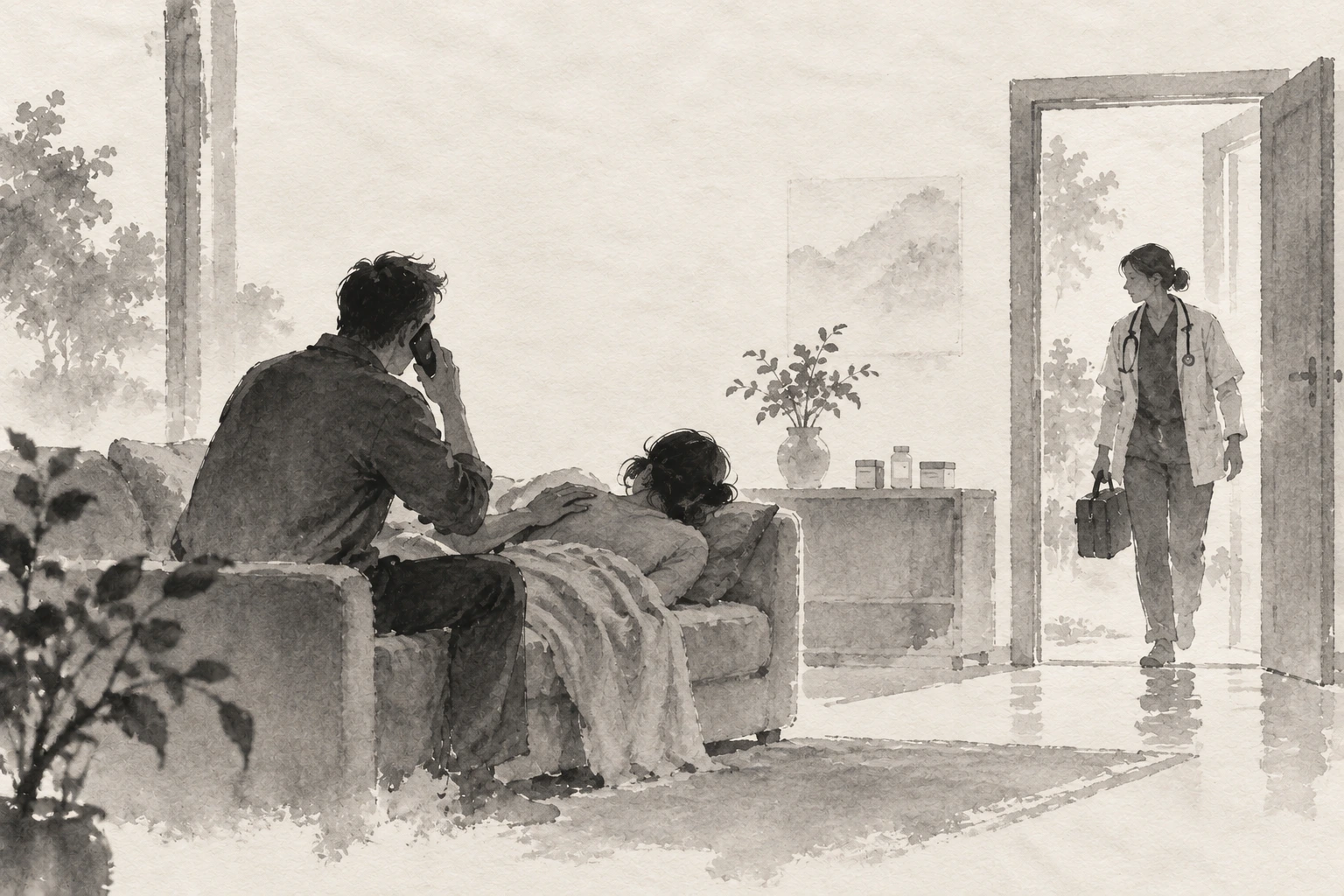
If someone suddenly becomes confused, contact local emergency medical services immediately. New sudden confusion alone is enough; do not wait for a seizure or “severe” disorientation. If poisoning is suspected, make that contact immediately even if no symptoms have appeared. Seizures, breathing difficulty, delirium, or hallucinations in a possible withdrawal situation also require immediate contact with local emergency medical services. Conversations about willpower, a routine appointment, and the questions in this article come after the emergency contact, not in its place.
I. When “just stop” becomes a medical question
A person may have good reasons to want to stop drinking or taking a prescribed sedative. The risk does not make that wish wrong. It changes how to act: where physical adaptation may have developed, abrupt stopping or rapid change can cause withdrawal and, for some people, dangerous deterioration. The NHS warns about this in relation to alcohol. Previous symptoms when cutting down, other illnesses, and other medicines matter in a conversation with a clinician before a planned change. Neither someone's story nor the present absence of symptoms lets an article guarantee a safe home route.
Alcohol, benzodiazepines, and Z-drugs are not interchangeable names for the same thing. They may be involved in different medical situations and have different reasons for prescription or use. Do not substitute one for another, recalculate doses yourself, or seek one shared withdrawal schedule. If there is no immediate danger, an appropriate first contact is the prescriber or a current local medical service that can assess risk and the available level of observation.
II. Physical adaptation is not an addiction diagnosis
The body can adapt to a regularly taken substance. Symptoms after rapid stopping show that the change needs attention; they do not by themselves establish a substance use disorder. In its 23 September 2020 benzodiazepine warning, the FDA discusses therapeutic use, physical dependence, misuse, and addiction separately. A prescribed medicine's benefit does not disappear because stopping it needs planning; its risks do not vanish because the prescription is legitimate.
Changing treatment is not a test of whether someone has a “real addiction.” A clinician considers the original reason for treatment, current benefit and harm, other illnesses, combined substances, past reactions, and the person's preferences. The ASAM benzodiazepine-tapering landing page describes change under clinical supervision when physical dependence is likely. It addresses clinicians; it does not give the reader a dosing plan.
III. Alcohol withdrawal cannot be judged from one detail
When a person is physically dependent on alcohol, abrupt stopping can be dangerous. Anxiety, sweating, or poor sleep may occur during withdrawal, but they do not let a family measure a safe limit at home. Seizures, new confusion, and hallucinations in the relevant context require urgent medical attention. Another illness, an injury, or poisoning may also explain deterioration; its cause cannot be read from appearance alone.
The WHO addresses alcohol-withdrawal delirium as a distinct clinical problem, not a home test of resolve. ASAM notes that withdrawal management is part of entering care for alcohol use disorder, not the whole treatment. That distinction matters after the immediate danger has passed: the person may need ongoing assessment and support, not only to survive a few days.
IV. Prescribed sedatives: benefit, risk, and a conversation before change
Benzodiazepines can be useful for particular indications, but the FDA warns that rapid reduction or abrupt stopping after regular use can cause severe withdrawal, including seizures. It also says there is no safe schedule that fits everyone. This is a reason to contact the prescriber, not to divide tablets according to a general chart or use someone else's medicine.
In January 2026, the UK regulator MHRA strengthened warnings for Z-drugs as well, while acknowledging the value of prescribed treatment for many patients. Using zopiclone as a specific example, the NHS advises against stopping suddenly and recommends talking to a doctor. One example does not establish identical withdrawal severity for all sleeping medicines. If several substances are involved, tell the clinician; do not decide at home what to take to “cover” withdrawal from another.
V. Emergency care does not wait for the cause to be known
The NHS states that new sudden confusion alone needs immediate medical help and can have many causes. There is no need to decide first whether withdrawal, use, a medicine, infection, or injury caused it. Seizures, breathing difficulty, delirium, or hallucinations during possible withdrawal also call for immediate contact with local emergency medical services. If poisoning is suspected, the NHS warns that symptoms can start later: contact local emergency medical services immediately, even before symptoms.
When calling, briefly report what you have observed: what changed and when, which medicines or substances are known, whether there was an injury, and who is present. Do not wait for a complete list, a confession, or an exact diagnosis before calling. A confused or unwell person should not drive. The local service can direct the next medical step; its number and access rules depend on where you are.
VI. A planned route starts before abrupt stopping
If there is no immediate danger but someone wants to stop alcohol or a prescribed sedative, contact the prescriber or an accessible local medical service before a rapid change. Share more than a substance's name: prior symptoms after changes, other medicines, illnesses, and the real conditions under which monitoring could take place all matter. A clinician can decide what assessment and level of care are needed; this article cannot decide whether home care is appropriate.
Turn the first contact into a real appointment: does the service see this age group; is the needed language or safe interpretation available; what do the visit and journey cost; when can the person be seen; is there an out-of-hours route; what documents are needed; how are data and consent handled; whom should they contact if their condition changes? “Here is a number” and “you are on a waiting list” are not clinical observation. If the first route is unavailable, ask a local professional about another actual option without assuming that one is guaranteed.
VII. What a relative can do, and must not be asked to do
A relative may help make a call, prepare a list of prescribed medicines for the clinician, offer a ride, or stay nearby if it is safe and the person agrees. They do not have to diagnose and should not impose a home withdrawal, dispense doses, or replace medical observation. Help does not require a full admission of the problem, perfect readiness, faith, or a promise of sobriety. If there are threats or violence, seek protection through a separate safe channel before any joint conversation.
A child must not monitor symptoms, interpret an adult medical discussion, hold medicines, or care for the adult. If a parent or another adult needs urgent help, do not delay the emergency call to arrange ordinary logistics; tell the service about the child and make sure a capable adult is actually with them. A booking, phone number, or promise that someone will come is not care.
VIII. Five optional questions for a professional conversation
These questions can help prepare a conversation. They give no score, diagnosis, or permission for home detox. Use only those that help; in danger, make the emergency contact first.
- What exactly do I want to change, and who currently oversees my prescribed treatment?
- Have symptoms followed earlier changes in alcohol or medicines that I should describe, and what other illnesses or medicines should the clinician know about?
- Which local contact can actually see someone of my age and language today, and who can confirm an appointment?
- What should I do if my condition changes before the appointment, and how do I reach local emergency services?
- Who will actually care for a child or another person who depends on me if I need medical help?
Relatives must not turn the answers into a threshold for deciding that things are “bad enough.” Even if none of these signs is apparent, a professional assesses risk. Emergency care does not depend on completing the questions.
IX. After stabilization
Getting through the acute period does not prove that no further help is needed. A person can discuss continued care for the original condition, support for a substance use disorder, sleep, mental health, and social circumstances with a clinician. The chosen path may change with the person and the services available. The boundary remains: one article cannot promise safe withdrawal, and help need not wait for “enough” willpower.
Sources and limits
- NHS, Alcohol-use disorder: UK patient page reviewed 24 April 2026; alcohol-withdrawal warning, not a home protocol.
- WHO, Treatment of alcohol withdrawal delirium: narrow [2012] recommendation with a linked mhGAP publication label of 24 June 2019; not a general regimen.
- ASAM, Alcohol Withdrawal Management: US professional landing page, site ©2021; full guideline PDF not read.
- FDA, benzodiazepine boxed warning: US regulator communication, 23 September 2020; not an individual schedule.
- ASAM, Benzodiazepine Tapering: professional landing page for a 2025 guideline; full PDF not read.
- MHRA, strengthened warnings: UK regulator press release, 8 January 2026; not a comparison of medicines.
- NHS, Zopiclone: patient page about one medicine, reviewed 22 June 2026; not a finding about every sedative.
- NHS, Sudden confusion: patient page reviewed 28 May 2024; new sudden confusion alone calls for immediate medical help.
- NHS, Poisoning: patient page reviewed 12 June 2025; immediate contact even before symptoms.
Tags
alcohol withdrawal, sedative medicines, benzodiazepines, Z-drugs, physical adaptation, withdrawal symptoms, medical assessment, emergency care, seizures, sudden confusion, child safety, access to treatment
About the authors
Andrey Zarinsh is the author and founder of United Wisdom. He explores inner transformation, the unity of traditions, intercultural dialogue, and contemporary spiritual discipline. Instagram: @andrey.zarinsh.
Maria Evilkut is a co-author of United Wisdom. Alongside her research, she seeks to test these ideas in practice and observe how the principles of unity and mutual understanding work in real life among people and cultures. Instagram: @ilkutki.
Content date
15 October 2026. English version.