
Prevention and supportive environments
Accessible Communities and Activities
If someone develops new, sudden confusion, contact the local emergency medical service immediately. This sign is enough on its own; do not wait for other symptoms. If poisoning is suspected, make that contact at once, even before symptoms appear.
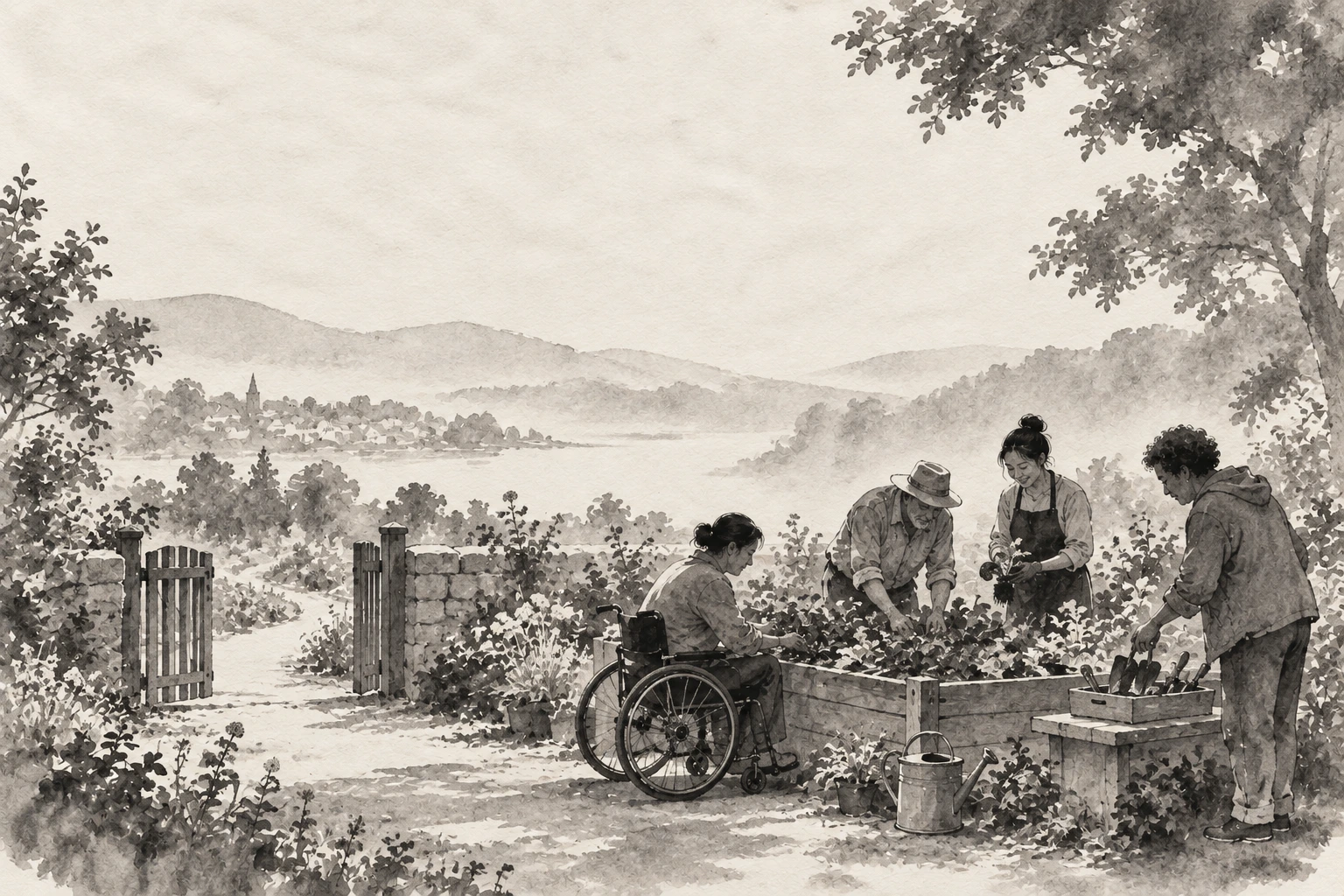
If someone develops new, sudden confusion, contact the local emergency medical service immediately. This sign is enough on its own; do not wait for other symptoms. If poisoning is suspected, make that contact at once, even before symptoms appear. A group meeting, the journey there, and discussion of its rules can wait. At ordinary times, being with people and taking part in a manageable activity may broaden life for someone with few safe options. An invitation is not actual participation, however, and participation does not replace medical care.
I. Belonging Without a Promise of Cure
Supportive connection is more than the number of contacts on a phone. What matters is whether someone can attend without humiliation, find reciprocity, and keep their own boundaries. The CDC describes social connection in terms of varied roles, relationship quality, and felt support; possible settings include neighbourhood spaces, work, recreation, and places of worship. This broad health page does not show that every activity, sport, or new group prevents or treats substance use disorder.
One person may prefer a workshop, library circle, or walk; another may prefer a mutual-help meeting, a quiet online activity, or a religious community by choice. Faith, public disclosure, complete abstinence, or readiness to explain one's past must not be an entry condition for professional care. The WHO and UNODC joint programme presents dependence care as part of health and social support, including community-based work. That is an institutional aim, not a promise that a particular venue already has the needed professionals.
II. A Suitable Format, Not a “Correct” Group
A group may offer familiar faces and a regular rhythm, but rules and atmosphere vary. In its long-term support guidance for alcohol problems, NIAAA gives secular and spiritually oriented examples and notes that mutual-help groups are usually not run by clinicians. These are US examples focused on alcohol, not a directory of services in every country or a clinical guarantee.
It helps to name the purpose: meeting people, a quiet activity, help with daily tasks, support from people with similar experiences, or treatment by a professional. These aims may coexist without being interchangeable. A difficult first visit does not prove someone is “not ready” for people. Time, language, a crowded room, noise, disability, anxiety, past humiliation, and lack of money may be real barriers. A smaller, remote, or differently run place may fit better without interrupting medical care.
III. Check Access Before Travel and Payment
Choose one currently operating local venue and find its up-to-date public contact. Ask the person responsible when and where it actually meets, what participation costs and whether concessions exist, whether entry requires approval, what language is used and whether interpretation is available, and whether the room or online format works for mobility, hearing, or vision needs. Check transport time and the journey home, whether a visitor may simply listen and leave without explaining, and what data and consent are requested. For a child, check age conditions and which responsible adult will be present. “Community” does not itself mean free or accessible.
An enquiry, a coordinator's reply, registration, attendance, and a genuinely safe relationship are five different events. Contact does not confirm a place. An invitation does not mean unconditional acceptance; a promise of support does not mean a meeting happened. Similarly, NIAAA describes medical referral as a process in which cost, logistics, and availability can prevent an actual appointment. Its guidance is for US clinicians dealing with alcohol; local services need fresh checking.
IV. Consent, Boundaries, and a Safe Exit
Before sharing a personal history, ask who can see messages, photographs, and participant lists, whether you can speak without recording, and how you can delete your data or stop attending. Do not assume absolute secrecy: confidentiality, reporting, and protective rules differ by place and format. Warning signs include compelled confession, shaming, demands for documents, money, or medicines, pressured purchases, a ban on contacting clinicians, or threats on leaving. Pause and discuss the situation through a separate safe contact rather than secretly investigating or arguing with someone threatening you.
If there is violence or immediate danger, use a separate safe protection route before any joint conversation with the person causing harm. Voluntary participation must include a real possibility of declining or leaving without losing food, housing, treatment, or care. Check local law, organiser duties, and an available protection contact; this article offers no universal legal guarantee. Do not make a child a translator, monitor of an intoxicated adult, medicine keeper, or group messenger.
V. Community Alongside Treatment
Social support can sit alongside professional help. A poorly fitting circle does not cancel the option of seeing a clinician, and professional care should not depend on joining a group first. For people with alcohol use disorder, NIAAA distinguishes mutual-help groups from clinician-led treatment. Even a sincere, experienced group leader should not prescribe medicines or direct home withdrawal. Prescribed treatment and physical adaptation do not automatically mean addiction. Abrupt stopping can be dangerous with physical dependence on alcohol; the NHS recommends medical contact before stopping. Do not change doses or stop prescribed medicines on your own.
If someone's condition changes suddenly, act before any gathering. The NHS sudden-confusion guidance calls for immediate medical assessment without another severity threshold, while its poisoning guidance calls for urgent contact on suspicion even before symptoms. Contact the local emergency medical service; a group or a volunteer's ride is not that route. If a caregiver is currently unable to keep a child safe, another capable adult who is actually present must take over. A service number or future booking is not supervision.
VI. A Small Step You Can Verify
Five optional questions can help without scores or self-diagnosis: “What kind of activity is manageable for me now?”, “Is there one safe person for the first contact?”, “What will it take in money, language, accessibility, and transport?”, “Which personal details am I willing to share?”, and “How can I leave if it becomes unsafe or simply does not fit?” Answers may change; not being ready to answer never disqualifies anyone from help.
Call or write through the chosen current contact, obtain the conditions, and check that the meeting will actually take place. If needed, separately ask a local medical or social professional about age rules, cost, waiting time, language, consent, and data handling. After a visit, consider whether promised conditions were met, whether returning is safe, and whether another form of support is needed. If it did not fit, seek another option. Belonging should not become another endurance test before treatment.
Sources and Limits
- CDC, Social Connection, 15 May 2024 — US overview of relationship quality and places for connection; not a trial of groups as addiction treatment.
- WHO, Joint UNODC/WHO Programme on Drug Dependence Treatment and Care — international programme page on health and community care; page update date not established, full 2020 standards not read.
- NIAAA, Long-term Recovery Support — US alcohol-focused consumer guidance with mutual-help examples; page date not visible, local group availability unverified.
- NIAAA, Make Referrals: Connect Patients to Alcohol Treatment That Meets Their Needs — US clinician guidance on tailored referrals and barriers to actual appointments; page date not visible.
- NHS, Sudden confusion, reviewed 28 May 2024 — UK urgent route; use a local emergency contact.
- NHS, Poisoning, reviewed 12 June 2025 — UK urgent route for suspected poisoning.
- NHS, Alcohol use disorder, reviewed 24 April 2026 — UK material on physical dependence and abrupt-stopping risk.
Tags
community, belonging, accessibility, activities, mutual help, recovery, safety, consent, disability, language, local support, boundaries
About the Authors
Andrey Zarinsh — author and founder of United Wisdom. He explores inner transformation, the unity of traditions, intercultural dialogue, and contemporary spiritual discipline. Instagram: @andrey.zarinsh.
Maria Evilkut — co-author of United Wisdom. Alongside her research, she seeks to test these ideas in practice and observe how principles of unity and mutual understanding work in real life between people and cultures. Instagram: @ilkutki.
Date
15 October 2026, Bangkok.