
Ageing, self-image and dignity
Appearance after Change: an Ageing Body and Recognising Yourself
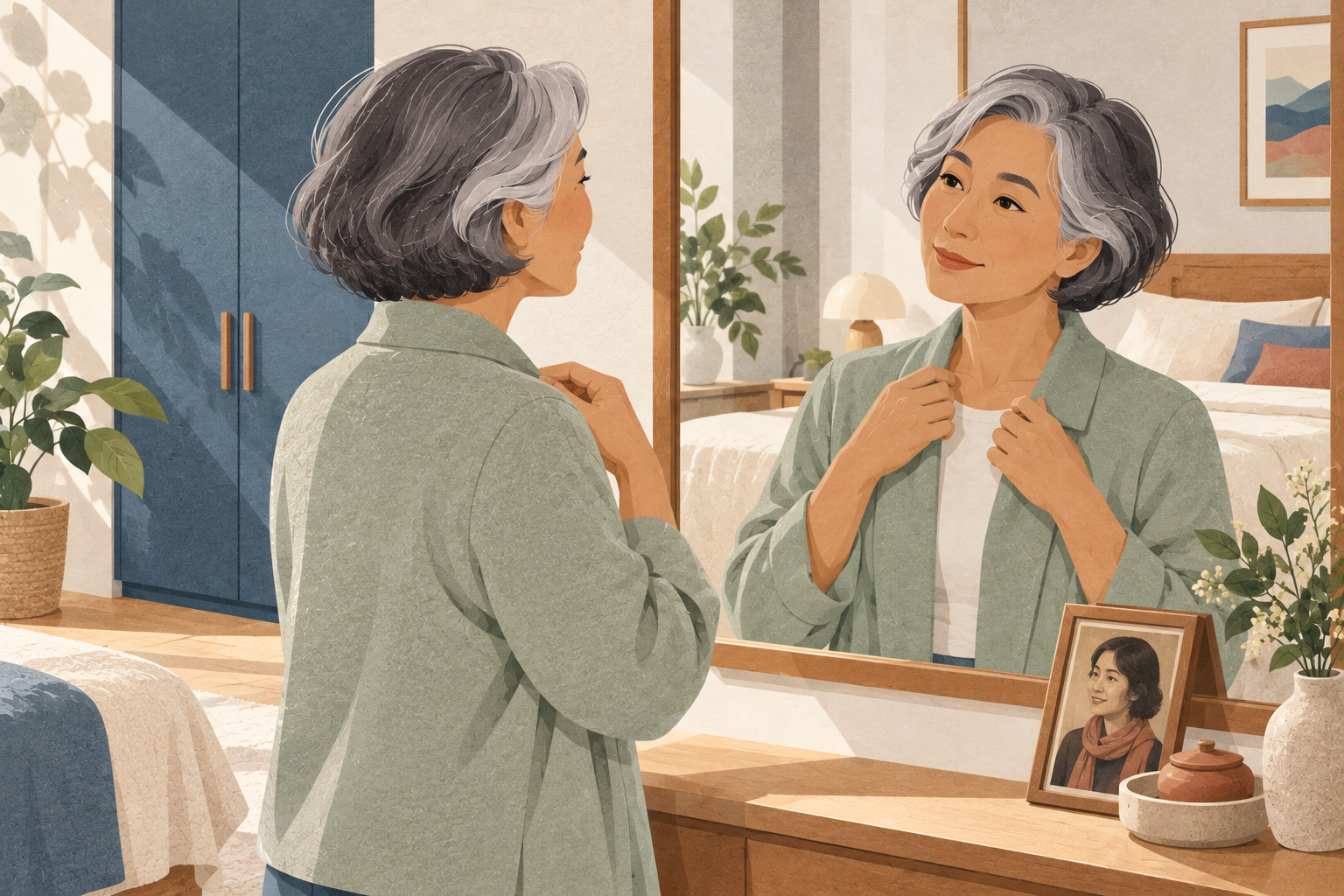
Someone opens a photograph taken three years ago and pauses over their own face. Their hair was different then, their cheeks had another outline, and they wore the familiar smile they used for the camera. Today's reflection does not seem entirely foreign, yet a brief bewilderment appears: when did I begin to look like this? The change may have been gradual or noticeable within a single season. It may have been…
Epigraph
“All things move.”
Plato, Cratylus, 402a: Socrates reports words of Heraclitus; Harold N. Fowler's translation, 1921. The Russian version uses our own editorial translation of this short fragment. [S2]
What this article is about
Someone opens a photograph taken three years ago and pauses over their own face. Their hair was different then, their cheeks had another outline, and they wore the familiar smile they used for the camera. Today's reflection does not seem entirely foreign, yet a brief bewilderment appears: when did I begin to look like this? The change may have been gradual or noticeable within a single season. It may have been wanted, inevitable, or connected with a difficult experience. Change itself does not tell a person how they must feel about it.
This article considers recognizing yourself after changes in appearance. Resemblance to an earlier image, present bodily experience, and an evaluation of what you like need to be distinguished. You can recognize yourself without liking a particular change; you can welcome a change without having grown accustomed to it. We will not infer character from a face or demand gratitude toward the body. Through hypothetical everyday scenes, a limited research distinction, and a philosophical image of change, we examine living with your current appearance without turning an old photograph into the sole document about yourself.
This article also examines gradual age-related changes, visible disability, and being spoken past. Ageing is not equated with disability; appearance and needing assistance do not reveal someone’s preferences.
I. Recognition need not begin with approval
Recognizing a change and approving it are different actions. When they are confused, every unpleasant feeling before a mirror begins to resemble a rejection of oneself. An extra demand then appears: before choosing clothes and leaving home, you must learn sincerely to love everything you see. An ordinary day cannot always wait for that agreement. A more precise description is available: my face has changed, that is difficult for me at present, and today I need a convenient way to get ready.
Imagine a woman noticing a gray strand in a photograph for the first time. She need not immediately see beauty, wisdom, or loss in it. Observation can first be separated from evaluation: the strand became visible in this lighting; I was surprised; I want to decide whether to leave it or color it. The last question concerns choosing an appearance. It does not require simultaneously deciding whether aging in general is good or whether she is accepting her life with sufficient dignity.
Recognition sometimes arises in details that look unimportant to an observer. Someone notices a familiar hand gesture, the way they tilt their head while reading, or their amusing attempt to keep their glasses in place. These details can connect past and present, but must not become another compulsory list defining proper identity. No comforting sign may appear today. An inability to feel continuity immediately does not establish that it has disappeared from every relationship, decision, and activity.
The scale of the conclusion matters here. Disliking your present face in one photograph does not mean that you can no longer be yourself anywhere. Yet a declaration of an unchanging inner essence does not cancel the real experience of losing a familiar appearance. This article holds both sides: an external change can matter, and its significance need not swallow the entire account of a life. Between denying change and delivering a final verdict, room remains to become acquainted with what has actually changed.
Gradual age-related changes may supply no single before-and-after moment. Photographs can reveal a difference before words are found. No deadline for liking the reflection follows. Nor can every new change be explained by age: medical questions remain separate. This concerns becoming acquainted with present appearance, rather than establishing the cause of a change.
II. Reflection, sensation, and another's gaze show different things
Appearance is available to a person in several forms. A mirror shows a surface from a particular viewpoint. Clothing supplies information about fit, movement, and comfort. Another person's remark adds their observation or evaluation. These pieces of information can concern the same body without providing the same measure. A photograph in which someone looks unfamiliar does not by itself reveal how comfortable walking down the street feels or whether they enjoy a chosen fabric.
After a change in figure, someone may continue buying their usual size. Irritation appears in the fitting room: this garment used to fit differently. Two questions sit alongside one another, however. Has the garment or body changed? Does the garment fit now? Answering the second need not wait for a final answer to the first. Another cut can be chosen, shoulder movement and sleeve length checked, without turning a fitting into a trial about what the body should have remained forever.
A new haircut provides another example. Friends insist that it looks excellent, while the person feels an unfamiliar exposed ear, rests their head differently on the pillow, and automatically reaches for the former length of hair. Other people's positive evaluations do not eliminate those sensations. Growing accustomed to an image and learning new everyday movements may proceed at different speeds. There is no need to decide which side alone is real. They answer different questions about experience.
Separating measures also helps when requesting assistance. Rather than asking whether you look good overall now, ask someone to check something specific: whether a mark shows on your clothes, whether the collar closes comfortably, or whether the mirror is conveniently positioned. This request does not prohibit discussing beauty. It moves part of the choice from an indefinite overall ranking into a task another person can actually understand. Appearance remains significant without having to be evaluated in its entirety whenever a simple practical answer is needed.
III. An old photograph preserves a moment rather than setting a standard
A photograph preserves a particular moment of life. When it becomes a mandatory model for present appearance, its role changes: evidence becomes a demand. The picture usually does not show that period's entire cost. Preparation time, exhaustion, the relationship with the photographer, selection of a successful frame, and everything outside the frame remain unrecorded. This is no reason to suspect every beautiful photograph of deception. It is a reason not to demand that today's morning coincide with its whole motionless composition.
Imagine a man comparing a holiday portrait with his reflection before a work meeting. One involved a day off, a walk, sunshine, and a successful turn of the head; the other involves an early morning and an overhead lamp. Even if appearance really has changed, comparison adds different conditions to that change. Both facts can be named separately. The question about present appearance then becomes more precise, and the photograph stops serving as proof that his entire earlier life was better.
In Cratylus, Socrates reports an image of movement attributed to Heraclitus. Here we use only that brief image, rather than Plato's complete doctrine or a theory of bodily identity. [S2] Our editorial task differs: notice that demanding resemblance to an earlier frame includes stopping time, something the frame itself cannot provide. It can recall an important period without deciding how present appearance should be treated.
An earlier image can be retained without a duty to reproduce it. It may preserve a trip, a person standing beside you, favorite clothing, or a feeling of freedom. If walks were what mattered, perhaps a walk can be recovered rather than the face of that age. If a particular style mattered, its present version can be chosen. This distinction guarantees no relief. It reveals which part of the past someone wants to continue and which part belongs to elapsed time rather than an unfinished task today.
IV. Measuring body image does not define a person's entire history
Body image can become a research subject, but a research instrument and an account of your own life have different scopes. In their 2001 work, Hopwood and colleagues developed a body-image scale for patients with cancer. The complete abstract was read for the original editorial research on 5 October 2026, rather than the full paper; we neither transfer this instrument to the reader nor invite them to complete it. [S1] Recognizing that limited research domain suffices here, while the following discussion remains independent editorial analysis.
In a hypothetical scene, someone faces questions after a visible change that are difficult to reduce to one evaluation. They choose clothing for a meeting, decide whom to tell about the circumstances of the change, and discover that an acquaintance's old joke now hurts. These tasks are connected but require different decisions. A comfortable shirt does not answer a question about control over personal information; a calm conversation does not determine a preferred way of being photographed. No overall score is needed to distinguish each task's destination.
It can be tempting to give your attitude a final name: I have accepted myself, or I do not accept myself. Such a formula can be a personal expression but is often too broad for a particular action. Someone can comfortably go to work while avoiding cameras. They may love a new hairstyle yet find another's remark difficult. They may have become accustomed to the mirror without wanting to discuss it yet. These combinations need no immediate judgment as contradictory or wrong.
It therefore helps to specify where difficulty arises. Before the mirror in the morning? In conversation with a particular person? While selecting clothes? In comparison with a past photograph? This precision preserves the seriousness of the experience while reducing unnecessary conclusions about the whole person. When a question has medical content, this text does not establish its cause or solution. Yet an everyday observation need not wait for a complete theory either: the location of difficulty can be named and an action selected that concerns it specifically, without granting research authority to describe your entire history.
V. Familiar objects may need reconsideration
Sometimes becoming acquainted with present appearance begins with objects. Glasses, a collar, a comb, a mirror, and a chosen camera angle once supported a convenient daily routine and now work differently. Every inconvenience may feel like fresh evidence of personal wrongness. Yet an object has its own construction, size, and purpose. If it no longer fits, choosing an appropriate object may be the task, rather than identifying a moral defect in its intended user.
Imagine someone keeping a festive suit as a promise to return to their previous figure. They need not immediately give it away or demonstrate liberation from the past. First, its present role can be decided. Is it a memory? Something for an actual upcoming event? A possible alteration project? When roles merge, each glance at the hanger repeats an indefinite demand. Naming its role makes a next step available: retain it as a keepsake, investigate alterations, or choose clothing for the scheduled evening.
This choice has a material side. We cannot assume that someone can easily replace a wardrobe, find the right size nearby, or afford custom tailoring. Possibilities depend on budget, place, time, and what is available. A request simply to choose what fits can therefore be insufficient. Name the main inconvenience first and one available adjustment. Changing how existing items are combined has a different scale from buying a complete set.
Responsibility for an unsuitable environment must not be assigned entirely to the person either. If work clothing lacks a needed size, how uniforms are supplied becomes the question. If a meeting camera is poorly positioned, its arrangement can be discussed. Personal choice and the organization of space are considered together. Recognizing yourself must not mean silently tolerating every construction designed for another kind of body. Sometimes the most precise action concerns an object, rule, or environment rather than your own reflection.
Visible disability can change both appearance and everyday conditions. In a hypothetical scene, someone uses a mobility aid and chooses festive clothing. Fitting-room access, comfortable fit, and personal taste differ. Assistance with one does not transfer the others to a companion. Clothing cannot be promised to resolve inaccessible space. Disability is not presented as an inevitable result of ageing.
VI. Another person does not own the entire account of a change
A noticeable change in appearance sometimes prompts questions before someone is ready to answer. An acquaintance asks about weight, hair, or a mark on the skin as though visibility automatically grants access to the circumstances. Yet an observable feature and a right to its history are different things. You can acknowledge that a change is visible and keep some information private. You need not first prove that the other's question was malicious.
In a hypothetical conversation, someone replies: yes, my appearance has changed, and I do not want to discuss the reasons now. This sentence requires neither concealing everything nor declaring the other insensitive. It names an available boundary. If conversation is welcome, another subject can be offered: selecting clothes for a meeting, choosing photographs for an album, or what is convenient in a new routine. The boundary has a subject, so every exchange need not become an argument over other people's unrestricted right to know someone.
A compliment does not always address the right place either. Saying that someone looks better now can inadvertently devalue an earlier appearance or the difficulty of the change. This possibility does not make every compliment dangerous. Your reaction can be clarified and another way of addressing you requested. For example, hearing about a chosen color may currently be more welcome than discussing a change in body size. The other person receives an intelligible request rather than a duty to guess every private circumstance from a glance.
The right not to tell also remains within close relationships, although actual shared tasks may require discussion. If comfort during shared recreation, clothing for an event, or conditions for photographs have changed, those particular matters can be discussed. A personal account does not become payment for a simple agreement. Someone can agree which photograph may be published without explaining their entire relationship with their appearance. Such specificity leaves room for closeness built on chosen participation rather than compulsory disclosure of every visible change.
Social invisibility can coexist with scrutiny of appearance. An older visitor is discussed in their presence, while a helper is asked which photograph they prefer. Their body is noticed; their answer is skipped. WHO’s ageism Q&A distinguishes age-related ideas, attitudes, and action. [S3] This scene establishes neither motive nor unlawful conduct. Address the person and clarify wanted help. They may choose another picture, decline photography, or request a helper’s answer without proving vigour or beauty first.
VII. Continuity of life exceeds resemblance between two images
Photographic resemblance is only one possible way to notice the continuation of your life. Other ways concern relationships, activities, memory, decisions, and what you value now. These too change and supply no absolute proof of an unchanging core of personality. They do, however, prevent external resemblance from acquiring sole authority over whether someone remains themselves. Sometimes continuation appears in what someone chooses to do under new conditions.
Imagine a woman who, after a change in appearance, does not recognize her familiar festive portrait. Yet she continues meeting friends around the same table, preparing a familiar dish, and carefully selecting music. Those activities must not be used to cancel her experience. They show another set of information. Difficulty with the photograph and the continuing importance of the gathering can be named together. Neither needs to swallow the other for the account of present life to be coherent.
Continuity is no duty to repeat a former image. Someone may always have presented themselves through a particular hairstyle, clothing, or bearing and now want something else. That desire does not necessarily betray an earlier version of themselves. Memory of a previous choice can remain while today's choice changes. An album does not demand lifelong enactment of every page. Respect for the past is compatible with its once-convenient forms no longer fitting today.
Rather than seeking one definitive sign, ask what you want to continue, change, and leave unknown. Continue a friendship, change how you dress, leave undecided today whether every photograph pleases you. This answer is more modest than a complete philosophical formula but has a destination in life. It does not prohibit a later, deeper discussion of identity. It permits present actions to proceed without waiting for a flawless definition of precisely who looks out from the changed mirror.
VIII. Losing a familiar appearance need not have a beautiful explanation
An attitude toward change can contain sadness, relief, irritation, and interest together. No order needs to be assigned in advance through which someone must pass toward proper acceptance. It can be especially difficult when others offer a ready-made noble meaning: now you have learned to value what matters. Perhaps the person will one day describe the experience that way themselves. Another's formula, however, replaces neither their present attitude nor the inconvenience of loss.
In a hypothetical scene, someone misses their former hair while understanding the circumstances of its change. They need not prove that this matters more than health, relationships, or other parts of life. The significance of one loss does not require denying other values. A simpler statement is available: I miss that familiar appearance. It leaves room to discuss a specific experience without turning a wish to recover the familiar into evidence of superficiality or ingratitude.
Sadness must not be mandatory either. Sometimes a change is welcome immediately, and remarks about an inevitable crisis only interfere. Someone can enjoy their new appearance without seeking concealed rejection of the past. This article does not read true feelings behind an available self-description. Saying you like something is your report; describing mixed feelings likewise requires no correction for the sake of a pure image of maturity.
Room for different responses on different days helps. Today you want covering clothes; tomorrow your usual outfit is comfortable. This is not always a sequence of improvement or deterioration. Weather, company, the purpose of a meeting, and available energy may have changed. Accurate observation considers circumstances rather than turning every choice into an examination of self-regard. Change need not become a beautiful story before you can treat today attentively and avoid adding a demand to appear dignified even in your own account of a real difficulty.
IX. Appearance can change without globally rejecting yourself
Wanting to change appearance deserves its own examination. It cannot automatically be declared evidence of failing to accept yourself, just as refusing every change cannot automatically demonstrate freedom. One person colors their hair to enjoy a favorite color; another keeps gray hair for convenience; a third hesitates because expense and upkeep matter. Different outward decisions can rest on clear preferences, and identical decisions can have different grounds. This article chooses no universally correct appearance.
The counterexample matters to the entire argument. Someone recognizes their changed face yet really wants another style. Responding only with a call to accept the present can close an available choice. Recognizing the present supplies initial information rather than prohibiting action. What precisely someone wants to change, their expected result, and known decision conditions can be distinguished. The more substantial the consequences of a chosen procedure, the less a general philosophical remark in this article can decide them.
For small reversible decisions, a particular element can be considered. Try another color, change a parting, or choose a different angle for a personal photograph. None promises a better relationship with the body. They help reveal a preference within a bounded task. Afterwards someone may notice: the color pleases me, but the fabric is uncomfortable; the new hairstyle is enjoyable, but daily styling does not suit me. That result is more useful than declaring that a true appearance has finally been discovered forever.
A choice need not prove independence from everyone else either. People learn styles from others, consider an occasion, and want to be liked. The question is which grounds someone is prepared to recognize as their own now and what the choice's cost affects. An outfit can be chosen for a shared celebration without treating every social expectation as law. A remark can be declined while an interest in beauty remains. Between complete submission to external rankings and compulsory indifference to appearance, many specific, explainable ways of managing your appearance remain.
X. New acquaintance continues through ordinary actions
Becoming acquainted with changed appearance rarely reduces to one final look in a mirror. It can develop through actions: choose comfortable clothing, resolve a photograph question, set a boundary around comments, or notice a preference. Such actions do not guarantee that unfamiliarity will disappear. Their result is narrower: a particular part of today becomes clearer and more accessible. It need not be upgraded to complete acceptance or downgraded because an unpleasant feeling remains.
The person at the article's beginning may retain the old photograph and stop using it for comparison every morning. They may take a new picture in ordinary light without publishing it. They may put the camera aside altogether and choose clothing for a meeting. These options form no compulsory ladder. The choice depends on what actually makes life difficult now and which step belongs to the person. The right to pause does not mean refusing every possible action.
Name a small result beforehand to help check it. A garment permits free movement; a chosen photograph serves its specific purpose; an acquaintance understands the request not to discuss the reasons for a change. Each result has its own conditions. If a request is not heard, the problem does not automatically become insufficient acceptance of your body. If a photograph is disappointing, that does not cancel a successful clothing choice. Separate accounting prevents one step from having to solve every relationship with appearance at once.
Returning to yourself here means returning to available examination rather than restoring an earlier picture. The present can be noticed, the past retained, and a future attitude left unknown. Today's face need not look like a symbol of wisdom, victory, or defeat. It belongs to someone whose life continues through specific relationships and choices. Recognition becomes more precise when the question changes: rather than how closely I match an earlier image, what information about myself is available now and how do I want to handle it today?
What this means in practice
Choose one moderate episode in which present appearance became unfamiliar: a fitting, a photograph, or an ordinary look in the mirror. Record observation without a global verdict. What exactly is visible or felt? In which lighting, garment, or position? Name evaluation and feeling separately. No kind wording is required if it does not fit at present; simply avoid adding unknown causes and conclusions about the whole personality.
Clarify what the comparison concerns. A specific past photograph, a memory, another's image, or former comfort? Name the task the comparison helps resolve. If there are several tasks, separate them. Remembering a trip, choosing clothes, and wanting to be liked at a meeting need not receive one answer. An old photograph can remain a memory while present appearance is chosen separately for a particular occasion.
Choose an action addressing an available difficulty. Check another cut; ask to reposition a camera; clarify which photographs may be published; prepare a brief boundary for conversation. Consider budget, time, and others' participation. Do not choose a substantial medical or irreversible procedure as an experiment from this article: it evaluates neither indications, risks, nor consequences. The subject here is everyday examination of a moderate situation.
After acting, record a separate result. Is moving more comfortable? Has the way of discussing the subject changed? Was a photograph found for its specific purpose? An unpleasant feeling may remain without canceling what was achieved. If no result appeared, name the obstacle rather than another global accusation. This practice is editorial, with no established clinical efficacy. It need not end in loving every change to supply accurate knowledge of one available choice.
If difficulty concerns another’s conduct, separate it from self-regard. Ask to receive the question and identify wanted help. An ignored request proves no deficient acceptance. Essential assistance remains necessary; no unsafe confrontation is required under threat.
Key quotation
“All things move.”
The same short fragment of Cratylus, 402a, is deliberately revisited as an image of time, rather than an explanation of health or a prescribed attitude toward appearance. Harold N. Fowler, 1921; Russian translation by the editors. [S2]
Connections between traditions
| Comparison | Actual resemblance | Substantial boundary |
|---|---|---|
| Hopwood's research and editorial examination | External change is treated as a distinct subject of attention. | An oncology instrument does not measure an entire personal history and is not transferred to the reader. |
| The image of change in Cratylus and an old photograph | The image helps question a demand for immobility. | A dialogue's remark is no clinical theory of identity; the everyday conclusion belongs to the editors. |
| WHO on age-related treatment and the editorial photograph scene | Appearance, attitude, and an action skipping someone’s voice can be examined separately. | The definition decides no legal case; a philosophical change image does not remove environmental responsibility. |
Comparison retains different foundations: a research instrument, a philosophical remark, and independent examination of a scene do not prove one another.
Sources
-
S1. P. Hopwood, I. Fletcher, A. Lee, S. Al Ghazal. A body image scale for use with cancer patients. European Journal of Cancer 37(2), 2001, 189–197; DOI 10.1016/S0959-8049(00)00353-1. Complete abstract read in the primary PubMed search result; full paper not read.
-
S2. Plato. Cratylus, 402a. Plato in Twelve Volumes, Vol.12; Harold N. Fowler, 1921. Entire returned text of the selected section and edition metadata read in the primary search result; opening the page with the tool failed.
-
S3. WHO. Ageing: Ageism. Q&A28 April2025. Reuses complete main-text reading19 October2026 in AGE-003/S1. Narrow distinction of age-related ideas, attitudes, and actions; no numerical effects, diagnosis, or legal ruling.
Tags
Appearance, body image, change, self-recognition, photograph, mirror, clothing, gray hair, habit, memory, identity, bodily experience, comparison, personal preference, boundaries, comment, personal information, practical choice, continuity of life, past, present, observation conditions, dignity, autonomy, Plato, Cratylus, Hopwood, United Wisdom, ageing, visible disability, social invisibility, accessibility, accompaniment.
About the authors
Andrey Zarinsh is the author and founder of United Wisdom. He explores inner transformation, the unity of traditions, intercultural dialogue, and contemporary spiritual discipline. Instagram: @andrey.zarinsh.
Maria Evilkut is a coauthor of United Wisdom. Alongside her research, she seeks to test these ideas in practice and observe how principles of unity and mutual understanding work in real life between people and cultures. Instagram: @ilkutki.