
Memory, dementia and participation
Forgetfulness, cognitive changes and dementia: what cannot be settled at home
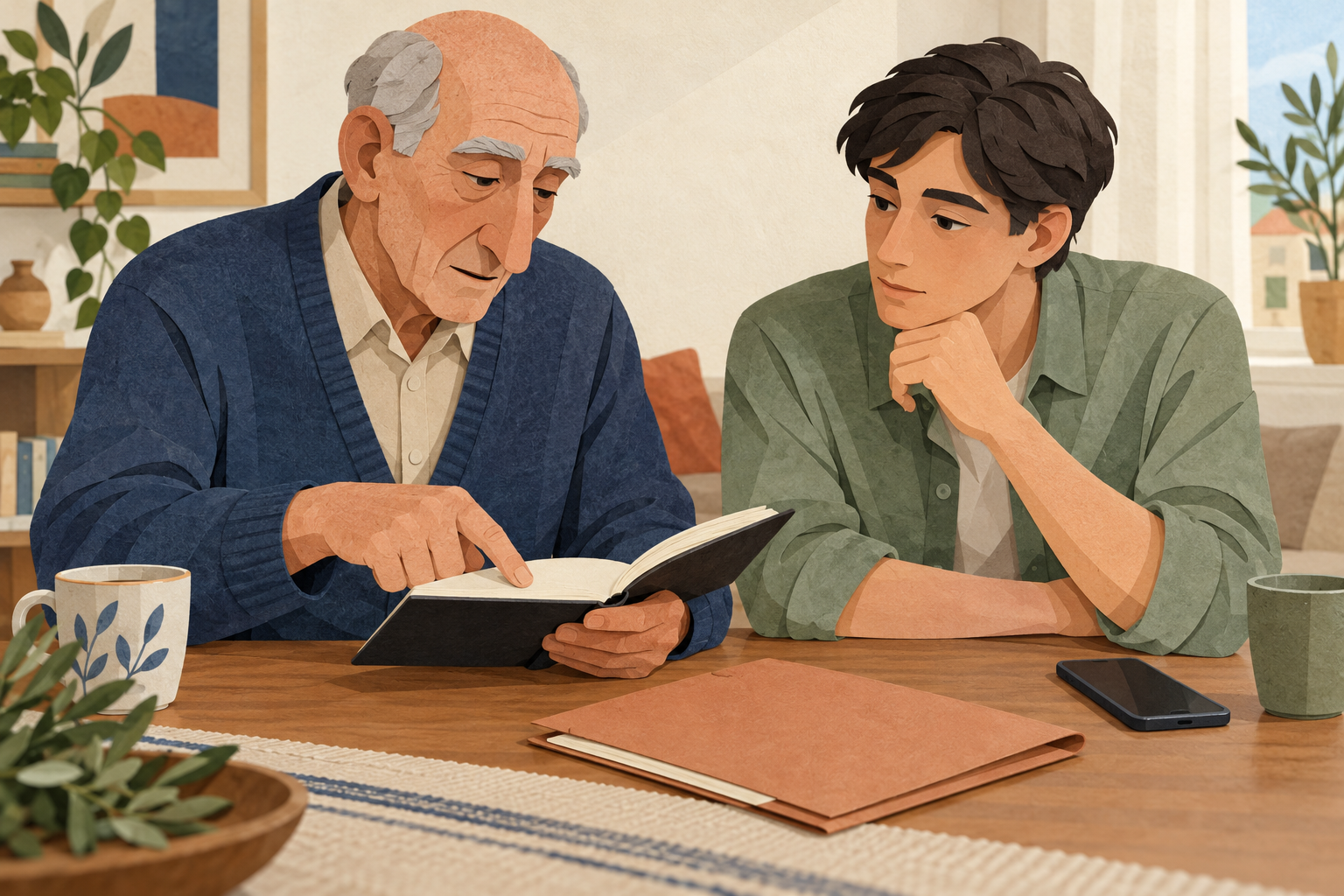
Stepan asks his grandson a second time when they agreed to meet. Nikita becomes worried and tells his sister that their grandfather is probably developing dementia. Stepan wants to check whether he wrote down the time correctly. This fictional scene contains an observation, a fear and a proposed diagnosis. These are different things. A change can deserve serious attention without a family explanation becoming a…
Epigraph
when you do not know a thing, to allow that you do not know it
Confucius, Analects II.17, a continuous excerpt from the English version derived from James Legge, 1891. The complete reply distinguishes knowledge from ignorance; it does not diagnose memory. Here the question addresses the person drawing conclusions about someone else. Text.
What this article is about
Stepan asks his grandson a second time when they agreed to meet. Nikita becomes worried and tells his sister that their grandfather is probably developing dementia. Stepan wants to check whether he wrote down the time correctly. This fictional scene contains an observation, a fear and a proposed diagnosis. These are different things. A change can deserve serious attention without a family explanation becoming a medical conclusion or permission to stop asking the person himself.
This article distinguishes everyday forgetfulness, cognitive changes, mild cognitive impairment and dementia for general orientation. It supplies no test, scores, diagnostic checklist, treatment or prognosis. We consider what information may help a professional assessment, how to prepare a consultation and how to support a particular task while questions remain open. One urgent boundary comes first: sudden confusion requires immediate medical help. Discussion of gradual changes must not delay that contact. We then return to situations where concern is real but its explanation remains uncertain.
I. First notice the timing of the change
NHS guidance calls for immediate medical help for sudden confusion. Do not wait for a routine memory appointment, family agreement or a home check. There can be several causes; choosing one yourself is not the task. This is a short boundary, not a complete emergency recognition procedure. Use the current local medical route for an acute change. An existing history of memory difficulties does not make a new sudden change an ordinary continuation that can wait until an appointment becomes convenient.
Our scene with Stepan does not describe ongoing sudden confusion. What follows concerns a gradually noticed or still unclear difficulty after urgency has been separated out. That condition matters. A calm conversation with a grandson can serve a particular question; it is not a universal first response to every change in health. Readers need not establish the exact medical term before seeking necessary help. Lacking a name does not make an experience less real or establish that it is safe to leave until later.
For a routine consultation, distinguish one event from a noticed sequence. Nikita can report hearing a repeated question today rather than saying Stepan always forgets everything. If similar changes occurred earlier, describe examples and their timing. No number of episodes is supplied here after which a family diagnosis becomes valid. Even a detailed list remains an account of circumstances. Its significance needs professional clarification; it is not settled by the relative who speaks most confidently or finds medical vocabulary first.
The person may notice a change before others do or describe it differently. His account should not be dismissed in advance because the concern involves memory. Different accounts do not require choosing one infallible witness either. Stepan remembers his purpose; Nikita remembers the question he heard. Each may know only part. Clarification serves a next action, not a trial of the family's memory. If a new acute circumstance appears, reconsider the calm original format instead of preserving it for the sake of a tidy conversation.
II. Similar words do not mean one diagnosis
In ordinary speech, forgetfulness describes different events: missing a word, leaving an object somewhere, asking again about a time. The description does not establish its medical cause. Cognitive changes is a broader expression for changes in cognitive abilities, not another name for inevitable dementia. NHS explains dementia in terms of a group of symptoms involving declining brain functions, different causes and more than memory alone. Alzheimer's disease is not a synonym for every difficulty remembering; it is one possible cause of dementia.
The NHS symptoms page separately describes mild cognitive impairment, MCI, where difficulties have not reached the level of dementia. Subsequent courses can differ between people. The term does not establish an inevitable outcome; lacking a settled diagnosis does not promise that nothing significant is happening. The term belongs within professional clarification. It cannot be assigned to Stepan from one scene, a convenient online table or the intensity of his grandson's fear, even when a description seems very familiar.
These distinctions do not invite a family to select a less frightening label. They explain why the next question remains open pending appropriate assessment. Ask what a professional means, what information has already been obtained and what remains to be clarified. An unfamiliar term need not be silently translated into a verdict about the entire future. Requiring a professional to guarantee a reassuring answer in advance would be another way of replacing investigation with the version a family would prefer to hear.
Definitions should not become a ladder of human worth. A diagnostic distinction concerns a condition and support needs, not the amount of dignity remaining. What the person needs today may be a more specific question than the name of the condition. Stepan needs clarity about a meeting and may need help arranging a consultation. That does not answer the clinical question or make it unnecessary. Different tasks coexist; they need not await a complete explanation of a life or allow one task to absorb all the others.
III. Observation helps more than a general family verdict
For worrying changes in memory or ordinary tasks, NHS advises seeking an assessment. Circumstances that can be reported without a diagnosis help prepare that conversation. What has become harder compared with the person's own usual pattern? When was it noticed? What does Stepan say? Which activities are affected? These are examples for preparing a question, not a diagnostic questionnaire. This article does not determine which investigations are needed or how many observations can confirm or exclude a particular condition.
The statement that he no longer understands anything conceals different information. Today Stepan confused a time but chose the meeting place and explained why he wanted to go. These fictional details do not prove the absence of impairment. They should be retained together so that a person is not described solely through what went wrong. Detail can change a practical task: checking a note rather than cancelling every meeting. A successful part of a day must not become a universal refutation of the difficulty prompting the consultation either.
Distinguish what was observed from what was heard secondhand. Nikita saw the messages; his sister heard his story; a neighbour proposes an explanation. A chain of retellings should not become several independent confirmations. Secret family surveillance, recording every mistake or provoking a difficulty again for persuasive evidence is not required. Clarify what medical information is relevant to the actual task. Agreed preparation and continuously testing someone's competence have different purposes and different costs for a relationship, even when both are described as concern.
Observers also have limits. Nikita did not see the whole day, does not know every circumstance and may notice especially what frightened him. This does not make his concern false. It helps him speak precisely: this is what I noticed, this is what I do not know, this is what I want to ask a professional. Participation does not require becoming a perfect witness. Confidence and a long list of anxious expressions do not increase what was actually seen or supply a professional basis for a conclusion.
IV. A result at home is not a complete assessment
Nikita finds a questionnaire and wants to test his grandfather over dinner. An official appearance does not make a family result a full diagnosis. This article reproduces no tasks, scores or thresholds. When a professional proposes an assessment, that professional determines its purpose, conditions and place among other information. The NHS account involves different aspects of health and everyday life. One convenient number cannot make every other circumstance irrelevant simply because the number is easy to compare or show to relatives.
Clarify an unclear task rather than conceal the difficulty. If someone did not hear a question, read the text or understand the language, tell the person conducting the assessment. No rules for recalculating a result are provided here. Correcting answers yourself, supplying hints or repeating the procedure until it produces the desired result can undermine its purpose. Ask for an appropriate explanation and report the conditions without assuming the professional role or pretending that an obstacle has no bearing on what is happening.
Ordinary conversation should not become an endless examination either. Questions about dates, names or the previous evening can serve different purposes. Contact with a relative need not repeatedly establish that his memory is sufficient. Ask one necessary detail without testing everything. Do not delay medical help for sudden confusion with such an examination. For gradual concerns, family checking also does not replace a consultation. A gentle tone does not turn an unsuitable procedure into an adequate or harmless way to settle the clinical question.
Stepan may fear being judged on every word more than he fears the subject itself. Explain why a professional conversation is proposed and what the family does not yet know. Do not promise that the appointment will confirm a harmless explanation. Presenting it as the place where his voice will inevitably be taken away would also be a premature verdict. Preparation can stay specific: the changes causing concern, questions to ask, organizational help he accepts and the person who is actually available to provide it.
V. Prepare a consultation around the person
Keep Stepan's own question present at the consultation. A grandson can help arrange it or describe observations where appropriate and agreed. NHS describes accompaniment as possible support; it does not make the fastest speaking relative the only participant. Write down questions beforehand and ask for unfamiliar terms to be explained. Professional roles and available services vary by location. A foreign description does not guarantee the same local route or immediate access to a specialist when an appointment is needed.
Provide relevant health information and details of medicines actually used to the extent needed by the professional. This article does not prescribe stopping a medicine, ordering a test or scan, or investigating a selected cause. A friend's previous investigation is not Stepan's plan. Clarification may require several steps. Preparation helps make the encounter understandable and preserves the opportunity to ask what a result means and what action is needed next. It does not mean arranging the answer in advance or collecting procedures as proof that everything possible has been done.
An uncertain conclusion also needs to be understood accurately. A professional may say there is insufficient information, suggest additional assessment or recommend later contact. This does not promise there is no problem or necessarily make the consultation pointless. Ask what is currently known and when to return. No follow-up interval is prescribed here, and no family diagnosis is supplied to fill a medical pause. Where uncertainty needs a plan, it should receive one, rather than borrowed certainty maintained until the next conversation becomes possible.
Afterwards, distinguish what was heard, recorded and understood. Nikita may remember one word and Stepan another. Clarify an important uncertainty at its source rather than assemble a new conclusion from fragments. Recognizing that help occurred does not require telling every acquaintance the consultation's contents. A purchase, journey or reminder may need only limited information. A diagnosis, if established, is not automatic permission to discuss someone wherever another person expresses concern or curiosity. Practical coordination and unrestricted disclosure remain different matters even within a close family.
VI. Disagreement is not settled by voting on memory
Stepan thinks Nikita is exaggerating; Nikita hears a refusal to admit the obvious. This disagreement does not by itself establish a diagnosis or determine who can make decisions. Name the specific concern and proposed help while leaving room for an answer. Describe the change prompting professional discussion instead of saying everyone can see it. The number of agreeing relatives does not turn an assumption into a clinical fact. Irritation does not prove that the person's account has ceased to matter or that further participation is pointless.
Serious danger and questions about understanding a particular decision require an appropriate professional and local legal route. This article cannot settle them remotely or grant relatives powers to compel, control money or disclose all information on the strength of the word forgetfulness. Respecting participation also does not mean leaving necessary help absent. If an essential need is unmet now, seek a real solution. A correct sentence about independence or a general promise to sort things out later does not complete the task of organizing that help.
Stepan may not be the only person afraid of the consultation. His grandson may fear the answer and postpone arranging it while collecting more opinions. Acknowledge fear without demanding immediate calm. Organization need not wait until every emotion disappears. Yet fear is not always the explanation for delay: access, money, time and other conditions can obstruct it. Find the actual barrier instead of assigning a psychological cause to every unfinished step. Understanding the obstacle matters because an explanation that sounds compassionate can still leave the practical need untouched.
The conversation can be simple and imperfect. A person need not respond gratefully, and a relative need not find flawless words. What matters is whether the concern remains clear and whether a health question has become a struggle for complete control of a life. If discussion reaches an impasse, consider another available way to obtain professional support. This guarantees neither agreement nor freedom from conflict. It offers a next action different from repeating the same unsupported household verdict with increasing volume and decreasing room for an answer.
VII. Today's help has a particular size
While assessment continues, Stepan may need help with one task: checking the saved meeting note together or finding a bill he wants to locate. This fictional arrangement is not memory treatment. Success is checked against the task: information found and understandable to him. It cannot prove there is no impairment. Waiting for a medical answer does not require withholding straightforward help because its cause has not yet received a precise name. A useful action and an unresolved clinical question can exist at the same time.
An agreed reminder differs from continuous control. Ask which format is useful and what the person wants to do himself. A note need not be welcome; buying a calendar does not establish its suitability. Actual use in a particular situation matters more than announcing that a system is installed. No device collection or training programme is proposed here. Where safety or an important prescribed task needs support, clarify its method and conditions in the relevant professional context, rather than guessing from the example of one successfully organized meeting.
Helpers also have limits. Nikita may find one document without being available to accompany every activity each day. Name that limit while keeping the necessary need visible. Kinship creates neither unlimited time nor automatic skill. Declining one role need not mean rejecting the person; accepting help creates no debt to accept every future form of supervision. Seek other options using real resources and the participants' agreement. Good intentions alone cannot appoint an absent helper or establish that an essential task will actually be performed.
Medical uncertainty does not make ordinary subjects inappropriate. Stepan wants to meet a friend and discuss a book read long ago. Conversation need not consist entirely of memory, testing and future services. This preserves the scale of a life without denying a problem. An important difficulty still needs to be named and addressed. Hold both realities: a need exists, and the person is more than a collection of signs to which others are now allowed to add only questions about help or reports of another mistake.
VIII. An uncertain result does not supply a forecast
If investigation continues, retain the exact meaning of what was said. Not yet established means neither definitely absent nor already clear. Families can replace uncertainty with a more convenient version. Nikita may seek final reassurance, Stepan an end to discussion and another relative grounds for reorganizing everything. None of these wishes supplies new medical information. Determine the next contact and questions from the recommendation received, rather than from whichever account feels easiest to bear today. A tolerable story and an established finding serve different purposes.
Even an established term does not define an entire future in a single word. MCI in particular should become neither an inevitable dementia story nor a promise of no further change. NHS describes differing courses. An individual needs information and professional explanation relevant to that individual. This article offers no progression timetable, probabilities or method for checking the outcome in advance. An honest boundary may reassure less than a confident prediction, but it avoids false grounds for major decisions and leaves room to ask further questions when the relevant information changes.
New circumstances may change an earlier plan. Report another significant difficulty to the appropriate professional rather than treat the original conversation as permanent permission to stop responding. New sudden confusion returns to the urgent boundary stated at the beginning. This does not appoint the family to continuous surveillance. It recognizes that an earlier explanation has a scope and time. An actual change is not obliged to fit the already convenient version that participants have become accustomed to repeating whenever someone raises another concern.
Support also needs review against its task. A reminder may no longer fit, or it may never have been accepted. Establish its actual effect rather than infer success from its price or the family's effort. Sometimes one adjustment helps; sometimes other professional support is needed. Neither outcome automatically proves the person's failure or ingratitude. An agreement can change while retaining a record of what was tried. That record does not itself become an established treatment programme or a reliable forecast of how the condition will develop.
IX. Acknowledging ignorance is the observer's task
Analects II.17 distinguishes what is known from what is not. Here it offers a limited ethical reference: claim no more knowledge for a conclusion than it has. This addresses Nikita, the writer and other observers; it does not measure Stepan's virtue. Forgetfulness is not a philosophical mistake to correct with the right attitude. A historical instruction supplies no diagnostic instrument and guarantees no participant an easy or tranquil acceptance of uncertainty about a person they care about.
In Plato's Apology, in the encounter with a politician, Socrates distinguishes ignorance from thinking knowledge has already been attained. The passage read concerns wisdom and things beautiful and good, not cognitive assessment. The comparison questions a speaker's claim to a conclusion. It cannot prove that medicine knows nothing or that professionals and relatives have identical competence. A personal limit can indicate where another method of clarification is needed; it does not cancel the possibility or value of that method altogether.
These traditions have different foundations and contexts. A shared concern with limits of judgement does not make them one doctrine or reveal a hidden mechanism of memory. Contemporary assessment relies on its own methods and information; philosophy cannot establish its result instead. Consider them together while retaining different questions: how a condition is established and how someone treats what has not yet been established. Merging the questions may produce an attractive general story without improving the accuracy of either the medical or the ethical conversation.
Respect for uncertainty must not become another prohibition on action. Nikita can lack an explanation and still arrange consultation, support an agreed task and recognize a need for urgent contact. Stepan need not share this article's philosophy to deserve a hearing. The comparison has a modest purpose: avoid replacing information with labels, requiring someone to earn dignity through good memory, or concealing an unmet need behind a general claim that nothing can be known. Uncertainty limits the claim, not the importance of the person or the need for appropriate help.
X. Judge results by what has actually been clarified
One result may be an arranged consultation and clear questions. That is neither a diagnosis nor proof that nothing is wrong. Another result is an explanation received and a next professional step. A third is practical help that someone could actually use. Name these separately. A successful conversation then need not become a report that the entire situation is resolved. An unresolved medical question also need not erase everything genuinely done for Stepan's daily life and his relationships with other people.
After an appointment or practical action, clarify what the person understood and what remains unclear. Do not automatically require a detailed retelling as another memory examination. Checking one important agreement accessibly and allowing questions again may be enough for that particular task. Request another explanation format where needed. No single support method is prescribed for everyone. The subject remains understanding a necessary action, rather than proving an ability to reproduce every word without error in front of impatient witnesses who already believe they know the answer.
Relatives may also need time and help to bear uncertainty and distribute involvement. That is a separate need, not proof that Stepan is responsible for everyone else's distress. He need not console them with a good result or immediate agreement. Name limits and seek resources while respecting privacy and the relationship. If essential support remains without an available provider, correctly describing everyone's feelings has not made the need disappear. Continue organizing a real response under actual conditions rather than calling the discussion itself a completed care arrangement.
A conversation at home therefore has value and a boundary. It can help notice change, hear the person, communicate circumstances and choose another contact. Love, fear, a relative's recollection and a questionnaire result do not thereby become independent diagnoses. With that boundary, serious action need not become a general verdict. The health question receives appropriate clarification, specific help receives an actual provider, and the person remains a participant in his life while part of the answer is unknown and familiar family explanations no longer suffice.
What this means in practice
Separate sudden confusion first: immediate medical help through the current local route is needed. Do not delay it with home questions or a routine memory appointment. This is not a complete list of emergencies. For a gradually noticed worrying change, prepare a professional conversation without assigning the cause yourself.
Record concrete examples and timing, distinguishing your observation, the person's account and secondhand reports. Do not turn this into secret surveillance or a case against the person's competence. No diagnostic episode count is supplied. Clarify which information is relevant, retaining the person's question alongside relatives' concerns.
Ask for terms, the meaning of findings and the next step to be explained. Do not administer a test yourself, recalculate scores or choose medicines, investigations or a prognosis. Forgetfulness, MCI and dementia are not interchangeable; none determines human worth or all the powers of a family.
While clarification continues, agree one usable form of help with an actual provider. Finding a bill or understanding a note solves that task; it establishes no clinical outcome. Serious risk, missing essential support or questions about making a particular decision require appropriate professional and local legal routes, not a family vote or disappearing help.
Check the actual result and remaining uncertainty. What is established, what is assumed, who takes the next step? Gratitude need not take the form of error-free answers. Preserve an ordinary subject and the possibility of asking again. Precision helps concern become action without making uncertainty a verdict or an excuse for leaving a need unmet.
Key quotation
I neither know nor think that I know.
Plato, Apology, Socrates' account of questioning a politician's reputation for wisdom; Benjamin Jowett translation, a complete short sentence. The context concerns things beautiful and good. It distinguishes claims to knowledge; it neither diagnoses memory nor rejects medical competence. Passage read.
Connections between traditions
| Comparison | Substantive question | Limit |
|---|---|---|
| Analects II.17 ↔ family observation | What is known, and where is there only an assumption? | The instruction addresses an observer's judgement, not a patient's memory or virtue. |
| Plato, Apology, politician episode ↔ confident conclusion | Has a claim to knowledge been mistaken for knowledge? | A historical discussion of wisdom is neither a diagnostic protocol nor a refutation of medicine. |
| Confucian distinction ↔ Socratic ignorance | Limits of confidence can be compared. | Different contexts and foundations; the shared theme establishes no single doctrine or memory mechanism. |
Medical sources supply a different kind of support. This map is limited to texts read; additional traditions have not been invented to increase its size.
Primary texts and official materials
- S1. NHS. How to get a dementia diagnosis, reviewed 17 July 2023; the next-review date, 17 July 2026, has passed. Substantive material read for assessment and preparation; no prescribed tests or transfer of British law.
- S2. NHS. Symptoms of dementia, reviewed 10 July 2023; next-review date 10 July 2026 has passed. Selected early section on MCI and differing courses read, not a classification of readers.
- S3. NHS. What is dementia, reviewed 20 July 2023; next-review date 20 July 2026 has passed. Definition, different functions and causes; no imported statistics or treatment promises.
- S4. NHS. Sudden confusion, reviewed 28 May 2024. Main material read; immediate help for sudden confusion, without a home test or foreign telephone number.
- S5. Confucius. Analects II.17, English derived from James Legge, 1891; provenance checked in the edition note. Complete selected reply and nearby context read, not the whole book.
- S6. Plato. Apology, Benjamin Jowett translation; selected oracle and politician episode. That context and translation attribution read, not the entire dialogue.
Page access on 19 October 2026 does not imply a new NHS editorial review. Dates are retained accurately; individual applicability requires separate assessment.
Tags
memory, forgetfulness, cognitive changes, MCI, dementia, ageing, professional assessment, sudden confusion, observation, uncertainty, diagnosis, home test, daily life, help, agreement, privacy, dignity, family, accompaniment, explanation, next step, limits of knowledge, Confucius, Analects, Plato, Socrates, authority, participation
About the authors
Andrey Zarinsh is the author and founder of United Wisdom. He explores inner transformation, the unity of traditions, intercultural dialogue, and contemporary spiritual discipline. Instagram: @andrey.zarinsh.
Maria Evilkut is a coauthor of United Wisdom. Alongside her research, she seeks to test these ideas in practice and observe how principles of unity and mutual understanding work in real life between people and cultures. Instagram: @ilkutki.