
Digital life, access and privacy
Cameras, trackers and sensors at home: safety and consent
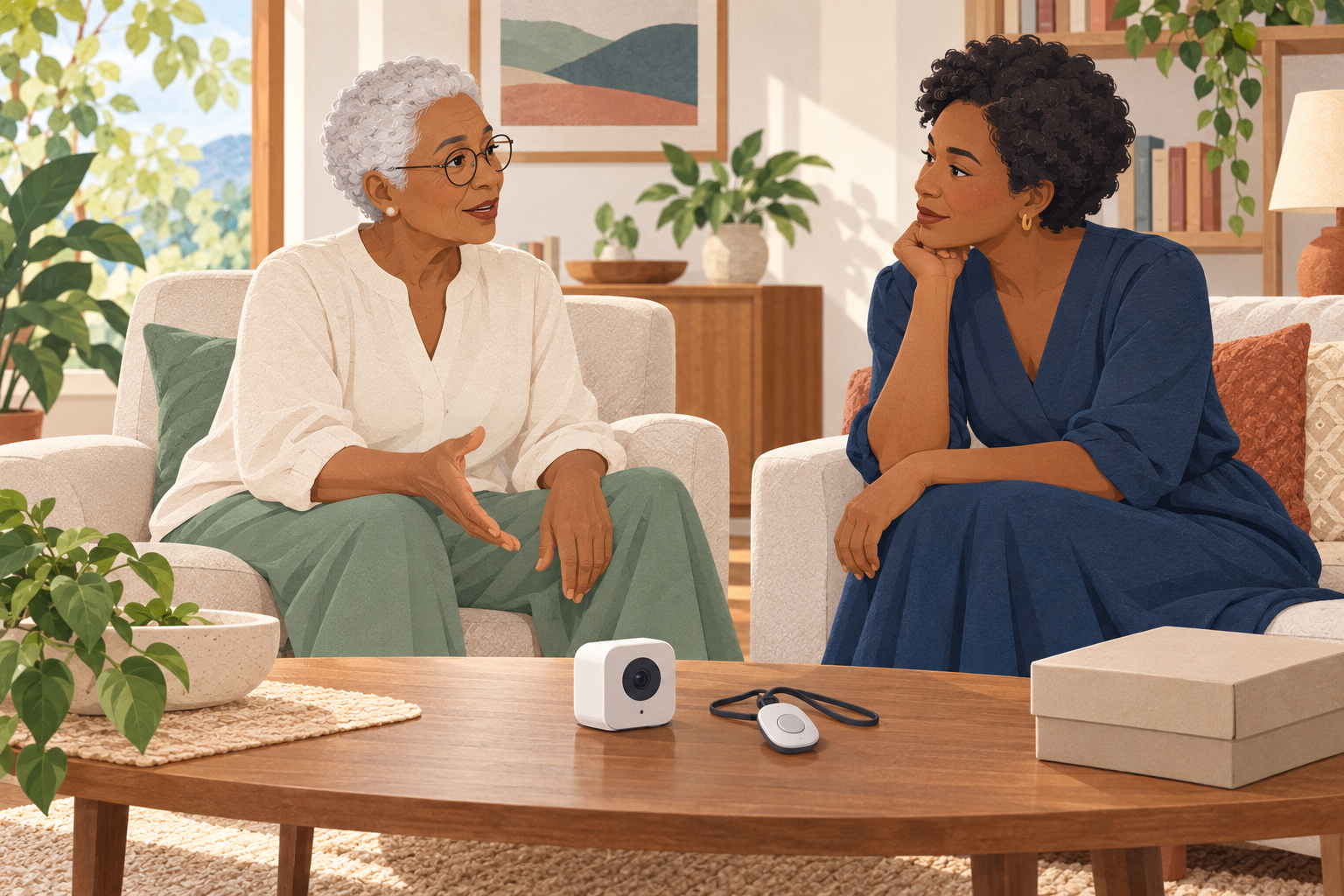
Tamara lives alone. After she falls, her daughter Oksana suggests a camera: then someone could check whether everything is all right. Tamara wants help when needed, but does not want her domestic life to become a continuous broadcast. Her daughter hears a rejection of safety; her mother hears a plan to take charge of her home. Neither the device’s task, its recording scope nor the person able to respond has been…
Epigraph
“…never as means only.”
Immanuel Kant, Fundamental Principles of the Metaphysic of Morals, Second Section, Thomas Kingsmill Abbott translation. An explicitly marked fragment of the humanity formula, not the complete formula, a monitoring instruction or an assessment of decision-making ability.
What this article explores
Tamara lives alone. After she falls, her daughter Oksana suggests a camera: then someone could check whether everything is all right. Tamara wants help when needed, but does not want her domestic life to become a continuous broadcast. Her daughter hears a rejection of safety; her mother hears a plan to take charge of her home. Neither the device’s task, its recording scope nor the person able to respond has been established.
This fictional scene explores home monitoring as a specific agreement about function, visibility, information and actual assistance. Cameras, location trackers and event sensors do different things. A name, a purchase or a relative’s reassurance establishes no particular system’s safety. This is no product selection, medical risk assessment, installation guide, legal opinion or immediate-danger procedure. Necessary assistance must not wait for a family discussion or the optional practice below. The subject is the person’s participation in the conditions of care.
I. Name the problem before discussing the device
“I need to know you are all right” expresses an understandable wish but an excessively broad technical task. A camera cannot answer for Tamara’s entire life. “All right” says little about the event, timing or action that matters. Is the concern that she may be unable to call, that a message may go unnoticed, or that nobody could arrive? Those questions need not have one solution. Clarification does not dismiss Oksana’s anxiety. It identifies what the proposal actually addresses and where too much is being expected of the device before anyone has checked its real function.
Tamara’s task is different: to continue living at home with accessible assistance. Her aim need not coincide with her daughter’s wish for greater visibility. Consider a possible arrangement against both aims while keeping them distinct. If more visibility adds no actual ability to help, that is a substantial limit. If the chosen assistance needs particular information, identify it specifically. Age alone determines neither necessary monitoring nor acceptable scope nor what a person is willing to change in an ordinary day. One fall does not establish every future condition. A known concern deserves a response without becoming a verdict on the whole life.
Alternatives can be discussed without promising that each equals a camera or covers the same risk. A suitable professional conversation, a different contact arrangement, a home adaptation or a particular service has its own conditions. This article does not prescribe these instead of an appropriate assessment. Compare real possibilities rather than imaginary perfect safety against complete abandonment. Where a reliable answer is missing, the question remains open. A device is not useless merely because it cannot solve everything, and not necessary merely because it exists and can be bought. Both conclusions would move beyond what has actually been established about the situation.
The bounded Kantian question is whether Tamara remains a participant or her everyday life becomes exclusively a means of reassuring someone else. That is the authors’ ethical application, not Kant’s conclusion about digital devices. Oksana has limits, work and fears too. Respecting both people means discussing specific participation without appointing one a permanent observer and the other an observed object. It promises no quick agreement. It prevents any quantity of information from being called care regardless of whom it helps and what its acquisition costs the person whose home is being changed.
II. Images, location and alerts are different information
A camera may provide an image, a tracker information about location, and a sensor an alert about some event or condition. Actual capabilities depend on product and configuration. These categories are not specifications: one device may combine functions that its general name does not reveal. Distinguish what is detected, transmitted, stored and available to someone opening an application. A visible casing does not disclose every information flow either. Answers about a real device require its relevant documentation and a competent party. A family assumption about how all sensors work cannot establish the scope of this one.
NHS general information distinguishes alarm types, monitoring systems and notification destinations. It provides a useful starting distinction, but the displayed page was reviewed in November 2022 and its scheduled next review is overdue. It therefore supplies no current purchase recommendation or compatibility confirmation here. The narrow point is enough: a device transmitting an alert and a service receiving it are different things. Its full feature list is not transferred to every domestic package. Reading the source helps ask a more accurate question; it does not prove the reader has the desired function or that it is enabled and works.
Tamara may accept reporting a particular event without accepting images of every evening. That does not mean any less detailed alternative is sufficient for her situation. It means information scope matters to the choice. Do not promise “only an alert” if the system lets others see more, or attribute filming to a sensor that does not film. Disagreement sometimes concerns a mistaken description rather than technology in general. Correcting the description can change the discussion without obliging the person to accept the proposal. Being properly informed is part of a decision, not a promise to make the preferred decision afterwards.
Location also needs a purpose. For which task and during what period is it wanted? Who receives it, and what can that person do? A delayed reply does not automatically require continuous route visibility. Agreement to a function during one journey is not permission for every future movement. These are the authors’ questions, not a legal regime for location data. Their purpose is to distinguish chosen assistance from a habit of checking whenever a relative feels anxious. Ask whether the proposed scope serves the actual task rather than simply using everything a purchased device happens to offer.
III. An alert needs an actual recipient
Receiving a notification and providing assistance are distinct actions. Oksana may see her phone at work without being able to answer or come immediately. Her brother may live nearby without accepting an on-call role. A plan cannot assign him merely because he is a relative and usually helpful. Otherwise the device appears to organize assistance where there is only hope of another person’s availability. The recipient question includes more than a name or number. It concerns a genuinely accepted role, its timing, limits and uncertainties, including whether the person understands what others now expect.
For a service, understand actual conditions: what counts as a received alert, what an operator does, and which possibilities depend on third parties. This article confirms no particular service’s quality or arrival time. “Around the clock” at one link does not make every other link continuous. Do not replace real terms with a familiar image of someone always waiting, already knowing the situation and able to open the door immediately. Entry and authority do not automatically follow from notification. A claim about one available function must retain its scope when people imagine the practical help that might follow it.
Tamara can understand what follows an alert and who learns about it without mastering every technical detail. An accessible explanation of substantial conditions matters. Oksana can honestly say, “I cannot always answer during working hours.” That admission is more useful than an unfulfillable promise and does not make her indifferent. If the arrangement depends on her, the limit belongs in the actual plan. Another camera or more frequent messages cannot supply missing time or the ability to act. Greater information may expose a need more clearly while leaving the question of assistance completely unresolved.
Immediate danger calls for suitable real assistance rather than waiting for an agreement to work as hoped. This article supplies no local emergency route and appoints no device as its replacement. A later conversation can separately examine which link responded and where expectations remained unmet. That is not a family trial or a promise to prevent recurrence. A useful alert and an inadequate next step can both be real results. Technical notification, a person’s response and an achieved outcome keep separate names even when everyone understandably wants to say the whole problem has been solved.
IV. Agreement concerns an understandable scope
Agreeing “to safety” differs from agreeing to specified monitoring. One names a desired good; the other a method with consequences. A conversation can identify function, place, time, recipients and substantial limitations. This is no universal legal form or mandatory settings list. Appropriate procedure depends on circumstances. But hiding the scope inside a good general aim does not support participation. Tamara need not prove love by accepting everything her family finds convenient. Oksana need not promise restrictions that the proposed method cannot actually provide. Both need a truthful description before debating the proposal’s value.
“You already agreed” settles little if sound now replaces an alert, recording replaces viewing, or another person gains access. Changed conditions deserve a separate explanation. Consent, where required and genuinely obtained, has a subject rather than an unlimited reserve for the future. These ethical distinctions do not replace law. Where special assessment, representation or formal procedure is needed, a family conversation does not automatically create it. Tamara’s decision-making ability is not assessed here. Rejecting a specific function supplies no domestic proof that she cannot reason. Neither agreement nor disagreement should silently acquire an authority it does not have.
Separate participation in a family arrangement from consent as one legal basis for processing information. In its home CCTV guidance, the UK ICO explains a particular context differently from the slogan “every recording always requires consent.” The guidance itself is marked as under review. It is not worldwide law and gives no general permission for a daughter to monitor her mother inside the home. Our question extends beyond one legal basis: does the person whose daily life changes understand the method, and how is that person included? An actual legal answer needs an appropriate local source and the real circumstances.
Pressure, fear of losing necessary help or inability to discuss a proposal freely leaves questions that a formal “yes” cannot settle. Suitable independent support may be needed. The article does not prescribe rejecting every form of assistance to prove independence. Neither covert installation disguised as something else nor a dangerous unsupported trial is an appropriate family test of choice. Discussion needs space for understandable disagreement and other genuinely available care. Whether alternatives are sufficient cannot be established by one ethical formula. Keeping the question open must also not become an excuse to delay assistance that is already necessary.
V. A home exceeds the camera’s field of view
Tamara wants to change clothes, meet a friend and speak on the phone without imagining an invisible audience. That preference does not require a secret or suspicious behaviour. Private life matters even where nothing needs justification. Article 12 of the Universal Declaration of Human Rights supplies a normative reference for privacy and home. It determines no camera position, retention period or local complaint procedure. Those questions need their own basis. Concern for safety does not, by itself, make an older person’s everyday life territory that belongs to nobody and can therefore be appropriated for any useful-looking purpose.
Partners, helpers and visitors may enter the observed space. Agreement with one resident does not automatically settle every question about their information and rights. A sign or one spoken warning is not presented as a universal solution. Understand who falls within the actual scope and how conditions of interaction change. Appropriate professional or legal advice may be needed. The authors’ framework merely prevents people beyond the main family pair from disappearing. Their presence neither makes the home a public venue nor becomes irrelevant because the installer means well. A family agreement can be important while remaining incomplete for other people affected by it.
Not viewing today differs from having no ability to view. A family might prefer limits to a function, time or access, but must distinguish actual system restrictions from interpersonal promises. Promises matter without automatically becoming technical protection. Avoid reassurance that switching off recording necessarily excludes all information at every party. Actual scope needs clarification for the chosen method. If it cannot be explained clearly enough, that is a substantial uncertainty in the decision rather than evidence that Tamara distrusts her daughter. Understanding a boundary can require information neither family member currently has, without either one having acted in bad faith.
Respect for private space does not require contempt for every form of monitoring. Someone may choose a particular function and find it useful without becoming less independent. What matters is what was chosen, which limits are known and which questions remain disputed. Tamara need not defend an ideal image of complete self-sufficiency. She can accept more support while retaining a voice, or reject some functions without declaring all relatives enemies. There is no promised correct position for every home between these possibilities. There is an actual task with people and conditions that the general word “care” should not conceal.
VI. Information can outlast a glance
Live viewing, recording and forwarding are different actions. Even when the initial aim was one alert, later handling may exceed it. Distinguish family access, service conditions and possible saved copies. This article audits no cloud system, sets no deletion period and promises no complete disappearance. Actual product conditions and applicable rules matter. “We never post it anywhere” does not automatically answer where information is processed, who has permissions or what has already happened. A sincere statement about one family action can coexist with uncertainty about other parties and functions. Both facts belong in an honest account.
Oksana might want to send her sister a short recording to explain her worry. For her it is an explanation; for Tamara it creates another audience. A private family chat also transfers information to other people even though it is not a public website. A good purpose does not establish prior agreement to the scope. Discuss what is actually necessary for the separate task. Special duties or grounds may apply in some circumstances, but cannot be inferred from this general story. The article prescribes neither keeping everything “just in case” nor deleting significant material without considering consequences and appropriate grounds.
Using a recording to settle disputes about sleeping, going out or keeping a promise changes more than the audience: it changes the purpose. Such use is not automatically included in the initial arrangement because the device is unchanged. Name what was chosen, what happened and what needs an answer. That supports a factual discussion without passing judgment on the entire family. A file is not a complete explanation of behaviour, health or intention either. The recorded portion may be real while the interpretation remains uncertain. More data does not remove the need to understand what a claim about a person actually rests on.
Ending viewing does not prove deletion of earlier copies; deleting one file does not prove termination of every access. These distinctions also matter in digital delegation, but ambient monitoring may continue without another separate action by the observed person. Describe ending and review in understandable terms. Relatives need not promise a complete technical audit or endlessly search for imaginary traces. Verification should answer a real, substantial question and state its limits honestly. Something unknown does not become safe merely because everyone is tired of discussing settings. A bounded confirmed result is more useful than a sweeping assurance that nobody can substantiate.
VII. Device silence does not establish that help is unnecessary
An absent alert can have different causes. This article establishes no missed-event probability or particular device reliability. The logical limit matters: the absence of a message does not, by itself, prove the person is well. A received message does not fully explain the event either. Observed condition, interpretation and action remain separate steps. Confidence cannot simply replace them, however good the intentions. Significant safety questions need suitable information about the actual device and assistance. Neither general faith in technology nor general fear of it establishes what can be relied on here. The claim should remain no broader than the evidence supporting it.
UK government telecare information explicitly identifies dependence on device and connectivity, separately discussing changes to British telephone infrastructure. No UK date or programme is transferred to other countries here. The narrow example shows that familiar equipment may need compatibility checking when conditions change. Power, connection, maintenance and an agreed service are questions for the relevant party, not settings prescribed by this article. We propose no unsupported disconnection of protection or dangerous fall simulation. Reading the information confirms no system in Tamara’s home. It identifies something worth asking about while leaving the actual technical answer to suitable evidence.
Frequent mistaken alerts yield no universal answer to ignore them or immediately change everything. Investigate what is known about the event, configuration and service with suitable competent help. Irritation does not establish that later alerts are unimportant. Nor does each alert prove someone can no longer live at home. Domestic observation does not automatically become medical assessment. An immediate problem requires an appropriate real response. Later device review has a different task and must not delay necessary help. The family can separate its fatigue from the factual question without pretending either one is absent or morally unacceptable to mention.
Limits can appear after a calm trial period. Yesterday’s success is a useful fact, not indefinite confirmation of all future conditions. A different recipient, service plan, connection or everyday need changes the question. This does not require constant anxiety or control over everything. It prevents the installation date from becoming permanent assurance about living safely at home. Sometimes an accurate result is modest: one notification was checked under specified conditions; other questions remain open. That precision leaves room for a justified next step without creating a misleading guarantee about an entire life. It also makes later changes easier to discuss without inventing blame.
VIII. Review need not wait for a crisis
A month later Tamara may still appreciate one signal while finding another function intrusive. Oksana may discover that she cannot sustain the role. Both can return to conditions without proving the earlier decision foolish. Review concerns current needs and actual possibilities, not one answer for every home and year. Previous expense does not remove the person’s voice. Cost is a real consequence to consider, not an unlimited justification for any amount of monitoring. A useful purchase can still need adjustment; an imperfect experience does not mean that accepting assistance was a mistake or that nobody should ever have offered it.
When change is needed, do not promise simple disconnection where necessary assistance depends on the system. Understand the actual change, known consequences and possible next arrangement. This does not mean keeping everything active until perfect agreement arrives. Danger, coercion or wrongful observation may need suitable real support; a general family suggestion cannot resolve those cases. In ordinary discussion, a precise subject helps avoid a false choice between tolerating everything and losing every form of help. Available alternatives are not automatically sufficient. Their value and limits need the same honesty as the original proposal rather than becoming comforting substitutes on paper.
A chosen trial may have a limited aim, but actual conditions must match the words. If access or collection remains afterwards, a calendar date alone establishes no completion. Ending has technical and organizational aspects; earlier information has its own fate. Appropriate confirmation depends on the system. There is no universal button or promise that every copy disappears. A suitable party can answer an outstanding question. Tamara need not become an expert in every component before she may retain a boundary in her home. Asking for that boundary and establishing how it can actually operate are related, separate parts of the work.
The UN Principles for Older Persons support dignity without making relatives an unlimited monitoring service or appointing their authority. Oksana’s participation can also be reviewed. Rejecting continuous duty differs from rejecting a mother; limiting images differs from rejecting care. These distinctions do not cancel actual obligations established separately. They help discuss a chosen contribution without a general moral verdict. Responsibility becomes more understandable when it has a subject rather than demanding continual proof of love through maximal control or sacrifice. A sustainable agreement may contain substantial help while still acknowledging that both people have lives beyond the monitoring arrangement.
IX. Useful care leaves the person a life
Tamara might find suitable help without a camera, through a limited function, or through broader monitoring she actually chooses under understandable conditions. The article prescribes no outcome. It asks whether Tamara herself has disappeared among messages about her. Knowing more may mean understanding less if nobody asks how she wants to live or what has changed for her. Even a useful device is no complete account of a person. An ordinary evening, friendship, freedom from explaining every movement and the ability to change one’s mind exceed what an application displays. Information about a life is not ownership of that life.
That does not require accepting every risk without discussion. Real concerns deserve specific consideration, including professional assessment where needed. But risk assessment and assistance choices must not silently become judgments of the entire person. Disliking continuous filming does not prove failure to understand consequences. Wanting monitoring does not prove a relative’s intention to dominate. Hold both possibilities while checking facts instead of staging a struggle between a good person and a bad one. Actual violations need no excuse based on good intentions. Accurate distinctions can support both accountability and care without assuming either outcome before the circumstances are understood.
Agreement may remain partial. A family knows the help it can offer but has not found acceptable monitoring. That is more useful than fictitious unanimity and promises no automatic solution through time. Which questions need an answer now, which can wait, is necessary help delayed, and who has actually accepted an action? Words do not build the system. These questions merely prevent an unresolved matter from being reported as an accomplished agreement. They preserve the possibility of finding an actual solution with suitable people while acknowledging that some constraints may remain real and painful rather than disappearing through better phrasing alone.
Kant’s formula recalls an ethical limit on using a person exclusively as a means. Domestic technology was absent from the passage; the application is the authors’ responsibility. Here the boundary concerns participation, actual function and consequences. Safety matters, private life matters, and helpers’ capacities are real too. None disappears with age. Care becomes more precise when people can say what was chosen, what was checked, who will help and what remains unknown. Neither a device nor a conversation guarantees perfect peace. Both can be useful while retaining a scope that leaves the older person visibly present in decisions about the life being supported.
What this means in practice
If appropriate and wanted, take one proposal for a domestic device. Without buying or activating it, name its task: which event matters and what actual assistance would be needed afterwards. Separate images, location and alerts from assumptions about their meaning.
Clarify what the person wishes to keep private, who genuinely accepts a recipient role, which conditions are known and what needs an answer from a provider or professional. One precise unresolved question can be enough. This is a conversational result, not safety verification.
No recording, posting, code sharing, dangerous trial, withdrawal of necessary protection or delay to assistance is required. The practice establishes no decision-making capacity, local lawfulness or sufficiency of alternatives. Immediate danger requires suitable real assistance rather than completion of a family exercise.
Key quotation
“…in every case as an end withal, never as means only.”
Kant, Second Section, concluding portion of the humanity formula, Abbott translation, Gutenberg 5682. A marked fragment of a longer sentence, not a complete aphorism or technical guarantee. The selected argument, formula and surrounding context were read, not the whole work. Adjacent historical judgments concerning suicide, bodily injury and rationality are not applied to an older person’s worth or need for assistance.
Connections and distinctions
| Reference | Distinction | Limit |
|---|---|---|
| Kant, Second Section | A person as an end rather than exclusively an instrument of reassurance | Authors’ ethical application, not law or technology |
| NHS, telecare | Device, signal type and recipient | 2022 review, next review overdue; no purchase recommendation |
| DHSC, telecare | Operation depends on device and connection | UK example, no global deadline or tested system |
| ICO, home CCTV | Contextual legal grounds differ from a general consent slogan | Guidance under review; no permission for family monitoring |
| UDHR Article 12 | Privacy and home have normative significance | No local installation or complaint procedure |
| UN Principles, paragraph 18 | Dignity continues alongside assistance | No capacity assessment or appointment of relatives |
Six actual references of different kinds, not six religions or a tested fall-prevention programme. Tamara’s story and the practice are the authors’ work.
Sources and primary texts
- Kant, Fundamental Principles of the Metaphysic of Morals, Second Section, work 1785, Thomas Kingsmill Abbott translation, Gutenberg 5682. Selected argument/formula/context read 19 October 2026, not whole treatise. Exact print edition/update unknown. Short fragments; own RU/TH renderings from English.
- NHS, Personal alarms, monitoring systems (telecare) and key safes, substantive page read 19 October 2026. Reviewed 11 November 2022; next review 11 November 2025 overdue. Only functional/recipient distinction, no current prices, purchase, installation or guarantee.
- DHSC, Find a telecare provider, 13 May 2025, substantive page read 19 October 2026. Device/connectivity dependency and a local network-change example only. No exported deadline/checklist. Displayed OGL v3 with exceptions.
- ICO, Home CCTV systems, substantive page read 19 October 2026, update unknown; legislative-change review notice displayed. Bounded contextual distinction of legal consent/family participation only, no exported procedures/deadlines. Displayed OGL v3 with exceptions.
- UDHR Article12, reproduced FMR June 2012 p. 6, UN 1948 primary text hosted by UNHCR Refworld. Article/context read earlier in this task, not whole collection. Reproducing publisher: Forced Migration Review.
- UN General Assembly, United Nations Principles for Older Persons, A/RES/46/91 Annex, 16 December 1991. Selected paragraph 18/context read earlier in this task; normative reference, no local implementation evidence.
No device, connection, service or domestic access was tested. CQC surveillance guidance returned an opening error and was excluded. Medical effectiveness, applicable legal regime and suitability of a particular package remain unconfirmed.
Keywords
ageing, home, camera, tracker, sensor, monitoring, consent, private life, alert, assistance, family, telecare, information, access, recording, location, choice, dignity, safety, limits, connection, recipient, review, Kant, NHS, ICO, UN
About the authors
Andrey Zarinsh is the author and founder of United Wisdom. He explores inner transformation, unity across traditions, intercultural dialogue and contemporary spiritual discipline. Instagram: @andrey.zarinsh.
Maria Evilkut is a co-author of United Wisdom. Alongside research, she seeks to test these ideas in practice and observe how principles of unity and mutual understanding work between people and cultures in real life. Instagram: @ilkutki.