
Protection from abuse and rights
Abuse of an older person: why care cannot justify harm
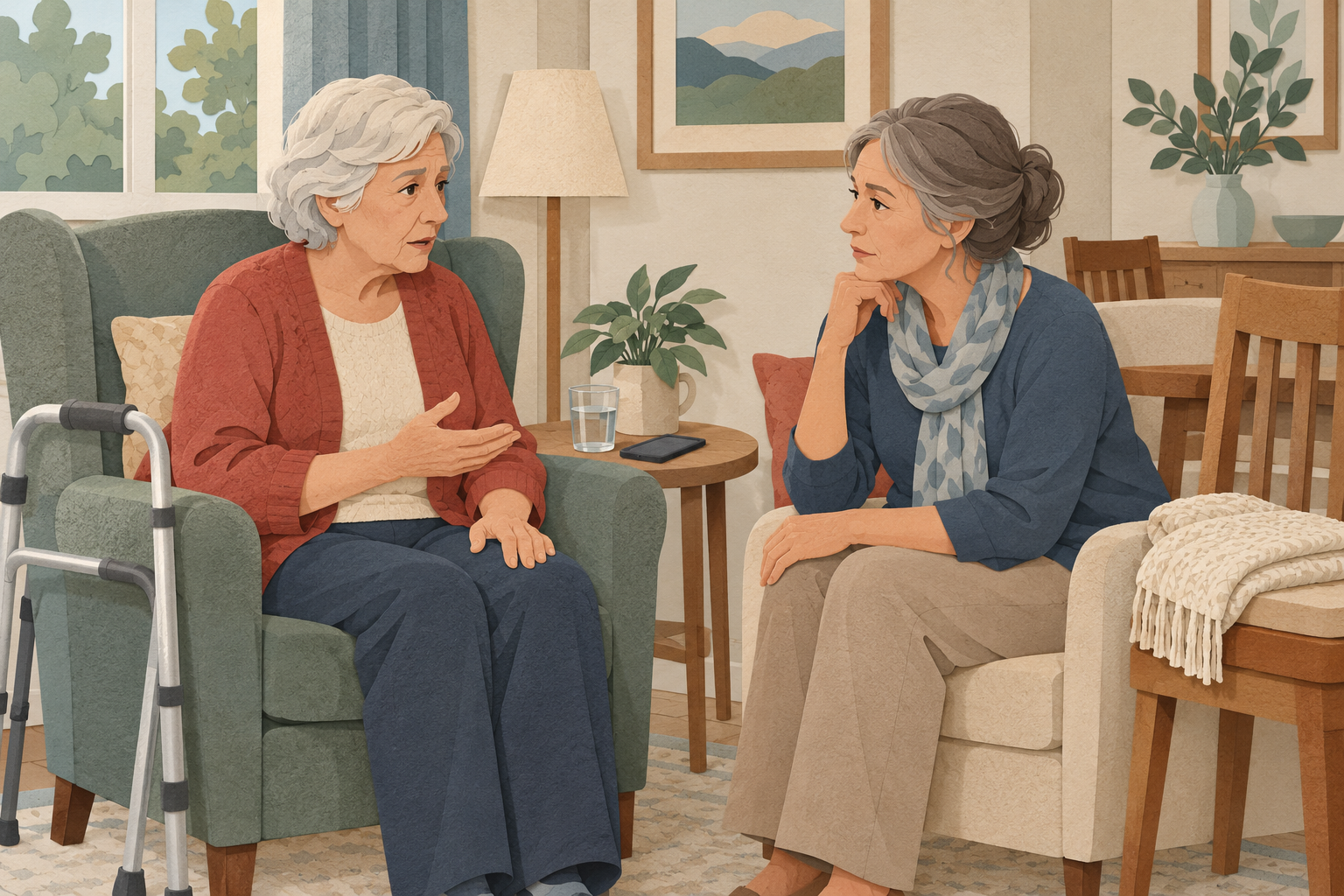
In this fictional example, Elena really does need help. After an illness, moving from her bed to a chair is difficult without assistance. Her son buys food, arranges visits and does many things well. He also shouts when she takes too long, removes her phone after she complains to her sister, and says that unless she obeys, nobody will help her get up tomorrow. Elena does not want to lose her son. She cannot see how…
Epigraph
“For we are made for co-operation”.
Marcus Aurelius, Meditations, II.1, translated by George Long. A short extract from the passage read.
What this article is about
In this fictional example, Elena really does need help. After an illness, moving from her bed to a chair is difficult without assistance. Her son buys food, arranges visits and does many things well. He also shouts when she takes too long, removes her phone after she complains to her sister, and says that unless she obeys, nobody will help her get up tomorrow. Elena does not want to lose her son. She cannot see how to seek protection without losing essential care. Her difficulty calls for more than the instruction to set a boundary.
This article examines harm within relationships of trust. It distinguishes forms of abuse and explains why dependence requires a particularly careful route towards help. We will consider the difference between a warning sign and an established fact, a caregiver's burden and an excuse for harmful conduct, support for a person and decisions made over their head. The article establishes neither a medical assessment nor legal authority. Its purpose is to help describe the situation clearly enough to seek appropriate support while preserving the older person's voice and continuity of essential assistance.
I. Providing real help does not permit every way of treating someone
Care involves both what gets done and what happens to the person receiving it. Buying food and using threats can be two real actions by the same individual. The first does not erase the second. Treating care as a balance sheet, with useful acts deducted from harm, makes the recipient responsible for tolerating mistreatment in proportion to the help received. Dignity becomes conditional on independence: you may object while you manage alone, but must put up with whatever happens once you need assistance.
Elena's son carries a real burden. It would be inaccurate to dismiss their entire relationship as false or deny his contribution. Yet threatening to withdraw essential help changes the conditions under which she agrees. Her answer after that threat does not establish that she freely chose the proposed arrangement. The relevant questions concern the episode: what was said, which assistance was made conditional on obedience, and what would happen if nobody came? There is no need first to prove that her son has never loved her.
The official CDC information page describes abuse of older people in terms of an act or failure to act that causes harm or creates a risk of harm within a relationship of care or trust. It distinguishes physical, sexual, psychological and financial abuse, and neglect. These distinctions direct attention towards conduct rather than a family's reputation. They are public health information; the legal classification of a particular situation requires the applicable local rules.
Age does not make every helping relationship dangerous, and ordinary irritation is not automatically established abuse. Equally, age creates no exemption allowing humiliation or coercion for someone's own good. A useful outcome does not settle whether the means were acceptable. Elena can have enough to eat and still need protection from threats. Recognising both facts makes a more accurate discussion possible.
II. Harm extends beyond visible injury
Different forms of harm affect different parts of the same life. Physical force concerns the body. Sexual coercion concerns consent and bodily integrity. Threats and humiliation shape the conditions in which someone lives and responds. Misuse of money affects access to resources. Neglect can concern essential needs left unmet. These distinctions help identify appropriate assistance; they are not instructions for readers to prepare their own legal findings.
Suppose Elena receives meals and clean clothes but is told that another call to her sister will leave her without help. The absence of a bruise does not make the threat irrelevant. In another fictional household, a helper speaks kindly while using an older relative's funds beyond what was authorised. A warm manner does not resolve the question of permission. Elsewhere, necessary help with personal hygiene is missing. Understanding why will require attention to responsibilities, resources and arrangements, but the unmet need already deserves attention.
Intimate care makes the distinction between necessary assistance and disrespect for the body especially important. Needing help to wash does not imply agreement to any touch, sexual remark, photograph or presence of an observer. How a particular care task should be carried out when communication, movement or understanding is difficult needs discussion with suitable professionals. This article does not teach readers to force a procedure or interpret silence as consent.
It can also help to describe what the person is no longer allowed to do: contact a friend, ask a question, see their own papers or request another helper. Restrictions themselves require attention to the circumstances; genuine medical necessity cannot be established from a general description. The questions remain specific. Which need is being addressed? What is restricted? Why was this approach chosen? Who has the authority to decide? Calling an arrangement care does not answer those questions.
III. Concern calls for attention rather than an instant verdict
A concern can be taken seriously while uncertainty remains. Bruising, weight loss, withdrawal or missing money can have different explanations. None establishes abuse, a diagnosis or an offender on its own. But requiring perfect proof before seeking advice creates another problem: a neighbour or relative rarely has the means to carry out a professional assessment. Between condemning someone and ignoring the situation lies the possibility of reporting exactly what has been noticed.
Elena's sister learns that calls are no longer answered. That establishes a difficulty in contacting Elena; it does not prove that her son has taken the phone. If safe, her sister can try to find out whether Elena is able to speak and what is happening. If Elena describes a threat, her words matter as her account, without added speculation. If a conversation cannot take place, that remains a circumstance to tell an appropriate professional about, rather than a gap to fill with a confident story.
An account for seeking assistance can be simple: the date, what was directly noticed, the person's words, a known care need and the reason for concern. Separate what you do not know or did not witness. This is an editorial suggestion for organising information, not a mandatory legal form. Do not provoke a helper, enter private accounts or obtain material in a way that increases danger just to complete a record. Safety and necessary medical attention should not have to wait for a finished dossier.
An inconsistent account is not a reason automatically to discard everything a person says. Nor should a listener diagnose the inconsistency as illness or trauma. Clarify what is needed for immediate assistance and pass on the available information to an appropriate professional. A repeated pattern may be informative, but serious individual incidents do not become insignificant without repetition. Nobody needs to wait for a second assault or further coercion before seeking necessary help. Deciding whether support is needed now is different from establishing everything about a relationship's past.
IV. Dependence changes the cost of saying no
Advice that works in an ordinary voluntary conversation may be unsuitable where essential care is involved. Someone who can leave an encounter is in different circumstances from someone who needs assistance to move, eat or reach medical services. Telling the latter to cut contact with a harmful helper leaves an essential question unanswered: who will provide what is needed afterwards? Without an answer, the proposed protection can place its cost on the person who depends on care.
Elena may fear more than her son's anger. She may worry about moving, unfamiliar residential care, losing her home or relatives no longer speaking to one another. These outcomes do not have to be inevitable for the concerns to matter. Wanting to preserve a relationship does not mean agreeing to threats. Being unwilling to leave immediately does not establish that no harm exists. Someone may need a way to change a particular care arrangement before deciding the future of an entire family relationship.
England's Care and support statutory guidance, particularly paragraphs 14.95–14.98, considers adults' wishes and proportionality in safeguarding. This is an example from a specified jurisdiction, not a worldwide procedure. It illustrates the difficulty: removing all contact can itself be a significant intervention, while a person's initial rejection of a proposed solution does not make careful attention unnecessary.
For a relative, a more useful starting point is the need for safe assistance in place of a harmful arrangement. Who can assess needs, discuss alternatives, arrange a replacement and establish the necessary authority? How can concerns be communicated without adding risk? Answers depend on local circumstances. Continuity of essential care belongs within the search for protection. The older person is seeking freedom from harm, not taking a test of their ability to live without other people.
V. A caregiver's exhaustion needs support, not an excuse for harm
The burden of caregiving can be real even when harmful conduct is unacceptable. Lack of sleep, insufficient skills and having nobody to take over can make an arrangement unsustainable. These difficulties deserve attention before a crisis. But explaining a difficulty and evaluating an action answer different questions. Saying that nobody else will help describes a lack of resources. It does not make threats, assault or sexual coercion an acceptable way to continue providing care.
The CDC summary of risk factors discusses stress, inadequate preparation and problems in care settings. It also distinguishes risk factors from necessarily direct causes. The material does not justify calling every exhausted caregiver dangerous or attributing a particular incident to one condition. The narrower conclusion is sufficient: sustainable care needs attention to its organisation, while responsibility for harmful conduct remains within that organisation.
If a helper recognises their own threats in this account, a useful next step is to stop the dangerous conduct and seek appropriate assistance. Taking a break must not mean leaving someone without life-sustaining care. A task needs a safe handover to someone actually able to accept it, or urgent contact with an appropriate service if lack of care places the person in danger. No single handover method fits every need and every available local service.
A family can seek protection for Elena while helping her son find relief, training or support. Elena should not have to become the sole listener to his despair in order to prevent further harm. Her sympathy is not a safety system. An apology may matter, but preventing repetition requires changes in conduct and circumstances. It cannot rest on an obligation for the person harmed to forgive quickly and stop mentioning what happened.
VI. An initial conversation should increase room for choice
A conversation about possible abuse should serve the person concerned rather than the listener's curiosity. NHS guidance recommends, where possible, speaking privately, listening and asking what assistance the adult wants. Where possible matters. If a helper controls visits, is present or reads messages, a familiar communication channel may be unsuitable. No invitation to talk can be assumed safe in every situation, and declining to talk now does not establish that everything is well.
Instead of a long interrogation, Elena's sister might say that she is concerned about what Elena said concerning tomorrow's help, and ask whether this is a suitable time to discuss what is needed. That stays close to known information and leaves space for an answer. If the setting is unsafe, do not press for details there. If hearing, speech or reading is difficult, find out which form of communication is accessible instead of treating the helper's answers as the older person's own words.
An absolute promise of secrecy may be impossible to keep; the NHS material advises against it. A more honest account of your role is that you are willing to listen and seek help together, while serious immediate danger may require urgent involvement from others. Reporting obligations and information-sharing rules depend on country and professional role. Avoid promising universal confidentiality or implying that every disclosure automatically triggers the same procedure.
Access also involves language and format, not just a closed door. Where interpretation or another way of expressing an answer is needed, suitable independent help may be worth exploring. Relying entirely on the person whose actions are questioned may leave the concern unheard. This does not establish a universal entitlement to a free interpreter or a reason to exclude every relative. The issue is whose words are being conveyed and whether the older person can correct the account. A useful conversation may produce only one preference or an indication that an option is unsuitable. Immediate danger, however, must not wait for an ideal discussion or agreement among all relatives.
VII. Seeking protection does not require a private investigation
The appropriate contact depends on the need and the services available locally. Immediate threats to life or a need for immediate medical attention require the local emergency route. For less urgent concerns, possible starting points include a treating professional, social services, an adult protection service or the police where a crime is suspected. These are directions for finding help, not a promise that every country has an identical system. Check current contacts and responsibilities through official local sources.
An approach can begin with a specific problem: the person reports that essential assistance will be withdrawn following a complaint and cannot replace it independently. This conveys both risk and dependence more clearly than saying that the family situation is complicated. Explain what is known, how urgent it appears and how a safe reply can be made. Not knowing the correct label for what is happening can be stated openly. A non-specialist should not have to settle the legal category before seeking assistance.
Where the suspected source of harm works for an organisation, approaching that individual alone may be insufficient. It may be possible to identify a route independent of the person providing care, such as an organisation's responsible service, a regulator or a local external protection mechanism. The existence, powers and procedure of that mechanism need checking. They cannot be invented from another country's example. Publishing names and a personal account is not a mandatory first step and may affect the older person's privacy.
After a concern is reported, practical questions remain. Who will help today with movement, food and necessary care? Confirmation that a report has been received is not confirmation that needs are being met. If danger persists or increases, urgency needs reassessment by appropriate services. Attending to an outcome differs from collecting reference numbers. The person needs actual protection and support, not only a record that a procedure began.
VIII. Supporting someone does not create legal authority
Family relationship, concern and age do not by themselves establish who can manage money, obtain medical information or make decisions. Authority depends on the applicable law and specific grounds. This article determines none of those grounds. Elena's sister's good intention to protect her therefore does not itself authorise taking documents, transferring funds or signing consent in her name.
Helping a person carry out a decision differs from replacing the decision-maker. Reading a letter aloud at Elena's request, writing down her question or helping contact a service is one kind of involvement. Deciding who will now receive all her health information or where she will live is another. Even where valid representation exists, its extent and conditions cannot be inferred from the phrase that someone is responsible for her. They need to be established through the appropriate process.
Difficulties with memory or communication do not automatically remove a person's voice. Equally, an ordinary family discussion cannot safely settle every question. A specific concern about the ability to make a particular decision calls for appropriate professional assessment and local rules. Uncertainty must not be used selectively, either to dismiss all answers or to ignore serious difficulties for the sake of a reassuring statement about independence.
The UN Principles for Older Persons, particularly principles 12 and 14, place assistance and protection alongside autonomy, dignity and participation in decisions. They provide a normative foundation, not a ready-made appointment as a representative. For this discussion, their implication is straightforward: protection should improve the real opportunity to be heard. If a rescue begins by making Elena's opinion irrelevant, the means of protecting her also deserve examination.
IX. Respect for elders must not become a demand to endure harm
Respect for elders can be an important ethical resource, although traditions explain it differently. In Leviticus 19:32, honouring age is connected with reverence for God. This is a particular biblical setting, not modern care law. It does not establish that older people must conceal harm for the sake of family honour, or that younger relatives have unlimited authority over their lives.
In Meditations II.1, Marcus Aurelius explains cooperation through a shared human nature. For this subject, the useful question concerns how people can act together. But a Stoic account of moral character cannot be converted into a claim that humiliation and physical harm cannot injure someone. Inner work does not replace bodily protection, access to care or attention to danger.
Modern human rights offer a further basis: dignity is not earned through usefulness. Principle 18 of the UN Principles distinguishes the value of an older person from economic contribution. Protection therefore belongs beyond the categories of a good parent, a former provider or a grateful patient. A person with a difficult temperament does not become an acceptable target. Harm they may previously have caused can be acknowledged separately, without permission to abuse them now.
These foundations meet around a limited ethical question about treatment of a person. They do not form one religion or a proven prevention method. Readers may draw on faith, secular commitments or their own understanding of relationships. None should be imposed as another requirement for help: forgive, become calm, recognise a family duty, and only then receive protection. Decent treatment is needed before a person can explain its philosophy.
X. Life after an intervention still belongs to the person
Stopping a particular harmful action is important, but it does not describe the whole future arrangement. If Elena's phone is returned, can she use it without threats? If another helper is appointed, is essential assistance actually available, and can she report new difficulties? A family discussion does not establish that circumstances have changed. What matters is conduct, not just the persuasiveness of promises.
Alongside safety, a person retains interests, attachments, habits and privacy. Elena may want to meet a friend, argue about books, attend to her own affairs and remain in contact with her son in another form. Not every wish can be realised immediately or easily. Nevertheless, life after protection should not become endless surveillance of an abuse case. The older person remains the reason assistance was arranged in the first place.
Relatives may also need support, explanations and a different distribution of tasks. Appointing a new responsible person achieves little unless willingness and capacity to take on the work have been established. Practical organisation may look less dramatic than a decisive confrontation, but it answers the question of tomorrow morning. A replacement helper, a clear contact route and a way to report a problem matter only when they are actually accessible.
Elena's story need not end in reconciliation, relocation or a final separation. This article does not choose the ending for her. A more modest and meaningful direction is less harm, essential needs actually met and as much participation as the circumstances allow. Care becomes more reliable when the need to provide assistance is no longer treated as authority over another person's dignity.
What this means in practice
First distinguish immediate danger from a concern that allows time for discussion. An immediate threat or urgent medical need calls for the appropriate local emergency route. Do not wait for complete proof, a family meeting or a finished complaint. This article cannot replace professional assessment of urgency.
Where immediate intervention is unnecessary, identify what happened, which assistance the person needs and what might make seeking support more dangerous. Answers should not be obtained at any cost. A conversation requires suitable conditions, and detailed records are less important than safety. An honest account of a concerning observation, including uncertainty about its cause, can begin a request for help.
Ask the older person what outcome they want if an accessible, safe conversation is possible. Do not require a choice between loving a relative and acknowledging harm. Someone may want threats to stop while preserving the relationship. Explain your role and the limits of any promise of secrecy; local circumstances determine specific information-sharing duties.
When contacting an appropriate health, social care, protection or legal service, mention dependence on care as well as the harmful conduct. Who will provide essential assistance if the current arrangement stops belongs within the same request. Do not independently change treatment, cancel life-sustaining assistance, assume authority or test the suspected perpetrator through a dangerous confrontation.
Finally, distinguish a promised action from an action completed. Establish which task the service has accepted, how a safe reply can be obtained and what to do if circumstances deteriorate. If support is not yet available, that is a real gap to name. It neither proves that someone must endure abuse nor disappears because an arrangement is described as care.
Key quotation
“honour the face of the old man”.
Leviticus 19:32, short extract, King James Version. Passage checked: 19:32–34. This religious expression of honour concerns how a person is treated; it does not establish an obligation to endure harm.
Connections between traditions
| Foundations | Connection and boundary |
|---|---|
| Marcus Aurelius, II.1 / UN Principles, 14 and 17 | Stoic cooperation and modern protection of dignity invite a question about whether care supports human participation. Shared nature and divine reason belong to Marcus's philosophical and religious framework; the UN text is normative. Neither proves the other or establishes the same protection procedure. |
| Leviticus 19:32 / UN Principles, 18 | Honouring age and valuing a person independently of economic contribution challenge treating someone as a disposable burden. The biblical command belongs within religious life; the contemporary principle addresses people of different convictions. Similarity establishes neither compulsory belief nor family obedience. |
| CDC categories of harm / English safeguarding, 14.95–14.98 | Public health distinctions concern conduct and risk, while statutory guidance addresses participation and proportionate responses in England. These are different tasks and kinds of authority. A CDC definition does not establish a crime; English guidance does not create a universal service elsewhere. |
Sources
- CDC. About Abuse of Older Persons, 7 November 2024. Official information: selected definitions, types of harm and limits to prevention evidence; linked studies were not all read.
- NHS. Abuse and neglect of adults at risk, reviewed 26 March 2024. Main article read: conversation, wishes, seeking help and urgent assistance; British context.
- Department of Health and Social Care. Care and support statutory guidance, updated 22 July 2025, selected paragraphs 14.2–14.10 and 14.91–14.98. English legal example; the site warns that parts remain outdated following 2022 changes. Not the whole guidance.
- UN General Assembly. United Nations Principles for Older Persons, A/RES/46/91, Annex, 16 December 1991. Refworld reproduction read, particularly principles 12, 14, 17 and 18; normative support for autonomy and dignity, not a national procedure.
- Marcus Aurelius. Meditations II.1, George Long translation, Internet Classics Archive. Complete selected paragraph: cooperation, the epigraph and a bounded philosophical comparison.
- Leviticus 19:32–34, King James Version, Bible Gateway. Selected passage read: the key quotation and its religious setting.
- CDC. Risk and Protective Factors, 16 May 2024. Official summary of factors at several levels; not an individual prediction or a reading of all primary studies.
Tags
ageing, older person, dignity, abuse, care, trust, dependence on assistance, physical harm, psychological abuse, sexual coercion, financial exploitation, neglect, safety, personal voice, consent, autonomy, social support, medical assistance, legal authority, proportionality, caregiver support, family relationships, confidentiality, seeking protection, Marcus Aurelius, Leviticus, UN Principles
About the authors
Andrey Zarinsh is the author and founder of United Wisdom. He explores inner transformation, the unity of traditions, intercultural dialogue and contemporary spiritual discipline. Instagram: @andrey.zarinsh.
Maria Evilkut is a co-author of United Wisdom. Alongside her research, she seeks to test these ideas in practice and observe how principles of unity and mutual understanding work in real life between people and cultures. Instagram: @ilkutki.