
World & consciousness
Al-Ghazali: Doubt, Knowledge and Religious Life
From doubt to arguments, causation and intention: al-Ghazali within an Islamic context, without the myth of destroying science.
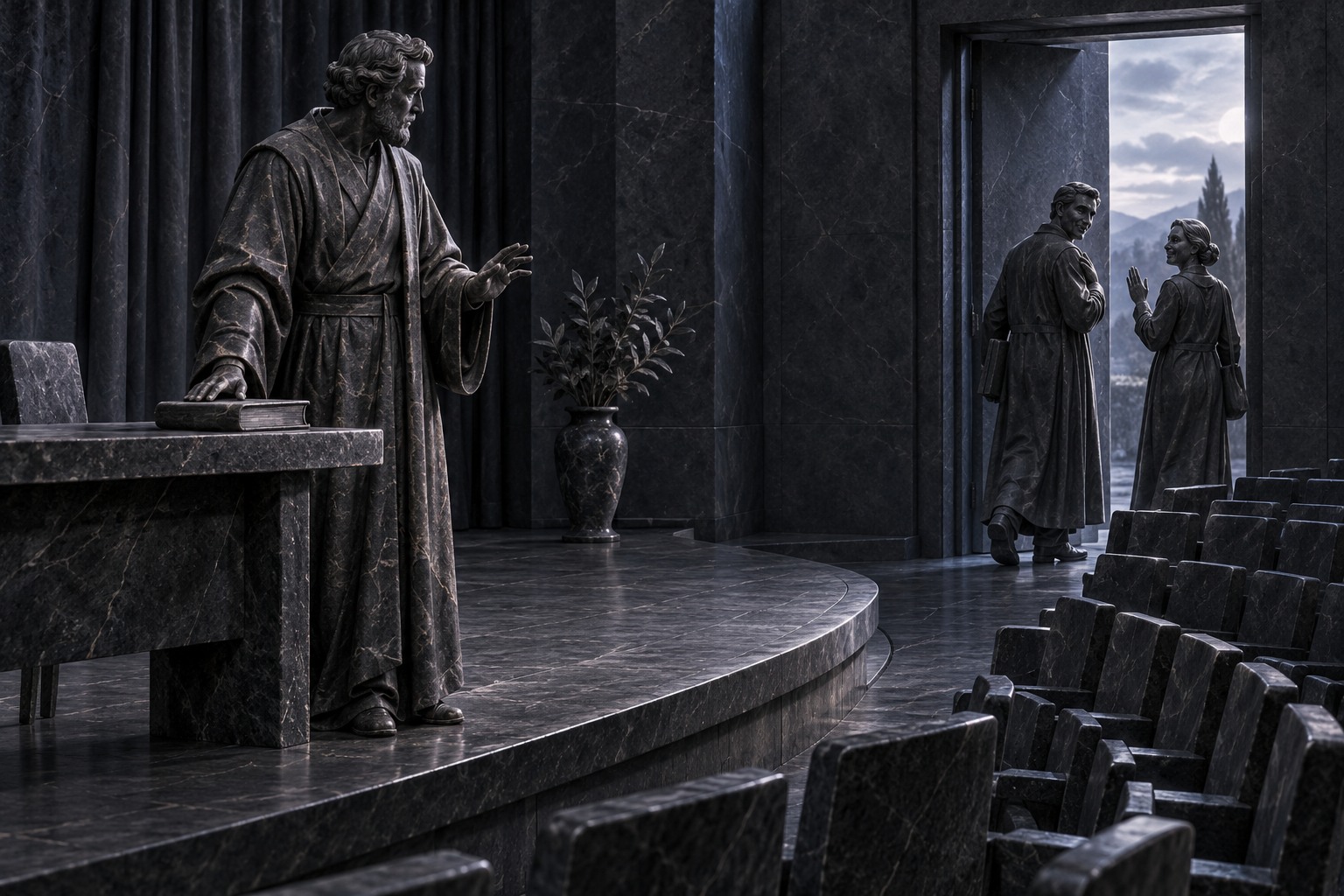
“Theory came more easily to me than practice.”
Al-Ghazali, Deliverance from Error, §81; source English translation by Richard J. McCarthy. Editorial English rendering of the approved Russian version, not the published English wording.
About this article
Someone explains why vanity should be abandoned, yet awaits admiration for that very explanation. This hypothetical scene leads to a difficult question in al-Ghazali: when does sound knowledge stop concealing an unsound intention? We move from his account of doubt to criticism of particular philosophical positions, then to knowledge and religious life. Fire and cotton help distinguish regular observation from proof of a necessary connection. This criticism does not mean he rejected mathematics or “destroyed science.” Comparisons with Hume, Augustine and Aristotle identify actual intersections without attributing a common answer to them. His testimony is rooted in Islamic faith and Sufi practice; the contemporary applications belong to our analysis. The article invites scrutiny of grounds and motives while preserving the difference between philosophical argument, religious narrative and one's own decision.
I. When confidence ceases to be a ground
We often call whatever we feel confident about knowledge. Until a serious objection arises, the substitution is almost invisible. We navigate familiar streets, recognise a voice and repeat family histories. Such confidence often helps us, but its strength does not explain why a belief is true.
A teacher finishes an explanation and gets exactly what he wanted: his listeners agree. In this hypothetical scene, his arguments are accurate, voice calm and reputation impeccable. That evening he notices he remembers the admiring faces more than the question discussed. Was he teaching truth or collecting proof of his importance? The correct answer in class does not settle this question.
In Deliverance from Error, al-Ghazali describes noticing how children adopt their surroundings' faith and seeking knowledge protected from error. This is his account of an intellectual and spiritual journey, not an impartial record of every religion. We use Richard J. McCarthy's translation, opening paragraphs 6–15.
Compare our hypothetical case. Two people sincerely hold opposite explanations of an event. Each heard their version from childhood. Sincerity does not remove disagreement. What is asserted, what evidence is available, and what inference from evidence does each accept?
Upbringing does not necessarily deceive. Language and habits convey much accurate information. The problem begins when a belief's origin replaces its justification: “That is what I was taught” answers everything. Criticism then feels like an attack on family or belonging, although the question may concern one argument.
The reverse substitution is equally dangerous. “I worked it out myself” guarantees nothing either. We can independently repeat a common mistake without recognising its origin. Independent thought depends on recognising grounds, limits and objections, not on having no influences.
The first useful question is therefore modest: what supports this particular belief? Answers may include testimony, observation, reasoning or religious trust. These differ. Handling them honestly begins by ceasing to call them all “obvious.”
Distinguishing grounds does not require living without trust. Personally checking every report is impossible and would undermine cooperation. But trust can be specific: whom do we trust, about what, and why? A friend may reliably report what they saw without becoming an expert on its explanation. A researcher may analyse data competently without knowing a particular family's circumstances. Naming trust's scope makes rejecting a broader assertion compatible with respect. We preserve a relationship without promising universal agreement. Trust can then be refined rather than merely maintained or broken.
II. Doubt directed at the means of checking
Ordinary doubt assumes a reliable way of settling the question. Unsure whether a door is shut? Look. Unsure about a calculation? Recalculate. But what happens when scrutiny targets the means themselves? If sight sometimes misleads, why trust this observation? If reasoning can err, how do we check reasoning about reasoning's reliability?
In these paragraphs al-Ghazali moves from distrust of the senses towards questioning reason's primary truths. He explains restored trust through divine light, not a new inference from proven premises. We convey the author's religious self-description, not a reproducible experimental explanation.
Distinguish refutation from the possibility of refutation. Showing a mistake in a calculation refutes that result. Saying calculations sometimes go wrong does not show a mistake here. Radical doubt asks whether every possibility of error can be excluded. This demand is stronger than testing a particular assertion.
The demand has a cost. Proof requires initial rules: expressions must retain their meaning and conclusions follow from premises. If everything is questioned simultaneously, we cannot quietly use those rules to declare doubt's final victory. That declaration also claims meaning and justification.
Readers need not accept al-Ghazali's religious answer to recognise the difficulty. What kinds of trust make inquiry possible, and which can be corrected within it? We refine sensory reports through other observations, instruments and reasoning. Yet correction presupposes a distinction between better and worse justified judgements.
This proves no chosen faith. It limits hasty scepticism: recognising knowledge's vulnerability does not make every answer equally good. Doubt becomes substantive when it specifies what remains unestablished rather than distributing indiscriminate uncertainty.
III. Criticising philosophers requires understanding philosophy
Al-Ghazali is sometimes reduced to a convenient scene: a religious thinker rejected reason, and inquiry stopped. Close reading defeats that scheme. In Frank Griffel's study, §§3–4, The Incoherence of the Philosophers is examined as a substantive philosophical criticism of particular doctrines and claims to demonstration. Accepting philosophical tools coexists with severe religious condemnation of some positions.
This unsettles simple camps. Someone may use logic while disputing a metaphysics. They may acknowledge one proof yet deny that the next argument reaches its standard. “Philosophy” is too broad for accepting or rejecting it to explain a position without distinctions.
Consider a hypothetical dispute. One participant offers a calculation, an account of an event and a claim about the world's ultimate ground. Another finds an error in the third. That does not refute the calculation. Nor does the successful calculation automatically confer reliability on the metaphysical conclusion. Each transition must be supplied separately.
Critical discipline begins by reconstructing an opponent's assertion so they could recognise it. Identify an unestablished premise or an inference that fails. Then limit the result: have we shown that this proof fails, that the proposition is false, or merely that clarification is required? These are different achievements.
Historical al-Ghazali was not a contemporary neutral discussion moderator. His religious condemnations had serious significance and consequences; they cannot be softened into a friendly invitation to unrestricted inquiry. Respectful reading requires neither defending every judgement nor deleting difficult parts of his position.
Our inquiry can preserve procedural precision without adopting that historical degree of condemnation. Explain why an argument fails. If a critic misrepresents an opponent, check against the opponent's sources. The critic's authority does not remove this duty. Criticism strengthens when readers can verify it independently of the name on the cover.
Distinguish truth from demonstrated truth too. Someone may guess correctly while offering bad grounds. Correcting the grounds leaves the answer unchanged but changes our justification for invoking it. Conversely, a faulty argument does not always prove the opposite proposition. If one explanation of an event lacks support, another is not thereby established. Evidence may be insufficient for both. That intermediate position lacks a victory declaration's drama but describes inquiry more accurately. It admits new evidence without tying a person's dignity to an unchanging account.
IV. Why he did not “destroy science”
In the mathematics and logic sections of Deliverance from Error, paragraphs 37–45 in McCarthy's translation, al-Ghazali distinguishes demonstrative knowledge from religious questions. He warns against extending mathematicians' authority to every opinion and against denying exact knowledge to defend faith. The text also contains restrictions and concerns about education. Making him an advocate of modern scientific freedom would likewise be anachronistic.
A claim that one person destroyed science requires different evidence from disagreement with philosophers. Explaining changes across a large intellectual world would require information about education, institutions, books, practices and people over time. An influential text can have consequences, but influence must be established, not inferred from a dramatic headline.
Notice this explanatory error's sequence. First select an outcome, then find a conspicuous opponent of a doctrine and connect them directly. Intermediate processes disappear. Readers get a drama with one culprit and lose distinctions between fields, periods and interacting causes.
Nor can an author be vindicated merely for acknowledging some sciences. Mathematics' demonstrative status does not settle research's permissibility, institutional freedom or treatment of dissenters. Historical assessment may contain tensions no single positive or negative label resolves.
Our contemporary conclusion concerns authority. Suppose a renowned specialist explains a phenomenon accurately, then pronounces on something entirely different. Their competence warrants attention but does not remove the need for evidence in the second case. Reputation draws us towards the argument; it does not replace it.
Likewise, disliking an author's worldview does not falsify their measurements. Checking measurement and evaluating worldview are different tasks. Mixing them lets our affiliation govern facts. The argument then loses even when it seems won: it no longer explains the original subject.
V. Fire and cotton: what observation shows
In Discussion XVII of The Incoherence of the Philosophers, al-Ghazali considers cotton burning on contact with fire. He disputes the connection's necessity, discusses divine action and allows miracles. The text contains different responses, not one declaration that events are wholly disconnected. The available English translation is by Sabih Ahmad Kamali; our account preserves the theological context.
No hands-on test of fire is needed to examine the question. Distinguish three judgements: an event happens regularly; there are grounds to expect it again; and it could not happen otherwise under any conceivable conditions. The last exceeds the first two. It requires additional premises about things' nature and the limits of possibility.
This distinction is not itself a modern scientific theory of causation. Natural inquiry tests conclusions in many ways, not by observing adjacent events once. A medieval dispute cannot be declared a refutation of all experimental knowledge. Equally, a regular connection should not quietly become an exhaustive metaphysical account of its ground.
A hypothetical device stops working after a software update. The sequence reasonably directs investigation. It does not exclude overheating, a damaged connection or coincidence. Further checks distinguish explanations. Once a cause is found, its scope remains: this device, this software version, or all similar cases?
Al-Ghazali's religious question differs: does events' ordinary order constrain divine possibility? Belief in miracles and analysis of experimental conditions have different grounds. We can discuss an argument's philosophical strength without presenting religious testimony as a laboratory result.
The practical distinction does not tell us to stop trusting regularities. Safe, responsible action takes justified expectations into account. A possibility considered in metaphysical debate does not promise an unusual outcome for a particular action. An open question about the world's ground does not remove caution within the world.
VI. Knowing about life and living according to knowledge
In the Sufi section of Deliverance from Error, paragraphs 80–88, al-Ghazali distinguishes learning a teaching from realising it. He describes examining his teaching motives and a severe crisis before leaving Baghdad. This is retrospective religious testimony; we do not assign a modern medical diagnosis.
The difference needs no retelling of his biography. Someone can explain why interrupting is unfair and still interrupt whenever a discussion touches their reputation. They know the rule but cannot yet sustain it under precisely the conditions that most require it.
At least three abilities differ: formulating a sound proposition, recognising the situation it concerns, and acting accordingly when time, comfort or recognition is at stake. The mistake often hides between the second and third: someone sees what they should do and immediately invents an exception for themselves.
Theory is not useless. Without clear understanding, we may persistently practise mistaken behaviour. But theory cannot replace attention to action. If reading only gives new words to justify old habits, knowledge grows while relationships remain unchanged.
For al-Ghazali, realising religious life concerns God, purification of the heart and salvation. It cannot be reduced to efficiency, calm or convenient self-control. A contemporary analogy may clarify the problem without exhausting the original path's purpose.
Our narrower application asks: what observable action would change if I took my judgement seriously? Valuing accuracy, will I correct my mistake publicly? Valuing gratitude, can I name another's contribution without returning the story to myself? This does not prove metaphysics but reveals the gap between declaration and conduct.
Another boundary follows: an experience that changed my life need not prove my explanation to others. Someone may acknowledge changed behaviour and still question its causes. Testimony deserves attention; attention need not end in shared faith. Rather than compel assent, specify what happened, what it meant to you and which conclusions you propose discussing. The listener can distinguish event, experience and interpretation. Respect for spiritual experience does not make every interpretation irrefutable; criticising an interpretation does not require humiliating the person who values it.
VII. Heart, intention and self-deception
In Chapter I of The Alchemy of Happiness, translated by Claud Field, the heart names the person's inner principle, not merely an organ. Self-knowledge points towards knowledge of God; reason and desires concern spiritual discipline. Using “heart” for any strong feeling is insufficient here.
Do not confuse sincerity with a pleasing conviction of purity. Someone may feel honest while selectively preserving flattering facts. Examining intention asks what they seek, whom they will ignore, and which loss they find unacceptable.
Return to the teacher. He may genuinely want understanding and also admiration. A mixed motive does not falsify every explanation. But seeking recognition may influence his choice of questions: he answers where he can shine and avoids admitting ignorance.
Our analysis does not demand absolute selflessness before every action. That demand can make someone endlessly preoccupied with themselves. Notice a motive's specific influence and change an action: let the student finish, correct an inaccuracy, or postpone a dazzling answer until it is checked.
External consequences matter too. Good intentions do not remove harm. If help humiliates, the helper's account of goodness leaves a question unanswered. The recipient may report what happened to them. Responsibility joins attention to motives with willingness to hear consequences.
In Chapter VI of The Alchemy of Happiness, self-examination and recollection of God concern accountability to Him and the life to come. Our comparison of everyday words and actions is narrower. It reveals discrepancies without replacing that religious perspective or promising spiritual attainment.
Judge others' intentions cautiously. We observe conduct and hear explanations without full access to inner life. Name a mistake and its consequences; claiming someone necessarily intended deception needs further support. Examining our motives and accusing another of hidden motives involve different responsibilities. Otherwise ethical rigour becomes a way to win: attribute vanity, then ignore the argument. Talk of a pure heart itself becomes an escape from honest scrutiny.
VIII. The same difficulty does not yield the same explanation
Different texts contain a gap between confident explanation and experienced difficulty. Examine its grounds in each. Comparison does not prove that authors describe one spiritual system in different words.
In Discussion XVII, al-Ghazali examines the move from jointly observed events to a necessary causal connection. In Hume's Enquiry, V.I, §§36–38, repeated experience relates to the habit of expecting one event after another. The shared question is clear: expectation needs explanation. Yet Hume investigates inference from experience, while al-Ghazali debates divine action and miracles. Equating them would strip one of its religious subject and add an unclaimed theological conclusion to the other. Comparison remains substantive without asserting direct historical influence.
A different transition concerns action. In Book VIII of the Confessions, Augustine describes understanding that does not end postponement. In §§80–85, al-Ghazali examines learned knowledge of the path against his life. Both resist the convenient thought that only another explanation is missing. But these are appeals to God in different religious histories, not reducible to productivity advice. Readers may understand the question without borrowing another's history as a description of their symptoms.
Aristotle on ethical habituation offers another approach: actions form a quality. Alongside al-Ghazali's scrutiny of intention, it separates what was done from its purpose. Repetition does not guarantee a pure motive; a clear motive does not perform an action for us.
The map's specificity helps our teacher. He can examine the lecture's argument, teaching's consequences and dependence on praise separately. Success in one does not remove another. Vanity does not alone falsify a good thought, but the thought does not prove he lives by it. This makes self-examination more precise and less theatrical.
IX. Knowledge that does not hide behind being correct
Productive reading retains al-Ghazali's tensions. He examines grounds, uses arguments and distinguishes fields of knowledge; his path remains religious, and some historical condemnations require critical attention. Making him merely reason's opponent or a modern critical thinker impoverishes the subject.
The tension challenges two comforts in our lives: inherited confidence as sufficient knowledge, and intellectual correctness as sufficient virtue. We may understand an argument better yet act unjustly. We may sincerely seek goodness yet misexplain events.
Truth and ways of living are connected but distinct questions. One tests assertions; the other notices motives and consequences. They meet when knowledge stops shielding us from responsibility. Admitting an error continues inquiry rather than defeats it.
Our teacher need not immediately abandon teaching to prove his seriousness. A less theatrical beginning is to open a question he cannot yet answer and let a student identify an inaccuracy. This does not repeat al-Ghazali's biography. It tests whether knowledge serves the subject or still demands admiration.
Suppose a student identifies an error and the teacher first notices an insufficiently respectful tone. That does not prove a single hidden motive. He can check two questions separately: is the objection correct, and how should its form be discussed? An unpleasant remark may be accurate; accuracy does not make every speaking style useful. He can correct the explanation before its audience, then agree on respectful discussion. If tone merely prevents correction, intention has a specific object for scrutiny. What does he protect first when acknowledging a mistake is accuracy's price?
Inquiry thus continues in two directions: refining what we can justifiably say and noticing what we do with knowledge. Neither finally releases us from the other. Their combined demands keep the question of knowledge and religious life alive.
What this means in practice
Choose an assertion you recently defended intensely. Write it without supporters' or opponents' names. Identify its grounds: observation, testimony, reasoning or faith. Separate mixed grounds before discussing the conclusion's truth.
Name the strongest relevant objection. “Nobody knows anything” is usually too broad. “Does this observation entail this conclusion?” helps more: identify a missing premise or refine the inference's scope. An unanswered question is a specific uncertainty that can be worked on.
Then examine authority. Remove a respected thinker's name and ask what remains of the argument. Restore it and consider what trust reasonably contributes: finding sources, understanding terms, beginning inquiry. Do not require trust to prove every thought immediately.
Find one action where the stated conviction should appear. Avoid redesigning your entire character. Choose a situation: acknowledge someone's contribution, report an error, or clarify a question instead of answering confidently. Afterwards assess what was done and needs correction, not the intention's beauty.
This sequence is our contemporary exercise in precision and responsibility. It is not Sufi guidance, religious prescription or a way to receive revelation. Readers within a tradition relate it to their own grounds and competent religious guidance without confusing genres.
Set an endpoint for checking too. Once sufficient grounds support a limited action, revisiting the same doubt may add nothing. Responsibility includes acting with justified, though not absolute, confidence and revising when new information appears.
Finally, what new evidence could change your conclusion? If “none,” examine whether the assertion is testable. It may concern a religious commitment, personal decision or definition, requiring another conversation. But asserting a fact while excluding correction makes checking decorative. State a revision condition before unwelcome evidence arrives: independent corroboration, a document, or a reproducible calculation error. This makes changing the rules after discovering the outcome harder and openness to objections visible.
Key quotation
“[My intention in public teaching] was not directed exclusively towards God.”
Al-Ghazali, Deliverance from Error, §85, the passage on his teaching intention; source English translation by Richard J. McCarthy. Editorial English rendering of the approved Russian version, not the published English wording. The brackets clarify the subject from the immediately preceding part of the sentence. He acknowledges his own intention, not the worthlessness of all teaching.
Connections across traditions
These are our analytical comparisons. Historical influence is not asserted without evidence.
| Subject | Positions and supporting texts | What can be compared | Where the boundary lies |
|---|---|---|---|
| Observation and necessity | Al-Ghazali, Discussion XVII — Hume, V.I, §§36–38 | Repeated observation differs from the grounds of causal expectation. | Divine action and habit do not yield a single theory of causation. |
| Explaining causes | Al-Ghazali: causation, Griffel's survey — Aquinas, I q.2 a.3 | Cause requires explanation beyond a list of events. | God and secondary causes cannot be related identically by assumption; different interpretations of al-Ghazali are discussed. |
| Knowing and beginning to act | Al-Ghazali, §§80–85 — Augustine, VIII.7–8 | Understanding can coexist with postponing change. | These different religious testimonies do not establish an identical doctrine of conversion. |
| Quality and intention | Al-Ghazali: intention, §85 — Aristotle, Ethics II.1 | A correct description alone does not constitute an ethical life. | Acquired virtue is not identical to directing action towards God. |
| Praise and responsibility | Al-Ghazali: teaching motives, §85 — Epictetus, §§1–2 | External recognition does not precisely measure one's action. | Stoic distinctions of control and Sufi scrutiny of intention have different ultimate purposes. |
Sources
Primary texts, normative documents and research commentary are distinguished in the descriptions. This heading does not make a reference study a primary text.
- Al-Ghazali. Deliverance from Error (al-Munqidh min al-Ḍalāl). Richard J. McCarthy's translation, published in Freedom and Fulfillment, 1980; electronic reproduction. Opening paragraphs 6–15, mathematics and logic 37–45, and the Sufi path 80–88. Translation.
- Frank Griffel. al-Ghazali. Stanford Encyclopedia of Philosophy. §§3–5 and 7, distinguishing criticism of proofs from rejection of philosophy, ethics and different readings of causation. Scholarly article.
- Al-Ghazali. The Incoherence of the Philosophers, Discussion XVII. Sabih Ahmad Kamali's English translation as reproduced on the site; page metadata indicates translation through Urdu. Opening, uncertainty objection and two replies. Discussion of causation.
- Al-Ghazali. The Alchemy of Happiness, Claud Field's translation, Chapter I: The Knowledge of Self. The heart and self-knowledge's religious purpose; not treated as an exhaustive critical edition of the Persian work. Chapter I.
- Al-Ghazali. The Alchemy of Happiness, Claud Field's translation, Chapter VI: Concerning Self-Examination and the Recollection of God. The religious frame of self-examination. Chapter VI.
- David Hume. An Enquiry Concerning Human Understanding, V.I, §§36–38. Primary text: habit and inference from past experience to an expected event. Text and passage used.
- Augustine. Confessions, VIII.7.16–18 and VIII.8.19; New Advent English text. Primary text: self-examination, postponing conversion and difficulty acting. Text and passages used.
- Aristotle. Nicomachean Ethics, II.1–2, 1103a–1103b; English translation by W. D. Ross. Primary text: acquiring ethical qualities through action. Text and passages used.
- Epictetus. Enchiridion, §§1–2; English translation by Elizabeth Carter. Primary text: what depends on us and what does not. Text and passages used.
- Thomas Aquinas. Summa Theologiae, I, q.2, a.3, the third way. Primary text: possibility and necessity; New Advent English edition. Text and passage used.
Tags
al-Ghazali, Islamic philosophy, kalam, Sufism, doubt, certainty, knowledge, intention, self-deception, practice, religious life, Deliverance from Error, Incoherence of the Philosophers, causation, observation, necessity, fire and cotton, miracle, mathematics, science, argumentation, heart, vanity, teaching, Hume, Augustine, Aristotle, Epictetus, responsibility, comparison across traditions
About the authors
Andrey Zarinsh is the author and founder of United Wisdom. He explores inner transformation, the unity of traditions, intercultural dialogue and contemporary spiritual discipline. Instagram: @andrey.zarinsh.
Maria Evilkut is the co-author of United Wisdom. Alongside her research, she seeks to test these ideas in practice and observe how principles of unity and mutual understanding work in real life between people and cultures. Instagram: @ilkutki.
Keep what resonates with you.