
World & consciousness
Alchemy: matter, images, and later psychological readings
Alchemical work and symbols, distinct voices in an old volume, and later scientific and psychological interpretations.
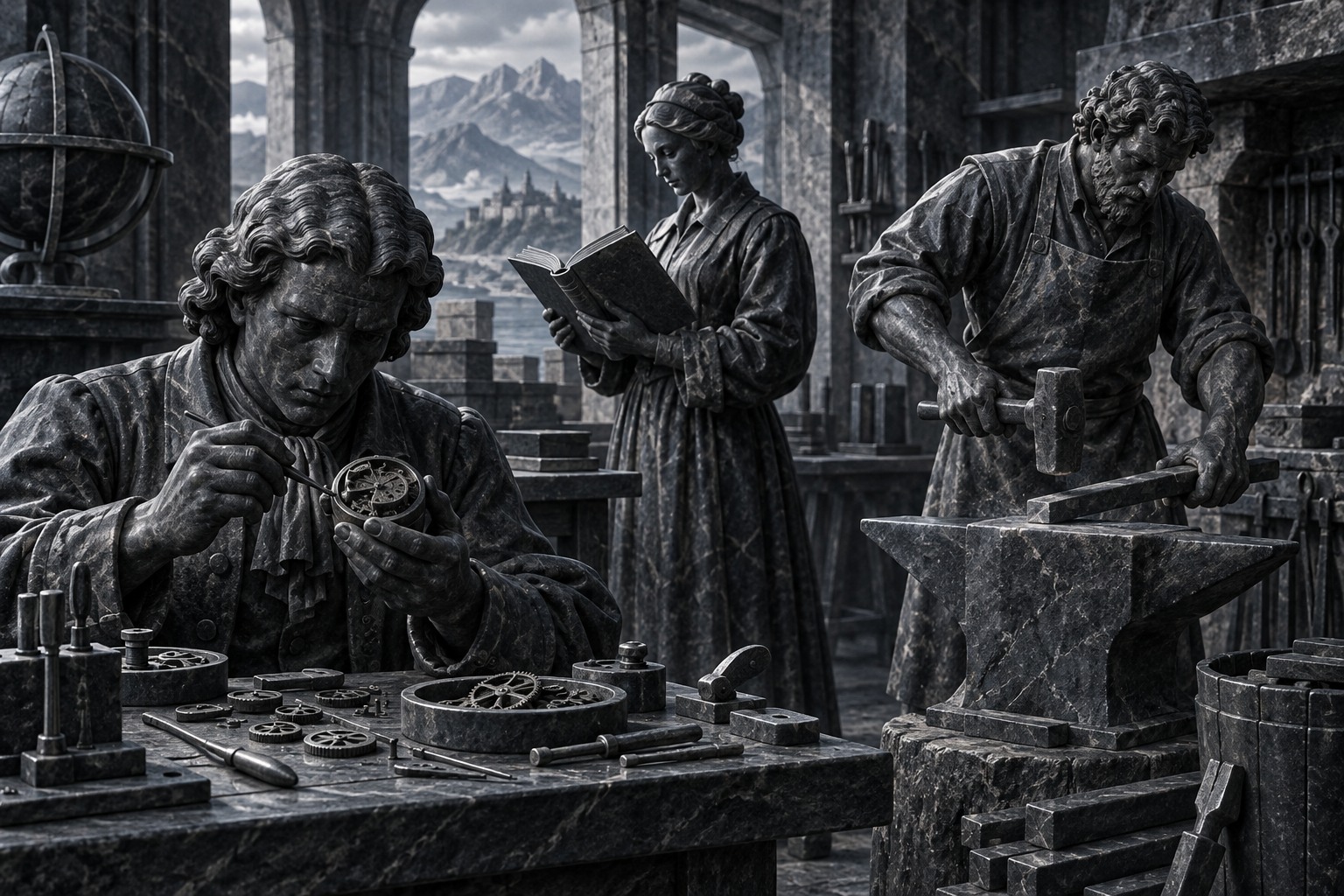
“Simplicity or plainnesse is the seal of truth.”
Michael Sendivogius, A New Light of Alchymie, the author's preface; English translation by John French, 1650. Original English wording. Source.
About this article
In a book from 1650, Sendivogius compares the chemists of his day and the old philosophers to a clockmaker and a blacksmith. Both work with iron, but mastery of one craft does not mean mastery of the other. The unexpected image raises a serious question: what can a researcher actually do, and does that ability match the promised result? Behind the familiar word “alchemy” lies a dispute about knowledge, work, and the direction of inquiry.
Alchemy brought together work with substances, ideas about nature, and a language of images. No single formula describes it: neither “failed chemistry” nor “secret psychology” covers the diversity of texts and activities. Here we will consider why transforming metals seemed possible, how laboratory operations stood alongside religious meaning, why authors used riddles, and what changed when alchemy began to be read as an account of inner human development. The psychological reading will be considered as a separate, later layer with questions and limits of its own. The practice concerns reading an image carefully: distinguishing a process description, a historical interpretation, and our own association. This does not require accepting the alchemical picture of the world or repeating its recipes.
I. A word that conceals several activities
“Alchemy” brings together texts from different periods and languages with different aims. Discussing it becomes more precise if we first ask who works, on what, for whom, and toward which result. Producing a dye, preparing a medicine, and searching for a means of transforming metals can use similar tools while addressing different tasks. A shared vessel does not make these activities one teaching.
A historian must reconstruct the actions and ideas available to a particular author. They cannot begin with the ready-made modern divisions of “science,” “religion,” and “symbolism” and then file every line into a box. Early texts drew these boundaries differently. Belief in nature's order could encourage experiment, and experiment could be interpreted within a religious worldview. This combination does not prove a conclusion correct, but it explains why the work made sense to its participant.
A Science History Institute overview places material work alongside theoretical expectations: making imitations of precious materials, processing substances, medical tasks, and the hope of transmutation. It presents Lawrence Principe's research; this is a review that was read, not a substitute for reading his whole book. Michal Meyer, Gold, Secrecy, and Prestige.
For the reader, a useful starting question follows. If a book mentions gold, it may mean a metallic product, economic value, nature's perfection, or a spiritual image. Sometimes meanings join. But their joining must be shown in the text, not inferred from one word. First the subject, then interpretation — this preserves both the alchemist's work and the later reader's freedom.
II. Why the expectation of transformation did not seem senseless
Turning lead into gold is easily pictured today as a caricature of greed. Historical understanding benefits more from reconstructing a question about metal's composition and capacity for change. If metal is understood not as a final, indivisible kind of matter but as a combination of principles, changing that combination may seem plausible. The mistake is not necessarily the interest in transformation itself, but a particular model of what transforms and how.
Heating, dissolving, and precipitating show that a familiar thing can lose its appearance and arise again in another form. This observation does not imply that any metal can be obtained from any other. But it creates intellectual room in which the question remains open. The history of knowledge includes precisely such transitions: the observation is real, while the extended conclusion may be wrong.
“Alchemists observed nothing” differs from “They explained their observations incorrectly.” The first erases craft; the second allows its achievements and errors to be studied. Likewise, a useful result from one operation does not confirm the author's entire cosmology. A good dye can be made by someone with a mistaken theory of matter. Failed transmutation does not destroy knowledge of a furnace, a mixture's composition, or purification.
This distinction protects against two temptations. One declares the past complete darkness. The other says that because old masters worked with real materials, modern science will someday confirm every supposition they made. Both avoid particular evidence. Respect for historical work takes a harder form: establishing which actions were performed, which results achieved, and which conclusions the author added.
III. Nature as a teacher: Sendivogius's example
In the first treatise of A New Light of Alchymie, nature is an active whole created by God. An observed body expresses its work, and the researcher must relate their intention to what it can produce. John French's English edition of 1650 retains this religious horizon. Sendivogius, First Treatise.
This is not permission to turn anything into anything. The author requires work within a kindred nature: work on metal must begin with metallic material. Nature's universality thus stands alongside a limit on the permissible transition. The common origin of things does not make every recipe meaningful. We encounter a particular ground for selection, not merely admiration for the world's possibilities.
Examine the reasoning. A view of the world is established first, then the possibility of an operation is questioned, and finally requirements are set for whoever performs it. Patience and integrity belong to this last part; they do not replace the first two. The modern advice “be persistent” therefore conveys only part of the author's thought. It says nothing about why this particular material should give this particular result.
The clockmaker and blacksmith comparison complicates the picture of progress. Sendivogius notices many new operations but does not consider their number sufficient evidence that the old goal has been reached. His question is whether there are more techniques or a clearer understanding of what is sought. We can dispute the promise of the philosopher's stone and still recognize the precise distinction between technical inventiveness and solving a task.
The alchemical book becomes interesting here as an argument. It does more than hide a secret behind attractive words: it proposes a measure of action. How correct that measure is needs separate investigation. Yet it can be reconstructed: possibility is determined by nature's structure, skill by handling material, and the researcher's worth also by their treatment of people. These lines connect while retaining different functions. Removing any one gives us a more convenient but different author.
IV. Matter resists a beautiful scheme
A laboratory does more than produce an expected result. It creates a place where expectation meets a material's resistance. A vessel may crack, a mixture remain unchanged, a product show an unexpected color. The author's theory must somehow survive this encounter. Sometimes it is refined; sometimes failure is attributed to the fire, impure matter, or the master's inadequate preparation.
One case cannot settle whether this is a reasonable check of conditions or a defense of a teaching against every refutation. The difference emerges across a series of actions. Does the recipe change after failure? Are conditions recorded? Is there a way to acknowledge that the substance lacks the expected property? These questions address practice, not the label “alchemist.”
History thus becomes a history of work. Time, cost, training, and access to material matter within it. The idea of a single secret often obscures many acquired skills. Even a clear record does not automatically pass on the ability to handle a tool. Anyone familiar with a craft understands the difference between a read instruction and a precise movement of the hand. This contemporary comparison helps us picture the difficulty of transmitting knowledge; it does not establish that a modern craft and alchemy are identical.
A participant could be wrong about the final goal and still distinguish intermediate states attentively. Alchemy's historical worth therefore does not require retrospective confirmation of the philosopher's stone. It can lie in particular techniques, observations, and ways of posing a question. We understand the past better when we do not force it to be either a winner or a complete failure on a single contemporary scale.
V. Why the text speaks in riddles
An image makes an invisible distinction memorable while also making reading harder. A lion, a marriage, death, and birth may name more than narrative characters. Their function depends on neighboring words, genre, edition, and the author's practice. A dictionary of symbols is useful as a starting point but dangerous as an infallible decoding machine.
Secrecy also varies. A craftsperson protects knowledge on which income depends. A religious author distinguishes a prepared from an unprepared reader. A writer creates a riddle that demands rereading. Several motives may operate together. Explaining all the complexity solely as an intention to conceal “true psychology” replaces investigation with a guess.
Local context matters especially in texts with figurative language. Suppose an animal description is followed by dissolution, filtration, and residue. This is a basis for checking a material interpretation. If sin, prayer, and salvation appear nearby, religious meaning needs considering. But no neighboring term alone settles the task. A good hypothesis must explain the sequence, not one striking match.
This approach has a practical strength: permission to leave a passage unclear. “Two readings are possible here” is sometimes more precise than a finished solution. The unknown need not be decorated with mystical certainty. It can indicate what information is needed next: another manuscript, an operation's description, an edition's history, or the same author's use of a word. The riddle gains a continuation in research, not only an emotional aura.
VI. Two books of knowledge: nature and faith
In To the Reader, John French proposes reading nature and Scripture with reason. This is the translator's voice, not another page of the author's treatise. He explains why he considers publication useful to the English reader and connects investigating matter with understanding God and humanity. French, To the Reader.
This connection looks different from the simple formula “alchemy was spiritual.” Faith here does not require abandoning reasoning; reasoning receives a religious task. Readers are to learn the grounds of trust and to distinguish claims. The translator also promotes the book's merits, so his confidence itself becomes a subject of assessment. The address presents a program for reading, not certification of every promised result.
Compare this with Sendivogius's first part. The author asks whether an intention agrees with nature's possibilities. French explains why studying nature can help in reading a sacred text. The first centers on the boundary of action, the second on a connection between two areas of knowledge. These are different arguments within one volume. A shared religious frame lets them meet but does not make their statements identical.
Psychological interpretation poses a further, separate question: what happens to a person encountering such images? It may be productive, but it does not by itself explain the translator's interest in reading Scripture rationally or the author's interest in metallic material. Historical reading reconstructs the subject of each voice before discussing its contemporary use.
The result is not a choice between furnace and soul, but several connected activities. Work with matter, religious reasoning, and moral requirements could support one another. Understanding their proximity requires following the transitions: when a possible operation is described, when trust is grounded, and when a question of how to live arises. These transitions make the book more complex than an unambiguous label.
VII. Redgrove: reading the past through the science of one's time
H. Stanley Redgrove's 1910 preface does not stop at a peaceful appeal to respect chemical and mystical readings. He proposes something stronger: in his view, alchemists' account of matter's common origin accords with the latest scientific ideas of his time. He turns to changes in elements and ether theory, hoping to restore philosophical worth to the old picture. Redgrove, 1910 preface.
For us, this is first a particular example of later reception. A historical author assesses earlier knowledge through his own scientific horizon. His book shows not only alchemy but the expectations of the early twentieth century. It cannot therefore be used as a transparent window into the intentions of everyone who worked with substances several centuries before.
Consider the argument's strength and limit. A similar general question — how different forms arise from one — can connect researchers. But the answer depends on what they understand by one, form, and transformation. Restoring a shared question enriches history; declaring the explanations identical needs further proof. Redgrove leans toward the stronger connection. Our reading preserves this as his position and checks what is actually compared.
This offers a substantive possibility for conversation between traditions. An old theory can be read without mockery, with attention to its question about the world's connectedness. Its account of matter can remain unaccepted at the same time. Recognition of a philosophical task then does not depend on a promise that new science must confirm every old scheme. The worth of a question and the success of its answer receive different measures.
Redgrove also criticizes one-sided interpretations: a chemical reading loses mystical language; an exclusively mystical one loses physical operations. This dispute becomes useful after examining particular pages by Sendivogius and French: we can already see which sides would disappear in each selection. The later author stops being just another witness to an “eternal secret” and becomes a participant in a particular debate over an inheritance.
VIII. Jung: a sequence of dreams becomes the material
Carl Gustav Jung approaches alchemy through another research task — individuation, the development of a more whole personality. In the professional IAAP abstracts of Psychology and Alchemy that were read, the material is one person's sequence of dreams and visual impressions; mandala images are connected with the emergence of a new center of the psyche. An institutional abstract of the book is used here, not a claim to have read the full original. IAAP, abstracts 000396–000399.
The material's specificity changes how the method is understood. The researcher works with the order in which images appear, not one convenient drawing. Meaning is sought in their context and change. This permits a question a dictionary of fixed symbols misses: what does a particular image do in this particular sequence and this person's life?
Alongside it appears a hypothesis of projection: content of the psyche may be experienced as a property of the substance on which an alchemist works. The direction of explanation now matters. Sendivogius explained possibilities for action through nature; a Jungian reading investigates the psyche's part in seeing nature. This turn may produce an independent result but does not cancel the material question of what was in the vessel.
Compare three subjects. For Sendivogius, the possibility of work and the researcher's qualities. For Redgrove, the relationship between an old picture and the science of his age. In the Jungian material presented, changes in images and psychic structure. The distinction is no longer merely dates: the data, question, and way of testing an interpretation change. One author's answer cannot therefore be transferred to another by retaining only “transformation.”
A contemporary reader still has the right to investigate a personal association. This does not require declaring it the alchemist's intention or promising a therapeutic result. An image's value appears in whether it helps formulate the task being experienced more precisely. Historical reconstruction requires different material. Separating these kinds of work leaves room both for inner meaning and for another's history, which we have not appropriated.
IX. One volume, several voices
The English volume of 1650 places the translator's address, the author's preface, and works with separate attributions beside one another. The title page names not only Sendivogius but texts attributed to Paracelsus, along with a chemical dictionary. The book's composition already requires asking whose particular thought we encounter. Title page and addresses to the reader.
Sendivogius's preface connects publication with false recipes and deceit. He wants to distinguish his evidence from empty promises while considering knowledge a gift that carries responsibility. Publicity and secrecy are not absolute opposites: he gives a text to seekers but retains an idea of worthy and unworthy recipients. This particular tension explains why an openly printed book can speak the language of limited access.
French's address foregrounds another task: justifying translation and proposing a way to read. He explains the book's usefulness and his own choice of language. This information lets transmission of knowledge be discussed without mixing translator and author. Even agreement between two voices does not turn them into one biography or one argument.
What is lost through selection is now clear. Keeping only the promise of transmutation misses trust and the moral use of knowledge. Keeping only moral requirements forgets the material aim. Choosing only images for contemporary self-examination makes a new work from old material. Each task is permissible when named; the problem arises when the selected result is presented as the whole book.
This work with voices is more useful than searching for one hidden author. It restores the reader's ability to check a particular transition: who makes the claim, on what grounds, and to whom? The answer depends on the page, not the appeal of a general name. Inheritance thus becomes a history of particular transmissions and changes in which a later reader can participate while preserving earlier people's independence.
X. Not every change turns one metal into another
A material operation and the model explaining it may diverge. Consider a workshop where a substance changes color after processing. The observation deserves recording: conditions, sequence, and appearance of the result. But “it became gold” adds a claim about composition. Distinguishing the surface from the substance requires a new check. This hypothetical example explains a historical problem; it does not reproduce a particular alchemical recipe.
The move between appearance and substance matters especially in a culture where making imitations of precious materials stood alongside the expectation of transmutation. The Science History Institute overview shows this proximity without reducing the whole subject to conscious fraud. Gold, Secrecy, and Prestige. A craftsperson might know they were making an imitation; another seeker might consider it an intermediate result in real transformation. The same outward effect allows different explanations and economic aims.
A distinction follows between knowing a technique and knowing a cause. Someone can reliably obtain a color without correctly explaining how it arises. This does not devalue the skill but limits the conclusion. Success at one stage cannot be transferred to the whole promised Great Work. Nor does a false theory imply that no working technique ever produced a result. History becomes more substantive when a final label is replaced by a chain of separate actions and claims.
This chain also helps read a symbol. Blackening may describe a visible change in material; a word about death may express its religious interpretation; a contemporary reader may see in that same word the experience of losing an earlier image of themselves. Each transition has its own grounds. Observing a color change does not prove spiritual death; an inner experience does not establish a substance's composition. The meanings are interesting side by side without having to confirm one another.
Read this way, ambiguity stops being a defect that must be removed by a final key. It becomes a research question: why did the author choose this image, what might it hide or explain, and which audience did they assume? Sometimes there is no answer. An honest statement of uncertainty is more useful than confident decoding based only on our associations.
For contemporary inner work, the metaphor of successive change can be retained, but its value should be sought in present action. A person clarifies a habit, tries another way of talking, and observes consequences. This is a separate practical task. It does not turn the old laboratory into a psychotherapy room or confirm metallic transmutation. The alchemical image broadens the language of reflection; testing a human decision remains in our shared world.
XI. What remains after giving up the single secret
Alchemy is interesting because hands, theory, expectation, and image stand together within it. One person wants to change matter, another to understand nature, and a third later sees in the surviving book a language for inner experience. History begins when we stop declaring all these tasks the same.
This approach promises no convenient single formula. It lets achievements be seen without excusing mistakes, and symbolic power without substituting for evidence. Respect for the past does not require believing every hope it held. It is enough to restore people's questions, work, and limited horizon of knowledge. Even a failed theory then stops being an occasion for arrogance and becomes material for thinking about how our understanding of the world changes at all.
A later reader has a right to an image too. But the right to interpret is not the right to speak instead of the author. A personal association may be accurate for your life and inaccurate for the text's history. Acknowledging this loses nothing valuable: history keeps its independence, and contemporary meaning stops depending on a legend of secret ancient approval.
Return to the clockmaker and blacksmith. Familiar material does not guarantee a shared skill, and a new skill does not guarantee the solution to an earlier task. Behind the comparison we now see Sendivogius's particular questions, the translator's choice, Redgrove's hope, and Jung's psychological task. None needs to speak for the others. This reading preserves the inheritance's richness and helps us understand more precisely which work we want to continue today.
What this means in practice
Take a description of an alchemical image from a museum catalog or an old open edition. Do not begin with an answer about what it “means.” First, record what is visible: objects, figures, their relationships, the caption, and the date. Then separate the source's information from your response. If the source merely shows an image, it has not yet explained its meaning.
The first reading is historical. What is the genre, who created it, and which words occur nearby? The second concerns the subject. Which actions or substances may have been discussed, and is there information about an operation? The third is personal. Which questions does the image raise for you? Data may be insufficient at any stage, and “I do not yet know” remains a valid result.
A hypothetical contemporary example: an image of a closed vessel reminds someone of a situation where speaking is difficult. The association can be examined as an image: what is held inside, what does the boundary protect against, and when does it obstruct? But these are our questions about our own situation. They do not reconstruct an ancient ritual or entitle us to call every quiet person someone at an alchemical stage.
It helps to check the association against its opposite. Perhaps the closed vessel suggests preservation rather than isolation? Different readings reveal the story we add ourselves. In choosing a meaning, ask whether it describes the real situation more precisely and reveals an available action. If the image only creates a grand formula while obscuring facts, it can be set aside.
This practice requires no chemical experiment. Old recipes are not instructions for home use: the primary edition contains outdated ideas about substances and treatment. Paper, an image, and careful distinctions between levels are enough for reading. The result may be a more precise question rather than a solved symbol. This is modest but substantive.
Keep the result in three short records. The first gives what the source actually contains: a term, drawing, or sentence with a locator. The second explains the historical meaning and notes the degree of confidence. The third describes your association. For instance, a vessel image may suggest the need to pause in a dispute. This association has a right to exist, but it should remain yours unless sources establish another status.
Return to the records after some time. Has new reading changed the historical conclusion? Did the association clarify a particular action? There is no need to measure yourself against alchemical perfection. It is enough to notice which explanations became more precise and which needed revision. An image then supports attention without acquiring power over a decision or closing the possibility of learning further.
Key quotation
“The searchers of nature ought to be such as nature her selfe is”
Sendivogius, A New Light of Alchymie, First Treatise; John French's English translation, 1650. Original fragment from this edition. Source. In the author's context, this requires aligning inquiry with nature and the seeker's qualities. It does not prove alchemical theory; for our reading it recalls that an interpreter's wishes do not replace the subject of inquiry.
Connections between traditions
These are our analytical comparisons. A shared question does not imply historical influence, one doctrine, or an identical practical result.
| Positions and sources | Shared question and limit |
|---|---|
| Sendivogius, First Treatise and Epictetus, Enchiridion, I, IV | Both relate action to nature. The alchemist studies a possible transformation of matter; the Stoic, aligning will and available action. A shared word does not make a material operation a moral exercise. The comparison helps clarify what a person considers their subject and where they accept limits. |
| Sendivogius, preface and Tao Teh King, §1, James Legge's translation | Alchemical inquiry needs language, while the Daoist text limits naming's exhaustive power. We compare attitudes to words while retaining different pictures of nature. An unclear term may require context; it does not automatically prove special depth. No claim of a shared secret source is made here. |
| Sendivogius on the seeker's qualities and Matthew 7:16–20, KJV | In one text a moral requirement belongs to the image of an honest seeker; in the other, recognition by fruits is voiced. The shared question concerns words and action. This does not prove successful transmutation from an author's moral character or turn a Gospel criterion into a chemical test. |
| Redgrove, 1910 preface and IAAP, Jung CW12 abstracts | Later readers discuss the relationship between material and inner life differently. Redgrove tries to retain two aspects of alchemy; the Jungian overview presents a psychological question. These are two stages of interpretation, not direct evidence of every old master's intention. IAAP abstracts do not replace a read book by Jung. |
| Sendivogius, author's preface and Waite, The World, 1911 | A religious horizon can accompany work with matter or the explanation of an image. We compare this horizon's role without equating subjects or assuming a direct line of inheritance. A later card can raise a question about perfection; it does not certify an alchemical recipe's content. |
Primary sources
- Michal Meyer. Gold, Secrecy, and Prestige. Science History Institute, 2014. Historical review of Lawrence Principe's research; not a full reading of his book.
- Michał Sędziwój. A New Light of Alchymie. Translated by John French, London, 1650; Project Gutenberg No. 61112. The prefaces and First Treatise were read; not the entire collection or verified attribution of all added treatises.
- H. Stanley Redgrove. Alchemy: Ancient and Modern. 1910/1922; Project Gutenberg No. 43240. The preface was read as evidence of later interpretation.
- International Association of Analytical Psychology. Volume 12: Psychology and Alchemy. Professional abstracts of C. G. Jung's work, second English edition, 1968; abstracts do not replace the book.
Additional primary texts for the comparison map:
- Epictetus. Enchiridion, English translation by Thomas Wentworth Higginson. §§I–IV and XXIV were read; comparison of attitudes to nature and action. The modern preface does not support the article.
- Laozi. Tao Teh King, translated by James Legge. §§1–2 and 8 were read; an English intermediary, not the Chinese original. Comparison of naming's limits and attitudes to action.
- Matthew 7:16–20, King James Version. The whole selected passage was read; comparison of moral claims and the fruits of action, without a conclusion that religions agree.
- Waite. The World, The Pictorial Key to the Tarot, II, XXI, 1911. Primary authorial text, read in full; the map compares the role of a religious horizon.
Tags
alchemy, history of alchemy, Sendivogius, John French, Redgrove, Jung, history of chemistry, matter, transmutation, metals, laboratory, craft, nature, observation, symbol, allegory, interpretation, religious meaning, psychological reading, individuation, translation, authorship, source criticism, preface, uncertainty, Great Work, metaphor, historical context, critical reading, inner change
About the authors
Andrey Zarinsh is the author and founder of the United Wisdom project. He researches inner transformation, the unity of traditions, intercultural dialogue, and contemporary spiritual discipline. Instagram: @andrey.zarinsh.
Maria Evilkut is a co-author of United Wisdom. Alongside her research, she seeks to test these ideas in practice and observe how the principles of unity and mutual understanding work in real life between people and cultures. Instagram: @ilkutki.
Keep what resonates with you.