
World & consciousness
Tarot: A History of Images and Interpretive Practices
Tarot's history as a game, an image, and an interpretive system; Waite's and Smith's distinct roles and the limits of predictive claims.
“the field of divinatory possibilities is inexhaustible”
Arthur Edward Waite, The Pictorial Key to the Tarot, 1911, Part III, §1. Original English. Waite speaks within the hypothesis of the art of divination itself; this is a condition of his reasoning, not evidence of predictive accuracy. Source.
About this article
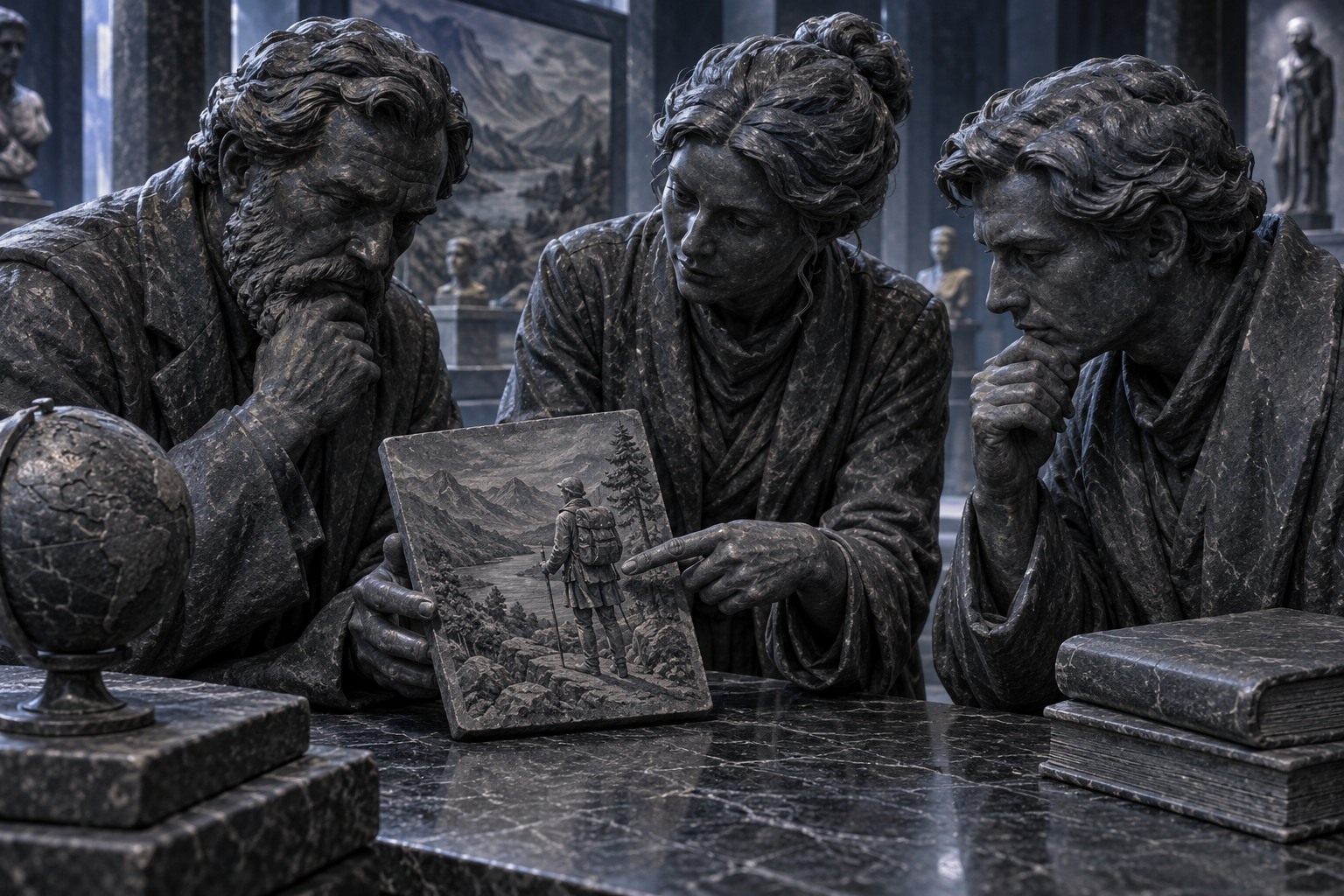
Three people look at the same card. One recognizes a figure from an old European game. Another sees a hint about next week. The third, an artist, notices the composition: the direction of the gaze, the pose, the contrast between a small figure and a large space. One object, different activities. The history of Tarot begins when we stop calling them a single kind of knowledge.
Tarot emerged in European gaming culture, while the esoteric explanations familiar today developed much later. Between an Italian court card of the fifteenth century and a modern deck for reflection lie changes in imagery, print production, occult systems, and ways of reading. This article traces these layers, explains the structure of a common deck, and shows why a symbol has no single meaning outside a specific context. It pays particular attention to the work of Pamela Colman Smith and Arthur Edward Waite, and to the distinction between an image, an interpretive system, and a claim about the future. The practical section offers a way to read a card as a cultural image, keeping historical information separate from personal associations. This approach requires neither divination nor belief in a hidden influence of cards on events.
I. The beginning: a game at court
Surviving early Tarot cards are associated with northern Italian culture of the fifteenth century. The celebrated Visconti–Sforza group shows us expensive objects with dynastic emblems and carefully executed paintings. The Morgan museum catalog treats them as cards for games played by the nobility, rather than instruments of an original secret Egyptian teaching. The dating and attribution of individual sets involve uncertainties of their own. Morgan, “Visconti-Sforza Tarot Cards”.
This original context changes how we view the images. The emperor, the pope, virtue, and death are not necessarily messages about a player's future. They belong to a world in which power, Christian ideas, allegory, and public spectacles were part of a shared language. A card could be an object of entertainment while drawing on serious cultural symbolism. Entertainment does not mean an absence of meaning.
It is important to distinguish the origins of ordinary playing cards, the emergence of a special set of trumps, and the development of later explanations of Tarot. These histories are related, but they do not coincide. Evidence that cards existed in one culture does not establish that all later trump images existed there. An account of the origins of paper is not evidence of a particular esoteric system either.
An early date does not by itself make a deck a source of ancient wisdom. It makes it a historical object to be considered in its own setting. And this is no impoverished substitute for a marvelous legend. The history of artistic labor, the patron's family, and the transformation of images into a game reveals how people gave shape to their world. The cards become evidence of human imagination before they become supposed evidence of fate.
II. The structure of a common deck
A complete deck familiar today contains 78 cards: 22 known in esoteric terminology as the major arcana, and 56 cards of four suits known as the minor arcana. Numbered cards and court figures belong to four sequences. This is a useful description of a common type, not a promise that all historical games and individually designed decks had the same composition. V&A, “A history of tarot cards”.
The names “major” and “minor” can suggest that one group contains important truth while the other offers secondary information about everyday life. But that is already a particular interpretive frame. For understanding the game, the cards' functions and their place in the rules matter more. For artistic analysis, the distinction between allegorical figures and repeated suit signs matters. For divinatory reading, the accepted vocabulary of meanings matters.
In his handbook, Waite discusses the four suits and court cards separately from the larger symbolic images. His explanation is useful as evidence of a particular system of the early twentieth century; his historical assumptions require separate scrutiny. Waite, “The Four Suits,” 1911.
Structure alone says nothing about the reliability of prediction. The number of cards, the symmetry of the sequences, or the possibility of connecting them to another set of symbols shows that the system is organized. Organization is not the same as a confirmed causal connection to events. We can construct a coherent classification of stories without gaining information about what will happen tomorrow. This distinction will matter later, when a game becomes a language of interpretation.
III. An image outlives its original function
A cultural object can change its use while retaining a recognizable appearance. A ritual motif becomes an ornament, a drawing from a book becomes an emblem, a playing card becomes material for divination. Such a transition is not necessarily a fabrication. Fabrication begins when the new function is declared the only authentic one from the beginning, without historical grounds.
Tarot lends itself especially well to reinterpretation because its images contain tensions. A figure may face a choice; power stands beside vulnerability, movement beside stillness. A reader can readily recognize situations from life. But this ease of recognition explains an image's usefulness for interpretation; it does not prove the continuity of a particular secret teaching.
A material object also preserves the artist's and publisher's decisions. Size, printing technique, color, and caption shape what a viewer notices. If a contemporary artist changes a figure's pose, removes a religious detail, or adds a motif from another culture, the possible reading changes too. This is already a new work, even if the card's name is retained. The history of an image cannot be reduced to the history of the word beneath it.
Consider an ordinary postcard that was once a personal greeting and later entered a museum. A present-day visitor may see a theme of the period in it, but should not attribute that later perspective to its original recipient. The same distinction applies to Tarot. An object can have several histories of use; each requires its own grounds. Respect for a symbol begins by recognizing that it does not belong exclusively to the current way of reading it.
IV. The Egyptian account: a powerful origin, weak evidence
In 1781, Antoine Court de Gébelin connected Tarot with an ancient Egyptian heritage. This was an important event in the history of occult Tarot. But the existence of such an explanation does not confirm its historical truth. Morgan explicitly treats the Egyptian reconstruction as a mistaken scholarly explanation that influenced the cards' later history. Morgan catalog.
Why is an origin legend so attractive? It gives a system depth, authority, and the promise of a hidden order at once. If a game that happened to survive turns out to be the remnant of an ancient book, every detail can be read as a deliberately concealed sign. The incomprehensible then strengthens confidence rather than weakening it: a mystery, by definition, is not supposed to reveal itself immediately.
A circular argument emerges. The cards are considered ancient because secret content is perceived in them; that secret content is considered proven because the cards are ancient. We can break the circle by asking about documents, dated objects, and traceable transmission. A symbol's resemblance to an Egyptian image is interesting, but does not yet show a route of borrowing. A history of origins requires intermediate evidence.
Abandoning the Egyptian genealogy does not diminish the later occult language. It allows us to name it for what it is: a new reading of European material with particular claims. A new symbolic system can be complex and influential. It does not have to pose as an unchanged monument of remote antiquity to become a subject of cultural research. Historical plausibility and richness of interpretation are assessed separately.
V. Different esoteric systems, different maps of meaning
In the nineteenth and early twentieth centuries, Tarot entered occult schemes that connected cards with letters, numbers, and other sets of symbols. The V&A overview shows the role of Éliphas Lévi and the Golden Dawn milieu in this change. These correspondences belong to particular authors and schools; they cannot be extracted from all historical cards as a single self-evident code. V&A overview.
Disagreement here concerns substance. Assign an image a different position in a sequence, and its neighbors and possible connections change. Treat the number as the primary basis, and an artistic detail may become secondary. Treat the image as primary, and the numerical scheme may be revised. A system does more than add meaning to a finished card: it determines which features of the card count as meaningful at all.
The expression “Tarot speaks” therefore conceals several participants. The deck offers images. The handbook's author offers meanings. The reader selects a question and joins the cards into a story. A community establishes acceptable rules. People participate in all these activities. Their decisions do not become an impersonal voice of antiquity merely because the resulting interpretation looks coherent.
In comparisons with other traditions, a borrowed word must not be turned into evidence of identity. The occult use of Kabbalistic terminology does not represent the whole of Jewish Kabbalah. Mentioning an Egyptian deity does not make a European ritual a continuation of Egyptian temple practice. We can study the translation, reworking, and new assignment of symbols while preserving the distinctions between the source and the receiving system. These distinctions are precisely what give intellectual history its substance.
VI. Waite and Smith: who creates the scene
The deck associated with Arthur Edward Waite and Pamela Colman Smith, published in 1909, became important to the modern history of Tarot. Naming it only after the man means losing Smith's artistic contribution. An image is not a transparent shell for a vocabulary: it creates its own relationships among figures, space, and action. V&A.
Waite explains that illustrated numbered cards should develop divinatory meanings without exhausting them. He also acknowledges earlier individual images on such cards. The categorical claim that “before this deck, numbered cards were never illustrated” is therefore too broad. Waite, “Distinction between the Greater and Lesser Arcana”.
A scene changes the reader's work. When only repeated suit signs appear, the reader depends more heavily on a learned rule. When people and actions are visible, a story can take shape before the handbook is opened. This is an analytical distinction of form, not evidence that one deck is superior or that a reading is “accurate.” A rich image makes it easier to generate versions; it does not tell us which version corresponds to external events.
There is also an important boundary of authorship. We can describe what appears on a card and separately quote Waite's explanation. But without documents, we cannot assign every detail to an exact personal intention of Smith's. The artist may have chosen a composition, while the handbook may have restricted or expanded its reading. Respect for creative work requires naming the artist and refraining from inventing on her behalf what the surviving source does not explain.
VII. The card, the spread, and the story
The meaning of an individual card does not exist wholly apart from the question. The same image can be read as an obstacle, a resource, a state, or a possible action. In a spread, meaning also depends on the assigned position and neighboring cards. A coherent story is therefore not an independent answer that was already fully formed inside the image.
We can test this without accepting a divinatory frame. A hypothetical example: two readers see a drawing of a person beside a road. One asks about starting a course of study, the other about completing a difficult project. The first sees readiness to set out, the second a risk of leaving too quickly. The drawing has not changed. The question has changed, directing attention toward different parts of the situation.
This flexibility makes interpretation creative, but creates a problem of verification. If any subsequent course of events can be reconciled with the original interpretation, confirmation ceases to differ from redescription. A predictive claim requires an event, a time frame, and a condition for error that are clear in advance. A story that permits endless changes after the fact may be meaningful as a narrative, but does not provide a rigorous test of prediction.
Interest in Tarot should not be reduced to gullibility, however. A person may seek an aesthetic experience, a game, conversation, cultural study, or a way to begin writing. These aims differ, and one need not justify itself through another. Artistic enjoyment does not require proof of prophecy. A prediction is not confirmed because someone enjoyed the conversation. The clearer the purpose of a practice, the more precisely we can judge what it actually offered.
VIII. What we can learn, and what a card does not establish
A card can tell us about an image and our own response to it. A museum record can tell us about an object's date, provenance, and attribution. A handbook can tell us about a proposed method of interpretation. These are different sources of information. None automatically establishes an absent person's intentions or the outcome of a future decision.
A hypothetical scene: someone worries that a colleague is withdrawing from a collaboration and notices a motif of departure in a card. The card helps name the worry, but does not confirm the colleague's withdrawal. The source of a fact here is the colleague's own message, agreement, or action. If the image prompts someone to clarify the situation, it can provide a useful occasion. If the image replaces clarification, it increases the distance between the person and events.
Nor should every association be turned into a diagnosis. Recognizing loneliness in a drawing does not prove a hidden trauma. A lack of response does not indicate inner resistance. A reader is entitled to find nothing interesting. A practice in which every answer confirms the interpreter's correctness deprives the participant of the possibility of actually disagreeing.
This boundary does not destroy imagination. It releases imagination from the excessive obligation to supply external facts. We can use an image to formulate possibilities and then test them by another means. Between symbol and decision, room opens for conversation, information, and choice. In that space, the person remains the author of the action, while the image is a conversation partner, not a judge.
IX. Three images and three different questions
A specific card reveals the work of interpretation more clearly than a general discussion of symbols. Consider three of Waite's descriptions: The Fool, The Hanged Man, and The World. These are descriptions within his own system of the early twentieth century. They do not automatically explain the meaning of an analogous figure in a fifteenth-century court deck, nor do they express the common view of all Tarot practitioners.
Waite describes The Fool as a young man at the edge of a precipice and gives him the meaning of a spirit seeking experience. The depicted pause and the direction of the gaze become part of the author's reading. Waite, Part II, “The Fool”. Our viewer may see carelessness, freedom, or danger. The difference between this impression and the author's religious interpretation is useful: it shows the work done by an added explanation. The cliff edge does not contain a single ready-made answer about the viewer's fate.
In The Hanged Man, Waite emphasizes the living tree, the facial expression, and the difference between life in suspension and death. His explanation refers to the relationship between the divine and the universe, and he rejects some common interpretations. “The Hanged Man”. Here it is especially clear that a school does more than gather any possible meaning: the author sets a boundary for a correct reading. The popular modern formula about needing to “look from another angle” may be an independent use of the image, but cannot be attributed to this paragraph without checking.
In The World, Waite speaks of the completion of the cosmos and the soul's state in divine vision, while also objecting to certain other explanations. “The World”. In a conversation about work, “completion” may mean a finished project; in this text, the scale is substantially different. If the two are joined without clarification, cosmology will look like everyday advice, and everyday advice like a revelation about the cosmos.
These three examples reveal the difference between description, doctrine, and application. Description notes visible relationships among figures. Doctrine explains their place in a worldview. Application selects the present reader's question. The transitions can be fruitful when they are identified. We can ask where a project has stalled without claiming that a card has discovered the invisible cause of the delay. We can study a religious meaning without turning it into a diagnosis of a project participant.
The artist also has an independent role. The scene exists before each new viewer receives an explanation: the positions of the body, objects, and space direct attention. The author of an explanation does not create all the reader's responses in advance. This openness explains the deck's longevity better than the assumption of one final decoding. Waite offers a demanding way of reading; Smith's images preserve the possibility of new questions. We can respect their collaboration by recognizing both authorial intention and the subsequent history of reception.
Another distinction is useful: an explanation of a picture is not an account of all its uses. The same sheet can sit in a museum display, on a gaming table, in a religious study, or in an illustrator's workshop. Each location poses its own question. An account of a practice should name the place and participants rather than infer their actions from the image alone. The history of use then becomes separate from the history of production.
Waite's polemic against other meanings is particularly evident in the selected chapters. His disagreement represents an author's intellectual position, not merely a list of possible answers. Serious reading allows us to reconstruct that position and then contest it. Our personal impression of a card has a different status: it may matter to us, but need not coincide with the author's norm. The distinction preserves a living conversation among the work, its explanation, and a new viewer.
X. The artist's authority: two ways to construct a scene
Waite's Hanged Man and World let us see an artistic decision without appealing to a legend of Egyptian origins. In the first description, living wood and a calm face lead us to read the suspended body differently; in the second, an individual figure acquires a cosmic and religious horizon. The two cards offer different relationships between the person and the whole. Waite, “The Hanged Man”, “The World”.
This is our comparative analysis of two descriptions by the author. In the first case, attention stays with a state between movement and completion. In the second, it turns to the relationship between an individual image and the fullness of the world. Such a comparison does not require each card to have the same meaning in every deck. On the contrary, the structure of a scene becomes visible when we abandon a single vocabulary: bodily position, facial expression, and the horizon selected by the author work together.
Smith's artistic contribution matters precisely here. A verbal handbook does not replace the scene in which a viewer notices details before reading a ready-made interpretation. Waite's description selects how to connect them to a system. Authorship of the image and authorship of the explanation therefore need to be held side by side. The deck gains content from their encounter, not only from a list of fixed meanings.
We can discuss the value of such an object in its own right. Removing the legend of secret antiquity does not destroy composition, tension, or religious thought. But strong composition does not authenticate prediction either. A card can be a significant work of its period and a useful occasion for conversation, while remaining an object whose history is checked through dates, editions, and specific works.
This gives the reader a clear choice of question. Do we want to understand Waite's program, the artistic effect of the image, or our own response to it? All three tasks are legitimate. Naming the chosen one makes the conversation more precise: we can assess a particular work instead of engaging in a general dispute about whether an entire deck must possess a single secret.
XI. Images without obligatory prophecy
The history of Tarot shows how an object used for play becomes a bearer of many new meanings. Court painting, mass printing, occult correspondence, and contemporary art do not form a single unchanging practice. They form a history of transformations. To explore it, distinguishing those transformations is more useful than seeking a single hidden essence of the deck.
A card retains the ability to surprise even when we abandon the legend of infallible knowledge of the future. An artistic scene can direct attention toward something we have long overlooked. Its value may lie in a precise question rather than a guaranteed answer. At the same time, not every image must be useful: sometimes it simply belongs to an interesting cultural world.
These boundaries mean different things to a practicing diviner and a museum viewer. The first may accept a particular worldview; the second studies the object without it. They need not be declared identical or forced to agree. We can respect people while discussing the grounds of particular claims. Respect for a belief does not require presenting it as a verified fact.
At the beginning of the article, three people saw one card differently. At the end, our task is not to select a single “correct” viewer among them. It is more precise: to understand what each person does and what supports each conclusion. Tarot then retains its history and artistic force, while the person retains the right to ask an image a question without entrusting it with the decisions of their life.
What this means in practice
Choose one card from a museum collection or a legally available edition. You may select it deliberately: drawing at random is not required. First describe what is visible without interpreting it. Where is the figure? Which way does it look? What is it doing? Which details can you name confidently, and which are hard to make out? If a museum commentary survives, read it after writing your own description.
Next, record the historical information: the object's date, place of creation, the artist's name if known, and its purpose. Do not replace an unknown attribution with a famous name. The word “probably” matters: it describes a degree of confidence, not ornamental caution. Then find out which system supplied the card's proposed meaning. The title of a handbook is more useful here than the phrase “it is generally believed.”
The third step is free association. Suppose the image reminds you of an unfinished conversation. Write down exactly what connects them: a pose, the distance between figures, the direction of movement. Then devise a different reading of the same detail. Distance may mean separation, space, or waiting. This check shows where the drawing is doing the work and where your story has already taken over.
Finally, bring the question back to reality. Is there a fact to clarify? Can you formulate a small, reversible step? In the hypothetical example, this might be a calm message suggesting a time to talk. It is justified by your wish to clarify the relationship, not by a “command from the card.” If no action is needed, noticing the thought or enjoying the image is enough.
There is no need to turn this procedure into covert therapy or a test of intuition. Its task is to reveal how interpretation arises. You can stop after the first step and stay with the art. You can discover that a symbol does not help with the current question. Both outcomes preserve the reader's independence.
When reading with another person, name the format in advance: are you examining an image, comparing a school's texts, or discussing a personal question? One participant is not obliged to talk about their life merely because the other has found a suitable symbol. You can stay with an artistic detail. You can say that the proposed association does not fit. Refusal helps clarify the conversation rather than indicating an inability to understand the card.
If the discussion concerns a choice, finish with an ordinary record: what you know, what you want, and which conditions need checking. A new project, for example, requires information about time, responsibilities, and resources. A picture may suggest a question about an obstacle, but the answer about resources comes from the project's participants. This return to reality preserves the dignity of interpretation: it helps reveal a question and need not pretend to be evidence it does not possess.
Key quotation
“the pictures are like doors which open into unexpected chambers”
A. E. Waite, The Pictorial Key to the Tarot, 1911, Part III, §1; original English. Source. The author is speaking about the expansion of interpretation within his system. For our study, this is an image of the possibility of posing a new question; it does not confirm the accuracy of every answer that emerges.
Connections between traditions
The table offers our analytical comparisons. It does not assert a common origin of the systems or turn a similar method into an identical doctrine.
| Positions and sources | Basis of comparison and its limit |
|---|---|
| Waite on imagery, III, §1 and Epictetus, Enchiridion, I | An image prompts many interpretations; the Stoic requires an examination of the impression. The shared question is how to separate the image that appears from the judgment we accept. Stoic discipline does not confirm divination, and a card does not establish what is within our power. The comparison supports attentive reading while preserving the practices' different aims. |
| Waite, “The Hanged Man” and Sendivogius, the preface and first discourse | Religious meaning arises alongside an image or an account of nature. We compare ways of explaining, without accepting that all symbols of death and change are identical. A pause in the card's figure is not an alchemical operation. Historical influence is not established in this row; the connection serves a question about the scale of interpretation. |
| Waite, “The World” and Tao Te Ching, §1, Legge | Waite offers a cosmological meaning; the Daoist text limits the finality of a name. Our question concerns the difference between a symbolic indication and an exhaustive explanation. This does not assert that the Dao equals Waite's divine vision. Readers can clarify what they consider known and what merely indicated. |
| Waite on interpretation, III, §1 and Matthew, 7:16–20, KJV | Openness of meanings is compared with discernment by fruits. Applying this comparison to reading, we ask what actions follow from an explanation. The Gospel passage is not about Tarot and does not endorse it; a useful conversation prompted by a picture does not prove a deck's prophetic ability either. |
| Waite, “The Fool” and Crowley, Liber II | A spirit seeking experience and the distinction between Will and whim provide two questions about direction. Similar interest does not mean a shared answer: the card has its author's iconography, while Thelema has its own Law. We do not credit The Fool with discovering true Will or declare every free association an expression of it. |
Primary sources
Three short primary chapters by Waite on individual cards were also read: The Fool, The Hanged Man, and The World. All chapters were read in full; they are parts of the same book, not three independent works.
- The Morgan Library & Museum. Visconti-Sforza Tarot Cards, MS M.630.1–35. An extended catalog commentary was read through a search extract; direct opening was unavailable to the tool. This was not the full body of research on early cards.
- Rebecca Billingham, Ruth Hibbard, Josephine Nardecchia. A history of tarot cards. Victoria and Albert Museum, updated July 16, 2026. The museum overview was read; excessively broad claims about origins and priority in illustration were not adopted.
- Arthur Edward Waite. The Pictorial Key to the Tarot, 1911. Part I, §3: The Four Suits. An English primary text of a particular system.
- Arthur Edward Waite. The Pictorial Key to the Tarot, 1911. Part III, §1: Distinction between the Greater and Lesser Arcana. The section on illustration and the divinatory meaning of numbered cards was read.
Additional primary texts for the comparison map:
- Epictetus. Enchiridion, English translation by Thomas Wentworth Higginson. §§I–IV and XXIV were read; comparison of the relationship to nature and action. The modern preface does not support the article.
- Laozi. Tao Te Ching, translated by James Legge. §§1–2 and 8 were read; an English intermediary, not the Chinese original. Comparison of the limits of naming and the relationship to action.
- Gospel of Matthew, 7:16–20, King James Version. The entire selected passage was read; comparison of a moral claim with the fruits of action, without a conclusion that religions agree.
- Sendivogius. A New Light of Alchymie, translated by John French, 1650. The author's preface and first discourse were read; the map compares the role of religious interpretation.
- Crowley. Liber II. The full short primary text was read; the map uses the distinction between direction and whim.
Tags
Tarot, history of Tarot, card game, Italy, court culture, Visconti, Sforza, images, iconography, deck, major arcana, minor arcana, Waite, Pamela Colman Smith, Court de Gébelin, Éliphas Lévi, Golden Dawn, The Fool, The Hanged Man, The World, interpretation, spread, divination, symbol, artistic intention, authorship, history of esotericism, critical reading, prediction, independent choice
About the authors
Andrey Zarinsh is the author and founder of the United Wisdom project. He researches inner transformation, the unity of traditions, intercultural dialogue, and contemporary spiritual discipline. Instagram: @andrey.zarinsh.
Maria Evilkut is a co-author of United Wisdom. Alongside her research, she seeks to test these ideas in practice and observe how the principles of unity and mutual understanding work in real life between people and cultures. Instagram: @ilkutki.
Keep what resonates with you.