
World & consciousness
Blavatsky and Theosophy: Synthesis, Borrowing, and Criticism
Blavatsky's Theosophical synthesis: common wisdom, cosmology, textual provenance, criticism, and a distinct moral argument about duty.
“The profession of a truth is not yet the enactment of it”
Helena Blavatsky, The Key to Theosophy, 1889, §XII, “Duty,” p. 230, the Theosophist's reply. Original English. Source.
About this article
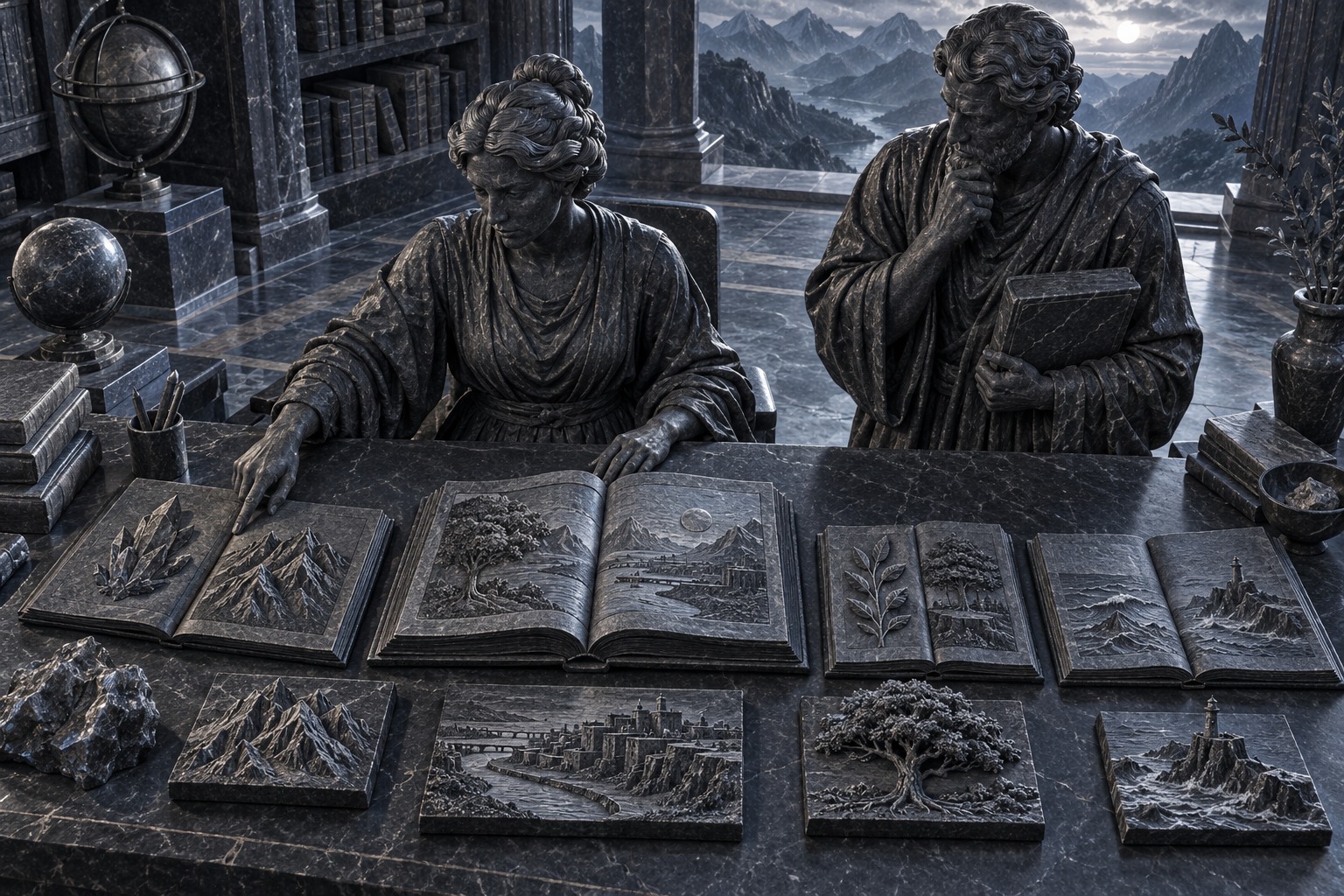
Books on Buddhism, European occultism, ancient religions, and natural science lie on a table. We can read them one after another, preserving their differences. We can try to discover a common source behind them. Or we can declare that the unity we have found predates all the books and confirms their true hidden meaning. Between these activities lies the history of modern Theosophy and the disputes surrounding Helena Petrovna Blavatsky.
Blavatsky's Theosophy offers an extensive synthesis of religious, philosophical, and esoteric ideas. To examine it seriously, we need both to hear the author's self-description and to scrutinize her ways of handling other people's texts. This article explains the project of common wisdom, the distinction between the society and the teaching, the metaphysical role of cycles, and the conception of spiritual teachers. We then consider borrowing, allegations of inadequate attribution, difficulties of historical verification, and internal tensions within the universalist project. An important boundary separates the claim that “this was influential” from the claim that “this is historically accurate.” The practical section offers a way to read a broad synthesis without losing the provenance of its elements. It is applicable beyond Theosophy, but here it will be applied to Theosophy's particular claims.
I. The society and the teaching are different levels
The Theosophical Society was founded in New York in 1875. Its program connected human brotherhood, the study of religions, and investigation of the hidden possibilities of nature and humanity. This is an organizational frame, not an obligation for every participant to agree with every cosmological detail. Blavatsky's The Key to Theosophy presents both the society's aims and her own account of the teaching. Blavatsky, The Key to Theosophy, 1889.
The distinction is especially important for an outside reader. Membership, shared reading, and acceptance of a particular idea do not represent a single degree of conviction. A person may participate in the comparative study of religions without agreeing with an explanation of the world's origins. The expression “Theosophists believe” therefore often needs clarification: which authors, which society, which period, and which proposition?
At the same time, Blavatsky's system cannot be dissolved into cultural openness alone. She does more than propose reading different traditions: she advances a particular picture of their common foundation. This picture makes metaphysical and historical claims. A program of tolerance may be attractive, but its appeal does not prove every proposition in the system.
For reading, it helps to imagine several concentric circles. The outer circle is the possibility of encounter and research. The next is a vocabulary for discussion. Further in comes agreement with individual ideas. Deeper still is acceptance of an authoritative source of knowledge. This is our analytical scheme, not an organizational charter. It helps us avoid assigning identical beliefs to all participants or presenting voluntary conversation as confirmation of a cosmology.
Henry Olcott stood alongside Blavatsky at the society's foundation. Their move to India in late 1878 and subsequent establishment in Adyar changed the project's cultural setting. Leslie Price, SPR historical overview. This is a particular history of people and an institution; it does not turn the Theosophical interpretation of Indian traditions into their agreed self-description.
II. Common wisdom as a strong claim
Blavatsky describes Theosophy as knowledge standing behind historical religions and distinguishes it from adherence to one faith. In The Key, she separately insists that Theosophy is not identical to Buddhism. Here we encounter an author's construction of common wisdom, not an agreed self-description of all religions. The Key to Theosophy.
The project responds to a real human tension. Different traditions speak about ultimate things but offer incompatible answers. A reader wants to preserve their significance and avoid choosing a single community as the only one that is right. The hypothesis of one hidden foundation promises both to respect diversity and to overcome disagreement.
But the cost of this solution needs attention. If one system explains to every tradition what it “really” means, a new center of power emerges. Another voice is accepted only insofar as it fits the general scheme. Its disagreement can easily be declared an outer shell, lost knowledge, or an incomplete understanding of its own tradition. Synthesis becomes less an encounter than an assignment of roles in a story written in advance.
Universalism can therefore be open and closed at once. Open when it invites us to read unfamiliar sources. Closed when it establishes in advance that the most important differences do not matter. To assess it, we need to examine a specific move: which proposition was preserved, which was changed, and who received the right to decide? The desire to find a common foundation is not itself evidence that one has been found.
III. The circle and the point: constructing a cosmological scheme
The Proem of The Secret Doctrine begins its cosmological exposition with a white circle on a black background, followed by a circle containing a point. The first image concerns the state before manifestation; the point concerns the beginning of differentiation. The world's manifestation and disappearance are subsequently explained as periodic states. Blavatsky thus establishes a transition from unity to multiplicity before discussing particular beings. The Secret Doctrine, “Proem,” pp. 1–5.
This line of thought deserves constructive examination. The circle offers an image of the whole; the appearance of the point makes differentiation within it possible. The scheme has two tasks: to preserve a foundation and explain the emergence of a changing world. Take only the first, and we get motionless unity. Take only the second, and we get a sequence of events without a foundation. Symbolic cosmology joins the two questions in its own way.
Yet the symbol does not depict an observed physical process. It organizes a metaphysical explanation. Its resemblance to the familiar word “cycle” therefore needs clarification: this passage concerns the cosmos's periodic manifestation within the teaching, not an everyday repetition or a calculated duration of a particular astronomical phenomenon. This limitation follows from the subject of the argument; it is not added in place of examining the argument.
In this picture, human history acquires a broader horizon. An individual life is considered within the movement of the whole; an individual event ceases to be the final measure of what happens. The appeal of this view is understandable: it connects scattered events. But its coherence does not confirm every historical or scientific detail later incorporated into the system.
Comparative reading now has a specific subject. We can ask how another teaching explains the relationship between an unchanging foundation and an emerging world, discovering both a similar question and a different answer. This is more precise than declaring every circle evidence of one secret knowledge. The conversation begins with a reconstructed line of thought, not an outward coincidence of signs.
IV. A secret source and the problem of provenance
The Proem of The Secret Doctrine begins with an account of an archaic manuscript. This account creates a particular mode of trust: the author offers more than her own theory, but also access to hidden material. The fact that such a claim is made can be established from the text; the age and origins of the source described require independent evidence. “Proem”.
It is important not to confuse two checks here. First: does Blavatsky actually assert a particular origin? Second: did the source actually exist in precisely that form, and does it possess the age claimed? Close reading resolves the first task. It does not automatically resolve the second.
Historical research requires an accessible object, a comparable text, dating, and traceable transmission. If some of these grounds are absent, uncertainty remains substantial. One later author's reference to another later author does not replace early testimony. Several repetitions of an account can reveal the spread of a belief, but not the independence of its confirmations.
At the same time, a missing check does not oblige us to invent an opposite history. Not established does not mean proven never to have existed. Yet the person proposing a particular ancient genealogy bears responsibility for confirming it. Readers may continue investigating the philosophical ideas without presenting the historical claim as a question already settled.
V. Borrowing can create something new
A synthesis almost always uses material from others. An author selects, translates, rearranges, and combines ideas. Borrowing in itself does not make a work empty. A new result can emerge from known material if a new combination changes the question or reveals a previously unnoticed connection.
But borrowing requires provenance. We need to distinguish direct reading of a primary source, reading its translation, using an overview, and repeating someone else's quotation. Each chain has its limits. If a borrowed quotation is presented as directly read, readers are told more about the author's competence than the actual work supports.
In a critical appendix of 1895, William Emmette Coleman alleged that Blavatsky repeatedly used contemporary books without adequate attribution and cited older works through intermediaries. This is historical criticism we have read, not our independent reproduction of all the comparisons he names. Coleman, “The Sources of Madame Blavatsky's Writings”.
Criticism raises two questions that should not be confused. One concerns accurate provenance and the use of wording. The other concerns the intellectual value of the resulting construction. Even a new idea does not justify false attribution. Even inadequate attribution does not automatically render every thought in a book meaningless. Assessing a work requires both tasks, without using one as a convenient substitute for the other.
VI. Reading criticism without turning it into a verdict
Coleman offers extensive accusations and counts of his own. The article can accurately report that he made them, but should not present his figures as results independently verified here. Detailed checking would require comparing particular editions, passages, and methods of quotation. Coleman's historical text.
Force of tone does not replace evidence. A disparaging remark about an author's knowledge may accompany a useful textual observation, but does not strengthen it by itself. Likewise, a defender may rightly point to a critic's bias and still fail to answer a presented parallel. The problem of provenance cannot be resolved through a psychological portrait of an opponent.
A sound check is bounded and reproducible. Take a hypothetical case: two books share a rare sequence of expressions. We should check the date, the edition's availability, an acknowledgment of the source, and a possible common predecessor. This is stronger than a general declaration that “everything was stolen” or “everything was inspired by the Masters.” A single coincidence cannot support a complete verdict, but it cannot be concealed behind the grandeur of the project either.
Critical reading is particularly necessary in the study of esotericism precisely because the subject provokes strong reactions. A supportive community may consider doubt hostility, while an opponent may consider every complexity an excuse. Between them remains the possibility of carefully defining the question and the limits of the result. This work is slower than polemic, but allows facts to be preserved regardless of one's attitude toward the teaching.
VII. Teachers, testimony, and belief
Spiritual teachers occupy an important place in The Key to Theosophy; the author defends the conception of them and the knowledge transmitted. This self-description reveals the role of their authority in the system, but does not confirm every account of manifestations and the unusual origins of letters. Blavatsky, The Key to Theosophy.
Historical disputes surrounding these claims include accusations and later criticism of investigative methods. The Society for Psychical Research overview describes Hodgson's report and Vernon Harrison's objections to its evidential work. This helps reveal that the dispute's history is more complex than a single generally accepted accusatory statement. SPR, “The Hodgson Report on Theosophy”.
Yet an identified weakness in an accusation does not prove a supernatural explanation. Between them lies room for several possible histories and insufficient information. If an expert examination rejects a particular conclusion about handwriting, it resolves the question of that conclusion, not the structure of the world's spiritual hierarchy. Every piece of evidence has a domain beyond which it does not apply.
For a participant in the tradition, trust in teachers may belong to faith and personal spiritual life. For a researcher, it also remains an explanation of how knowledge is organized. These approaches need not be declared identical. We can accurately convey the significance of a belief for people without confirming its object. This distinction makes conversation respectful without substituting an acknowledgment of faith for historical verification.
Criticism also has a limit of scope. A handwriting conclusion concerns the authorship of particular letters; it does not settle the content of a cosmology. A polemic about borrowed phrases concerns a book's compilation; it does not explain the origins of every unusual experience. Sometimes one dispute is used as a lever for the entire system: one accusation is refuted, so the whole teaching is proven; one borrowing is confirmed, so every thought is meaningless. Both transitions exceed their grounds.
A more precise map contains several unresolved cells. We can establish that a critic challenged a procedure and leave the event in question open. We can recognize the need for textual comparison without presenting a comparison not yet performed as a result. This is a substantive limit of the research, not an evasion of a conclusion: it shows which evidence would change a particular assessment.
VIII. Brotherhood and hierarchical pictures of humanity
Universal brotherhood is an important part of Theosophy's self-description. But Blavatsky's system also includes categories of “races” and stages of human development. These categories should not be turned into a scientific description of human groups. Nor should they be concealed merely because the overall project proclaims unity. The Key to Theosophy and the Proem of The Secret Doctrine.
Two kinds of precision are required here. We cannot simply equate every historical use of a word with any later political meaning. But we cannot treat a cosmological redefinition as sufficient to settle the question of human hierarchy either. We need to examine the roles assigned to actual peoples and persons: equal dignity, different abilities, different stages, or different rights to speak for themselves.
The problem extends beyond one word. When an author distributes traditions across levels of common wisdom, she may declare her own scheme deeper than their participants' self-descriptions. Respect for another person then becomes conditional: the person is accepted, but their understanding of the world is deemed inadequate in advance. This tension matters to any project promising to unite humanity through a single explanatory system.
We can preserve the idea of equal dignity while rejecting a particular hierarchical cosmology. Such a choice should be named as an independent editorial or personal decision, rather than silently rewriting the earlier text. A historical article should reveal the difficulty, not resolve it by deleting an uncomfortable part of the inheritance.
IX. Why Theosophy is not equivalent to Buddhism
In The Key to Theosophy, Blavatsky specifically separates Theosophy from Buddhism and explains a distinction between the words Buddhist and Budhist, connecting the latter with wisdom. This explanation represents her own terminological program. It does not establish that Buddhist schools recognize Theosophy as a higher or complete expression of their teaching. The Key to Theosophy, “Theosophy is not Buddhism”.
This particular example helps reveal how the synthesis is structured. The author does more than place existing religions side by side: she establishes a new level on which to redescribe them. Terms from elsewhere therefore acquire a place in her system. To assess the accuracy of that place, we need to return to texts of the relevant school. Similar-sounding words and a claimed common source do not yet replace this work.
The question is not reducible to whether a person is forbidden to use another's thought. The history of philosophy and religion includes continual exchange, translation, and change. But exchange assumes the possibility of naming precisely what was taken and what was transformed. If readers are promised a new authorial construction, they assess it as a construction. If they are promised a restoration of an ancient tradition, provenance and accurate transmission become central. Blavatsky's program makes both claims, so both kinds of questions arise.
Our overview's boundary follows from this too. We do not examine the entire Buddhist canon or decide on behalf of all its schools which borrowings they are willing to recognize. A narrower fact is established here: Blavatsky herself considered the distinction necessary. This does not permit replacing her texts with the name of Buddhism, and does not confirm her explanation of the borrowings either. Substantive dialogue begins by recognizing that different systems can dispute the meaning of one familiar term.
X. Two genres: a secret foundation and an open conversation
The Secret Doctrine and The Key to Theosophy present the teaching differently. In the opening of the first book's Proem that we read, the author introduces an archaic manuscript and a symbolic picture of the cosmos. In the second, she addresses the reader through questions and answers, explanations and objections. The way knowledge is authorized differs: from a claimed hidden foundation to public reasoning about accessible doubts. The Secret Doctrine, I, opening of the “Proem”; The Key to Theosophy, preface and section I.
An open form is useful, but does not guarantee equality among participants. In the dialogue, the author writes both the answer and the question; she determines which objection receives a place. This is a literary model of conversation that an actual reader can continue with other questions. For example, by requesting a more precise identification of an accessible original, clarifying a translation, or separating a moral proposition from a cosmological one. This work need not indicate hostility: it follows from taking the claimed knowledge seriously.
A hidden source also creates a particular structure of trust. If it cannot be checked independently, readers must assess the intermediary and the coherence of the offered picture. Internal persuasiveness may support religious faith, but is not equivalent to documentary confirmation of origins. The distinction becomes especially apparent when an author uses historical and scientific examples: these can be checked separately, even if the central foundation remains inaccessible.
The comparison of genres shows why criticism of quotation does not close the entire conversation, and why appealing ethics do not settle the question of sources. A moral proposition can have substance independently of the manuscript account. The manuscript account can require evidence independently of the proposition's moral value. We can separate these questions without breaking the text into disconnected phrases. On the contrary, the reader sees more clearly which parts rest on a shared foundation and which allow independent discussion.
This way of reading preserves Blavatsky's historical complexity. She acts as an author, compiler, interpreter, and bearer of a claim to special knowledge. None of these voices should silently be presented as the others. Synthesis becomes a subject of research precisely where we notice ways of combining, rather than merely repeating a conclusion about unified wisdom.
XI. Duty: a universal program encounters an individual person
In section XII of The Key to Theosophy, duty is defined through one's relationship with humanity, neighbors, family, and especially those who need help. Personal satisfaction may accompany action, but, in Blavatsky's argument, should not become its chief motive. The next transition names equal rights regardless of origin and position. The Key to Theosophy, XII, “Duty,” pp. 227–231.
This is a concrete moral side of universalism. Instead of a single origin of religions, the discussion concerns the recipient of an action. If the foundation is shared, care should not be confined to the benefit of one's own circle. This transition contains an independent argument: commonality makes a demand on relationships, rather than merely giving a person a sense of belonging to a great history.
Yet the same section connects spiritual growth with overcoming difficulties and a readiness to bear one's duty. For contemporary application, an important question of proportion arises. Helping someone in need does not require considering every injury a useful stage or denying the helper their own needs. This is our assessment of a possible transfer of the norm, not a silent correction of the author's position. The historical thought is preserved along with its demands.
Let us compare the moral and cosmological levels. The proposition of equal rights does not arise from observing the circle symbol as a conclusion arises from measurement. It is justified within the whole teaching and addressed to conduct. A person can therefore discuss the value of this norm separately from agreement with periodic worlds. A shared undertaking gains a sufficiently concrete subject: who received help, which obligations were recognized, and whose rights are considered.
A synthesis becomes more mature when it permits such a separate conversation. Another person is entitled to share the care without accepting the proposed history of its origins. This does not destroy cooperation. On the contrary, it allows us to test whether universal brotherhood actually includes a living conversation partner who retains their own explanation of the world.
XII. A synthesis that allows another voice
Blavatsky matters to the history of modern esoteric systems precisely because of the scale of her project. She proposes connecting many fields of knowledge and creating an explanation that surpasses individual faiths. This project can be studied without obligatory agreement with its historical and supernatural claims.
Reading reveals both the power and the difficulty of synthesis. Breadth allows new combinations to become visible. The same breadth can conceal intermediaries, simplify other teachings, and replace verification with a promise of a secret source. Universalism can open a conversation and simultaneously deprive a conversation partner of independence. These possibilities should not be fused into one final assessment.
The reader retains a useful right to separate questions. Is the origin story reliable? Was the source used correctly? Is the argument convincing? Are the consequences acceptable? Does an individual thought matter? Answers may differ. Rejecting one claim does not oblige us to deny all the others, and accepting one idea does not require endorsing the entire system.
At the beginning, different books lay before us. After becoming acquainted with Theosophy, they should not turn into identical pages of a single secret volume. A good synthesis can offer a common perspective without forbidding each book to say what does not fit within it. This ability to hear a difference that has not been absorbed is precisely what distinguishes an expansion of thought from an elegant closure of every question.
What this means in practice
Choose one claim from a broad synthesis, such as the claim that several religions express the same idea. Record it faithfully in your own words, trying not to improve it in advance. Then name the traditions listed and the source actually read for each. If the author uses an intermediary, that warrants a separate entry, rather than being a shortcoming to conceal.
Next, clarify the level of similarity. Is it an identical word, a similar image, a similar moral recommendation, or a shared aim? We cannot jump between levels. Two traditions may value compassion and diverge in their understanding of personhood, salvation, and authority. A shared practical gesture does not confirm a shared metaphysics.
Now find the difference that the general claim explains least well. There is no need to select an opponent for a dramatic dispute. What is needed is a substantive counterexample: a proposition retained in the source that does not fit the supposed unity. If the general conclusion can be sustained only by deleting this proposition, the conclusion should be narrowed.
A hypothetical contemporary example: a reader writes that “all religions teach that the True Self is eternal.” Selecting a few suitable phrases is not enough to test this. We need to establish what each tradition calls a “self” and where a permanent selfhood is contested at all. The result may be more modest: “Some of the texts read contain different conceptions of an enduring foundation.” This is less striking, but much more informative.
The last step is to identify your own contribution. If you create a connection that the sources themselves do not propose, say so. A new interpretation has a right to exist. Its quality is determined by what it clarifies and preserves, not by its claimed antiquity. Keeping reading distinct from synthesis makes thought testable and leaves other people the right to object.
Then try to retell another position to someone familiar with it, inviting them to correct your account. Three results are possible: they recognize their understanding, clarify an important detail, or reject the entire comparison. Each result contains information. Do not respond to disagreement by asserting that you already know the deeper meaning of their tradition. The possibility of correction is precisely what makes comparison research rather than appropriation.
Specify separately which words belong to the source, which to the translation, and which to your combination. If only an English intermediary is available, do not claim direct reading of an ancient original. If an author refers to an inaccessible manuscript, record the claim as a claim. This work requires patience, but does not force a reader to accept or reject an entire system for the sake of one useful question. The map remains open to a more precise source and another person's objection; this quality is especially important to material claiming to connect different cultures.
Key quotation
“That which is motionless cannot be Divine.”
H. P. Blavatsky, The Secret Doctrine, 1888, Volume I, “Proem,” p. 2; original English. Source. The sentence expresses Theosophical metaphysics of movement. It can be studied and contested; it does not become a confirmed physical law merely by using a word about motion.
Connections between traditions
These are our analytical comparisons. A shared question does not imply one secret system; influence is not asserted without separate historical evidence.
| Positions and sources | Similarity of question and its boundary |
|---|---|
| Blavatsky, The Key, section XII and Epictetus, Enchiridion, IV | Profession of a belief and its enactment are compared with maintaining a chosen attitude in action. Both positions let us ask about the difference between words and conduct. The Theosophical foundation of improvement does not coincide with the Stoic one; a practical similarity confirms neither a secret source nor an entire cosmology. |
| The Secret Doctrine, I, opening of the “Proem” and Tao Te Ching, §1, Legge | A symbolic account of the world's foundation meets a limit on exhaustive naming. We compare the relationship of language to an ultimate subject. The Dao is not declared the Theosophical Absolute; a similar difficulty of description does not prove a historically unified doctrine. Divergence remains part of the map. |
| The Key, section XII and Matthew, 7:16–20, KJV | Moral enactment is compared with discernment by fruits. The shared question is how talk of truth relates to life. This does not assert that the Gospel recognizes Theosophy as Christianity's hidden foundation. An individual moral parallel does not remove differences of faith, authority, and the conception of humanity. |
| The Key, section III and Helena Roerich, letter of September 8, 1934 | A program of brotherhood is compared with a program of cultural work. Both texts ask how a general aim becomes activity. The letter has a particular addressee and conditions; the society's statutory aim is broader. We do not consider the entire subsequent Roerich movement a simple copy of Theosophy. |
| The Key, section I and Crowley, Liber II | A claim to universal wisdom is compared with a particular Law of Will. Both projects offer a spiritual horizon, but define it differently. Our question concerns what happens to a reader's independence when accepting a system. Shared membership in a Western esoteric milieu does not establish agreement between these teachings. |
Primary sources
- Helena P. Blavatsky. The Key to Theosophy, London, 1889; electronic reproduction, Theosophy Library Online. Selected parts of I, III, XI, XII (“Duty,” p. 230), the beginning of XIV, and the appendix were read; not the entire work.
- Helena P. Blavatsky. The Secret Doctrine, 1888, Volume I, Proem; Theosophical University Press. The opening pages 1–6 were read; not the full Proem or the entire two-volume work.
- William Emmette Coleman. The Sources of Madame Blavatsky's Writings, 1895, Appendix C to A Modern Priestess of Isis, pp. 353–366; Blavatsky Study Center. The opening and selected passages of the polemical appendix were read; its allegations and counts were not independently reproduced.
- Society for Psychical Research, Psi Encyclopedia. The Hodgson Report on Theosophy. The overview of the report's history and its criticism was read; not the original examination materials, and not proof of supernatural claims.
Additional primary texts for the comparison map:
- Epictetus. Enchiridion, English translation by Thomas Wentworth Higginson. §§I–IV and XXIV were read; comparison of the relationship to nature and action. The modern preface does not support the article.
- Laozi. Tao Te Ching, translated by James Legge. §§1–2 and 8 were read; an English intermediary, not the Chinese original. Comparison of the limits of naming and the relationship to action.
- Gospel of Matthew, 7:16–20, King James Version. The entire selected passage was read; comparison of a moral claim with the fruits of action, without a conclusion that religions agree.
- H. I. Roerich. Letter of September 8, 1934, Russian original. The letter was read in full; comparison of a cultural program and brotherhood.
- Crowley. Liber II. The full short primary text was read; comparison of different spiritual projects.
Tags
Blavatsky, Theosophy, Theosophical Society, The Secret Doctrine, The Key to Theosophy, synthesis, borrowing, criticism, Coleman, Hodgson, Harrison, Mahatmas, manuscript, textual provenance, universal wisdom, brotherhood, comparative religion, Buddhism, cosmology, cycles, root races, hierarchy, authorship, quotation, intermediary, translation, source criticism, spiritual authority, critical reading, intercultural dialogue
About the authors
Andrey Zarinsh is the author and founder of the United Wisdom project. He researches inner transformation, the unity of traditions, intercultural dialogue, and contemporary spiritual discipline. Instagram: @andrey.zarinsh.
Maria Evilkut is a co-author of United Wisdom. Alongside her research, she seeks to test these ideas in practice and observe how the principles of unity and mutual understanding work in real life between people and cultures. Instagram: @ilkutki.
Keep what resonates with you.