
World & consciousness
Vodou: An Anthropology of Transparency
An authorial reading of Vodou through embodiment, mediation, vèvè, and reciprocity; cross-tradition similarities are distinguished from scientific proof.
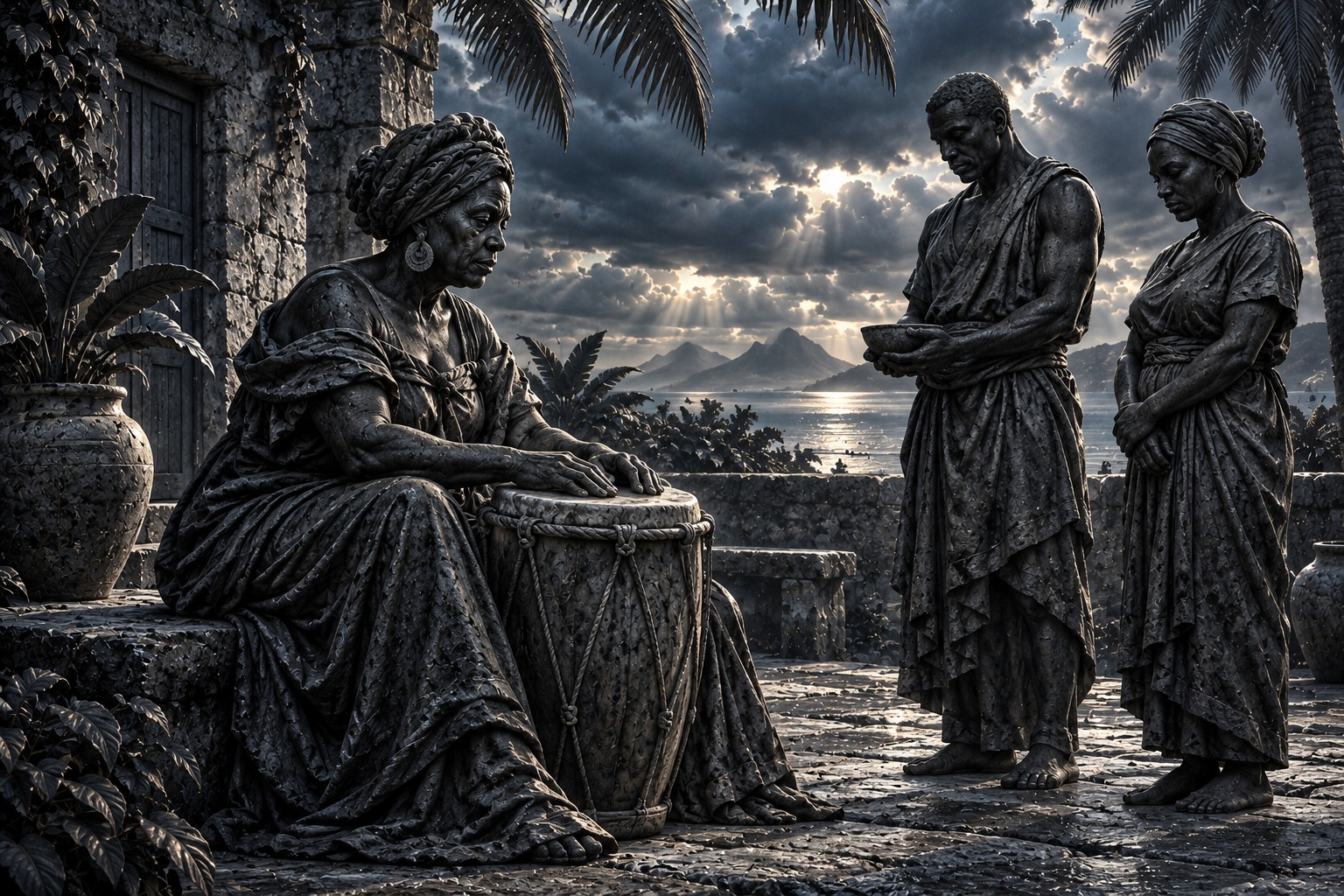
Why matter is imagined here not as an obstacle, but as a membrane for another consciousness
Andrey Zarinsh & Maria Evilkut
Inner transformation · An authorial essay
Epigraph
“The horse does not lose its head—it lends it.”
— Attributed in the archive to a Haitian proverb; attribution not newly verified.
What This Article Is About
A familiar misunderstanding reduces Vodou to dolls, black magic, or exotic folklore. The authors object not simply because such a reading can offend believers, but because it misses a structure. They approach Vodou as a complex way of knowing, with its own practices for relations between visible and invisible worlds, rather than as an archaic superstition.
This article reads Vodou alongside other developed traditions of the sacred: Sufi fanāʾ, Indian shaktipāt, Chinese accounts of qì, and Kabbalistic tzimtzum. Its stated aim is not syncretism but a point of convergence. Wherever people have developed ways of entering an altered condition while returning to ordinary awareness, the authors propose, similar patterns appear: a remote source, mediating powers, forms of invocation, and an ethics of exchange. They find Vodou's distinctive contribution in an image of matter as a temporary membrane through which something other becomes manifest. This is the essay's comparative framework, not an established identity among these traditions.
I. Why So Much Is Misunderstood: Vodou as a Way of Knowing
To see the structure, the essay argues, we first need to set aside the map imposed by Hollywood and colonial descriptions. Vodou—French vaudou, related to Fon vodún—is not a collection of spells directed against one's neighbors. It is a cosmology shaped by West African traditions, including those of the Fon, Yoruba, and Ewe, and adapted in Haiti. Its central question, in this reading, is not “How do I get what I want?” but “How are right relationships maintained between worlds?”
The authors compare this function with what other traditions call dharma or the order of being. They draw a parallel with the Hindu distinction between nirguṇa Brahman, the unqualified absolute, and saguṇa Brahman, conceived with qualities; and with Kabbalah's Ein Sof and tzimtzum. In their account, Vodou distinguishes Bondye, the “Good God,” a remote and incomprehensible creator, from the lwa, powers with characters, preferences, and responsibilities. Bondye is the source but not the everyday agent; the lwa are agents but not the source. The distinction shapes the article's entire interpretation of practice.
The authors argue that a Western outlook shaped by Cartesian matter/spirit dualism struggles with their image of a temporary membrane. It tends, in their characterization, to see the body as either substance or prison. In Vodou, the body can be called a chwal, a horse: a temporary bearer, not intended to be destroyed or humiliated. The essay compares this with Tibetan tulku and Sufi fanāʾ while emphasizing a temporary, cyclical return. Its image is that the horse comes back from the ride not damaged but informed. This does not establish that every experience is harmless or that those religious categories are equivalent.
II. Bondye and the Lwa: Distance as a Condition of Nearness
Any account of absolute transcendence faces a question of access. If God or the Absolute is wholly other, how can a person address it? The essay reads Vodou as answering through mediating powers, described here less as lesser gods than as facets or paths related to a source.
It compares Bondye, also called Gran Mèt, the Great Master, with Ein Sof in Lurianic Kabbalah and nirguṇa Brahman in Advaita. In the authors' analogy, the source withdraws and the intervening space is filled by the lwa, glossed as mysteries or laws. Legba, Danbala, Ezili, Gede, and others are presented as chemen, paths through which power reaches the world. The archive uses the term àṣẹ for that power; this cross-tradition terminology requires care and is not assumed to describe every Vodou community's own language.
The essay compares this with Ibn ʿArabī's unity of being: multiplicity is read as the faces of the Real. It calls the lwa Bondye's “names of action,” just as it reads the sefirot as names and aspects of Ein Sof rather than separate deities. The organizing idea is that mediation makes an inaccessible source approachable: closeness becomes possible through the source's own distance. This is a proposed philosophical comparison, not a declaration that Vodou, Sufism, and Kabbalah teach the same doctrine.
III. Chwal: The Body as a Borrowed Horse
The central image is the horse. When a lwa “mounts” a person, the expression is not merely that a spirit has entered, but that the lwa has mounted its horse. The rider directs; the horse carries. The article describes the bearer's ordinary awareness as temporarily receding to make room. It also reports a lack of recollection afterward, comparing it with a sleeper's lack of memory of deep sleep. That is the archive's account, not a universal diagnostic description.
Maya Deren, the American filmmaker and ethnographic writer who spent years among Haitian practitioners, described the experience in Divine Horsemen (1953). The essay values her account as participatory: it says she herself became a horse for Ezili. It reads her testimony not as exotic spectacle or simple self-loss, but as a culturally organized change in who is understood to act.
The authors compare this with Sufi fanāʾ followed by baqāʾ, and with the Zen saying about chopping wood and carrying water before and after awakening. In their comparison, the body and world remain, while the relation to agency changes. Vodou adds a particularly explicit rhythm of temporary change and return. The horse is needed as a horse: whole, well, and able to carry again. These analogies retain their symbolic force without establishing a single underlying process.
IV. Matter as Membrane, Not Barrier
The essay identifies Vodou's main philosophical contribution as a refusal to oppose matter and spirit. Against its sketch of Cartesian matter as passive and inert, it presents matter as a surface of contact. Water, a crossroads, a tree, a drum, or a dancer's body are not obstacles between worlds, but places where worlds meet.
It compares this with Abhinavagupta's Kashmir Shaivism, where manifestation is read through consciousness and spanda; with Daoist qì, which does not follow the same matter/spirit division; and with Christian incarnation, sacrament, and the icon as a window rather than an idol. The source then invokes modern physics, Alain Aspect's 1982 experiments, and the 2022 Nobel Prize in Physics, suggesting a fundamental connection between observer and observed. That final move is the authors' analogy: Bell experiments do not establish Vodou's religious claims or an identity between consciousness and a physical field.
The poto mitan, the central post of a temple's peristyle, gives the article a concrete image. Within its religious account, it is an axis along which the lwa enter the ceremony. The authors compare it with the world tree, Jacob's ladder, and Mount Meru. The post is understood not merely as a symbol of connection but as its location. In this reading, matter does not deceive; it serves. The contrast with “māyā” is an authorial simplification of other traditions, not a complete account of their teachings.
V. The Geometry of Invocation: Vèvè and Precision
Within the account presented, wishing is not enough for a lwa's arrival. A particular lwa is addressed through a vèvè, a ritual diagram drawn on the ground with materials such as flour, ash, or coffee. The article understands it not as a device of automatic coercion, but as an address: a form associated with a particular lwa.
The idea that access to the sacred involves precise form appears elsewhere. A Tibetan mandala may be both a cosmic map and a deity's palace; the Kabbalistic tree depicts relations among the sefirot; Islamic geometric ornament gives finite form to patterns suggesting infinity. The authors' shared principle is that an encounter is shaped, not formless.
They distinguish function as well as resemblance. In their description, a mandala provides a space into which the practitioner's awareness enters, while a vèvè invites a lwa into human ceremonial space. Form does not merely decorate the invitation; it belongs to the invitation itself. The archive compares an inaccurately drawn vèvè with a wrongly dialed telephone number, making it an image of disciplined precision rather than chaotic magic. That is a religious and interpretive claim, not an experimentally verified guarantee that correct drawing produces an external being's arrival.
VI. The Ethics of Exchange: Why There Is a Price
The essay says there is no “free magic” in Vodou. Relations with the lwa involve service, offerings, and feeding. Food, drink, color, rhythm, and attention are forms of exchange. The archive associates Danbala with white offerings such as eggs and milk, Legba with cooked food, and Gede with peppered rum. These inherited examples are not presented as a universal ritual prescription.
The authors read them through reciprocity: power obtained without relationship or responsibility is imagined as destructive, while exchanged gifts sustain order. They compare this with Vedic yajña, where gods and humans nourish one another, and the classical formula do ut des, “I give so that you may give.” Their Christian comparison acknowledges that grace is not purchased, while linking spiritual life with inward effort. The shared intuition proposed is balance in relationships between worlds; the traditions' meanings of gift and grace remain different.
The archive also connects this with Rada and Petwo, which it labels right and left hands. Rada lwa are described as dous, sweet or balanced, with African inheritances; Petwo lwa as cho, hot or rapid, associated with Haiti's history of enslavement and revolt. Its point is that this is not a simple opposition of good and evil, but a difference in the “temperature” of power. These categories and the right/left mapping should not be generalized without checking particular communities.
In the essay's language, maturity means considering the obligations of an exchange rather than merely choosing a power. Doll magic, so prominent in popular fear, is described here as marginal and ethically condemned rather than the tradition's center. That sweeping characterization is inherited, not freshly established by fieldwork.
VII. The Crossroads: A Geography of Choice
Alongside the horse, the article places the crossroads, kafou. It associates Legba with opening the way and with the beginning of a ceremony: “Papa Legba, open the gate.” The crossroads is where worlds meet, passage becomes possible, and a choice can be made.
The authors compare this with Hermes-Mercury, associated with roads, boundaries, messages, and guiding the dead; with Odin's sacrifice for knowledge at the boundary of life and death; and with the Christian cross, joining vertical and horizontal. In their symbolic scheme, an intersection is not merely geometry but a place of decision.
Legba is read as a Haitian relative within that symbolic family. Like Hermes in the authors' comparison, he can be a trickster who opens what is closed or changes a path. The essay notes his association with Saint Peter and the keys. Its conclusion is an image of freedom: sacred action begins where the route is not yet settled. Legba and other crossroads figures in Vodou should nevertheless not be collapsed into one undifferentiated deity.
VIII. Gede: Laughter at the Edge of Death
The Gede are presented as lwa of the dead, with Baron Samdi in a black tailcoat, top hat, and dark glasses. One might expect only fear, yet the article describes joyful greetings, ribald jokes, the erotic banda dance, and rough humor. In its interpretation, death is brought into life through laughter rather than denied or dramatized.
The essay finds related combinations of death and vitality in Mexico's Día de los Muertos, with sweets and sugar skulls; in the carnival culture Mikhail Bakhtin described through bodily humor; and in Buddhist contemplation of death and the unattractive body. The archive also uses the phrase “Tibetan chitta practice,” whose intended reference is unclear and requires correction or verification. The proposed common insight is that looking directly at mortality may change its place in experience. It is not a guaranteed effect.
The authors call Gede a “therapy against repression,” in an expressive rather than established clinical sense. Baron Samdi stands at the cemetery's boundary as Legba stands at a crossing. His obscenity is read as an insistence that life and death, eros and thanatos, are neighbors. Acknowledging them may loosen paralysis. The article presents Vodou here as teaching how to look at death while continuing to live, rather than as a promise of immortality or a threat of hell. This is the essay's emphasis, not an exhaustive account of all believers' doctrines.
IX. What This Means in Practice
The essay offers several intuitions that it considers available without believing in the lwa or entering the tradition.
First, an altered condition need not be defined solely as either ordinary life or madness. The authors propose culturally bounded, reversible relations between everyday identity and other experiences, using the horse's return as an image. This is a possibility within their argument, not a promise that any altered state is safe or voluntarily reversible.
Second, matter is not an obstacle to inward work but its setting. Body, rhythm, place, and objects need not be overcome to reach something spiritual. They may be the means through which experience takes form. A practice that despises the body risks losing the very membrane through which anything appears.
Third, the authors insist on responsibility and exchange. They criticize “enlightenment in a weekend” and “energy without discipline” as promises of transformation without effort or relationship. Their language that everything has a price is an ethical metaphor, not justification for exploitative payment or coercion.
Fourth, precision matters more than intensity. In their vèvè analogy, fidelity to form matters more than strength of desire. They describe mature inward work as discipline rather than emotional heat. Finally, they return to Gede: acknowledged fear may have a different hold from fear that is excluded. Their claim that facing death frees us remains a reflective proposal, not clinical assurance.
Key Passage
“The lwa does not come to someone who calls only for themselves. It comes to someone ready to become its horse: to disappear as rider and appear as a path. That is the point—not that you acquire power, but that power finds in you a place through which to pass. Whoever understands this understands why everything has a price. The payment is not for power, but for the right to be its membrane.”
The archive gives this passage without an external speaker or source. It is retained as an unattributed passage within the essay, not authenticated traditional speech.
Connections Between Traditions
The following are the authors' comparative proposals; arrows mark analogies, not established equivalence:
- Bondye ↔ Ein Sof ↔ nirguṇa Brahman ↔ Dao ↔ the apophatic God: a remote, incomprehensible source, interpreted as withdrawing to make manifestation possible.
- Lwa ↔ sefirot ↔ divine names in Islam ↔ archangels ↔ devas: mediating figures read as facets or paths in relation to a source.
- Chwal ↔ fanāʾ/baqāʾ ↔ tulku ↔ shaktipāt ↔ Greek en-theos: the essay's comparison of altered agency and sacred presence. Their theological and experiential meanings are distinct.
- Vèvè ↔ mandala ↔ the sefirotic tree ↔ Islamic geometry ↔ yantra: patterned form as part of sacred contact.
- Poto mitan ↔ axis mundi ↔ world tree ↔ Jacob's ladder ↔ Mount Meru: a material or imagined axis connecting worlds.
- Exchange ↔ Vedic yajña ↔ do ut des ↔ grace and inward effort: proposed comparisons concerning reciprocity, with important doctrinal differences.
- Legba and the crossroads ↔ Hermes as psychopomp ↔ Odin on the tree ↔ the cross: an intersection read as a place of choice and passage.
- Gede and Baron Samdi ↔ Día de los Muertos ↔ Bakhtin's carnival ↔ Buddhist death contemplation: ways of bringing mortality into human attention through humor or direct regard.
Sources Listed in the Archive
- Maya Deren, Divine Horsemen: The Living Gods of Haiti (1953). The archive presents this as a classic participant account of possession and the horse image.
- Stanford Encyclopedia of Philosophy, “African Religions” and related entries; the archive supplies only the encyclopedia homepage, not a verified entry URL.
- Britannica, “Vodou”.
- Britannica, “Loa”.
- Alfred Métraux, Voodoo in Haiti (English translation, 1959), an ethnographic work.
- Karen McCarthy Brown, Mama Lola: A Vodou Priestess in Brooklyn (1991).
- Donald Cosentino, editor, Sacred Arts of Haitian Vodou, UCLA Fowler Museum (1995).
- Internet Encyclopedia of Philosophy, philosophy-of-religion entries; homepage supplied by the archive.
- Ibn ʿArabī and unity of being; William C. Chittick, The Sufi Path of Knowledge (1989).
- Lurianic Kabbalah and tzimtzum; Gershom Scholem, Major Trends in Jewish Mysticism (1941).
- Shankara and Advaita Vedanta's nirguṇa/saguṇa distinction.
- Abhinavagupta, Kashmir Shaivism, and the teaching of spanda.
- Alain Aspect and colleagues, Bell-inequality experiments (1982); 2022 Nobel Prize in Physics, awarded to Aspect, Clauser, and Zeilinger.
- Mikhail Bakhtin, Rabelais and His World (1965), carnival and the bodily lower stratum.
- Mircea Eliade, The Sacred and the Profane (1957), axis mundi and hierophany.
- Wikipedia, “Haitian Vodou,” “Lwa,” and “Divine Horsemen,” characterized in the archive as initial orientation supported by academic sources; Haitian Vodou. That characterization is inherited, not a new audit of the sources.
Tags
Vodou, vodún, Bondye, Gran Mèt, lwa, chwal, horse, possession, Maya Deren, Divine Horsemen, fanāʾ, baqāʾ, tulku, shaktipāt, tzimtzum, Ein Sof, nirguṇa Brahman, Advaita, Ibn ʿArabī, unity of being, Kashmir Shaivism, spanda, vèvè, mandala, axis mundi, poto mitan, Legba, crossroads, Hermes, psychopomp, Gede, Baron Samdi, Rada, Petwo, reciprocity, yajña, carnival, Bakhtin, Bell inequalities, anthropology of transparency.
About the Authors
Andrey Zarinsh is the author and founder of United Wisdom. He is responsible for strategy, topic selection, editorial tone, and final editing. He explores inward transformation, comparisons among traditions, intercultural dialogue, and contemporary spiritual discipline. Instagram: @andrey.zarinsh.
Maria Evilkut is a coauthor of United Wisdom. She is responsible for testing ideas in practice and keeping the writing connected with real life. She seeks to explore how principles of unity and mutual understanding operate in actual relationships between people and cultures. Instagram: @ilkutki.
Archival editorial note. This adaptation preserves the essay's arguments, examples, and comparisons while distinguishing interpretation from established evidence. Vodou is a living and internally diverse religion; the essay's single architectural model does not exhaust it. The epigraph, ritual generalizations, the use of àṣẹ, the Legba/Kafou and Rada/Petwo mappings, and the unclear “chitta” reference require source-specific review. Possession, tulku, fanāʾ, and shaktipāt are not interchangeable categories. Bell experiments do not provide scientific confirmation of spirit manifestation. No clinical safety, guaranteed reversibility, therapeutic efficacy, or universal cultural agreement is established here. All source references are inherited and have not been newly verified.
References Inherited from the Archive
These links preserve the archive’s reference record; their contents were not newly checked for this translation.
Keep what resonates with you.