
World and Consciousness
Voodoo: An Anthropology of Transparency
If your knowledge of Voodoo is limited to Hollywood horror flicks about zombies, shrunken heads, and sticking needles into a ragdoll of your ex-boss, the authors of this article have bad news for you: you haven't…
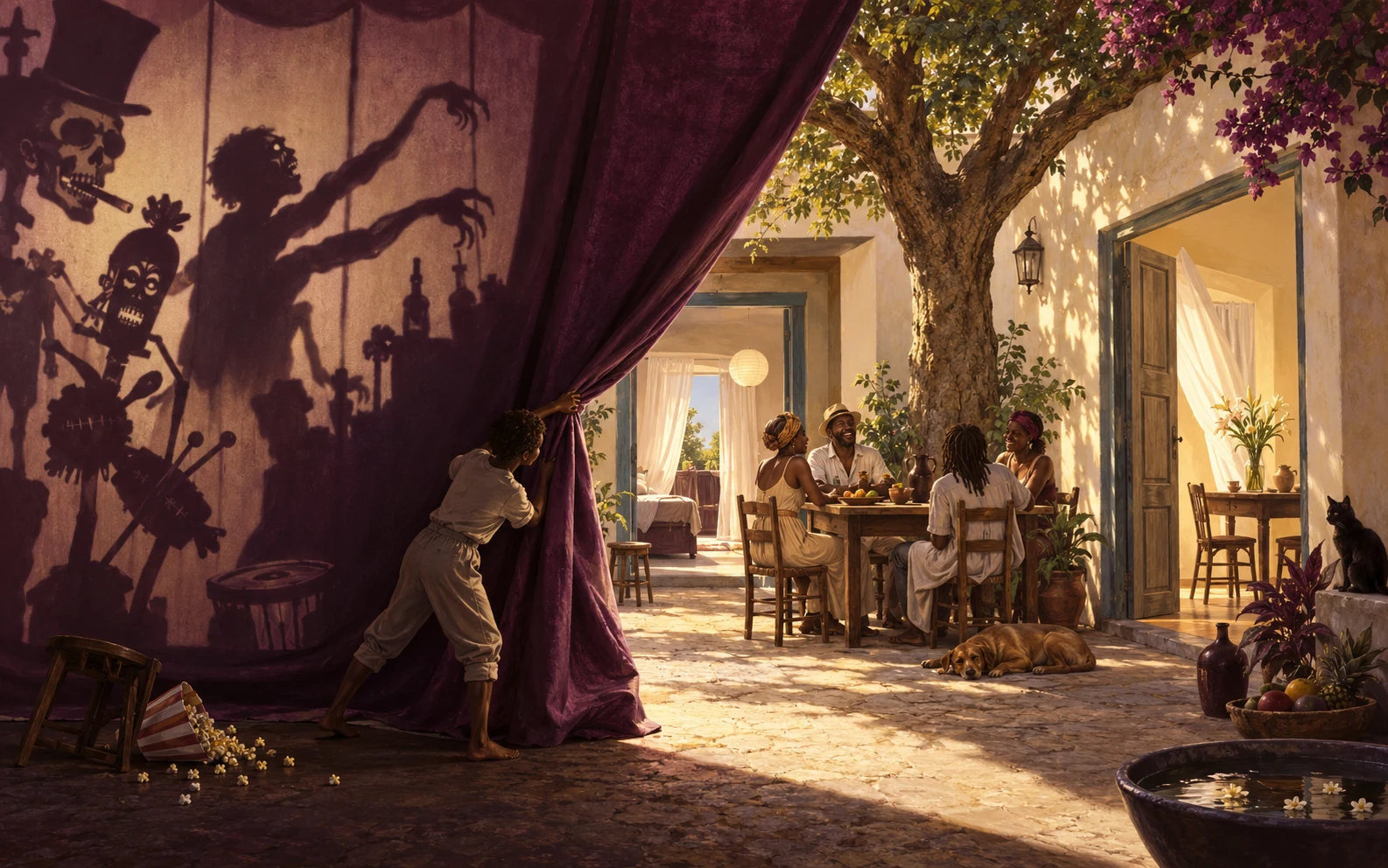
If your knowledge of Voodoo is limited to Hollywood horror flicks about zombies, shrunken heads, and sticking needles into a ragdoll of your ex-boss, the authors of this article have bad news for you: you haven't understood a thing. From the perspective of cultural studies and comparative philosophy, Voodoo is a rigorous operating system for inter-world interaction, not a branch office of a village coven.
Let's make an important caveat right away: this is exclusively the author's philosophical and anthropological lens. No pretty cultural parallels turn different religions into "the same thing," quantum trials (like Aspect's entanglement experiments) do not prove Voodoo rituals, and the article's metaphors guarantee neither psychological safety nor, even less so, medical benefit.
Yet, if you set the popcorn aside and turn on your brain, the text's logic breaks down into several straightforward points.
1. Cosmology: The Remote CEO and His Field Staff
In the Haitian pantheon, everything is arranged in an utterly bureaucratic manner. At the very top sits Bondye ("the Good God," also known as the Grand Master). He is the equivalent of the unknowable Absolute. He created the world, shrugged, and went permanently offline. Trying to pray to him directly for a pay raise or relief from a hangover is about as sensible as filing a complaint about a broken lightbulb in your hallway directly with the United Nations: he is far too grand, too distant, and simply does not deal with mortals directly.
All the real field work is handled by the Lwa—the active agents, spirits, and operators of the cosmos. Each Lwa possesses their own foul or pleasant disposition, specialization, wardrobe, and dietary rider. Bondye is the primary power source, while the Lwa are the transformers and wall sockets you can actually plug into.
2. The Body as a Cheval: Renting a Meat-Suit with No Lease-to-Own Option
At the word "possession," a Westerner immediately pictures spinning heads, projectile green vomit, and exorcists. In Voodoo, this process carries a far more pragmatic name—cheval (horse).
The human being here is not an unfortunate victim of the devil, but a borrowed pony. The Lwa literally "mounts" the practitioner for the duration of the ceremony. The person's ego and everyday "I" step aside to take a smoke break; the spirit runs its business through their muscles and vocal cords, and then dismounts. The golden rule of this car-sharing service: return the ride in one piece, well-fed, and un-wrecked, so it can be taken out for another spin. After the trance, the person remembers nothing, but the system keeps right on ticking.
3. Matter Is Not a Wall, but a Semi-Permeable Membrane
For centuries, European thought suffered from dualism: supposedly, there is pure, exalted "spirit," and then there is the grubby, sinful "meat-sack matter". Voodoo views this melodrama with total bewilderment. Here, matter is not a prison for the soul, but a contact membrane.
The body, drumming, wood, rum, water, and the central temple pillar (potomitan) are not barriers cutting us off from the invisible, but points of physical contact. The pillar stands in the temple neither for decoration nor as an abstract symbol, but as a physical elevator down which the Lwa descend to join the party.
4. Vèvè: Don't Doodle, Dial the Exact Number
The Lwa do not show up for some vague, angsty cry like "Oh, everything hurts, somebody help me". They require a precise protocol. To provide this, priests trace vèvè—intricate geometric diagrams—on the ground using flour or ash.
A vèvè is not a mystical incantation to enslave spirits; it is a QR code and a direct phone number in the directory. Misplace a couple of lines, and the recipient won't answer; the signal simply vanishes into the void. Zero emotional clutter: discipline and geometry dictate everything.
5. The Ethics of Reciprocity: Rum Upfront, Results to Follow
There are no freebies in Voodoo; the concept of "unearned grace without effort" is completely missing. Interaction with spirits operates on a strict barter economy. If the Lwa clocked in, the Lwa must be fed.
Offer Danballa the white serpent his eggs and milk; hand fire to the fierce crowd; pour stiff, fiery booze for the Baron. Trying to pocket otherworldly power "on the house" or skipping out on the tab is considered a surefire way to snap your own neck. The traditions are divided into the moderate and calm (Rada line) and the wild, explosive (Petwo, forged in the fires of slave revolts), but the underlying rule is identical: you must settle the bill regardless. As for the needle-poked dolls that pop culture loves to freak out over—that is pathetic fringe behavior and a gross breach of basic transactional balance.
6. The Crossroads and Papa Legba: The Gates Open Here
Every gathering in Voodoo begins at the crossroads (kafou) with an invocation to Papa Legba. Without him, literally nothing functions: he is the doorman, the dispatcher, and the keeper of the keys.
The crossroads is a universal point of choice, where worlds intersect and decisions get made. Legba is a crafty trickster old-timer: he can open a road, or he can slam the door right in your face. Until you've asked Legba to clear the way, you can bang your forehead against the altar all day long—there will be no connection.
7. The Gede and Baron Samedi: Dark Humor on the Brink of the Grave
Rounding out this circus is the Gede family—the spirits of death led by the flamboyant Baron Samedi in his black tailcoat, undertaker's top hat, and dark sunglasses. By all accounts, it should be time to drop to your knees and tremble in sepulchral terror. Yet when the Gede arrive, outright debauchery breaks out in the temple: they talk dirty, crack crude jokes, chug hot pepper-infused rum, and bust into the erotic banda dance.
Why? It is an ingenious vaccine against existential dread. Death is inevitable, so wailing and burying your head in the sand is useless. The Gede link death directly to raw sexuality and primal laughter: if you can laugh in Baron Samedi's face, death no longer has the power to paralyze your life.
Finale: Translating from Mystical to Human
What is the point of this entire comparative breakdown? The authors lead us toward a thoroughly pragmatic everyday philosophy—one you don't need to run to a cemetery to understand:
- Keep your sanity intact: entering altered or high-stress states doesn't have to turn you into a lunatic; you must know how to clock out of any trance or role right on schedule.
- Don't wage war on your body: flesh, daily chores, sleep, and physical actions are not "filth," but operational tools without which no thought can ever manifest.
- There is no such thing as a free lunch: banking on "enlightenment via a three-day webinar" dodges real effort and reciprocity, risking little more than the hangover of wishful thinking.
- Technique beats whining: the cold precision of method and discipline consistently out-performs chaotic emotional tantrums.
- Look fear straight in the eye: acknowledging the finite nature of life liberates you from trivial fuss far better than pretending we are going to live forever.
And the ultimate moral: power does not descend upon the one who puffs up their cheeks and plays the great sorcerer, but upon the one willing to serve as a humble, functional conduit. Yet the right to be that conduit must always be paid for in discipline and resource.