
World & consciousness
Florensky: Symbol, Knowledge, and Religious Thought
Florensky on symbols, names, and icons: distinguishing meaning, experience, and claims about reality.
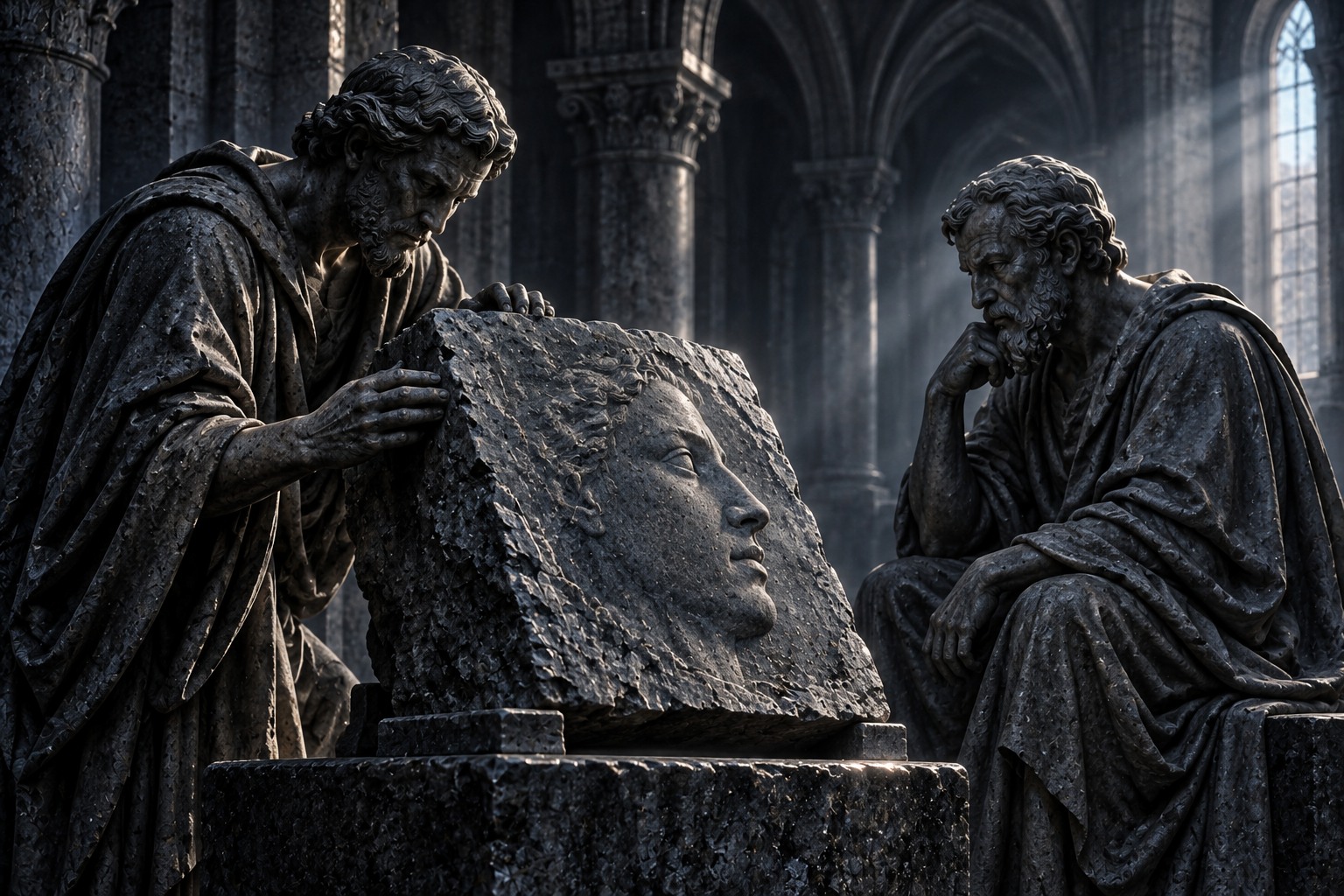
Epigraph
“Being that is more than itself.”
Pavel Florensky, “Name-Glorification as a Philosophical Premise,” IV, the opening definition of a symbol. Our English translation of a short Russian fragment. The Russian title, Imeslavie kak filosofskaya predposylka, follows the edition consulted.
What this article is about
In a museum, we encounter a board, paint, and an image. In a church, the same object can offer a way of addressing a reality that a believer does not consider visible to ordinary sight. The difference extends beyond taste or the emotional intensity of an impression. Pavel Florensky proposes understanding a symbol as the presence of something greater within something smaller, rather than as a conventional label. This is a strong religious and philosophical claim. We will examine what it means for an icon, a word, and knowledge, while keeping theological thought distinct from experimental theory. We will also consider reverse perspective: why an unfamiliar way of depicting something need not be a mistake. The practical question concerns reading difficult texts and cultural objects. How can we distinguish a symbol's structure, our experience of its meaning, and a claim about the world? These distinctions help us understand Florensky while retaining the right to accept part of his argument and reject another part.
I. An object that extends beyond its surface
One object invites several questions, and none necessarily cancels the others. Imagine a museum visitor asking what kind of wood an icon is made from. An art historian studies the painter's technique. A believer recognises an image addressed in prayer. These are three ways of relating to one board, rather than three different boards. We need to preserve their differences before declaring one superficial and another uniquely authentic.
In “Iconostasis”, Florensky connects the icon with the manifestation of spiritual reality, rather than with depiction alone. In his account, the material image directs attention towards the invisible. This belongs to Orthodox philosophy and the theological interpretation of art. It cannot be deduced directly from the chemical composition of paint, or refuted simply by observing that the board is material.
It helps to separate three levels. What is physically present? What does this object mean within a particular tradition? What claim about reality does that tradition make? At the first level, we investigate materials. At the second, history and practices of use. At the third, the grounds of faith and philosophical argument. Connections between these levels are possible, but the transitions need to remain visible.
The mistake can run in either direction. We might describe every religious relation to an object as ignorance of its materials. Or we might treat an experience of the sacred as proof of specific physical properties. In both cases, a question belonging to one field takes over another. Materiality does not exhaust meaning, but the strength of meaning cannot replace measurement. These two propositions need not contradict each other.
This distinction makes closer attention possible. A reader need not accept Florensky's entire theology to understand his question about symbols. Yet we must recognise that he means more than a pleasing association or decorative sign. Preserving that content allows a real conversation with the text to begin. Replacing it in advance with a convenient modern metaphor can make us agree with the author precisely because we have stopped hearing his claim.
II. A symbol and a conventional designation
For Florensky, a symbol is stronger than an ordinary conventional sign. In “Name-Glorification as a Philosophical Premise,” III–IV, he examines the relation between being and its manifestation. Here, “energy” belongs to a philosophical and theological account of activity and manifestation. We cannot quietly substitute a physical quantity and conclude that a symbol transfers measurable force between people or objects.
For contrast, imagine a room-number sign. Its number helps people find the room through an accepted convention. We can change it while preserving its function. Florensky asks instead about a relation in which a symbol does more than indicate something absent: it participates in the manifestation of what it symbolises. This difference is central to his thought and should survive any simplification of his terminology.
Everyday life contains intermediate cases. A wedding ring signifies a relationship and also forms part of how it is experienced. A signed document communicates a decision and makes it available to others. A family possession maintains a connection with the past. These examples raise a question about how meaning works, but they do not automatically confirm Florensky's ontological symbolism. Similar functions need not imply the same structure of reality.
At the beginning of “On Interpretation”, Aristotle distinguishes spoken sounds, experiences, and objects, considering a name in terms of conventional meaning. The comparison shows that “sign” and “symbol” do not work identically everywhere. When authors use similar terms, we should first establish the relation each term denotes. Otherwise, comparison produces agreement between words instead of understanding the thought.
In practice, this means resisting the quick translation of everything into one vocabulary. A sign may perform different functions in artistic description, liturgical action, and a road system. We may compare them and find shared features without dismissing their differences. Careful reading begins with a specific question: what does this symbol make possible in this context, and what claim about the world has been entrusted to it?
III. A word leads outward or closes us inside
A word need not remain a report about our internal states. At the beginning of “Name-Glorification as a Philosophical Premise”, Florensky connects knowing with reaching towards the world beyond subjectivity. For our purposes, the direction matters. In naming, we claim to speak about what we encounter, as well as about what we have experienced internally.
Imagine someone saying “a promise.” They may mean a reassuring image of a dependable relationship. Yet a promise also exists as another person's action, particular words, a deadline, and an expectation. Reducing everything to personal experience removes the shared subject about which we can ask questions and check disagreements. Reducing everything to an external record removes the meaning participants give their agreement.
Between these extremes, words make joint examination possible. What was promised? Who heard it? Did both sides understand the condition alike? How do changed circumstances affect the obligation? Such questions require acknowledging both a real world and the independence of its participants. Shared meaning is neither created by one person's arbitrary decree nor always found ready-made in a dictionary.
Naming itself can mislead. Someone calls an action care, while another person experiences it as interference. The name expresses the speaker's intention, but does not establish every property of the action. We need to examine consequences and the recipient's response. Here, Florensky's question about words and reality becomes a demand for precision, although our application does not reproduce his theological theory of naming.
We should distinguish a name from proof. Naming a phenomenon does not establish that we understand it correctly. Yet a name can open a path towards inquiry: identify a subject, maintain a distinction, and make discussion possible. A word then need not lock experience into a settled category. It can let us encounter something that resists the category and requires us to revise it. That possibility matters to believers and to readers who reject the author's religious foundation.
IV. Unfamiliar perspective need not be a mistake
We should assess an image in light of what it attempts to show. At the beginning of “Reverse Perspective”, Florensky considers features of icons that depart from linear perspective. His question is whether these features must indicate a lack of skill. This is a substantive problem of form. It does not turn every historical judgement he makes into an established fact of art history.
Linear perspective organises an image around a particular viewpoint. Another kind of drawing may combine sides that cannot be seen simultaneously from that position. A modern reader may readily call it wrong if the only criterion is resemblance to a familiar image. First, however, we should establish the function of space within the work. One kind of realism does not exhaust the possibilities of art.
Imagine a building diagram showing several floors at once. It departs from the building's familiar external appearance but helps explain its structure. A child's drawing enlarges an important person without observing proportions. This is not yet the reverse perspective of icon painting. The examples serve only to distinguish two things: departure from one rule may support another task. We cannot judge quality without establishing the task and considering whether it has been achieved.
Respect for different forms does not prohibit criticism. A drawing can be unsuccessful, an argument weak, a chosen technique ineffective. Calling every departure profound would remove the possibility of assessment. Another perspective requires another criterion, rather than no criteria. We should make the question concrete: which relations become visible through this form, and which may have been hidden?
This reading helps us move beyond the automatic superiority of a familiar viewpoint. It does not require treating all depictions as equally successful or religiously true. Perspective becomes a matter of choice and analysis. We can see how form directs attention and examine the cost of that direction. This yields more than simply replacing one universal standard with another equally certain of its own exclusivity.
V. A map helps precisely because it selects
A complete picture of the world would not make a useful map. A map selects streets, terrain, or transport according to its purpose. Its usefulness depends on selection, rather than on literal correspondence with the territory. This ordinary example lets us discuss the form of knowledge without attributing a ready-made modern theory of models to Florensky. We are proposing our own distinction between representation, purpose, and reality.
Imagine a traveller looking at a transport diagram and drawing a conclusion about exact distances between stations. The diagram may show their connections but not their proportions. The error need not lie in the diagram itself. It arises from transferring useful knowledge to a different task. Precision always requires a specified subject: precision about what, and for which use?
Some difficulties in reading philosophical texts have a similar structure. An author's image may reveal a relation that ordinary language struggles to show. Yet the image need not also provide measurement, historical proof, and practical instructions. Demanding all of these at once makes us either reject a useful thought or draw conclusions from it that it does not support.
Florensky seeks more than this modest theory of representation: his symbol must connect with reality. That is why calling his symbol a map cannot settle the question. Comparison makes the contrast visible. A map is recognised as selection for a purpose; a symbol, in the religious thought under consideration, claims to participate in manifestation. We must preserve the difference even when both direct our attention.
A practical discipline is to examine the transition from form to conclusion. If a diagram shows a connection, do not turn it into proof of a cause. If a symbol gives an action meaning, do not automatically infer a physical effect. If a model predicts one thing, do not demand that it explain all of life. Limiting a form's application does not diminish its value. It helps us use it where its operation is intelligible and open to examination.
VI. The sacred exceeds the intensity of an impression
A religious symbol cannot be understood solely through how strongly it moves an observer. In the prologue to John's Gospel, 1:1–18, the Logos is connected with God and incarnation. This Christian context helps explain why the relation between visible and invisible has a content for Florensky distinct from a general interest in striking images.
Someone may feel a powerful impression in a church, museum, concert hall, or beside the sea. The intensity alone does not establish that these events are equivalent. For a believer, tradition, address, and a claim about reality matter. For an art historian, form and historical significance matter. Another observer may be responding to personal memories. Respect for an experience does not require declaring all its grounds interchangeable.
Imagine a visitor saying that they felt a special presence in an old building. We can hear the account without disputing their right to feel what they felt. But if it is followed by a claim that the building's supernatural action has been proved, a different foundation is required. Reporting an experience and explaining it remain distinct even when the account deserves careful attention.
Equally, the absence of an impression does not prove that a symbol is meaningless. Someone may lack its context, be occupied with something else, or not share the faith. Their reaction need not become a diagnosis of spiritual deficiency. Florensky sometimes uses forceful polemical language. A reader may examine that language without reproducing its judgement of every contemporary participant.
Serious comparison begins with a question about a particular practice. Who engages with the symbol, how, within which tradition, and with what understanding? A religious object then acquires its own content instead of becoming a generic resource for improving one's mood. We can reject a faith while accurately understanding its claim. Such precision offers more than superficial agreement in which differences disappear because no one clarified the subject.
VII. A difficult thought is not necessarily an antinomy
An antinomy involves a substantive collision between propositions, rather than merely an impression of incomprehensibility. At the beginning of “Name-Glorification as a Philosophical Premise”, Florensky allows that not everything will be brought into one explanation. This matters to his way of thinking. A contemporary reader should nevertheless avoid using “antinomy” as permission to leave an ordinary error or unclear formulation unchecked.
Imagine a text in which one sentence says an event occurred yesterday and another says it did not occur. If both concern the same event in the same respect, we should first check the information. A profound label cannot repair the discrepancy. In another case, someone wants closeness and distance simultaneously. This may express tension between different needs rather than a formal logical contradiction. Distinguishing these cases changes the next conversation.
In “On Interpretation”, Aristotle considers affirmation and denial, including the conditions under which they concern the same subject. The relevant discipline is to check terms, time, and relation before declaring two statements incompatible. Spiritual depth does not remove this work; it may make it more necessary.
A philosophical tension may remain after clarification. We can show it without promising an immediate solution. How, for example, can a symbol be materially independent while manifesting something greater? Florensky offers his own account of the connection. Readers may examine what it explains and which questions remain. We need neither replace a difficult question with “everything is one” nor dismiss it because one measurement cannot resolve it.
Useful incompleteness has a form that vagueness lacks. We know which claims we retain, why, and where they remain unresolved. Vagueness prevents even this. If, after reading, we cannot state the question without elevated language, we should return to concrete words and examples. A difficult text deserves effort, but the effort should increase understanding, rather than merely our feeling of belonging to complexity.
VIII. A name gives no authority over a being
Understanding a philosophy of naming does not provide a way to control people through well-chosen words. Florensky asks about naming and reality within the stated religious context. This cannot become a recipe according to which a name automatically changes the world, guarantees a wish, or grants hidden power. Such conclusions require entirely different grounds, which the examined passages do not establish.
In everyday life, names do affect how we relate. Calling someone an employee, citizen, or guest brings different expectations. Yet this social action operates through agreements, habits, and institutions. It is not equivalent to established metaphysical causation. Words can influence events, but we still need to show who heard them, how they understood them, and what actions followed.
Imagine an organisation renaming its customers “partners.” If participants receive more information and the right to discuss terms, the word accompanies a real change. If conditions remain identical, the new name may merely improve the impression. Examination moves from the word to the arrangement of relations. An attractive name alone does not confirm a changed connection with what it denotes.
Conversely, not every meaning can be measured through immediate behaviour. A dead person's name in a family story may preserve memory without prompting a separate external action. We should avoid devaluing meaning by demanding immediate usefulness. Yet memory, value, and a claim about continued physical existence remain distinct. One does not automatically prove another.
Careful naming includes readiness to abandon an unsuitable name. If someone does not recognise themselves in our description, we should clarify rather than insist more strongly. We may have reasons to challenge their self-description, but must present those reasons separately. A word becomes a bridge to reality when it allows reality to resist it. If it prohibits every revision, the bridge has become a wall bearing a persuasive definition.
IX. Different questions require different grounds
The unity of a person working in mathematics, art, and theology does not imply that all their arguments are alike. An author may think across several fields, but we need to examine the basis of each conclusion. The breadth of Florensky's biography does not itself make a religious claim a mathematical theorem, or a mathematical image evidence of the supersensible.
Imagine a lecture where a geometric figure helps represent relations between whole and part. It may be a clear illustration. If the lecturer then says the figure has proved a theological thesis, another argument is needed. Moving between fields is permissible. The transition simply does not occur automatically through an image's expressiveness or the authority of someone fluent in several languages of knowledge.
This distinction does not require hostility between science and religious thought. It lets them meet without appropriation. Scientific description sets particular conditions of observation and testing. Philosophical argument examines concepts and implications. Religious thought enters a tradition of faith and interpretation. Connections are possible, but they should preserve a way of answering why we ought to trust a particular conclusion.
A contrast with Solovyov's programme of integral knowledge is useful here. Both thinkers invite questions about a broad connection between knowledge and life. But a programme of synthesis is not a synthesis already accomplished, and a symbolic ontology is not an experimental model. A shared direction does not remove differences between particular works and arguments.
For readers, a good test is to change the question without changing our honesty. What can I understand as an image? What does the author offer as a philosophical argument? Which proposition is accepted within faith? What requires measurement? Making these questions explicit allows interested and critical reading together. We need not choose between accepting an author entirely and refusing to hear anything outside our single familiar way of checking.
X. Seeing more without claiming too much
Symbolic reading becomes stronger when it can stop at a conclusion's boundary. We may see more than an object's material without attributing unsupported action to it. We may understand a religious claim without accepting it. We may recognise a form's expressiveness while disputing the author's historical judgement. These combinations preserve the reader's independence without impoverishing the text.
The imagined visitor from the beginning can now ask several clear questions. Which features are depicted? How was the object used? What does a particular tradition see in it? What philosophical thesis does Florensky propose? The visitor's view expands, but need not become certainty that every answer coincides. The open difference between answers makes further reading substantive.
The same ability helps us with powerful everyday words. “Home,” “faith,” “freedom,” and “kinship” can carry more than one definition. They connect memory, norms, and expectations. To keep our bearings, we can ask which layer of meaning is operating. Sometimes a dispute concerns an implicit promise that one participant hears in a word and another never made.
Separating layers does not destroy a symbol. It gives a meaningful object a more precise place in life. The object need not answer for every hoped-for miracle to remain important. It can preserve memory, direct attention, or express faith. Yet if a decision rests on it, consequences and conditions need separate examination. Depth of meaning does not remove practical responsibility.
Florensky asks readers to take seriously what extends beyond the surface. We can answer with another kind of seriousness: neither simplifying his claim nor expanding it without grounds. A symbol then becomes a subject for attentive thought. It helps us notice how form opens the world, while asking where our interpretation has closed that world through an explanation too convenient for us.
What this means in practice
Choose an object or word that has special meaning for you. It could be a family possession, place, photograph, or concept such as “home.” First describe it without interpretation: its material, image, the word's use, its particular history. Then write what it means personally. You need not prove an experience's value by immediately finding a universal explanation.
Third, establish the cultural context. If the object is religious, name the particular tradition and practice of engagement rather than general “spirituality.” If the meaning is familial, separate your memory from other people's accounts. Different participants may relate differently to one object. That does not automatically make one relation false: meaning and historical fact require different checks.
Now examine the conclusion you usually draw from its meaning. “This house matters to me,” for example, becomes “I must never leave.” Or “This promise has force” becomes “Its conditions cannot be discussed even after circumstances change.” The transition itself needs attention. Significance explains why the question is difficult; it does not yet establish a single possible answer.
Try preserving meaning while changing how you act. You can cherish a place's memory and live in another city. You can respect a religious object without using it as proof of a physical effect. You can clarify a promise without calling the earlier connection meaningless. A decision should have concrete grounds and consequences you are willing to examine separately from powerful symbolic language.
Finally, ask whether clarity has increased. If you have acquired only more elevated words, return to description. Good work with symbols enables distinctions, rather than simply intensifying an impression. It need not remove faith, love, or memory. It gives them a precise place alongside facts and decisions. We can then see more in an object without claiming more about the world than the grounds actually examined support.
Key quotation
“The word, as an activity of knowing, leads the mind beyond subjectivity.”
Pavel Florensky, “Name-Glorification as a Philosophical Premise,” I. Our English translation of the beginning of a Russian sentence clause; the initial capital was normalised in RU. The author concerns contact with reality, rather than the automatic truth of every spoken name.
Connections between traditions
| Comparison | Shared question | Boundary |
|---|---|---|
| Florensky: symbol ↔ Aristotle: name and designation | Language connects experience and its object. | Aristotle's conventional name is distinct from Florensky's ontological symbolism. |
| “Iconostasis” ↔ John's prologue | Visible and invisible are discussed in the Christian context of incarnation. | The Gospel's Logos is not equivalent to every cultural sign or human word. |
| “Reverse Perspective” ↔ a modern map | Form selects how to show relations. | The map is our explanatory example, not proof of an icon's theological significance. |
| Florensky: naming ↔ Plato: living knowledge in “Phaedrus” | Naming and recording do not remove the question of knowledge. | Plato's criticism of writing is not a doctrine of name-glorification. |
| Florensky ↔ Solovyov: knowledge and life | A specialised field does not exhaust human understanding. | This connects questions, not identical systems or an accomplished scientific and religious synthesis. |
Primary sources and research
- P. A. Florensky, “Name-Glorification as a Philosophical Premise” (Imeslavie kak filosofskaya predposylka), I–IV — word, essence/energy, symbol; selected passages and both quotations' context were read. The page reproduces the 1990 edition; modern notes are not quoted.
- P. A. Florensky, “Iconostasis” (Ikonostas) — passages on the altar screen, window, and icon; the entire work was not read.
- P. A. Florensky, “Reverse Perspective” (Obratnaya perspektiva), “Historical Observations,” I — the question of unfamiliar form; the editor's qualification concerning outdated historical information remains in the research notes.
- Aristotle, “On Interpretation,” chapters 1–4 and 6 — language, conventional meaning, affirmation and denial; E. M. Edghill's English translation.
- Gospel of John, 1:1–18, KJV — the Christian context of the Logos; paraphrase, without an additional verbatim quotation in RU.
- Plato, “Phaedrus,” 275d–276a — living knowledge and writing, Benjamin Jowett's translation; used in the connections table.
- V. S. Solovyov, “Philosophical Principles of Integral Knowledge” (Filosofskie nachala tselnogo znaniya), II — comparison between a programme of synthesis and the question of symbols.
Tags
Florensky, symbol, knowledge, name-glorification, name, word, icon, Iconostasis, reverse perspective, religious philosophy, theology, Orthodoxy, Logos, meaning, interpretation, reality, image, sign, form, attention, perspective, antinomy, Aristotle, Plato, Solovyov, memory, culture, limits of inference.
About the authors
Andrey Zarinsh is the author and founder of United Wisdom. He explores inner transformation, the unity of traditions, intercultural dialogue, and contemporary spiritual discipline. Instagram: @andrey.zarinsh.
Maria Evilkut is a coauthor of United Wisdom. Alongside her research, she seeks to test these ideas in practice and observe how principles of unity and mutual understanding work in real life between people and cultures. Instagram: @ilkutki.
Keep what resonates with you.