
Traditions and Worldviews
How Not to Mistake a Plank for a Miracle: Florensky, Symbols, and Brakes for the Mind
Imagine that a painted wooden board is placed in front of an audience, instantly producing two irreconcilable camps.
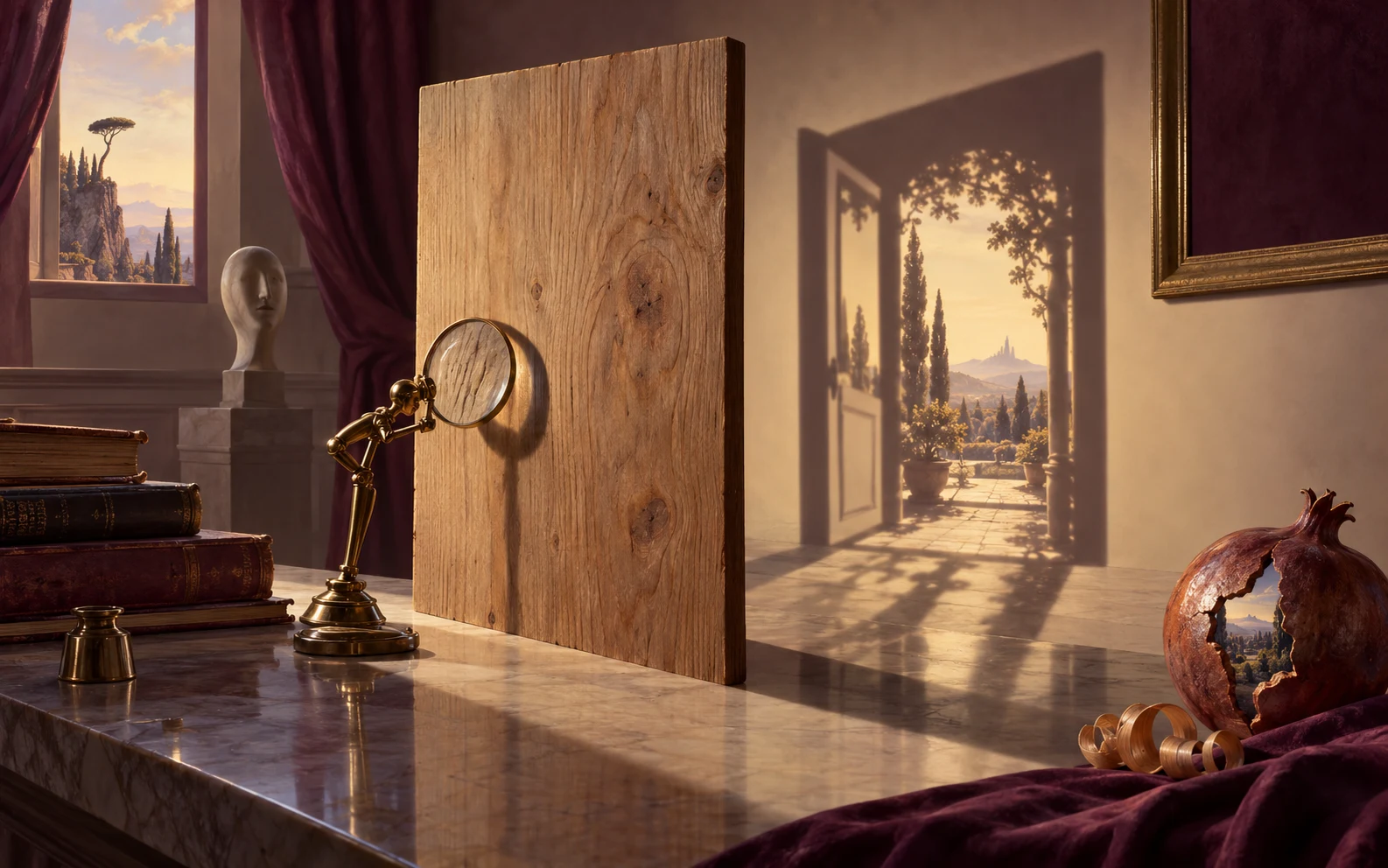
"Being that is greater than itself."
Pavel Florensky, “Onomatodoxy as a Philosophical Premise,” IV (English translation prepared for this article).
I. A Plank, Daub, and the Sacred: Three Storeys of a Single Object
Imagine that a painted wooden board is placed in front of an audience, instantly producing two irreconcilable camps. One faction dashes off to scrape pigment for spectral analysis, proudly declaring that having isolated a molecule of drying oil, God is officially debunked. The other, catching holy goosebumps from the sheer pious splendor, immediately demands that the board be certified as a direct emitter of supernatural radiation.
In Florensky’s “Iconostasis”, an icon is not merely an illustration, but a manifestation of spiritual reality. Yet this is strictly a religious-ontological proposition within Orthodox theology, not an experimental lab protocol for physicists. Keep the three storeys distinct: the physical composition of the timber, the cultural practice of handling it, and the theological claim of faith. No chemical breakdown of pigments invalidates the meaning of prayer, but neither does the intensity of your personal ecstasy convert a wooden board into a particle detector. Reducing faith to a pedestrian ignorance of chemistry is foolishness, but swapping rigorous measurements for devout gasping is every bit as foolish.
II. A Symbol Is Not a Restroom Door Plaque—Nor a 220-Volt Socket
For the casual observer, any sign is merely a handy label. Screw a sign reading “Accounting” onto an office door and you get bean counters; swap it for “Cloakroom” and coats get hung. It is a matter of conventional agreement. But for Florensky in “Onomatodoxy as a Philosophical Premise,” III–IV, a symbol operates entirely differently: it actually participates in manifesting the very reality it denotes.
At this point, esoterically inclined enthusiasts gleefully latch onto the word “energy”. Calm down: theological “energy” is neither kilowatt-hours nor a measured physical quantity that can be picked up with a multimeter. A symbol does not pump electrical current between the astral plane and ordinary citizens. Our everyday examples—grandma’s antique watch, wedding rings, or notarized legal documents—help illustrate how a physical object holds human meaning, but these are strictly conventional mundane analogies, not empirical proof of the metaphysical architecture of the cosmos. Florensky is not Aristotle from “On Interpretation”, where a noun or name is defined as a spoken sound significant by convention. Do not dump distinct thinkers into one indiscriminate conceptual mush just because both happen to pronounce the word “sign”.
III. The Word Is an Exit Outside, Not a Self-Obsessed Echo
One can easily picture someone convinced that language exists solely to broadcast their precious internal moods: “I feel it this way, therefore the universe must conform”. In “Onomatodoxy as a Philosophical Premise”, Florensky points in precisely the opposite direction: cognition strives to break through toward a reality that lies well beyond your subjective cranium.
When one person labels their behavior “caring” while the other suffocates under overbearing control, the truth is not determined by whoever shouts the prettier label louder. Naming a phenomenon is not yet proof that you have understood it. A name is a working compass for investigation and verification, not an indulgence granting instant correctness. When reality punches your ornate definition in the nose with hard facts, you need the decency to revise your vocabulary rather than declaring the external world defective.
IV. Unfamiliar Perspective Is Not Always Clumsy Hands—Yet Not Every Smear Is Genius
When an educated connoisseur encounters a medieval icon where background banquet tables are drawn wider than foreground ones, their fingers itch to give the iconographer a failing grade in drafting. Florensky in “Reverse Perspective” asks an entirely reasonable question: what makes you so certain that Renaissance linear perspective is an absolute law of nature? Visual form serves a specific task. An architectural cutaway blueprint displays three floors simultaneously; it is entirely anti-realistic to the human eye, yet exceedingly functional for the intellect.
Here, however, lies an easy trap for the uncritical: canonizing every distortion and clumsiness as “mystical depth”. An unfamiliar mode of depiction is not necessarily an error, but neither is every blatant anatomical or spatial mismatch a sign of esoteric wisdom. Sometimes an artisan simply blended paints poorly or could not manage composition. Furthermore, do not transmute Florensky’s own outdated historical assertions into unshakeable art-historical facts. Appreciating an alternative visual syntax requires a sober standard of judgment, not blind adulation before every crooked angle.
V. Why Maps Work: The Art of Trashing the Irrelevant
A subway map does not trace the actual physical twists and depths of subterranean tunnels, and precisely because of that abstraction it can help keep you from getting lost. Draw a transit map at a one-to-one scale complete with every sewer grating and manhole, and it risks becoming useless for navigating the line. A map selects only what is necessary for a specific purpose.
Do not, however, confuse our applied analytical model with theology. A street map or railway diagram is strictly our own contemporary illustrative example, not proof of symbolic metaphysics. Florensky stakes a far stronger claim: for him, a religious symbol actually participates in the very being to which it points. Do not water the author’s philosophical claim down to a basic functional diagram. And keep your logic on a tight leash: just because a diagram helps you change trains at the station, that is no excuse to spin it into a grand cosmological theory of personal salvation.
VI. Goosebumps Are Not Evidence of Divine Grace
One can shed a tear in an Orthodox cathedral, weep at a stadium rock concert, or stand paralyzed before the majesty of a churning ocean. Yet an emotional shockwave does not by itself make these experiences identical. In the Gospel of John (1:1–18), the Logos is made flesh within a concrete Christian revelation, rather than dissolving into the fuzzy aesthetic bliss of sunset enthusiasts.
If you stood by an ancient stone wall and felt your knees tremble—splendid, but that remains your subjective psychological dispatch, not the verified log of a scientific experiment. The intensity of an impression never serves as proof of a supernatural effect. And consider the flip side: if an unbeliever walks into a church and remains completely unimpressed, there is no need to assume pastoral airs and diagnose them with “spiritual blindness”. The absence of an emotional thrill proves nothing about that individual's condition. Do not confuse cultural unfamiliarity with a moral defect of conscience.
VII. An Antinomy Is Not a Medical Note from Logic to Excuse Stupidity
The term “antinomy” is the favorite bunker for people who stumble over two straight trees and refuse to admit they are lost. In “Onomatodoxy as a Philosophical Premise”, Florensky certainly engages with intense antinomic tension. Here, an antinomy implies a substantive collision of claims right at the frontier of rational explanation, not a convenient hall pass for basic intellectual sludge.
If in one sentence you swear that an event occurred yesterday and in the next insist it never happened at all, you have not unraveled a grand cosmic paradox; you simply failed to check your calendar and facts. As Aristotle reminded us in “On Interpretation”, before cooking up profundities, ensure that you are speaking of the exact same subject at the exact same time and in the exact same relation. Invoking an antinomy does not relieve anyone of the duty to formulate precisely which propositions have collided and why they cannot be reconciled. If a text leaves behind only foggy rhetoric and pious murmuring, you are looking at ordinary intellectual carelessness dressed up in expensive terminology.
VIII. Magical Thinking: The Right Word Does Not Rearrange the Furniture
Do not twist Florensky’s philosophy of the name into a wish-granting recipe. Knowing a name grants no occult leverage over your neighbors, compels no favors from the universe, and guarantees zero instant hypnosis. Nothing in the arguments considered here provides a technique for manipulating someone else’s will.
When a corporation repaints its signs and begins addressing exhausted clients as “esteemed partners” while continuing to levy extortionate fees, the practical reality of the relationship has not budged a single millimeter. That is merely marketing. A word establishes contact with reality only when it is prepared to encounter the pushback of that reality. If you slap on an authoritative label and forbid reality from talking back, your symbol has degenerated into a blind fence with writing on it.
IX. A Mathematician in a Cassock Is No Reason to Mix Logarithms with the Eucharist
Florensky worked fluidly across divergent languages of inquiry: mathematics, art history, and theology. But the fact that he wore the same cassock while tackling all three does not transform his mathematical formulas into dogmas of faith, nor his religious insights into differential equations. Different inquiries demand fundamentally different warrants.
In a hypothetical classroom lecture, an elegant geometric figure might serve as a sparkling visual metaphor for unity or tri-unity, but of itself it proves no theological dogma. Do not indulge in illusions, and do not conflate Florensky with Vladimir Solovyov and his project of “integral knowledge”. The aspiration toward a grand synthesis of science and religion is an ambitious philosophical project, not an already settled scientific transaction. Maintain basic intellectual hygiene: religious faith rests on trust in Revelation, scientific description rests on defined conditions of observation and verification, and philosophy rests on the rigorous critique of concepts. Do not blend them into a single pot under the pretext of an author's polymathic brilliance.
X. How to Look Deeper Without Inventing Miracles Out of Thin Air
A mature grasp of the symbol consists in discerning the depth of an object without burdening it with gratuitous fantasies. You are entirely free to appreciate an icon as a pinnacle of painterly genius, respect the devotional practice of a believer, and simultaneously decline the theological claims of the author. A grown-up mind can navigate complexity without panicking and demanding that everything be smashed down to a flat common denominator.
Florensky urged us not to skim merely over the surface of things. The sharpest response to that challenge is uncompromising intellectual sobriety. Do not demote a symbol to a dead shipping tag, but do not turn it into an occult power bank either. Knowing how to pull the emergency brake at the perimeter of an inference—refusing to build an elaborate metaphysical pagoda where plain empirical facts suffice—is a way to honor a thinker while keeping your own sanity intact.
What This Means in Practice (Voluntary Practice)
-
Select an object or a weighty word. Pick an heirloom ring, an old photograph, a childhood home, or a demanding term such as “duty”.
-
Describe the material baseline. Note the raw facts without sentimentality: the alloy, the hallmark, the timestamp of the photo, the square footage, or the literal dictionary definition. No fabricated “energetic vibes” or secret cosmic meanings—stick strictly to verified details, and mark the unknown as unknown.
-
Articulate the personal meaning. State honestly what this item signifies to you personally. Do not attempt to upgrade private nostalgia into a universal moral law.
-
Identify the tradition and context. If the object is religious, name the specific historical confession and canon rather than invoking airy “spiritual vibrations”. If it is familial, untangle your genuine recollections from stories told by other relatives.
-
Audit your logical leaps. Catch yourself red-handed making ungrounded transitions—for instance, when the sentiment “I cherish my grandfather’s cottage” mutates into “I am morally obligated to rot in this village forever, or else I am a traitor”. Cherishing a memory does not automatically generate a lifelong mandate to stay put. One can preserve sincere fidelity to meaning while making free, sensible, and pragmatic choices.
"The word, as an activity of cognition, leads the mind beyond the boundaries of subjectivity."
Pavel Florensky, “Onomatodoxy as a Philosophical Premise,” I (English translation prepared for this article).
| Comparison | Similarity | Boundary |
|---|---|---|
| Florensky: symbol ↔ Aristotle: noun/name and signification | Language bridges internal human experience and external objects. | Aristotle’s conventional sign established by agreement is not identical to Florensky’s ontological symbolism. |
| “Iconostasis” ↔ prologue of John | The visible image and invisible reality are addressed within the Christian framework of the Incarnation. | The Johannine Logos is not just any random cultural sign or clever human utterance. |
| “Reverse perspective” ↔ modern map | Visual composition deliberately selects a vantage point to make underlying relationships intelligible. | A transit map is merely our own mundane illustration, not evidence for the theology of the icon. |
| Florensky: naming ↔ Plato: living knowledge in the Phaedrus | Written letters and exterior labels do not of themselves guarantee genuine possession of knowledge. | Platonic critique of dead writing is not equivalent to Florensky’s Orthodox onomatodoxy. |
| Florensky ↔ Solovyov: the unity of knowledge and life | Narrow technical specialization is judged inadequate for understanding the full horizon of human reality. | A shared philosophical impulse toward wholeness does not mean identical doctrines or an accomplished scientific synthesis. |
-
P. A. Florensky. “Onomatodoxy as a Philosophical Premise,” I–IV — problems of language, the theological distinction between essence and energy, and the ontology of the symbol.
-
P. A. Florensky. “Iconostasis” — analysis of the altar screen, the icon as a spiritual window, and the vision of the invisible.
-
P. A. Florensky. “Reverse Perspective,” “Historical Observations,” I — the problem of artistic form, vantage point, and the critique of linear perspective’s claim to absolute realism.
-
Aristotle. “On Interpretation,” chapters 1–4 and 6 — logic of propositions, conventional nature of verbal signs, and the criteria of non-contradiction.
-
Gospel of John, 1:1–18, KJV — the prologue concerning the eternal Logos and Incarnation as foundational to the Christian worldview.
-
Plato. “Phaedrus,” 275d–276a — the critique of written texts and the defense of living dialectical knowledge.
-
V. S. Solovyov. “Philosophical Principles of Integral Knowledge,” II — the concept of synthesizing empirical science, philosophy, and religious revelation.
Tags
Florensky, symbol, knowledge, onomatodoxy, name, word, icon, Iconostasis, reverse perspective, religious philosophy, theology, Eastern Orthodoxy, Logos, meaning, interpretation, reality, image, sign, form, attention, perspective, antinomy, Aristotle, Plato, Solovyov, memory, culture, limits of inference.
About the Authors
Andrey Zarinsh — author and founder of the United Wisdom project. Explores themes of inner transformation, the unity of traditions, intercultural dialogue, and contemporary spiritual discipline. Instagram: @andrey.zarinsh.
Maria Evilkut — co-author at United Wisdom. Alongside research, she tests these ideas in practice, examining how principles of unity and mutual understanding operate in real-world relations across people and cultures. Instagram: @ilkutki.