
Inner world
The Mask and the Mirror: Persona and Shadow
An authorial reading of Dogon masks, Noh theater, carnival, and Jungian persona: a social role can remain a tool without becoming an entire identity.
Symbols · An authorial series
Andrey Zarinsh & Maria Evilkut
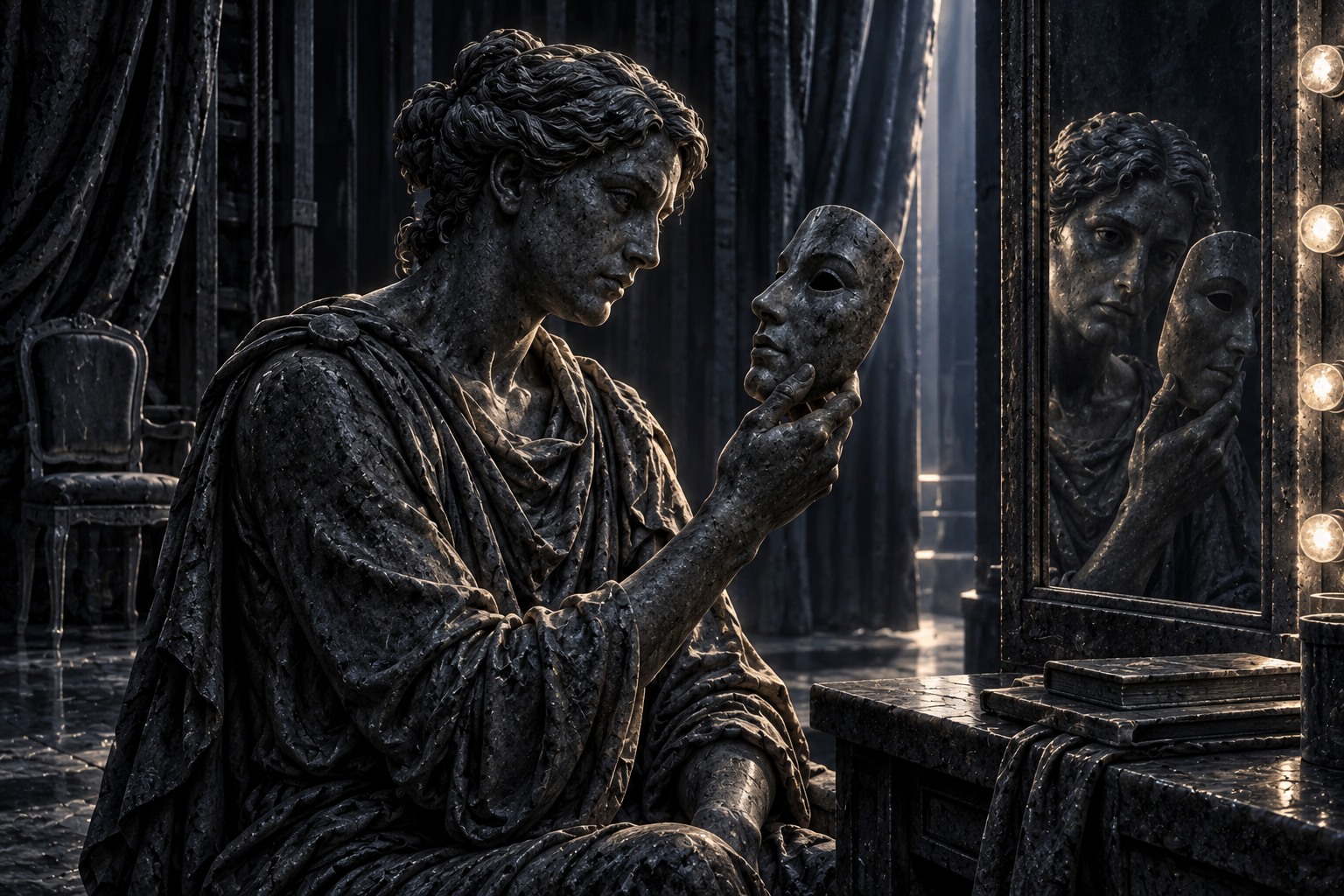
A person has two faces: the one shown to the world, and the one that remains when they are alone. Jung called them persona and shadow. The mask is an ancient means of engaging with this duality: for a while, it allows us to become someone we cannot ordinarily be. The mirror is its companion. If we know how to look, it shows what lies beneath the mask.
I. The Face We Wear
A person has two faces. One is presented to the world: adapted to circumstances, rehearsed, acceptable. The other remains when we are alone and no one is watching.
This is an ordinary observation; everyone has made it. Jung, however, gave it a terminology. He called the first face persona, the Latin word for an actor's mask in Roman theater. The second was the shadow, Schatten.
The persona is not a mask in the negative sense of hypocrisy. It is a normal, necessary social front. Without it, social life would be impossible. A teacher in class cannot behave as a loving husband does. A surgeon in the operating room cannot give way to tears. A diplomat at negotiations cannot lose control. Each role makes demands on the face, the voice, the response. Persona is the ability to meet those demands.
The problem is not having a persona. It is one of two imbalances.
In the first, the persona is thin and crumples easily. Someone shrinks at every remark at work, cannot sustain the role, loses composure. In the article's terms, this is not only trouble with the shadow; it is trouble with a fragile persona.
The second imbalance, described here as more common, occurs when the persona becomes all a person knows about themselves. They identify with the mask. The doctor is who I am. The priest is who I am. The good father is who I am. Whatever does not fit the mask then recedes into shadow. It lives there without a voice, accumulating, waiting.
We explored this in earlier articles through the devil, the abyss, and the labyrinth. Now we approach it through an object literally worn on the face: the mask.
II. The Mask as a Technology
The mask is one of humanity's oldest technologies. Older than writing. Older than the state. Perhaps older than the domesticated dog.
A mask does three things at once. It conceals its wearer. It makes the figure it represents visible. And, most subtly, it temporarily transforms the wearer into that figure.
The third property is the crucial one. A mask is more than a costume. In many traditional cultures, it is an instrument of transformation (Contemporary African Art, “African Masks”). Put it on and you become someone else. Take it off and you return to yourself. Between those two actions, something happens that would not happen without it.
What, exactly?
Anthropologists describe it in different ways. Some speak of a “social license”: someone wearing a mask may do what they could not do without it. Shout. Dance indecorously. Insult the chief. Speak to the dead. Be angry with the gods. Ordinary prohibitions are suspended for a time.
Others use a broader account: a mask allows a person to encounter an archetypal power at a manageable distance, something larger than themselves—a god, an ancestor, an animal, a demon. In that symbolic account, the power would overwhelm an unmasked person; through the mask it can pass while remaining slightly apart.
There is a third, psychological level. A mask allows us temporarily to become someone we ordinarily forbid ourselves to be. Angry, if we are usually peaceful. Playful, if we are usually serious. Beastlike, if we are usually courteous. Within the ritual setting, the part otherwise confined to the cellar is allowed out.
This is what the article calls shadow work in a form thousands of years older than Jung.
III. The Dogon: Masks of the Dead
The Dogon live along the Bandiagara escarpment in Mali. Their traditional religion and rituals became widely known through the work of Marcel Griaule in the 1930s. Masks occupy a central place in their culture.
The main ceremony involving masks is the dama, a collective funerary rite for deceased men. Its purpose, within the tradition, is to ensure the safe passage of the dead person's soul into the world of the ancestors (Smarthistory, “Mask: Kanaga [Dogon]”).
Dama masks are made by the initiated men's society, Awa. More than eighty types are described: hunters, warriors, healers, women, people from other communities, animals, birds, and abstract forms. The archive describes them dancing together over six days.
One of the best-known is the kanaga: an elongated rectangular face topped by a double cross with short vertical projections. At one interpretive level, it represents a bird. At another, it symbolizes the structure of the world: the upper crossbar is the sky, the lower the earth. In the article's image, its wearer dances not as a bird but as the axis of the world itself.
What matters here? Living men wear the masks to guide the souls of the recently dead through a ritual. The living take on an image of the dead to help the dead depart. This is a crossing. The mask acts as a bridge.
The crossing works in both directions. On one side, the deceased person's soul is understood to have an opportunity to return, appear, and perform through the mask. On the other, a living person can try on death: encounter it from within, wear it on the face, and then take it off.
Translated into the language of shadow work, the article's proposal is that a mask lets someone experience bodily what they avoid—death, fury, madness—and then return to ordinary life. Not suppress it, which the article considers ineffective; not surrender to it, which it considers dangerous; but move through it within a bounded form.
This seems, to the authors, a remarkably intelligent technology, one modern Western culture has largely lost.
IV. Japanese Noh: The Mask as a Mirror
Japanese Noh theater, which took shape in the fourteenth century and is associated with Zeami Motokiyo, uses masks differently. They are not only a means of contact with the dead, although that too can be involved. They finely attune the actor's inner state.
Several principal types of Noh mask are described in the archive (Brandon Chin, “5 Essential Noh Masks”; the-noh.com, “Noh Masks”).
Ko-omote is the mask of a young woman: soft features, a slight smile. It is used for maidens, heavenly beings, and young princesses.
Okina is presented as the oldest and most sacred mask: a smiling, gray-haired old man embodying wisdom and longevity. It belongs to ritual performances rather than narrative plays.
Tengu is a mythical being with a long nose and birdlike features, a symbol of supernatural power.
Kishin, the “demon deity,” has exaggerated features, bulging eyes, and gold on the teeth: divine power in its terrifying form.
Hannya depicts a woman consumed by jealousy and transformed into a demon. It has horns and a double expression, showing grief and rage at once. The archive calls it the best-known Noh mask.
The article emphasizes the hannya mask's visual dynamics. It describes an upward head tilt as revealing grief, sorrow, and human suffering, and a downward tilt as making the face demonic. One object, two expressions, with the transition depending on posture. This directional description is retained as an archival statement, not newly verified technical guidance.
That is a technical detail, but the authors read an entire philosophy within it. The demon and the suffering woman are the same figure, seen from different angles. One face shows grief, then fury. The article proposes that much human demonization can be understood as grief turned another way: when grief cannot be lived through, it takes another angle and becomes a demon.
Hannya appears in Aoi no Ue (Lady Aoi). Lady Rokujō, a noble court lady, is consumed by jealousy of Aoi, the new beloved of her former lover. Her soul leaves her body and attacks Aoi as a vengeful spirit. At the climax, the actor literally changes masks: first a woman's mask, then hannya. A transformation takes place onstage. The audience sees jealousy become a demon.
The authors find in this an exact observation: emotions are not simply stable properties lodged inside a person. They transform. Pity can become cruelty; love, hatred; grief, rage—if the movement goes unnoticed.
The mask makes the transformation visible. What usually happens quietly within a person is brought onto the Noh stage as a change of mask, so that the spectator can see and recognize it.
Crucially, in this account, the spectator does not simply identify with the actor. They watch and preserve a distance. They see a transformation outside themselves. Through that distance, they may later recognize something about their own life.
V. What Jung Said About the Mask
The archive places Jung's formulation of persona and shadow in Two Essays on Analytical Psychology, citing 1928 as the definitive revision (Wikipedia, “Two Essays on Analytical Psychology”).
It describes persona as “what a person is not in reality, but what they and others believe them to be.” It is a compromise between individual and society: a mask society asks for and the individual puts on in order to be accepted.
That is not in itself bad. Without persona, social life would not be possible. But identifying with it means losing touch with oneself. “I am my professionalism.” “I am my position.” “I am my marriage.” “I am my status as a parent.” This is convenient and creates a sense of stability. The article argues that over the long term it can be destructive.
The shadow is described as “everything a person refuses to be, yet nevertheless is”: the qualities they do not acknowledge, the impulses they have suppressed, the desires they feel ashamed of having.
The shadow is not simply bad. It includes what a culture calls bad—aggression, selfishness, laziness, lust—but also qualities considered good that have no place in a particular persona. The serious person suppresses frivolity. The cheerful person suppresses seriousness. The artist suppresses practicality; the accountant, artistry. In this framing, the shadow is everything left outside the persona.
The archive cites an important formulation through IAAP's “Persona”: individuation, or becoming oneself, includes the “dissolution of the persona.” Not its destruction, but its dissolution. A rigid mask needs to soften so that the face behind it can be seen.
This does not mean taking the mask off for good. The mask is needed. It means recognizing it as a mask: understanding that what is outside and what is inside are different, and neither is the whole of you.
VI. The Mirror
The mask needs a companion object: the mirror.
If the mask is what I show, the mirror is where I see myself. Here things become interesting.
The article suggests that people often think they see themselves in a mirror when they are actually looking at a reflected persona. They see themselves through other people's eyes, judging the reflection by how closely it matches the person they wish to appear to be.
“Do I look good?” is a question addressed to the mask, not the face.
For the mirror to become an instrument of self-knowledge, it must show something the person would rather not see. Otherwise, it merely reinforces the persona.
The authors find this insight in older traditions. In Hinduism, Ramana Maharshi's ātma-vichāra, or self-inquiry, asks “Who am I?” The question is repeated inwardly, stripping away each layer of response. “I am a teacher.” Who is the teacher? “I am good.” Who is saying that? “I am the one who thinks.” Who is this thinker? And so on, toward the point where answers run out.
In Zen Buddhism, the koan offers a paradoxical question—“What is your original face before your parents were born?”—that cannot be resolved at the level of the persona. In the account given here, something opens when thought exhausts its habitual answers.
In Christian mysticism, the parallel is confession: here understood not as public declaration, but as an inward act. Sit and say to yourself and to God everything that is present. Without a mask. Without allowances.
The article reads each of these practices as a way of making the mirror reveal what lies under the persona rather than merely reflecting it.
In modern psychotherapy, it gives feedback a comparable role. A good therapist may say what a client rarely says to themselves. This is not condemnation, but a mirror tilted so that the shadowed part becomes visible.
People often resist such a mirror. The article calls that understandable: seeing one's shadow can hurt. Yet without this mirror the shadow remains unknown, and the unknown shadow, in the authors' formulation, continues to exert influence.
VII. Carnival and Halloween
Two major European cultural traditions preserve a ritual role for the mask.
Carnival is a medieval practice tied to the Christian calendar. In the days before Lent, and in some places for several weeks, people put on masks and costumes and upset the ordinary order. Servants became masters. Men became women. Children became adults. A fool was chosen as the town's “king.” Sacred texts were parodied. Scenes unthinkable at other times were performed.
In Rabelais and His World (1965), Mikhail Bakhtin described “carnival culture” as a distinctive temporary suspension of hierarchy. Carnival is the world turned inside out. It does not destroy the ordinary order: afterward, things return to their places. It shows that the ordinary order is not absolute.
Psychologically, the article interprets carnival as a collective emergence of the shadow. For a short time, people wear their darker sides together within a socially bounded form, releasing what has accumulated.
Halloween offers another instance of this logic. The archive traces contemporary commercialized Halloween to the Celtic festival of Samhain, marking the boundary between the worlds of the living and the dead. That night, the boundary was believed to grow thin and the dead could return. The living wore frightening masks to scare them away or conceal themselves.
In modern Halloween, much of that function has faded, but the mask remains. Children dress as monsters, witches, and ghosts. For one evening, they may become someone they cannot be for the rest of the year.
The authors consider this useful: it gives the shadow a voice, even a parodic or commercialized one. Better that, in their view, than none.
They argue that modern Western culture has lost most of its ritual channels for shadow work. In many places carnival has become a tourist festival; Halloween, marketing; religious confession, a rarity; psychotherapy, a luxury.
What remains? Horror films, a contemporary way of trying on a frightening mask for ninety minutes. Video games, where someone can be a gunfighter, thief, or killer, then leave the game to make tea. Social media, where an anonymous account lets someone become another person, more beautiful or more vicious. These are forms too. The authors judge them imperfect, but they are the forms available.
VIII. The Thread Running Through the Series
We have moved through a cycle on the shadow:
- In religion, the shadow was given the name of the devil.
- In philosophy, it was given a space: the abyss.
- In myth, it was given a body and an address: the Minotaur in the labyrinth.
- In a symbol, it acquires a form that can be put on and taken off: the mask.
Each form makes the shadow something we can engage with. It gives it an outline, a place, an appearance.
Without these, the shadow is formless and therefore elusive. It is difficult to work with something that has no edges.
The mask may be the oldest and most direct means of engaging with it. Give it a face. Wear that face for an hour. Take it off. Recognize that both belong to you.
The next article closes the cycle by approaching the same subject in contemporary scientific language: Wegner's work on thought suppression and the “white bear” effect, projection, and Schwartz's Internal Family Systems therapy. The archive introduces it with the suggestion that the laboratory has repeated what culture knew for thousands of years. That is the series' interpretive bridge, not a demonstrated equivalence between those bodies of knowledge.
IX. What Remains
The mask is ambivalent.
It can become a prison. A person lives behind it; gradually it grows onto them, until one day they can no longer remove it or say where the mask ends and they begin. The authors see this as the fate of many public figures, professionals, and successful people.
It can become an instrument. A person plays with it, wears it in some situations and removes it in others, knows it is a mask, and remembers the face beneath. The article calls this healthy adulthood.
It can become a ritual. A person uses it temporarily to be someone they ordinarily will not allow themselves to be, letting the shadow emerge in a bounded form. An ancient craft: shadow work through costume.
Between mask and mirror there is a continuous movement. The mirror shows the mask; the mask reflects something deeper. That deeper thing needs its own mirror, made neither of metal nor glass but of attention: the ability to see oneself without a storyline.
Someone who learns to look into this mirror discovers much they would rather not have known. Gradually, they become less afraid. The mask becomes clothing rather than skin. The shadow becomes a part rather than a threat. The mirror becomes a friend rather than a judge.
Perhaps that is what Jung's “individuation” means here. Not becoming someone different and better, but discovering all that is present and learning to wear it as one wears different clothes on different days.
Andrey Zarinsh & Maria Evilkut
United Wisdom · One source, many languages
Archival editorial note. This is a full adaptation of a symbolic essay, not a diagnostic or treatment framework. Its opening two-face image simplifies Jungian terminology: the shadow is not simply everything one is when alone. Broad claims about masks, cultural loss, catharsis, grief, or therapeutic benefits remain the authors' interpretations. Religious practices retain their own purposes and are not interchangeable psychological techniques. Cultural details, the hannya tilt description, historical dates, and quotation wording are inherited and require source-specific checking before factual reuse. No ritual is made safe merely by calling it symbolic or bounded.
References Inherited from the Archive
These links preserve the archive’s reference record; their contents were not newly checked for this translation.
Keep what resonates with you.