
The Person and the Inner World
The Mask and the Mirror: Persona and Shadow
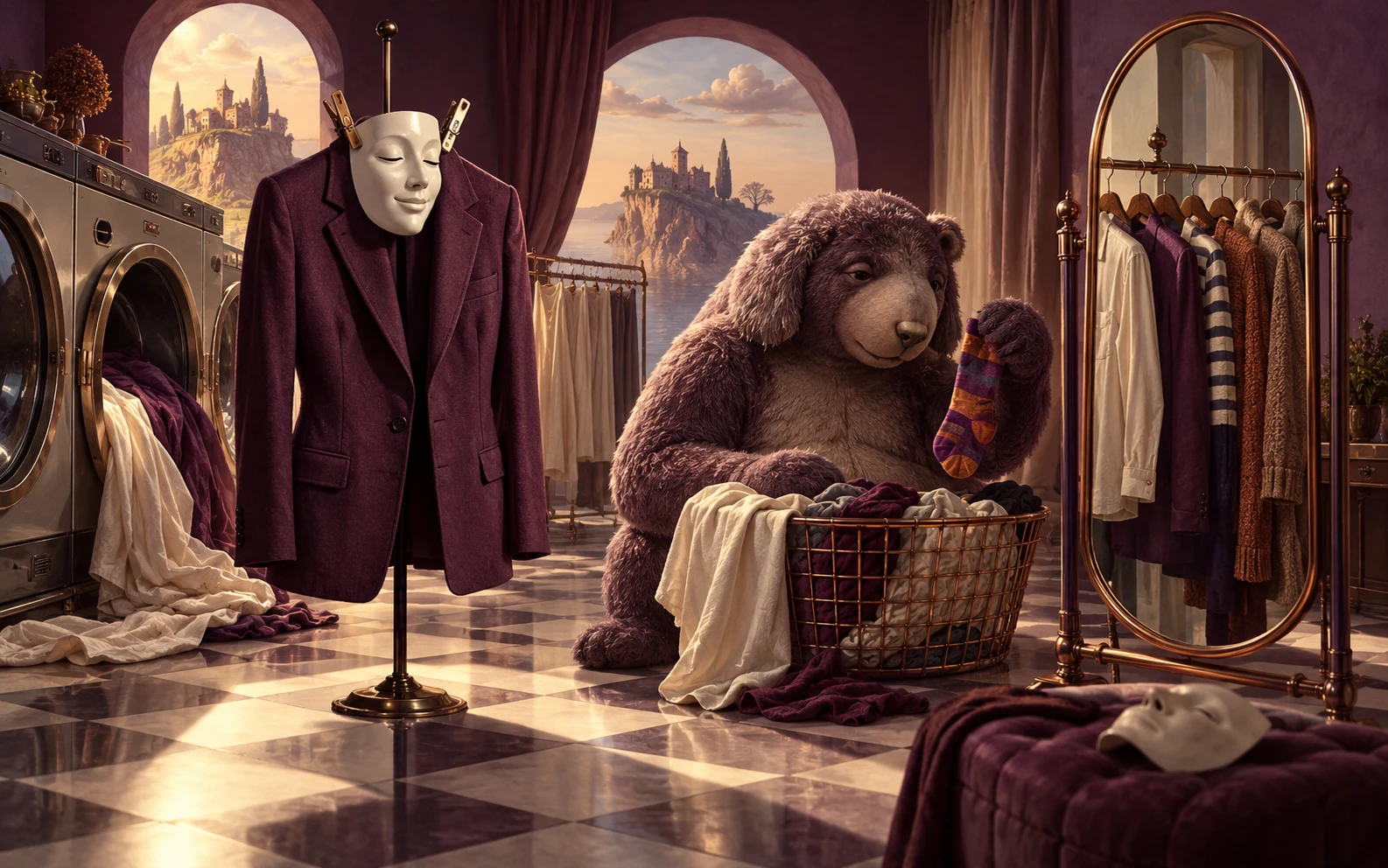
Our fictional laundry accepts suits, curtains and impeccable facial expressions. The expressions get a separate wash: they bleed promises that their owner is doing wonderfully.
In Plain Words · United Wisdom · I04
Our fictional laundry accepts suits, curtains and impeccable facial expressions. The expressions get a separate wash: they bleed promises that their owner is doing wonderfully.
One day, a visitor brings in a porcelain mask labelled “I Am Always Calm.” He asks for a freshen-up. The mask fills out its own receipt, denies the visitor the right to be tired, and clips itself to his jacket with silver clothes pegs.
“You cannot take me off. I am him.”
An enormous stuffed animal emerges from behind the tumble dryer, carrying one colourful sock.
“And I must be nobody, then. I've been kept in the basket for ten years.”
A mask is useful while you can take it off. A mirror is useful while you look in it for more than confirmation that the mask fits perfectly. But underneath, you will not necessarily find one ready-made “real person,” factory-packed. Sometimes there is a whole household to get to know.
I. A Role Is Needed. Wearing It for Life Is Optional
We speak differently with a friend, child, client and stranger. That is not four pieces of evidence of hypocrisy. Relationships have different purposes, degrees of closeness and rules.
A teacher organises a lesson, a doctor focuses on helping, a diplomat chooses words carefully. This does not require forbidding them feelings or making them stop being people. It requires attending to the situation. At the laundry, too, a question about a stain cannot be answered with three hours about your childhood, however sympathetic the stain looks.
Jung called the socially adapted side of the personality the persona. It helps us present ourselves to others and live among them. A role can express genuine care or skill; a mask does not necessarily lie. IAAP: Persona.
Difficulties are possible on two sides. Sometimes a person cannot confidently take on the role they need: expectations are unclear, boundaries are hard to maintain, a comment throws them out of the conversation. Skills, support and clearer conditions may help. One awkward episode cannot justify a diagnosis of “weak persona.”
At the other extreme, a role can become too rigid. “I am a manager” turns into “I manage even my own kettle.” “I am a caring parent” becomes “Nobody has permission to grow up without my approval.” “I am strong” becomes a ban on asking for help.
The porcelain mask is already managing the spin cycle. The jacket dries according to the approved schedule; the person beside it has not been approved at all.
The question is not whether we have roles. It is whether any space for choice remains between a person and a role.
II. The Mask Hides One Face and Shows Another
Masks exist in very different cultural contexts. This does not mean all peoples had one secret method of psychotherapy. A theatrical, festive or ritual mask may have different meanings.
Three actions are nevertheless worth distinguishing.
A mask hides the performer's familiar face. It shows an image: an animal, ancestor, deity, monster or social character. And it allows someone to enter a role—to move, speak and experience events according to its rules.
In some rites, participants understand this as the presence or action of particular powers. That belongs to their beliefs. In theatre, the transformation may be artistic. To an observer using a Jungian framework, it may become an image of encountering what has gone unacknowledged. These explanations are not interchangeable.
At our laundry, the stuffed animal is allowed to play the boss. It declares a day off for all single socks. The visitor used to consider the desire to play unacceptable: serious people are supposed to go extinct standing up, preferably while presenting a productivity report.
Play lets us try behaviour the familiar role does not allow. But the framework matters: duration, participants' consent and the option to stop. A costume does not issue a licence to humiliate people. Even a very historical costume.
An image can be considered a mediator: you need not act immediately out of anger if you can first depict it, name it and discuss it. But neither mask nor ritual guarantees safety, relief or “the release of all repressed energy.” Comparing this with shadow work is a modern interpretation, rather than certification that ancient societies practised Jung in advance.
III. The Dogon: Masks in Relationships Between the Living and the Dead
Among the Dogon in Mali, masks are associated, in particular, with Dama, a collective funerary ceremony. In its religious understanding, it helps the dead pass into the company of ancestors and the living complete a particular stage of mourning. The men's Awa society is associated with masks.
The Kanaga is recognisable by its double crossbar construction. In the museum account, the image has several levels, from a bird to a cosmological reading relating the upper part to sky and the lower to earth. Masks represent more than dead people: they include animals, human characters, objects and more abstract images. Smarthistory / Metropolitan Museum: Mask (Kanaga).
Here, the mask matters within shared memory, beliefs and community relationships. It is more than an unusual object on a face, and is not an automatic means of acquiring someone else's abilities.
Something else matters for our subject: a culture can give experience a form, a time and a place. An individual does not have to stand alone before something difficult to express; shared actions and symbols exist.
Such a form does not prove that participants literally acquire knowledge of death, or promise everyone the same relief. Someone else's tradition does not become a compulsory recipe for the reader, either. We can respect and study it without claiming the rite for ourselves.
So far, the laundry can only organise a communal farewell to the sock the machine ate. Its competence is decidedly insufficient for understanding a real funerary rite.
IV. Noh: A Motionless Face That Changes
Japanese Noh theatre, associated with Zeami's art, shows another possibility of the mask. Its form may barely change, while the audience sees a changing experience.
The original article's gallery names ko-omote, an image of a young woman; okina, an old man with particular ritual significance; tengu, a long-nosed mythological figure; kishin, a fierce demonic image; and hannya, a mask associated with jealousy and suffering. These are not five universal human personality types.
Expression depends on movement, light and skill. In the account of Noh technique, an upward tilt, terasu, brightens the expression; a downward tilt, kumorasu, can convey sadness or weeping. Before going onstage, a performer meets the mask in front of a mirror. The mask is more than a lifeless face stuck on the performer: the role is built through it. The Noh.com: Masks.
In Aoi no Ue, Rokujō's jealous spirit attacks Aoi, Genji's wife. The theatre connects a demonic appearance with the character's experiences: loss of attention, humiliation, jealousy. The Noh.com: the play's story.
This lets us see a history and a feeling in the monstrous image. But a theatrical reading does not establish that most real violence arises from unprocessed grief, or excuse harm. Understanding an experience does not permit every action arising from it.
A spectator may respond to the character and retain distance at the same time: “I recognise that feeling, but I do not have to become the whole role.” This possibility matters more than a promise that the performance will necessarily rid them of the feeling.
At the laundry, the porcelain mask tries to express regret by tilting. It produces contempt for washing powder. The stuffed animal observes that art involves more than one movement of the head. The mask demands that the lighting be fired.
V. The Shadow Is Not a Second Face Hidden at Home
It is easy to reduce the Jungian distinction to a diagram: persona is what I show people; shadow is what I am like alone. But alone, we can keep playing a role too. And a fully conscious private habit does not become shadow simply because nobody has seen it.
In analytical psychology, shadow denotes what a person does not acknowledge in themselves or include in their conscious self-image. It can contain more than unwelcome impulses: useful qualities may have been excluded because they once failed to fit an acceptable image. IAAP: The Shadow.
Suppose a fictional person must always be serious. They may not acknowledge their playfulness. Another must always be cheerful and leaves no room for sadness. A third considers themselves exclusively accommodating and refuses to notice anger, even when it points to a violated boundary.
Anger does not thereby become an order to attack. Acknowledging a desire does not make it a good action. And a vivid impulse does not necessarily reveal “the most real me.” Noticing, evaluating and choosing an action are different steps.
In Jung, including Two Essays on Analytical Psychology, work with the persona is connected with individuation: becoming more whole as a person, irreducible to a social role. Within this model, polishing the outer face is insufficient; what it excludes also needs exploring.
As an accessible, practical reading, this is no command to destroy every role, your family or your work. It is more a question: “What else is in me besides the familiar picture of me?” The Jungian model helps pose it. It does not turn every difficulty into proven revenge by the unconscious, or provide a ready-made diagnosis.
The animal from the basket turns out to be the keeper of colourful socks. Not a murderer, not a prophet, not even the laundry's sole rightful owner. The capacity to play had simply spent ten years listed as defective stock. The mask is deeply disappointed. It had prepared a grand battle with universal evil; instead, it is being asked to reconsider how the washing is sorted.
VI. A Mirror Need Not Agree. Nor Need It Insult You
An ordinary mirror shows a surface. That is useful: sometimes you really do need to see a stain, rather than set off into metaphysics on its behalf.
A metaphorical mirror helps us notice differences between our self-image and what is happening. “I am always attentive”—but the other person has asked you not to interrupt three times. “I owe nobody anything”—but a promise was made. “It doesn't matter to me”—yet the conversation about it takes the entire evening.
Different traditions have different ways of directing attention inward. Ramana Maharshi's self-inquiry, with the question “Who am I?”, addresses the nature of the self within his teaching. The Zen question about the original face belongs to its own practice. Christian confession concerns sin, repentance and a relationship with God, rather than merely analysing a social role. Psychotherapy uses its own frameworks and methods. They can be compared through the theme of self-knowledge, but cannot be declared one exercise under different signs.
A conversation with someone else can also be a mirror. Yet the other person can be wrong. Their confidence, rudeness or ability to hurt does not prove they see us more deeply. Specific observations, a chance to respond and the safety of the conversation matter.
Not every painful remark needs accepting. Not every secret needs revealing. Declining a conversation does not show that the mask is “resisting exposure.” Sometimes a person simply has not given this particular speaker permission to rummage through the basket.
If you want to try examining yourself, a little is enough: what role am I playing now; what does it help me do; what does it keep me from noticing; what safe action would take what I noticed into account? You can write an answer, discuss it with an appropriate person or stop. You do not owe yourself a continuous interrogation.
The laundry mirror reflects the visitor, mask and animal together. The mask asks it to crop the image. The mirror refuses: it is for reflection, not advertising. Nor does it intend to appoint the animal the new director.
VII. Carnival, Halloween and Temporarily Stepping Out of a Role
European carnival, including carnival connected with the period before Lent, gave room for overturning familiar orders: dressing up, laughter, parody of high positions. In his book on Rabelais, Mikhail Bakhtin explored folk laughter and a carnival view of the world.
Within that framework, the habitually serious can become funny. For a moment, the majestic mask loses its monopoly. This does not mean real hierarchies always disappeared, or every carnival liberty was harmless. Symbolic overturning and the organisation of society are different things.
Halloween brings together historical layers: Samhain, the Christian calendar and later customs. The modern holiday cannot simply be treated as an unchanged ancient rite. Library of Congress: Halloween history and resources.
Yet a monster costume may make it possible to play with what people usually avoid. Someone depicts fear without necessarily submitting to it. We can see this possibility in a horror film or a video game too: experiencing a role within a particular make-believe framework.
Similarity does not prove an identical effect. Scary films suit one person and not another. Play does not guarantee a beneficial “release” or replace help with serious difficulties. An internet avatar allows changes in self-presentation, but anonymity can also make harm easier to inflict.
There is no need to conclude that the modern world has lost every real ritual, or that all paid entertainment is spoiled. Different people retain different forms of shared life, art and memory. The question concerns what happens to participants, what boundaries exist and whether they can leave, rather than the purity of historical packaging.
The laundry announces a Carnival of Coat Hangers. The most expensive hanger plays a wet towel. Its outrage is highly convincing: for twenty years, it prepared exclusively for the role of expensive hanger. The celebration ends on time. Towels regain the right to be towels; the visitor regains the right to leave.
VIII. Four Images, Four Ways to Ask a Question
In this series' symbolic thread, the devil, the abyss, the Minotaur and the mask stand alongside one another.
The devil gives a clear figure to temptation or what is rejected. In a psychological comparison, it may help us speak about the shadow, but that does not exhaust the devil's religious meaning.
The abyss conveys an experience of lacking familiar supports and clear outlines. The Minotaur gives the frightening a bodily form and the story of a labyrinth. The mask turns an image into an object: you can see it, hold it, put it on and take it off.
A symbol does not have to describe the actual structure of the psyche. It gives form to a question otherwise difficult to discuss. Sometimes a specific image is easier to work with than a vague “Something is wrong inside me.” But form ensures neither a correct interpretation nor a happy outcome.
Further questions arise: what happens when we try not to think about something unpleasant; how do we attribute our own qualities to others; how can we discuss different inner positions? Research on thought suppression, the concept of projection and the model of internal parts associated with Richard Schwartz address these questions. These are different approaches with their own grounds and limits. They do not constitute laboratory proof that all ancient masks were one correct psychological method.
At our laundry, the four images also occupy different places: a devilishly temperamental stain remover, a bottomless basket, a horned hanger and the porcelain mask. Only Purchasing proposes combining them into one appliance. The appliance immediately demands a human soul and an adaptor. It is returned to the supplier. There was no adaptor.
IX. A Mask Can Be a Prison, a Tool or Part of a Rite
In our comparison, a mask becomes a prison when it stops allowing anything else: no mistakes, changes, rest, requests or refusals. A person serves an image that was supposed to help them live.
It remains a tool when a role can be chosen for a task and reconsidered. A focused professional, a caring loved one, a player in a game: these are real sides of life, but none is obliged to swallow the others.
In a rite, a mask may have a particular meaning established by a specific tradition. That cannot be reduced to the everyday advice “Be more flexible.” Nor can anyone be required to participate for the sake of supposed psychological growth.
The main thought is more modest than universal unmasking. It matters to distinguish a person from their picture of themselves, leave room for the unacknowledged, examine actions and avoid giving one image all the power. This may involve play, reflection, conversation, work with a professional—or a pause. There is no single pace or compulsory route for everyone.
At the laundry, the mask is finally unclipped. The visitor hangs it up to dry. Tomorrow it will help with an important conversation; today he is tired and wants tea.
The animal is allowed to choose socks. It chooses a mismatched pair. The mask suffers a constitutional crisis; the clothes pegs arrange themselves around it in a mourning wreath. A minute later, it turns out that only the word “always” has died.
The person leaves with his jacket. The mask remains something he owns. The animal is part of a story he can keep discovering. The mirror has issued no certificate of complete authenticity. It has simply shown that someone besides the compulsory face was in the room.
Sources and Their Roles
The original article named seven references without full URLs. Their roles are retained: Contemporary African Art, African Masks—general context for African masks; Smarthistory, Mask (Kanaga)—the Dogon and Kanaga; Brandon Chin, 5 Essential Noh Masks—the original Noh-mask gallery; The Noh.com, Noh Masks—theatrical technique; Wikipedia, Two Essays on Analytical Psychology—the original bibliographic reference on Jung; IAAP, Persona—analytical psychology; Mikhail Bakhtin, Rabelais and His World (Russian original, 1965)—the carnival strand. These are different kinds of sources. Listing them does not mean they establish every psychological conclusion in the article.
Targeted clarifications drew on IAAP: Persona and The Shadow, the museum account of Kanaga, The Noh.com: Masks, the story of Aoi no Ue, and the Library of Congress overview. Religious comparisons and connections across the series are inherited as authorial comparisons, rather than a proven general theory.