
Inner world
The Minotaur in the Labyrinth: A Monster in Your Own House
Theseus's myth becomes an image of concealed conflict, support, and return, with archaeology, myth variants, and psychological analogy kept distinct.
Myths · An authorial series
Andrey Zarinsh & Maria Evilkut
The monster does not come from outside. It is born in the house, among people outwardly righteous. It can neither be released nor killed. It is hidden. The labyrinth is the perfect mechanism for a shadow that cannot be destroyed or faced every day. A single winding path leads toward it. And the thread is not needed to find the way: there is only one way. The thread is needed to return.
I. What We Know About Knossos
In 1900, the British archaeologist Sir Arthur Evans began excavating Kephala Hill in northern Crete, near Heraklion. Beneath the earth he found the ruins of an architectural complex that proved to be one of the largest Bronze Age palaces in the Mediterranean. He named the civilization that built it “Minoan,” after the legendary Cretan king Minos.
The palace of Knossos was enormous. Estimates cited in the archive put it at roughly 20,000 square meters, with around 1,300 rooms on several levels, water supply and drainage systems, storerooms, a throne room, and terraces. Evans walked through the ruins in astonishment at their complexity. The archive describes him as saying that one could wander for hours, climbing and descending stairs, only to discover that one had returned to the same room by another route (Hellenic Museum, “Theseus and the Minotaur”).
Evans proposed that the palace was the labyrinth of the Minotaur myth. He associated the Greek labyrinthos with labrys, “double axe,” a symbol of the Minoan goddess. Many double axes were indeed found at Knossos. “Labyrinth” might mean “house of the double axe”: the goddess's house, a place of ritual (Wikipedia, “Labyrinth”).
Other discoveries were equally striking. Evans found frescoes showing bull-leapers (Wikipedia, “Bull-Leaping Fresco”): young men and women grasping a bull's horns and somersaulting over its back. This was a ritual, a sport, or a religious ceremony involving bull and human, the movement of one through the other.
The bull held a central place in Minoan religion. Finds include bull-headed drinking vessels, or rhyta, bull figurines, and representations of horns on altars. The Minoans worshipped, or at least honored, this animal.
These findings provide historical ground for the myth. The Greek legend of the Minotaur may reflect a reality transmitted in altered form to classical Athens centuries after the collapse of Minoan civilization, dated in the archive to around 1450 BCE.
II. The Myth
The myth survives in several versions. Let us bring them together, as modern retellings often do.
Minos, king of Crete, asked Poseidon for a sign of favor: a snow-white bull. Poseidon sent it. Minos was supposed to sacrifice the bull to the god, but it was too beautiful. He spared it and kept it among his herd. As punishment, Poseidon inflicted on Minos's wife Pasiphaë a transgressive passion for the bull.
Pasiphaë approached Daedalus, the brilliant engineer at court. He built a wooden cow that she could enter. The bull took it for a real cow, and from the union a child was born with a human body and a bull's head: the Minotaur.
Minos did not kill him. Could he not? Did he not want to? The myth is silent. Instead, he ordered Daedalus to build the Minotaur a home: the Labyrinth, so intricate that anyone entering it could not find the way out.
The Minotaur ate human flesh. Athens, defeated in war by Crete—or punished for the death of Minos's son Androgeus—had to send seven young men and seven young women to Crete every ninth year. Other versions say every year. They were given to the Minotaur.
One year, Theseus, son of the Athenian king Aegeus, was among them. He volunteered, promising his father that he would return alive and change the ship's black sails to white.
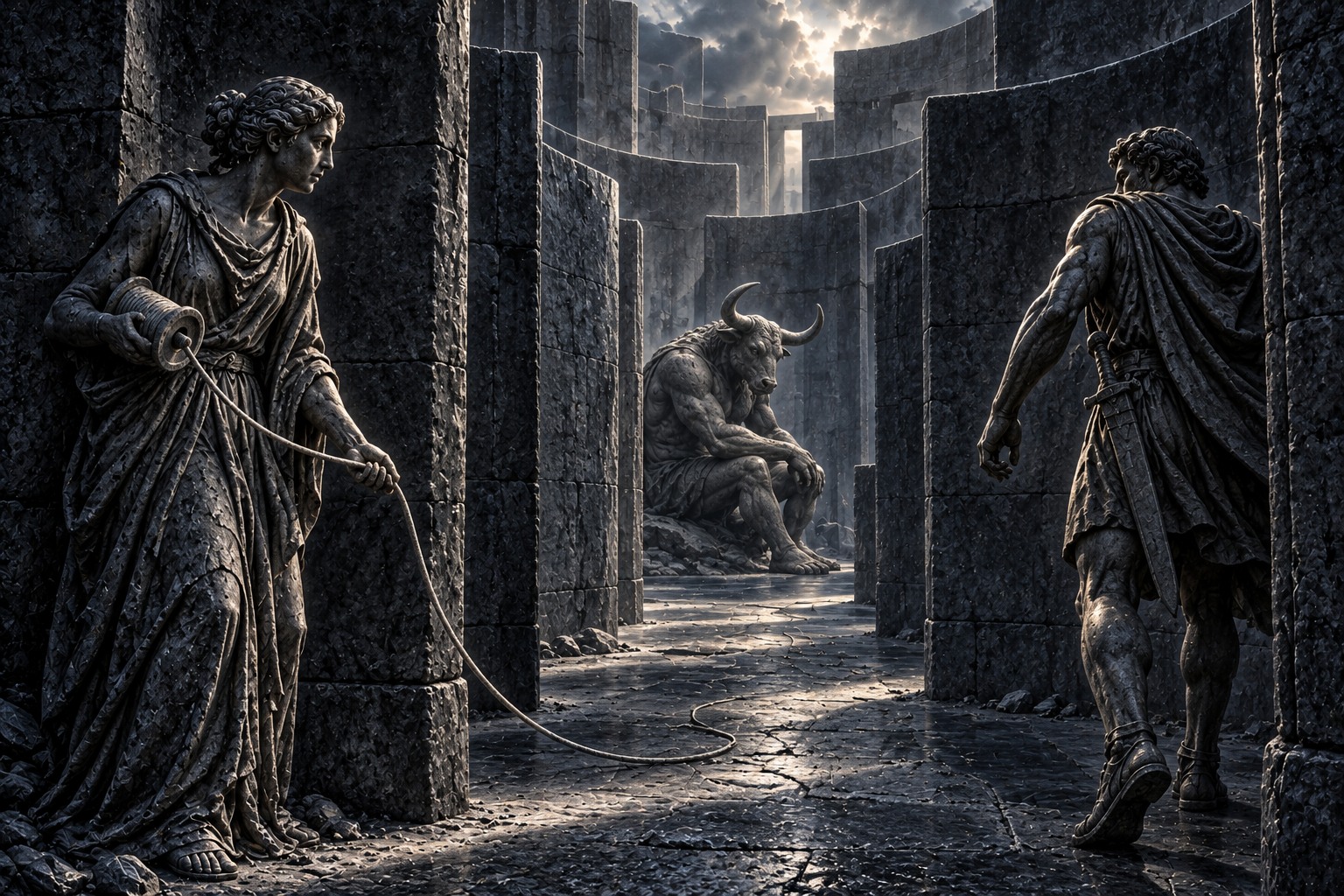
On Crete, Ariadne, Minos's daughter and the Minotaur's sister, fell in love with Theseus. She asked Daedalus how to help him survive. Daedalus gave her a ball of thread, which she secretly passed to Theseus. He tied one end to the entrance of the Labyrinth and unwound it as he went deeper.
At the heart of the Labyrinth, in the version recounted here, he found the Minotaur asleep. He woke him, fought him, and killed him. Then he followed the thread back and emerged.
Theseus fled Crete with Ariadne and the rescued Athenians. On Naxos, he either forgot her, lost her, or deliberately abandoned her. The versions differ: in one Dionysus takes her as his bride; in another Artemis kills her. Theseus sailed home, but forgot to change the sails. Seeing black sails, Aegeus threw himself from a cliff into the sea. The sea was named the Aegean.
III. What It Means to Have a Monster in Your Own House
This is not merely an adventure story. In the authors' reading, it is a compact and terrifying story about consciousness.
Notice that the Minotaur did not arrive from elsewhere. He did not fly down from Olympus or crawl out of the underworld. He was born in the house, to the queen, within the family: from Pasiphaë and her passion. Nor was this a passion she freely chose and for which she alone was responsible. Poseidon inflicted it; it was fate, the consequence—the article says “karma”—of her husband's offense. Yet it still happened at home.
That is the first important point. The dark side is born within the household, among those outwardly righteous and adorned with respectability. It comes from a mingling of divine—the bull belongs to Poseidon—and human—Pasiphaë is a queen. The authors connect this with Jung's shadow: what a person represses, splits off, or refuses to acknowledge as their own takes on the image of a separate creature and settles in the cellar.
Second, the Minotaur is not killed. Minos had the power to order his death, but did not. He built him a house instead. Not “I cannot see it, therefore it does not exist,” but “I see it, I know it, I hide it.” The labyrinth becomes an ideal mechanism for a shadow that cannot be killed, cannot be let loose, and cannot be looked at every day.
The article reads this as an image of a defense mechanism. The psyche neither destroys what it cannot accept nor allows it freely outside. It hides it in a complex structure: a place one can visit, but would rather not.
Third, this is a royal house. In the essay's image, the Minotaur lives beneath the palace. The higher the building above ground, the more prosperous the family appears, the more substantial the cellar. This is not a law, the archive says, but a recurring pattern: someone building an impeccable facade may also be building a labyrinth underneath.
IV. The Labyrinth as a Structure
One technical distinction is often overlooked.
The archive describes the ancient labyrinth shown on Cretan coins, which it dates to the seventh century BCE, and on the floors of early temples as unicursal (Hellenic Museum). There are no dead ends or forks, only one winding path leading to the center and back. It contrasts this with the later branching maze, which it places in the medieval period. The image here is a spiral with turns.
That distinction matters to the essay. In a unicursal labyrinth, there is no wrong turn. One can only proceed.
The authors therefore read the myth not as a story of losing one's bearings or choosing the wrong passage, but of having to walk. The only choice is forward or back. In this symbolic reading, the thread is not needed to discover the route—there is only one—but to return from the center, to avoid remaining there.
This changes the interpretation. The labyrinth is a path to be traveled to its end, to the encounter with the monster. The task is not to discover a shortcut but to walk the entire long, winding road toward what frightens us.
Psychologically, the article proposes that there is no shortcut around disowned parts of ourselves. Its metaphor is a slow spiral path, sometimes almost returning to the beginning before turning onto another circuit. Within that image there are no dead ends: every turn brings the traveler closer.
V. The Monster at the Center
Theseus arrives. At the heart of the Labyrinth is the Minotaur. He is asleep.
The archive emphasizes this detail, attributing it to a familiar version associated with Plutarch's Life of Theseus and some earlier accounts. The monster is not charging, guarding, or attacking. He sleeps. That specific attribution remains an inherited claim requiring verification.
Theseus wakes him, fights him, and kills him.
The sequence matters to the authors. The shadow does not attack first. It is in the cellar, sometimes dozing, sometimes making a low murmur from below. To meet it, someone must go there and bring it into the light.
And Theseus kills the Minotaur. He does not tame him, understand him, or integrate him. He kills him.
This may be the disputed point. Modern psychological accounts often say that the shadow cannot be killed, only recognized and accepted. Where repressed impulses are concerned, the authors broadly agree.
But in this myth, they argue, Theseus kills a monstrous offspring: not his own shadow in a pure form, but a particular product of a particular family. The Minotaur is not Theseus's shadow. It belongs to Minos, Pasiphaë, and the Cretan household. Theseus comes from outside and cuts through a knot the family cannot untie.
The authors suggest another function for the myth: sometimes a person's or a family's hidden difficulty is more than they can manage alone. Someone from outside is needed—a psychotherapist, a priest, a friend, a sibling. Someone willing to enter with thread and sword. These remain images of support and clarity, not instructions for violence.
VI. Who Is Ariadne?
Ariadne is the story's most mysterious figure.
She is the king's daughter and a casualty of the palace secret: the Minotaur is her half-brother. She sees the truth and knows whom the Labyrinth contains. She falls in love with a stranger who has come to kill her own brother, however terrifying he may be.
In some versions, she is simply a princess with a ball of yarn. Another interpretation is associated with Károly Kerényi, a major twentieth-century mythologist. The archive points to a Linear B clay tablet from Knossos mentioning a “Mistress of the Labyrinth,” a deity receiving honey as an offering (Wikipedia, “Ariadne”). Kerényi believed Ariadne had originally been a great Minoan goddess, ruler of the labyrinth, before her name entered Greek myth as that of a mortal princess.
Whatever the interpretation, her function in this essay is constant: she gives the thread. Without it, Theseus will not emerge.
What is the thread?
Something connecting entrance and center, doorway and heart, surface and cellar. It marks the way the hero came and the way he can return.
The article compares it to a “holding container” in analytical psychology: a sustaining connection through which a person can approach depth without losing themselves. That connection might be an analyst, a long history of relationship, a spiritual practice, or a loving person to whom one can return.
Without a thread, the essay warns, entering one's own labyrinth may be dangerous. One can enter and fail to return. It speculates that Nietzsche may have traveled without a thread, referring to the previous article, while Jung had his method, notes, and practice, reached the center, and returned. This is literary comparison, not a clinical account of either life.
Ariadne symbolizes support waiting outside. She does not enter the Labyrinth. She stays. Her task, in the article's image, is to hold the end so there is somewhere to return to.
Yet after the hero returns, the thread is often broken. Ariadne is often left behind. The authors find a bitter recognition here: someone who has passed through their depths does not always return to those who helped them enter. Sometimes they return to others, sometimes to solitude, sometimes to a new god—as Ariadne does to Dionysus.
VII. Daedalus and His Own Trap
Do not forget Daedalus, the great engineer. He made two things: the wooden cow enabling Pasiphaë to conceive the Minotaur, and the Labyrinth in which the Minotaur was confined. He helped create both the problem and its concealment.
This is a deeply human figure. Someone first helps a forbidden desire become real, then builds an elaborate structure to hide its consequences. In this reading, he is not a villain but a clever person too ready to help.
What happens to him? Minos learns that Daedalus assisted Pasiphaë and imprisons him with his son Icarus in their own labyrinth. Its creator enters his own construction. Daedalus builds wings, and the two fly away. As everyone knows, Icarus flies too high; the wax melts, and he falls into the sea.
This secondary story matters as much as the main one. In the essay's interpretation, someone who constructs labyrinths for other people's shadows may eventually find themselves inside their own. The way out here is upward: not walking horizontally, but taking flight.
This is a different strategy. Not “enter the center and kill,” as Theseus does, but “rise above and fly away,” as Daedalus does. Both work within the myth; both are imperfect. Theseus loses Ariadne and brings about his father's death. Daedalus loses his son.
The article reads this as another message: engagement with the shadow does not always leave a person untouched by loss.
VIII. The Bull and the Bull-Leaper
Let us return to the Minoan bull-leaping frescoes. Perhaps they hold a key.
They show neither the killing of a bull, nor a bullfight, nor a hunt. They show young men and women taking a bull by the horns and turning over its back. This is acrobatics, a dance, apparently a ritual.
What does it mean to turn over a bull? In the essay's metaphor, it means passing through the animal's force without killing it and reaching the other side. For a moment, the leaper joins the movement and continues. The timing must be exact. The leaper does not fight the bull but uses its momentum to fly.
This offers another image for engaging with the bull-like force within. Not killing, as Theseus does in the later myth. Not confinement, as with Minos. Passing through, using the energy.
The authors propose—and explicitly call it a hypothesis, not proof—that the Minotaur myth may be a later Greek, patriarchal reinterpretation of a Minoan ritual of integration. In this proposed contrast, the Minoans danced with the bull; the Greeks fought a monster. The Minoans leapt through the animal's power; the Greeks killed it.
It would represent a shift between cultures and models: from the bull as sacred to the bull-man as monstrous, from joining and passing beyond to separation and destruction.
What could this mean for us? Perhaps there are two symbolic paths for engaging with shadow energy. The “Greek” path: enter, kill, carry out the body. The “Minoan” path, if that interpretation is historically warranted: accept the movement, use the impulse, pass through without destroying.
The authors liken modern analytical shadow work to the second path. Not killing rage, envy, or fear, but passing through them and reaching a place where their energy can become part of one's own available strength.
IX. The Thread Running Through the Series
Earlier articles considered the shadow as a character—the devil in religion—and as a space—Nietzsche's abyss. The Minotaur combines both: a character with a place, a shadow with an address, a monster with its own cellar.
The authors see a mythological truth here. The dark side is not only subjective; it also has an imagined spatial reality. A place where it lives, an architecture containing it, a path toward it, and a path back.
The article compares this with what might now be called a Jungian complex, a Freudian defensive structure, or a dissociated part in Internal Family Systems therapy. A complex has a form; a structure, a space; a part, a voice. These comparisons are the essay's analogies, not an assertion that the theories are interchangeable.
They cannot, in the metaphor, be reached in a single leap. One walks along the thread, around the spiral, through the entire corridor.
The next article turns to another aspect of the story: what a person shows, the mask, and what they hide, its mirrored side. Persona and shadow as Jung distinguished them, and the ways ritual masks allowed people temporarily to become someone else: a fuller self or a darker one.
X. What Remains
The story of Theseus and the Minotaur may, the authors suggest, be one of Europe's oldest formulations of shadow work.
The Minotaur is what was born in your house from a mingling that should not have happened and cannot be undone.
The Labyrinth is how you hid it, so that you would neither have to see it every day nor destroy it.
The thread is support outside, allowing you to enter and leave.
The sword is your attention, clarity, and decision.
The center is the meeting place, where something sleeps that you have allowed to sleep for years.
And the return is the journey back along the same thread, toward the exit, the light, another life.
Not everyone who entered returned. Not everyone who returned did so without loss. Theseus came back, but lost Ariadne and his father. The essay treats this as a possible price of encountering one's own Minotaur.
Its alternative image is leaving the creature to grow in the cellar until it comes upstairs as “inexplicable aggression,” a “strange decision,” or an “accidental outburst.” Then, the story warns, one may have neither thread nor sword nor a choice about the encounter.
Better, in the essay's final image, to enter by choice. With a thread. While the creature sleeps.
Andrey Zarinsh & Maria Evilkut
United Wisdom · One source, many languages
Archival editorial note. This essay reads myth as a psychological metaphor. It does not establish that outwardly successful families conceal pathology, that difficult reflection inevitably entails loss, or that distress has a single hidden cause. The closing invitation is not a requirement to pursue destabilizing self-exploration. The myth's violence is not a model for treating people or emotions. The proposed Minoan/Greek contrast is explicitly speculative. Archaeological dates, the labyrinth/maze history, the sleeping-Minotaur attribution, and comparisons involving Nietzsche, Jung, and therapeutic schools are inherited claims, not findings newly verified in this adaptation. A unicursal image does not establish the layout of the Labyrinth in every mythic version.
References Inherited from the Archive
These links preserve the archive’s reference record; their contents were not newly checked for this translation.
Keep what resonates with you.