
The Person and the Inner World
The Minotaur on the Balance Sheet: How to Manage a Domestic Monster Without Getting Lost in the Utility Closet
The ancient Greeks possessed a staggering talent for turning tacky domestic scandals and sheer administrative incompetence into high tragic drama.
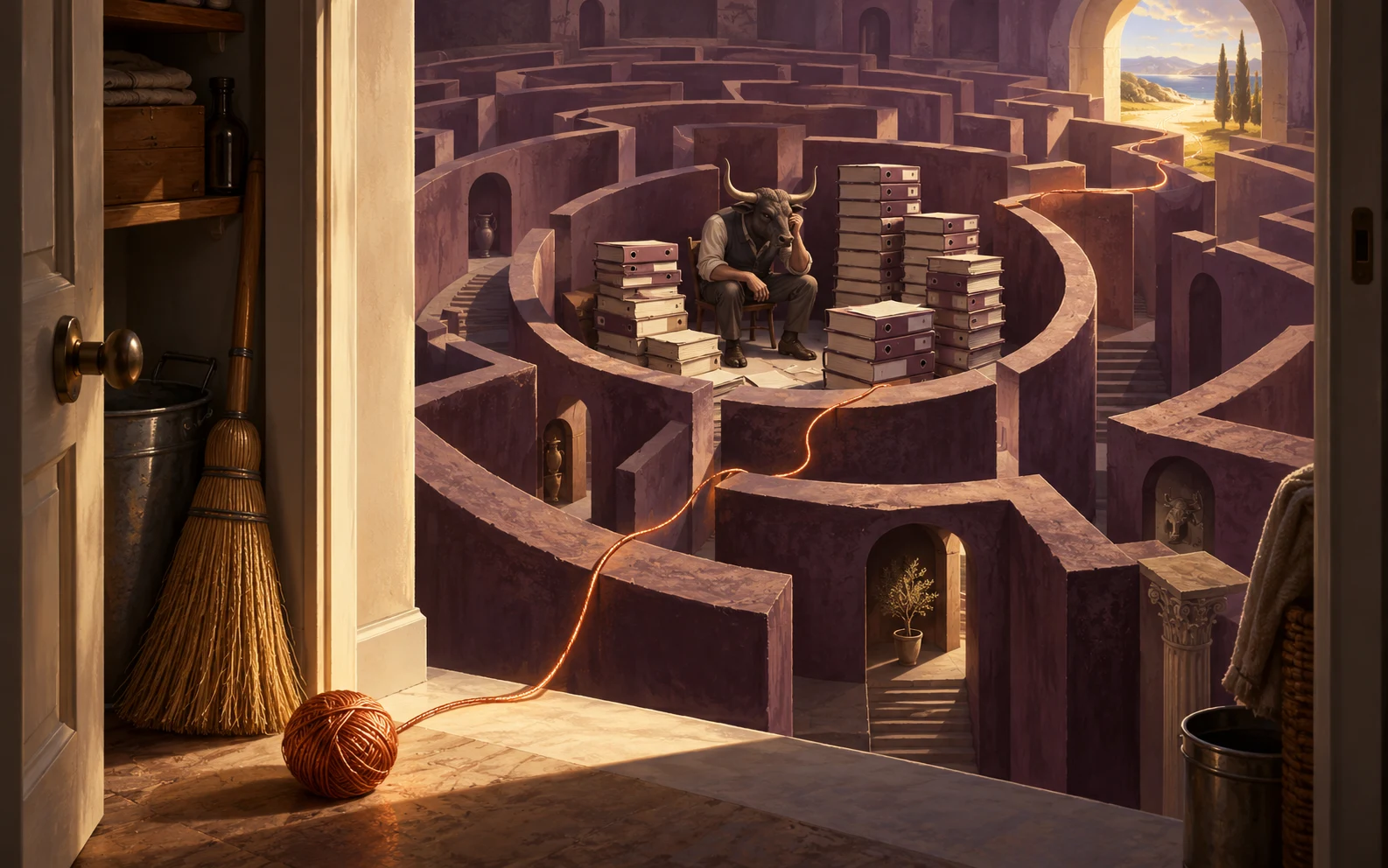
The ancient Greeks possessed a staggering talent for turning tacky domestic scandals and sheer administrative incompetence into high tragic drama. If a modern individual discovers a skeleton in their closet, they retain legal counsel or call a PR firm. King Minos, facing an analogous domestic catastrophe, commissioned an architectural masterpiece, slapped a youth levy on neighboring city-states, and carried on as though that had been the master plan all along.
The story of the Labyrinth and the Minotaur is a timeless ode to humanity’s relentless drive to erect cyclopean structures just to cover up whatever is too awkward to discuss at Sunday dinner. Yet, before diving headfirst into the murky depths of Jungian waters, it pays to separate archaeological masonry from mythological embellishments—and psychological metaphors from clinical protocols.
I. Knossos Without the Mysticism: What Was Actually Unearthed
In 1900, the British archaeologist Sir Arthur Evans launched extensive excavations at the Kephala hill near Heraklion on Crete. Emerging from beneath the soil were the remains of an immense, multi-tiered Bronze Age complex, complete with cascading terraces, sprawling storage magazines, and a plumbing system startlingly advanced for its era. Evans christened this newly revealed civilization "Minoan," honoring the semi-legendary King Minos.
Naturally, a romantically inclined explorer longed to discover not just an ancient administrative-economic depot, but The Labyrinth itself. Evans linked the term labyrinthos to labrys ("double-bladed axe"—a recurring sacred motif found plastered and carved across Knossos). The resulting moniker, "House of the Double Axe," was evocative, dramatic, and cinematically compelling; in strict terms, however, it remains merely one linguistic and archaeological hypothesis, by no means a verified municipal address for a horned abomination.
The Minoans undeniably maintained an intimate cultural relationship with bulls: rhytons carved into bovine heads, horned stone altars, and the celebrated Bull-Leaping Fresco, currently preserved at the Heraklion Archaeological Museum. Museum specialists generally lean toward the view that the acrobats vaulting over the charging beast represent an actual physical practice rather than a painter’s fever dream. Nevertheless, the definitive purpose of these death-defying somersaults—sport, rite of passage, or sacred mystery—remains unresolved.
And no, Minoan civilization did not vanish in the snap of a finger around 1450 BCE due to a solitary volcanic cataclysm. Cultural history cannot be reduced to a single calendar date or an isolated trigger. Material archaeological finds and surviving mythological narratives are entirely distinct categories of evidence.
II. The Palace Soap Opera: From Divine Wrath to Forgotten Sails
Greek myth is an eclectic composite of classical variations, where deities are vindictive and mortals consistently display jaw-dropping lapses in judgment.
The premise is straightforward: King Minos begged Poseidon for a magnificent snow-white bull as divine endorsement of his claim to the throne. The terms were ironclad: admire the beast, parade it before the populace, and promptly sacrifice it back to the god. Minos, however, applied standard corner-cutting economics: it seemed a dreadful waste to butcher prize breeding stock, so he slipped an ordinary barnyard bovine onto the altar instead. Poseidon was not amused by this petty penny-pinching. By way of retribution, he cursed Minos’s queen, Pasiphaë, with an uncontrollable lust for the bull. Within this narrative tradition, the desire is divinely inflicted; imputing autonomous moral agency or voluntary choice to the queen is fundamentally beside the point. Framing this as "bad karma" would merely impose a modern borrowing from an entirely different tradition.
Enter the tour de force of the resident royal engineer, Daedalus. Rather than tactfully talking his sovereign out of the idea or calling in sick, Daedalus engineered a hollow, wheeled wooden cow. The contraption worked, and the union yielded the Minotaur (Asterius)—a human-bull hybrid serving as a permanent walking monument to the failure of royal fiscal foreign policy.
Rather than executing the offspring of divine vengeance, Minos commissioned the perpetually accommodating Daedalus to design the Labyrinth: an intricate architectural maze from which escape was practically impossible. Following the death of Minos’s son in Attica, the Cretan monarch imposed a brutal tribute upon defeated Athens: a recurring shipment of seven youths and seven maidens to serve as creature fodder.
Athenian prince Theseus eventually volunteered to join the victim pool. His plan was audaciously ambitious: slay the beast and sail home under celebratory white sails rather than the grim customary black. Upon his arrival in Crete, romance disrupted the machinery of state: Princess Ariadne extracted the architectural solution from Daedalus and handed Theseus the legendary ball of thread. Securing the line at the threshold, the hero navigated his way to the monster's den.
In Pseudo-Apollodorus’s Epitome (1.9), the climactic bout lacks any Hollywood grandeur: Theseus simply bludgeons the Minotaur to death with his bare fists. There is no mandatory mythic broadsword, nor is there any universal consensus that the creature was sound asleep (sleep is not mentioned in this source and is not a universal dogma).
The finale is a masterclass in classical negligence and ingratitude. Following the thread back out, Theseus fled Crete with his surviving countrymen and Ariadne in tow, but her ultimate fate on the island of Naxos is told in contradictory ways: Theseus abandons her, Dionysus carries her off, or Artemis strikes her down. To crown the triumph, the victorious hero neglected to hoist the white sails. His aged father, Aegeus, scanning the horizon from the cliffs, assumed his son had perished and flung himself into the sea, conveniently securing posthumous naming rights to the body of water.
III. The Domestic Monster: When the Facade Trumps the Truth
Treating this myth as a psychological metaphor for the "family skeleton" or "domestic monster" is an undeniably appealing exercise, though it remains an unmistakably modern lens. Commentators read the narrative as an emblem of a buried domestic secret; this is not an assertion that ancient Greeks were anticipating 21st-century therapy, nor does it imply that most human miseries originate around the dining room table.
The Minotaur functions as an undeniable family byproduct: an indelible stain and a living reminder of an executive attempt to swindle the cosmic system. Minos’s instinct to bury the embarrassment beneath flagstones serves as an exquisite caricature of psychological defense mechanisms. Rather than addressing the crisis or admitting its existence to the public, leadership builds an elaborate labyrinth of evasions, corridors, and conversational taboos. You end up with a polished royal facade upstairs and a resonant, subterranean bellowing reverberating through the floorboards.
Still, one must avoid escalating this metaphor into an absolute psychological doctrine. Not every neat facade hides a lurid secret, not every human struggle stems from a "hidden rot," and external adversity is by no means always a projection of your own psyche. If a brick drops onto your foot or your supervisor turns out to be an erratic tyrant, self-reflection has its place, but the brick does not magically transform into your repressed Shadow. The Jungian Shadow is an analytical concept within a theoretical framework, not a sentient, subterranean beast squatting in your crawl space.
IV. The Labyrinth's Blueprint: Myth Versus Geometry
Seekers of esoteric meaning frequently seize upon a curious architectural paradox: on some ancient Cretan coins and floor mosaics, the labyrinth is rendered as strictly unicursal. It features no blind alleys or branching intersections—simply a solitary, convoluted path winding steadily from perimeter to core. From this observation arises a sweeping deduction: supposedly, one could never actually get lost in the Labyrinth; there was only one path, meaning one simply put one foot in front of the other, and Ariadne’s thread was needed strictly to walk backward.
It sounds delightfully profound, but let us not conflate a stylized iconographic motif with literary narrative. In the myth itself, Daedalus deliberately constructed a layout designed to confound escape. Why go through the logistical nightmare of erecting a cyclopean labyrinth if escaping merely required doing an about-face and retracing an unbroken furrow? Furthermore, claiming that branching puzzles (multicursal mazes) were invented exclusively in the Middle Ages is factually inaccurate.
As a literary metaphor, the winding pathway is brilliant: internal crises rarely resolve along a straight, eight-lane highway. Life loops back, trips over familiar roots, and forces us to circle the block. Yet in reality and clinical psychology, there is no guarantee that life presents you with a single track free of dead ends, nor does every repetitive cycle signal evolutionary growth. Sometimes a dead end is simply an error in judgment.
V. The Hero, Bare Knuckles, and the Limits of Outsider Intervention
In the mythological climax, Theseus dispatches the Minotaur without sentimentality. Because certain traditions depict him catching the beast dozing, commentators occasionally jump to the breezy conclusion that "the Shadow never strikes first; it slumbers peacefully until you stir it." Alas, classical texts offer no such consensus, and an episodic plot point cannot be converted into an emotional timetable—psychic conflicts keep no heroic calendar.
The most dangerous pitfall is reading Theseus's brawl as a literal prescriptive manual: "march into the dark and execute your shadow." A metaphorical blade is no literal psychological intervention and establishes no clinical outcome.
Furthermore, Theseus is an external agent—an outsider drafted to shovel out another dynasty's accumulated generational wreckage. In therapeutic literature, he is sometimes cast as the external guide: the analyst, the confessor, the steadfast friend. It is an engaging analogy, provided it comes with heavy disclaimers. A real-world therapist or ally is not a mythological slayer. They will not descend into your internal catacombs to carry out summary executions on your behalf, nor does their presence guarantee a tidy resolution. Support never absolves an individual of responsibility for their choices, even though no one is obligated to untangle everything in total isolation.
VI. Ariadne: The Thread, The Anchor, and The Discarded Ally
The figure of Ariadne has accumulated thick strata of academic hypotheses and mystical speculation. Mythologist Karl Kerényi advanced the intriguing thesis that Ariadne represents a surviving remnant of an archaic Minoan Great Goddess, demoted by classical Greek tradition to the rank of a naive, lovesick mortal. This remains a scholarly interpretation, not an incontrovertible historical fact.
Functionally, Ariadne performs the most indispensable role in the narrative: she provides the thread. Metaphorically, this is an anchor, a connection to the external world; it does not guarantee safe passage through a difficult experience.
Yet elevating this spool into an infallible psychoanalytic "holding environment by default"—or demanding that an Ariadne figure stand vigil forever at the entrance of someone else's dysfunction—is pure reductionism. Retroactively claiming that Friedrich Nietzsche’s descent into madness was caused by "abandoning the thread," while Carl Jung’s stability was secured by holding the "correct spool," is armchair speculation at its most indulgent.
Moreover, the myth offers a stark commentary on the price of human loyalty. In versions featuring her abandonment, Theseus’s escape is followed by a rupture. The betrayal of an ally is an ancient, morally murky trope, not a sacred cosmic blueprint mandating "spiritual liberation through the betrayal of those who helped you." Sometimes, betrayal is just betrayal, even when committed by a pedigree hero.
VII. Daedalus: The Engineering Mind and Contractor Ethics
If there is a prime operative behind this structural fiasco, it is Daedalus: an absolute technical virtuoso unburdened by professional ethics. The queen demands assistance with an unnatural obsession? Certainly, here is an anatomically convincing wooden cow on wheels. The king panics and needs the fallout buried? No problem at all; sign right here on the Labyrinth invoice. Daedalus embodies the quintessential contractor who brilliantly creates a crisis and then bills a handsome retainer to manage its containment.
Royal appreciation, however, has historic limits. Once Theseus slipped away, Minos deduced who had drafted the facility's escape plan. According to Apollodorus (1.12), Minos locked Daedalus and his son Icarus inside the very same Labyrinth for aiding the Athenians.
Their airborne escape on wings of wax and plumage provides the narrative's tragic crescendo, culminating in Icarus flying too near the sun. Psychological commentators adore framing this maneuver as an "alternative crisis management strategy": if you cannot overpower the beast on the ground, rise above the entire scenario. It sounds inspiring, provided you overlook the fact that this "alternative strategy" concluded with a teenager plunging into the ocean. The demise of Icarus is hardly a required benchmark for personal growth, and Daedalus’s wax wings are not a reliable blueprint for crisis intervention.
VIII. The Bull Leap: Sacred Choreography Over Carnage?
The Knossos fresco presents an attitude toward the bull radically divorced from the slaughter of mainland Greek myth. There are no clubs, no severed arteries, and no fractured craniums. Instead, we see lithe figures performing acrobatic vaults over the spine of an elongated bull.
A tempting interpretive parallel suggests itself: comparing this vaulting to the integration of volatile emotional states. Rather than trying to "slay the inner beast" (à la Theseus), the Minoans allegedly mastered the art of harnessing its kinetic fury, turning untamed power into the momentum for personal flight.
It is a poetic, intellectually playful analogy, but let us leave it to the essayists. The actual purpose of bull-leaping remains an open question to modern archaeology, and museum curators do not endorse treating Bronze Age artifacts as workshops on shadow integration. We cannot claim the Cretans commanded an "advanced psycho-technology" that cruder mainland Hellenes later vulgarized into a back-alley shakedown. Different eras, different rites, different folklore.
IX. Models of the Mind: When the Map Mistakes Itself for the Land
Writers can drape any number of psychological frameworks across this legend, but doing so does not turn an ancient myth into a floor plan for a clinic.
- In Jungian terms, one can draw an analogy between the beast and the Shadow or disowned experience, leaving the "subterranean floor" strictly as an illustrative metaphor.
- Through a psychoanalytic lens, the Labyrinth resembles a fortress of Ego defense mechanisms constructed to isolate dangerous, unsanctioned impulses of the Id.
- In Internal Family Systems (IFS), the creature might be likened to an "Exile," locked away by overzealous "Managers" or "Protectors." Crucially, however, this model does not treat internal parts as inherently diseased defects or predatory monsters marked for execution.
All these systems—Jung, Freud, IFS—are merely distinct conceptual languages, provisional maps of complex terrain. Not one of them turns an ancient monster into tangible matter, nor do they guarantee that psychological health is a tidy, single-track spiral. A metaphor serves well as long as it clarifies a process; it turns toxic the second it is mistaken for an anatomical atlas of the soul.
X. Returning to Daylight: Stripped of Pathos
What remains of this ancient blockbuster once the archaic bombast and pop-psychology jargon are stripped away?
The Labyrinth and its resident brute remain an honest mirror for our evasions. We can sometimes emulate King Minos: having committed an act of petty cowardice or myopic greed, we expend tremendous energy constructing an intricate network of rationalizations and strict household taboos to cover our tracks. We exhaust immense vitality raising internal fortifications, operating on the fantasy that locking an embarrassment behind three deadbolts will prevent it from spoiling our lives.
Yet a cautionary tale is not a clinical protocol. There is no need to strap on an imaginary broadsword and go storming through your childhood memories determined to "butcher the beast in its sleep." Nor should you paralyze yourself with the dread that any unresolved internal conflict will inevitably bring down the household. And under no circumstances should you sacrifice your relationships under the delusion that "true personal growth demands collateral damage."
Common sense is vastly more grounded: one can periodically take a clear look at what we are trying to conceal behind complex emotional architecture. It is wise to maintain tangible anchors, to respect those who hold the thread for us in the outside world, and, above all, to shoulder straightforward adult responsibility for our own actions—well before covering them up requires retaining an engineering crew.