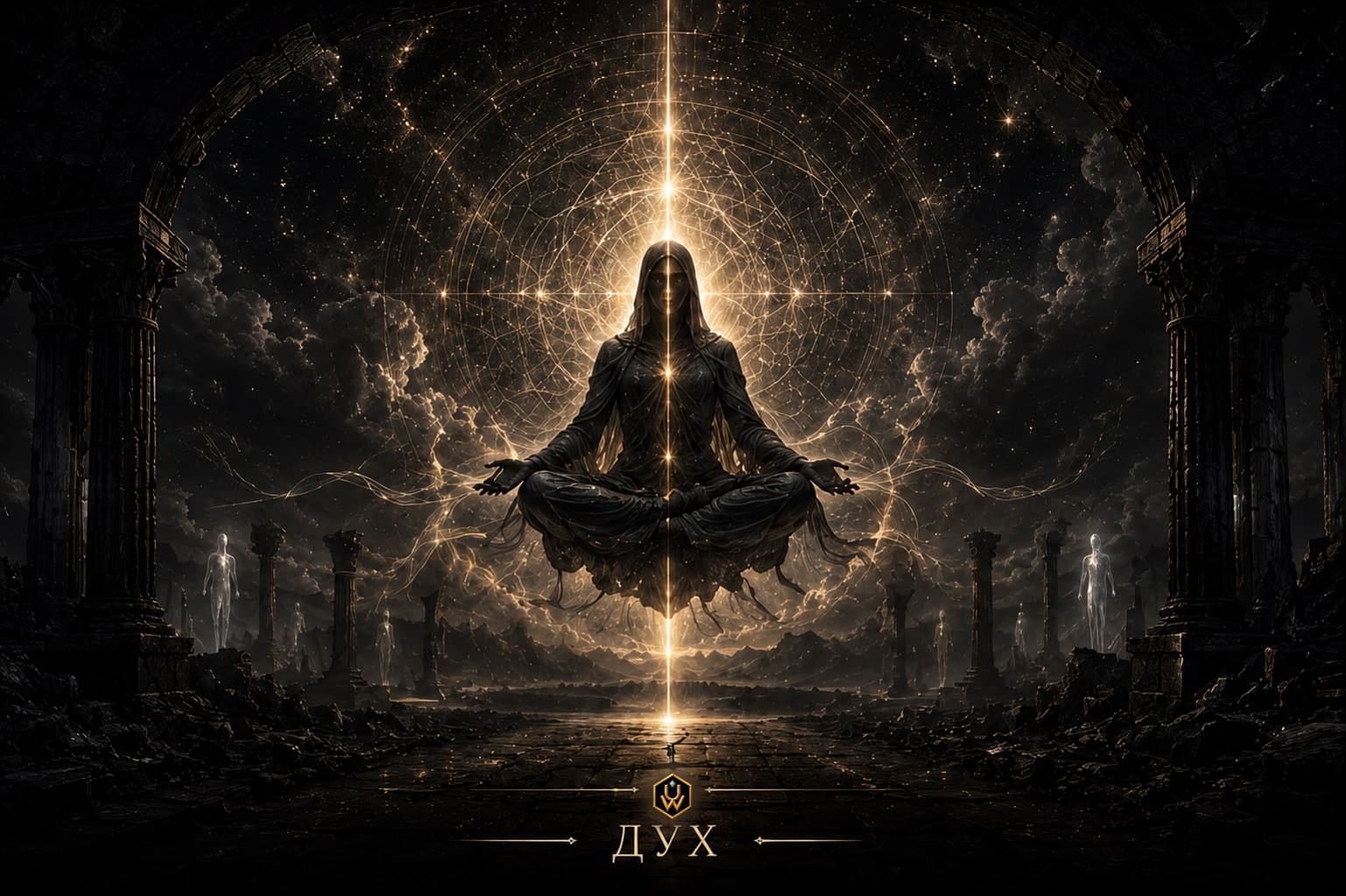
I. Not a pattern to color in
Almost everyone today knows what a mandala is. A bookstore, the esoterica section: there is always a pad of round ornaments there, fill them in with colored pencils, calm your nerves.
This is the shallowest thing that has happened to one of the oldest symbols human beings have.
A mandala is not an ornament. It is a map. A map of the place where consciousness finds its center. The word has a history of its own, three and a half thousand years long, and almost nothing in it has anything to do with coloring books.
II. Etymology: a book of circles
The Sanskrit maṇḍala means, literally, "circle," "disk," "that which is round." But already in the Rigveda (fifteenth to twelfth centuries BCE) the word takes on a second meaning — "section," "cycle," "book." The ten divisions of the Rigveda are called ten mandalas.
So a mandala is both a geometric form and a unit of text. In its oldest use it already means "something completed, turned about a center." The book and the circle are the same thing.
In Buddhist texts the word shifts. Maṇḍala becomes the palace of a deity seen from above, in a bird's-eye view: a square inscribed in a circle, four gates on the four sides, a throne at the center. Tibetan renders this as kyilkhor — "circle around a central point" (Project Himalayan Art).
From this point on the mandala stops being only a text and becomes what it is for us today — an image.
III. The archetype of the circle
Before turning to particular mandalas, something simple has to be said.
The circle with a center appears among human beings independently. At Stonehenge it is laid out in stone around 3000 BCE. In the medicine wheels of North America it is laid out in boulders along the four directions. In Celtic labyrinths it is cut into rock long before Christianity. In the Aztec sun stone it is carved as a calendar and a cosmological scheme. In the Chinese taiji symbol it becomes the sign of a shifting equilibrium.
Everywhere the same thing. The circle is a form with no beginning and no end, and so it stands for the whole. The center is the place toward which everything is drawn. The four directions divide the circle into quadrants, and quadrants are already a world.
This is a structural unit of the way human beings perceive space. Wherever a person looks — standing on the ground, he sees a horizon-circle around him and himself at its center. What the mandala draws is exactly this basic sense: I am at the center, the world is around.
IV. The Sri Yantra: Hindu geometry
The best-known Hindu mandala is not called a mandala but a yantra — though structurally the two are one. The Sri Yantra is the geometric diagram of the goddess Tripurasundari, made of nine interlocking triangles.
Four triangles point upward: this is Shiva, the masculine principle. Five point downward: this is Shakti, the feminine. They interlock so that forty-three smaller triangles form inside. At the very center is the point, the bindu.
The point is indivisible. It has no size. It cannot be drawn — what we draw is only its indication. The bindu is the place where multiplicity arises out of unity and where multiplicity returns. It is what one meditates on.
The outer boundaries of the Sri Yantra are three circles, an eight-petaled and a sixteen-petaled lotus, and finally a square with four gates on the four directions. This is the same structure we will meet again in the Kālacakra: a circle inside a square, four gates, a center.
In the practice of Sri Vidya — the tradition of worship of the Goddess — the Sri Yantra is built up over years, step by step, as a meditative path. Each ring is a stage. Each triangle holds a seed syllable, a bīja-mantra. When the practitioner reaches the bindu, he is held to have touched the source.
V. Kālacakra: a map of time
The Tibetan Kālacakra mandala is probably the most complex of those we know. Kālacakra means, literally, "wheel of time." According to the description of the mandala, it is a five-story palace occupying a space of 200 by 200 "arm spans."
The outer ring is the ring of wisdom, a protective ring, ornamented with golden flame.
Then come four rings of the elements: air, fire, water, earth. Inside them, the palace itself.
The palace has three main platforms:
— the body mandala (at the bottom, 200×200), with four great gates on the four directions; — the speech mandala (on a platform 100 spans high, 100×100), structurally repeating the one below; — the mind mandala (on a platform 50 high, 50×50), repeating it again.
Inside the mind mandala are two further levels: the Mandala of Supreme Wisdom (25×25) and the Mandala of Great Bliss. At the very center is a lotus, and on it stand Kālacakra (dark blue) and his consort Viśvamātā in the yab-yum posture, the tantric union. Kālacakra stands for the moon, Viśvamātā for the sun.
In its full version the mandala holds 722 deities — each with its own name, color, attributes, mantra. All of it the monk must hold in visualization at once. Michael Henss writes that the aim of the practice is to be able to visualize the entire palace with all its details within a space the size of a pea, and to hold it there for as long as one wishes.
This is not a decorative exercise. It is a microcosm. The practitioner identifies himself with the central deity — and by doing so becomes the center of the world. Not "as if," but literally: my body becomes the mandala, my channels become the elements, my breathing becomes the movement of time.
VI. The sand mandala: the point of destruction
The best-known form of the Kālacakra is the sand mandala. The Tibetan monks of Namgyal in Dharamsala, students of the Dalai Lama, build it out of colored sand. The work takes anywhere from several days to several weeks.
The sand is made from ground stone dyed with opaque mineral pigments. The base colors are white, black, blue, red, yellow, green, plus derivatives. The instrument is called a chakpu — a metal funnel with a ridged surface. The monk rubs the funnel with a rod, and a thin stream of sand runs out of the narrow end.
First a monk at the center draws the whole geometric framework in white ink — with ruler and compass, exactly to the canon. Then several monks at once fill the framework with sand, starting at the center and working outward. The concentration required is such that during those days almost nothing is said.
When the mandala is finished it is shown to the public, sometimes for hours, sometimes for days. And then it is destroyed.
This is the central point. Not by accident, not by mistake, not with regret. A monk takes up a vajra — a ritual weapon — and with one movement draws it across the diagonal. The structure breaks. The colors mix. All 722 deities become colored sand again.
The sand is gathered into a vessel and carried in solemn procession to a river. It is poured into the water. The water, it is held, will carry the blessing out into the world.
Why this way? Not because of a fashionable idea about impermanence. Because the structure of the practice has it built in: making is one part; contemplating is one part; destroying is one part. Leave the mandala hanging on a wall as a picture and it stops being a mandala. It becomes decoration.
A mandala is a verb, not a noun. It is a process, not an object.
VII. Iikaah: "the place where the gods come and go"
Now a step across half the planet.
The Navajo of the American Southwest have a rite called iikaah — in their language, literally, "the place where the gods come and go." The singer, the hataalii, spreads colored sand across the floor of the hogan, the traditional dwelling. Not ordinary sand: ground white gypsum, ocher, black charcoal, blue from charcoal mixed with gypsum, red from sandstone. Sometimes cornmeal, pollen, ground roots are added.
The sand runs through a pinch of the fingers. No instruments. Only fingers and hand.
The singer draws the holy figures on the ground — the hills where the gods live, scenes from the legends, the figures of the healing spirits. By various counts, between 600 and 1,000 canonical paintings are known in the tradition.
When the painting is finished, the patient is seated on it. The singer chants the "way" — a ritual text that can run nine nights. The patient, it is held, absorbs the power of the holy figures, and they in turn absorb his illness.
And then the painting is destroyed. The fresh drawing has become unclean — it has taken the illness into itself. The sand is swept up, carried out to the north of the hogan, and returned to the earth.
This painting has nothing in common with the Tibetan one in content. The gods of the Navajo have nothing in common with Buddhist deities. The scenario is different. The climate is different. The continent is different.
But the structure is the same:
— colored sand, laid down precisely to a canon; — a central figure spreading symmetrically toward the edges; — orientation by the four directions; — ritual making; — use as a channel between a person and the powers; — obligatory destruction after use.
This is not borrowing. Tibetans and Navajo never met. It is a structural unit: a person in crisis lays a circle with a center underneath himself, and the circle helps him gather.
VIII. The labyrinth at Chartres: a Christian mandala
A third example. Southwest of Paris, in the town of Chartres, stands a Gothic cathedral. In its nave a labyrinth is laid into the floor in light and dark stone.
It is not a puzzle-labyrinth — it has no dead ends and no forks. It is called a labyrinth by tradition, but structurally it is a single-path circle with one long winding course leading from the edge to the center. The diameter is about 12.4 meters without the lunations, the toothed outer rim, and about 12.9 meters with them. Eleven concentric rings. At the center, a six-petaled rose.
The length of the path is about 261.5 meters by John James's measurement.
The labyrinth was laid around 1200. Medieval sources mention pilgrims walking it on their knees, saying prayers. It was called a "Jerusalem in miniature": for those who could not make the pilgrimage to Palestine, the cathedral labyrinth stood in for it symbolically.
Look closely at the structure: a circle, a center with six petals, four axes (four large turns along the way), movement from the edge to the center — this is the same mandala. Only without deities, without Sanskrit, without the Tibetan canon. A Christian of the thirteenth century crossing Chartres on his knees was doing what the Tibetan monk does before a sand mandala: returning to the center.
Chartres is not the only one. There were labyrinths in the cathedrals of Reims, Arras, Sens, Amiens, Bayeux. Most were destroyed in the eighteenth century as "pagan." The one at Chartres is among the few that survived.
IX. Rosette, cross, calendar
Look around, and the circle with a center turns up in nearly every developed culture.
In Neolithic Palestine, the Jericho rosette — concentric circles engraved in stone 9,000 years ago. In ancient Egypt, the solar disk of the Aten with its hand-rays. In the Buddhist stupa, a round base with a relic inside. In Islamic geometry, eight-pointed stars inscribed in a circle, as in the domes of the Alhambra. In the Christian roses of Gothic cathedrals, a mandala in stone set west of the altar (the rose of Notre-Dame de Paris is 9.6 meters across).
In science, too. Rutherford's structure of the atom is concentric circles around a nucleus. Before 1543 the solar system was drawn as geocentric spheres around the earth; after Copernicus, as heliocentric spheres around the sun. The structure stayed the same: a circle with a center.
Jung took this for something other than coincidence — for a single archetype showing itself. Not that every culture "invented" the same thing. Rather that something in the makeup of the psyche moves toward this form whenever the whole has to be pictured.
X. Jung and his own mandala
Carl Gustav Jung met the mandala in 1916.
By then he had been in a personal crisis for four years. After the break with Sigmund Freud in 1913 the hallucinations began, the anxiety, the sense of coming apart. To keep from losing his mind, he started writing down dreams and visions in a large red notebook — what would later become the Liber Novus, the Red Book.
In January 1916 he drew a circular diagram. He called it Systema Munditotius, "the system of all worlds." At the center, the figure of the boy Eros. Around it, concentric rings with the symbols of the opposites: light and dark, above and below, masculine and feminine, spirit and matter.
This was the first mandala Jung drew. And the first moment when he felt the disintegration stop. Later, in Memories, Dreams, Reflections, he writes: "It became increasingly plain to me that the mandala is the center. It is the exponent of all paths. It is the path to the center, to individuation." And a few lines further: "I knew that in finding the mandala as an expression of the self I had attained what was for me the ultimate. Perhaps someone else knows more, but not I." (Memories, Dreams, Reflections, recorded and edited by Aniela Jaffé, translated from the German by Richard and Clara Winston, Vintage Books revised edition, in the chapter "Confrontation with the Unconscious.")
From then on he drew mandalas regularly. The Liber Novus holds dozens. They grew more complex, more symmetrical, more detailed.
Then Jung did what any clinician would do: he checked whether his experience was unique. And he found that patients in crisis — with no knowledge whatever of Tibetan or Hindu symbolism — spontaneously draw the same form. A circle. A center. Four axes. Sometimes a square inside. Sometimes petals. Sometimes mythological figures at the sides.
What Jung saw in this was not cultural influence but the self-regulation of the psyche.
XI. The Self, not the ego
The Jungian reading of the mandala rests on one distinction.
The ego is the conscious "I." The agency that says "I want," "I think," "I am tired." The ego is limited: it does not know the unconscious, it forgets most of the past, it governs neither the heartbeat nor dreams.
The Self (Selbst in German) is the whole psychic totality, conscious and unconscious together, including what the ego does not yet know about itself. The Self is larger than the ego. The Self is a potential that the ego moves toward across a whole life. Jung called the process of that movement individuation.
The mandala, for Jung, is an image of the Self. Not of the ego, which is always off-center, partial, in conflict, but of the whole. At the center of the mandala is what the ego is not, and what it reaches toward. All the opposites that in ordinary life are felt as tearing a person apart are arranged, in the mandala, around a center — and by that are held together.
This is why the mandala appears spontaneously at moments of crisis. A psyche split in two draws a circle in order to gather itself. It is not a "therapeutic technique," it is an automatic response of the unconscious.
The mandala is the self-representation of a homeostatic process in the psyche. When a personality is under threat of breaking up, the mandala is the sign that in the depths an assembly is under way.
XII. The axis of the world
One further notion has to be brought in here — the axis mundi, the axis of the world.
Many archaic cosmologies hold that the world has a vertical axis: the underworld below, our earth in the middle, the sky above. Along this axis the shaman in trance "ascends" and "descends." On this axis the world tree grows — Yggdrasil among the Scandinavians, the Tree of Life in Kabbalah, the banyan in India, the ash among the Slavs.
The mandala draws that axis in plan view. Look at a tree from a bird's-eye view and you see the circle of the crown with the point of the trunk at its center. That is the mandala: the point through which the world axis passes, and the forces spreading around it.
So the center of the Kālacakra is not a decorative motif. It is the place where the heavenly axis crosses the earth. To enter the center of the mandala is to stand on the axis.
XIII. The modern trivialization
In the twentieth century the mandala became fashionable.
In the 1960s the psychedelic movements and art therapy discovered it. In the 1970s universities began to study it. In the 2000s it entered mass culture — as a tattoo, as decor, as a coloring book. In 2015 the British publisher Boxtree brought out Emma Farrarons's The Mindfulness Colouring Book, dozens of round patterns. It sold in the millions.
This is not bad in itself. Coloring in a mandala genuinely does calm a person — concentration on circular symmetry slows the breath, narrows attention, takes the edge off anxiety. Art therapists use the effect seriously.
But there is a problem. What the coloring book offers is the last, outermost, purely aesthetic shell of the mandala. Without the building. Without the contemplation. Without the destruction. Without any understanding that the circle is a map of something.
When a Tibetan builds a sand mandala, he enters it with his mind. When a Navajo draws an iikaah, he calls the gods. When a pilgrim at Chartres walks the labyrinth on his knees, he makes a journey. When a patient in crisis spontaneously draws a circle, he gathers himself.
When a modern person fills in a template with colored pencils on an iPad, he does nothing. He rests. It is a perfectly good rest. It just should not be confused with what a mandala is.
XIV. The mandala as method
This is perhaps the main thing to be said.
A mandala is not a thing. It is a sequence of three actions.
Building. The geometric structure is built slowly, to the canon, with full attention. This is the first meditation: attention held on a form. The Tibetan builds his mandala over weeks. The Navajo, in a day. Jung drew his in an evening. The time can differ; the substance is one — attention that does not come away from the center.
Contemplation. The finished mandala is an object to be looked at. Not as a picture. As a map. The eyes travel from the outer edge to the center and back. They take in each ring, each segment. They recognize something of themselves in it.
Destruction, or integration. The sand mandala is ritually destroyed. The Chartres labyrinth is walked to the center and back. Jung's mandala is drawn and put away in the Liber Novus. The yantra remains, but the practitioner leaves. In every case the form gives way to what was lived through it.
Drop any one of the three actions and there is no mandala left. There is a pattern.
XV. What remains
One line has run through every chapter of this series.
In Advaita it was said: tat tvam asi, and that's how you are — there is something in you that is not your roles, your suffering, your body; it is the witness, which is not drawn in.
In Stoicism it was said: prohairesis, moral purpose — the agency inside you that judges circumstances while remaining free of them; the inner judge.
In Prometheus it was said: fire is the symbol of the moment when consciousness first separates from natural blindness; the one who carries that fire pays, and the fire remains.
The mandala is a fourth name for the same thing. What Advaita calls the witness, Stoicism the judge, the myth the fire-bearer, the mandala draws as the center. The bindu, the point, indivisible, unmoving, through which the axis of the world passes.
All the opposites — masculine and feminine, dark and light, yours and another's, past and future — are arranged around this center. They do not destroy each other, because the center holds them.
That is what the mandala draws. Not a philosophy, not a doctrine, not a belief. The geometry of the place where consciousness finds itself.
So when a person in crisis takes a sheet of paper and, with no knowledge of the Tibetan canon, draws a circle with a center and four axes — he is doing what Jung did in 1916, what the monk in Dharamsala does, what the Navajo singer did a thousand years ago, what the pilgrim at Chartres did in 1200.
All of them are going to the center. The map is the same.