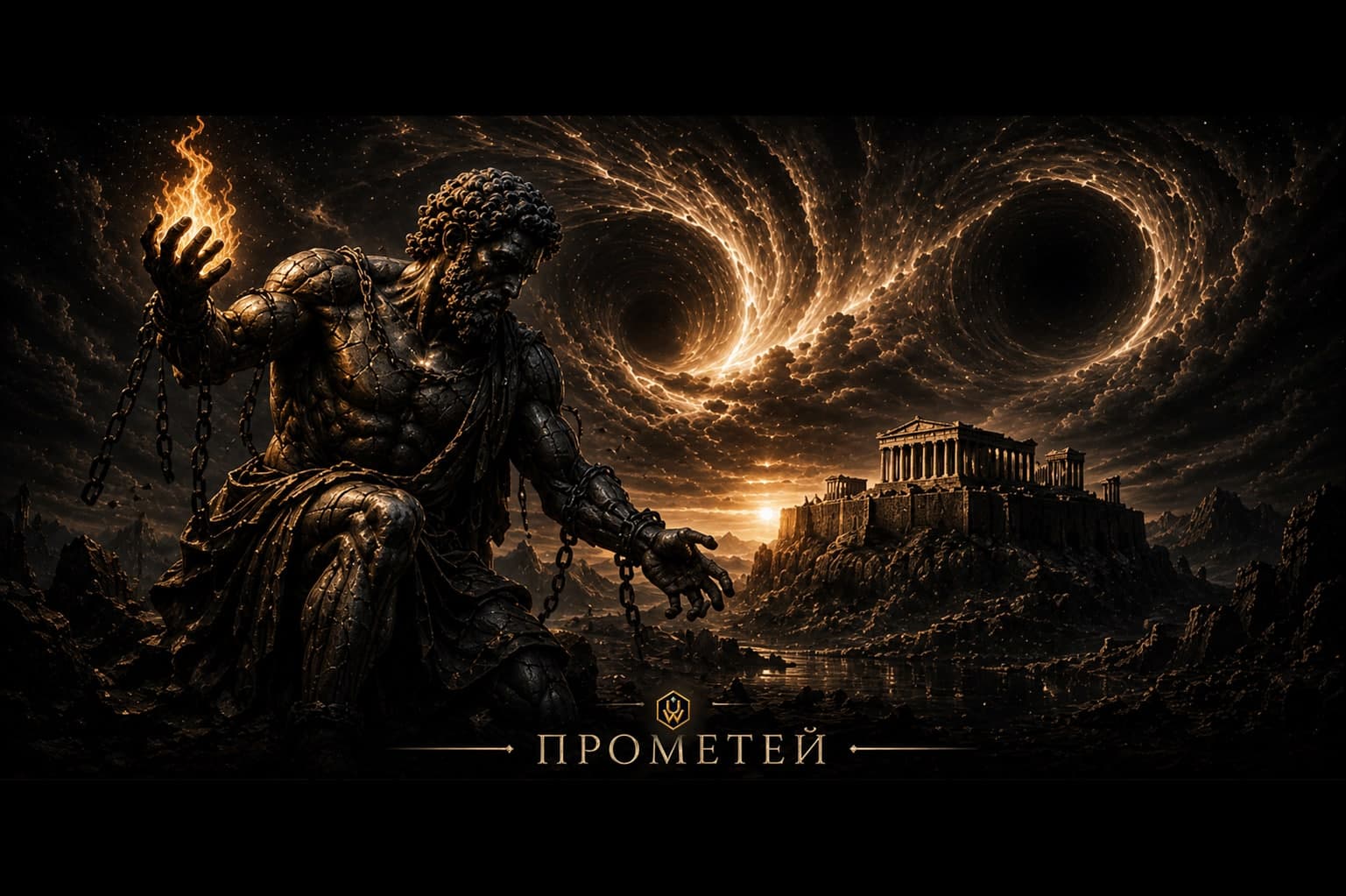
I. The empty stalk
The scene anyone remembers on first hearing this myth: a figure walking down from the mountains at night. In his hand, a long hollow fennel stalk. Inside the stalk, at its very core, an ember smolders, stolen from the hearth of the gods.
Prometheus is walking toward human beings. He carries them the thing without which, until this night, they were not human — fire.
For this night he will be chained to a rock in the Caucasus. Every morning an eagle will come and eat out his liver, and every night the liver will grow back. In Hesiod this lasts for generations; in Aeschylus, thirty thousand years. Until one day Heracles arrives, draws his bow, and kills the eagle.
But between the theft and the release lies almost an eternity. And all that time an ember burns in the hollow fennel stalk.
II. The sources
The Greeks have no single canonical text about Prometheus. There are four principal ones, and they say different things.
Hesiod is the earliest, late eighth to early seventh century BCE. In the Theogony (lines 507–616) and in Works and Days he tells the myth twice, with different emphases. In Hesiod, Prometheus is above all a trickster, a deceiver who twice gets the better of Zeus and is punished for it.
Aeschylus, fifth century BCE. In the tragedy Prometheus Bound (the first part of a trilogy that has not come down to us) Prometheus is a tragic hero, a sufferer, the fire-bringer. From his speeches to the chorus of Oceanids a straight line runs to every later reading of Prometheus.
Plato, late fifth to fourth century BCE. In the dialogue Protagoras (320c–322d) Socrates puts his own version of the myth into the mouth of the sophist Protagoras. Here Prometheus is the savior of humankind, and his theft a forced gesture that corrects his brother's mistake.
Ovid, first century CE. In the Metamorphoses (I.78–88) there is a passing mention: Prometheus molds the human being out of earth mixed with rainwater. A late addition to the myth, and later more popular than the canonical versions.
These four voices do not agree. And it is their disagreement that made Prometheus a figure into whom the next three thousand years wrote the most various meanings.
III. What is in the name
The name Prometheus — Promētheús in Greek — contains the root mētis, "mind, cunning, design," and the prefix pro-, "ahead, in advance." Literally: the one who thinks ahead.
He has a brother. Epimētheús, Epimetheus. The same root, a different prefix, epi-, "after." The one who thinks afterwards.
Hesiod characterizes them in a single line: "clever Prometheus, full of various wiles, and scatter-brained Epimetheus." The Greek behind the epithet is akritomētis, literally "of unsorted mind." Epimetheus is not stupid. He sees clearly, but always after the event, when nothing can be corrected.
Two brothers, two modes of mind. One looks ahead, the other looks back. One saves in advance, the other repents afterwards. The myth does not place them side by side by accident.
IV. Two modes of mind
Before the scene with the fire unfolds, Greek thought has already encoded a fundamental observation into this pair of figures: the mind works in two modes.
One mode is pronoia, forethought. The capacity to see a consequence before it has arrived. To hold in the imagination a scenario that does not yet exist. To make a decision on the basis of a nonexistent future, and by doing so to change it.
The other mode is epinoia, afterthought. The capacity to understand after the fact what has happened. To name the mistake. To draw the lesson — usually too late for it to be of use in this particular case.
Cognitive science would call the first planning and counterfactual thinking, and the second reflection and learning. The Greeks knew both and understood that without both the human being is incomplete. Prometheus alone is dangerous, because he acts without looking back. Epimetheus alone is helpless, because he only looks back.
When we come to read fire as consciousness, it is worth keeping in mind: for the Greeks consciousness is already here, in this pair of brothers, divided into two functions, and both of them belong to the human being.
V. Mecone
Where the story begins. In Hesiod, with a feast at Mecone, a city in Sicyon in the northern Peloponnese. Gods and mortals have gathered to divide the carcass of a sacrificed ox. Prometheus takes on the division.
He does it this way. On one side he lays the bones, carefully covered with glistening fat. On the other, the meat and the entrails, hidden under an unappealing hide and stomach. To Zeus — head of the gods and judge of the dispute — he offers the first choice.
Zeus chooses the glistening part. He opens it and finds bones.
From this moment on, Hesiod says, the order of sacrifice is established: people burn on the altars the bones wrapped in fat, and eat the meat themselves. That order is two and a half thousand years old: the whole of Greek religious practice is built on Prometheus's deception at Mecone.
Zeus nursed the offense. And in punishment he took fire away from human beings.
VI. The theft
This first affliction without fire is a symbolic one. People already eat meat — Prometheus arranged that — but they cannot cook it. In winter they are cold. They do not know the crafts that are impossible without fire: smithing, pottery, cooking. In Aeschylus (Prometheus Bound, 442–471) the hero describes the state in which he found humankind: "Though they had eyes to see, they saw to no avail; they had ears, but they did not understand; but, just as shapes in dreams, throughout their length of days, without purpose they wrought all things in confusion." They lived in caves like ants in their holes, knowing nothing of the year, of the seasons, of carpentry, of letters, of numbers.
Prometheus decides to correct this himself. He enters the forge of Hephaestus — or, in another version, hides by the wheel of Helios — and steals an ember. He conceals it in the hollow stalk of the plant the Greeks called nárthēx, giant fennel.
The detail is not incidental. The core of the narthex stalk is porous and smolders easily without flaring up. An ember can be laid inside it and will burn slowly, for hours, without giving itself away. Greek shepherds really did carry fire over long distances this way. Prometheus does not steal fire once, for theatrical effect. He steals it in a technically competent manner, by a method that would later pass into common use.
VII. The chains
Zeus learns of the theft when he sees fires on the earth at night. In Hesiod: "And Zeus who thunders on high was stung in spirit, and his dear heart was angered when he saw amongst men the far-seen ray of fire."
Then comes a double punishment. On human beings — Pandora, with her pithos, a large clay storage jar in which all the afflictions are shut (a later tradition would call it "Pandora's box"; in the original it is an enormous vessel for storing oil or grain, not a box). Pandora is given in marriage to Epimetheus. Epimetheus, true to himself, accepts the gift — and then watches the lid open and disease, old age, hard labor and deceit go out into the world.
On Prometheus — the Caucasus. The rock. The chains. The eagle.
In Hesiod the description is short and terrible:
"And wily-minded Prometheus he bound in indissoluble bonds, with painful chains, having thrust them through the middle of a column. And he urged against him an eagle with-wings-outspread: but it kept feeding on his immortal liver, while it would increase to a like size all-round by night, to what the eagle with-wings-outspread had eaten during the whole day before." (Theogony 521–525, translated by J. Banks, adapted by Gregory Nagy; Center for Hellenic Studies, Harvard University)
[Hesiod is quoted here in Banks's translation, not Evelyn-White's as elsewhere in this article: Evelyn-White drives a shaft through Prometheus's body, where the Greek drives the chains through the middle of a column. The epithets differ in the two sections because the Greek differs — ankylomēteō, crooked of counsel, at line 511, and poikiloboulon, of intricate designs, at line 521.]
The word "immortal" does double work here. Prometheus is a Titan, a god; his liver cannot die — and for that very reason the torture has no end.
VIII. Plato
Plato, in the Protagoras, tells a different version. In his telling the gods made humans and animals out of earth and fire, and then charged Prometheus and Epimetheus with distributing the faculties among all the species. Epimetheus asked his brother to let him do it: "And when I have dealt," he said, "you shall examine."
Epimetheus distributed. To some he gave swift legs, to others wings, to others a thick hide, to others fangs. When it came to the human being, it turned out that Epimetheus, in his habit of thinking after the fact, had already given everything away. The human being was left naked, without claws, without speed, without fur.
Prometheus saw this and decided at once: he stole from Hephaestus and Athena the wisdom in the arts, entechnos sophia, and fire along with it. And gave them to human beings.
In Plato there are no chains and no eagle. Prometheus here is not a sufferer but a colleague correcting another's mistake. But there is an important detail here too: technē alone is not enough for people. They begin to kill one another. Zeus sends Hermes to carry a second thing through the world — dikē, justice, and aidōs, shame and reverence. Without them the theft of fire turns into catastrophe.
Plato's version is the earliest political interpretation of the myth: fire, which is to say technology, is destructive without ethics.
IX. Aeschylus
The Prometheus Bound of Aeschylus is a tragedy in the full sense. Here Prometheus knows what is coming. He knows he will be chained. He knows the term of the punishment — thirty thousand years. He knows that Heracles will free him. And he goes through with the theft anyway.
In the middle of the play Prometheus delivers a long speech, a catalogue of gifts. What exactly he brought to human beings:
"Though they had eyes to see, they saw to no avail; they had ears, but they did not understand; but, just as shapes in dreams, throughout their length of days, without purpose they wrought all things in confusion… I taught them to discern the risings of the stars and their settings, which are difficult to distinguish. Yes, and numbers, too, chiefest of sciences, I invented for them, and the combining of letters, creative mother of the Muses' arts, with which to hold all things in memory. I, too, first brought brute beasts beneath the yoke… and to the chariot I harnessed horses and made them obedient to the rein… It was I and no one else who invented the mariner's flaxen-winged car that roams the sea. Wretched that I am — such are the arts I devised for mankind, yet have myself no cunning means to rid me of my present suffering."
Aeschylus lists them: astronomy, arithmetic, writing, animal husbandry, the wheeled cart, seafaring, medicine, divination, metallurgy. Fire in Aeschylus is not simply a flame on the hearth. It is the whole body of what distinguishes culture from nature.
X. The gift of forgetting
And one more gift, named separately and standing apart. The chorus asks Prometheus what else he gave to mortals.
Prometheus answers: "Yes, I caused mortals to cease foreseeing their doom."
"Of what sort was the cure that you found for this affliction?"
"I caused blind hopes to dwell within their breasts."
Typhlai elpides. Blind hopes. This is perhaps the strangest line in the whole play. Prometheus, Pro-metheus, the one who thinks ahead, gives human beings precisely what allows them not to look ahead. He gives them the capacity not to know when they will die.
The Greeks understood that the knowledge of one's own mortality, if it is continuous, paralyzes. To be able to plant a tree, build a house, bear a child, one has to be able to forget that all of it will outlive you, or will not outlive you at all. Prometheus gives culture, and in the same movement gives the instrument without which culture is unbearable — the capacity to live as though there were time enough.
XI. Fire
What is in this fire.
Fire is the most concentrated of material phenomena and at the same time the least material. A stone can be weighed, water poured into a cup. Fire cannot. Fire is a process, not a thing: the continuous passage of the solid and the liquid into gas and light. It lives only as long as it is fed. It dies faster than anything else. It spreads like something alive.
The Greeks saw in fire the fourth element, pŷr, and connected it with the swiftest and finest part of the soul. Heraclitus, a contemporary of Aeschylus, held fire to be the very foundation of the world order: "This world, which is the same for all, no one of gods or men has made; but it was ever, is now, and ever shall be an ever-living Fire, with measures of it kindling, and measures going out."
In the myth of Prometheus, fire is not one particular skill and not one particular tool. It is the capacity to produce processes as such. To kindle is already an act of transformation. Everything else grows out of fire: forging, pottery, cooking, light, protection from predators.
Through metaphor, fire becomes a figure of consciousness. Consciousness burns too. It too has to be fed continuously — with impressions, relationships, tasks. It too spreads to whatever it touches. It too tells the living from the dead. It too is dangerous: with it you can burn yourself and others.
XII. The fire of consciousness
Where consciousness interrupts the animal.
An animal lives in a world of impressions. It sees what is there. It reacts to what happens. It remembers — some species more deeply, others less — but it does not look back into memory as a separate region. It does not imagine what is not there. It does not ask who it is.
Consciousness, in the narrow sense in which the Greeks discussed it and in which the philosophy of mind discusses it now, begins with a rupture. It is the moment when the gap between impression and response appears — a pause in which it is possible to imagine otherwise. If I do this, that will follow. And if I do otherwise, something else will.
This is already Prometheus. The gift of forethought is not an additional function of the animal mind. It is another way of existing. With it comes culture, because culture is the holding of time on top of biological cycles; comes ethics, because choice requires the possibility of acting otherwise; and comes, finally, a suffering of a particular kind, one no animal can undergo — the suffering that comes of knowing one's own mortality.
The fire of consciousness is the same scene of theft, played out inside the human being. Something that once belonged only to the gods — the ability to see ahead, to remember with separation, to choose — is one night stolen and carried into the clay hut of human biology. The ember in the hollow stalk is what separates us from the animal. And it is precisely this that is stolen goods.
XIII. Why the liver
A detail readers of the myth rarely stop at: why the liver, of all organs.
For the Greeks the liver, hēpar, was not simply an organ. Homer and the tragedians often place the passions in it: anger, fear, desire. Plato writes in the Timaeus (71a–72b) that the human soul has three parts — the rational, in the head; the spirited, in the chest; and the appetitive, in the belly. And it is the liver that is given a special role: on its smooth surface the gods "reflect" the thoughts of the rational part, so that the appetitive part can "see" them and obey. The liver in Plato is the place where reason meets instinct.
So the eagle eating out Prometheus's liver is not simply torture. It is an image of a specific kind of pain: the pain in which reason meets passion, meets instinct, meets the biological side of the creature.
Prometheus brought human beings the fire of reason. What he pays with is that every morning his reason meets his own bodily suffering and cannot stop it. This is the psychological structure of self-awareness: a reason that knows about the pain of the body and cannot get out of it.
XIV. Regeneration
"But by night the liver grew as much again."
This is the second part of the torture, crueler than the first. If the eagle ate the liver once, that would be death. Prometheus could die. But he is a Titan, his liver is immortal, and it restores itself. The pain returns every morning.
This is the structural figure of self-awareness. Not a one-time awakening, but the daily return of the same recognition. In the morning, again: I am mortal. In the morning, again: I am separate. In the morning, again: this cannot be undone.
Many spiritual traditions describe an analogous phase: "the dark night of the soul" in John of the Cross, kenshō in Zen students after the first breakthrough, the phase of disillusionment in Christian mystics after the first experience of grace. Consciousness, once acquired, does not stay in festival mode. It stays in the mode of everyday work — and part of that work, every morning, resembles having your liver eaten out.
XV. A line of reflections: Adam
In the Book of Genesis (3:1–24) there is a parallel scene. Adam and Eve in the garden. A prohibition: do not eat from the tree of the knowledge of good and evil. The serpent persuades Eve: "Ye shall not surely die… ye shall be as gods, knowing good and evil." They eat — and see for the first time that they are naked. Shame. Expulsion.
The parallel with Prometheus is structural: something that belonged to the gods passes to the human being, and there is punishment for it. But the differences matter just as much.
Among the Greeks the intermediary figure is external — Prometheus, a Titan, not a human being. He steals and hands over; people receive passively. Among the Hebrews there is no intermediary. The human being decides to eat the fruit. Among the Greeks the punishment falls on the intermediary. Among the Hebrews, on the people themselves.
Among the Greeks, fire is unambiguously a good. Aeschylus's Prometheus is a hero. Among the Hebrews the fruit of knowledge is a double-edged event: on one side the loss of paradise; on the other, the beginning of history, without which there would be nothing to tell. Genesis does not condemn the theft outright — it describes the consequences and leaves them to the reader.
Two stories about one and the same scene: how the human being came by consciousness. And both insist that consciousness costs expulsion from animal bliss.
XVI. Parallels around the world
The scene of the theft of fire is not unique to the Greeks. It appears in so many independent traditions that anthropology has singled it out as a distinct folklore motif — motif A1415 in the Thompson Motif-Index, "theft of fire."
In Polynesia the hero Māui steals fire from the fire goddess Mahuika and brings it to human beings. The gods take revenge: they set the forests ablaze, and Māui escapes only by turning into a hawk.
In North America the motif repeats dozens of times with local heroes. Among the peoples of the northwest, fire is stolen by Raven. Among the Navajo and many peoples of the plains, by Coyote. Among the Miwok of California, by Lizard: while the other animals argued, it went down under the earth and brought an ember up.
In Australia, Aboriginal peoples have many stories of fire being taken from creatures who secretly possessed it — from a bird, from a crocodile, from women. The motif is the same: fire first belonged not to people but to those who had to be outwitted.
Among the Maya, in the Popol Vuh, fire is brought by the monkey god Vucub Caquix; in other Central American traditions fire is stolen by the opossum, who carries the ember in its tail, which is why the opossum's tail has been bald ever since.
This is not contact and not borrowing. It is a structural unit of human thought. Where there is fire and a story about how people came by it, there is almost always a trickster who obtains it, at a risk or at a price.
XVII. The Indo-European layer: Mātariśvan
If we narrow the angle and look only at the Indo-European traditions related to the Greek, the picture becomes more precise.
In the Vedas, the oldest corpus of Indo-Aryan texts (roughly fifteenth to twelfth century BCE), there is a figure called Mātariśvan. The name literally means "growing in the mother," and by "mother" is meant either mother-matter or mother-flint. Mātariśvan finds the hidden fire and brings it to the Bhṛgus, the clan of priests responsible for maintaining the sacred fire.
Rigveda III.9.5 says: "Him, from a distant place… the hidden one — Mātariśvan brought him to the gods." [my translation; no published edition verified]
Structurally this is the same scene as in the Greek. Fire is at first inaccessible to human beings. An intermediary obtains it. Through the intermediary, fire becomes the center of cultic life.
But the differences are just as significant:
— Mātariśvan is not punished. In the Indian tradition the bringing of fire is a merit, not a crime. The gods do not chain him to the Himalayas. There is no eagle.
— Agni himself, the god of fire, is not the intermediary's adversary but his addressee: fire is not "stolen from Agni" but "brought as Agni." Fire is not the object of a theft but the presence of a god that has to be established.
— Sacrifice remains the central act of Vedic religion: the fire of the altar is the mouth of the gods, and through it people pass food upward. Among the Greeks the sacrificial fire is the legacy of the deception at Mecone; among the Indians, the legacy of a pure gift.
Even so, the onomastics speak for themselves. Linguists trace Greek pŷr, Latin ignis, Sanskrit agníh, Lithuanian ugnìs and Old Church Slavonic ognь all back to one Proto-Indo-European root, PIE *h₁n̥gʷnis. The same fire burned for all the descendants of the Indo-Europeans. Only the stories in which it reached human hands differed.
XVIII. The Caucasian layer: Amirani and Pkharmat
Prometheus was chained to the Caucasus. This is a detail by which the Greeks themselves explained his remoteness — the edge of the world, far from Olympus. But if one looks at the Caucasus from the other side, something remarkable appears.
The Georgians have a hero named Amirani. He steals fire from the heavenly smiths and brings it to human beings. For this he is chained to a mountain in the Caucasus range. An eagle, in some versions, pecks at his liver every day. The parallel with Prometheus is so exact that in the nineteenth century some scholars considered it a direct borrowing from the Greeks. Today most folklorists agree: this is an independent and very ancient Caucasian myth, which could equally have been a prototype or a parallel.
The Vainakh, the Chechens and the Ingush, have Pkharmat. He steals fire from Sela, the god of storms, and brings it to human beings. For this he is chained to Mount Kazbek. A falcon, not an eagle, comes every morning and eats out his heart, not his liver; by night the wound closes.
The Ossetians, in the Nart sagas, have Sosruko, or Soslan — he does not steal fire, but obtains a "firebrand" from the giants.
The geography of these stories converges on one point: the Caucasus range. The Greek, the Indian, the Georgian, the Vainakh, the Ossetian — each knows that somewhere in these mountains is a rock to which the one who brought people fire is chained. It is impossible to say with certainty who borrowed from whom, or whether anyone borrowed at all. But for this whole group of traditions the Caucasus is the place where one and the same scene is played out.
XIX. Loki
The northern parallel is the best known and at the same time the most disputed. The Germanic and Scandinavian peoples have Loki.
Loki is a jötunn among the Æsir. A trickster, a shapeshifter, a counselor and a betrayer. He never brings fire to human beings directly — here the resemblance breaks down. But the other features coincide almost exactly:
— Loki is not quite one of the gods' own, as Prometheus is not quite one of the Olympians' (a Titan, of another race).
— Loki constantly deceives the gods by cunning, and some of these deceptions work to the benefit of human beings or of the gods as a whole.
— At the end of the Lokasenna and other tales, Loki is bound in a cave: above his face hangs a bowl catching the venom of a serpent. While his wife Sigyn holds the bowl, the venom does not drip on his face. When she turns away to empty it, a drop of venom falls on Loki's face, and the earth shakes with his convulsions. This is the Icelandic explanation of earthquakes.
Bound in a cave, an agonizing torture, an association with fire — in some sources Loki is called a fire god outright, though the etymology is disputed — the structural parallelism is obvious.
The main difference: Loki is a figure who at the end of time will come out against the gods at Ragnarök. He has no Heracles to free him. His connection with fire is double-edged: on one side the hearth; on the other, the forest fire, destruction, the end of the world.
The Germanic myth tells the same scene with the opposite emphasis: the trickster chained for his gifts is not a hero but a threat. The same fire, the same image, a different moral coloring.
XX. Slavic fire
Among the Slavs no myth of the theft of fire has come down to us in pure form. Pre-Christian Slavic mythology is known only in fragments — from late chronicles, sermons against paganism, folklore survivals. But in those fragments fire holds a central place.
The principal figure is Svarozhits, "the son of Svarog." Svarog himself is the heavenly smith, the creator god, the father of fire and the sun. Svarozhits is fire as such: the fire of the hearth, the fire of the altar, the fire that is addressed in prayer. The name is attested in many Slavic traditions; the chronicle of Thietmar of Merseburg describes a great temple of Svarozhits at Rethra, where a sacred fire was kept.
Here the structure is different. Among the Slavs fire is not stolen from the gods. It is the son of a god. The smith god Svarog forges the world with a hammer at a heavenly forge, and the sparks from that hammer are the fire that burns on the human hearth. Fire is not stolen but inherited.
A parallel figure is Rarog, in Czech, Slovak and Ukrainian folklore, a fiery falcon. He is born from an egg warmed in an oven for nine days and nights. This may be a late local figure in which an ancient image of the fire-bearing bird shows through.
Among the eastern Slavs the veneration of fire survived longest. Fire could not be given into another's hands on the day of remembrance of the ancestors. It could not be spat on. Coals from the hearth were held to be alive. "Svarozhits" has come down to us as a name, but even without the name it has come down as the practice itself of treating fire as a being rather than a thing.
The Slavic answer to the scene with Prometheus is not "from whom did we steal fire" but "how must we respect it." Slavic fire is always a relative, never a captive.
XXI. Jung
In the twentieth century Prometheus returns, no longer as the hero of a tragedy but as a psychological figure. Carl Gustav Jung comes back to this image throughout his life. In one of the early Zofingia Lectures he puts it this way: "Man is a Prometheus who steals lightning from heaven in order to bring light into the pervasive darkness of the great riddle." [my translation; published English wording not verified against the edition]
In the later work Jung develops this systematically. Prometheus and Epimetheus are for him figures of the process he calls individuation: the becoming of a separate, conscious personality. Prometheus is the part of the psyche that takes the risk of separating from the collective unconscious. Epimetheus is the part that afterwards makes sense of the consequences of the separation.
The theft of fire, read in Jungian terms, is a symbol of the very emergence of the ego out of dissolution. The ego, in appearing, steals part of the light of the unconscious and begins to shine with it separately. For this the ego pays: with loneliness, with anxiety, with a sense of being cut off, with the regular return of pain — that same eagle.
Jung insists that the act of the Promethean theft is necessary. Without it the human being remains in animal fusion. But it is neither painless nor single. It is a process that accompanies the whole of conscious life.
XXII. The modern Prometheus
In 1818 there appears in London a novel by Mary Shelley, Frankenstein; or, The Modern Prometheus. A young woman of nineteen, she thought up the story over the summer of 1816 on Lake Geneva, when she and Percy Shelley, Byron and Polidori were telling one another ghost stories.
The subtitle, The Modern Prometheus, is an instruction for reading. Victor Frankenstein steals from nature — or from God; Shelley deliberately leaves the figure open — the secret of life, and creates a living being. For this there is punishment. Not chains on a rock, but something more terrible: the creation itself becomes his executioner.
Shelley does with the myth what no one had done before her. She shows that the modern theft of fire has acquired a new feature: the gift can turn on the giver. In her version Prometheus is punished not by the gods but by the fire itself.
This becomes the principal interpretation of the myth for the nineteenth and twentieth centuries. The industrial revolution, nuclear physics, cybernetics, genetic engineering, artificial intelligence — every large technological wave brings back the figure of the modern Prometheus. Sometimes as a hero: Bacon, in De Sapientia Veterum, praises Prometheus as an image of scientific genius. Sometimes as a warning: Heidegger, Ivanov, Fukuyama, any critic of technology.
XXIII. How the myth goes wrong
The myth of Prometheus is too strong an image not to be used wrongly. Three of the most frequent distortions.
The first is the heroization of revolt. Prometheus becomes a symbol of any "rising against the established order." The Romantics of the nineteenth century often read the myth exactly this way: Percy Shelley, Byron, Goethe in the poem "Prometheus." This is strong literature, but a bias is written into it. Prometheus does not rebel against Zeus as order in general; he makes good the error of one particular distribution. In Plato he acts within a corridor that Zeus himself then widens, adding dikē and aidōs to human beings. Pure revolt without a restoring ethics is not Prometheus. It is something later and more dangerous.
The second is technological optimism. "Prometheus brought fire, and ever since we have been moving upward." This line runs from Bacon through the Enlightenment to the ideologists of the twentieth century. It loses the main detail of the myth: fire comes with an eagle. The gift has a price, and that price does not diminish with time. Every new Promethean discovery — steam, electricity, the splitting of the atom, genetic engineering, artificial intelligence — arrives together with an eagle of a new size.
The third is turning the myth into a moral lesson. "Do not meddle with fire that does not belong to you." This is the reverse of the optimistic reading, and just as inaccurate. The Greeks are not moralists. Aeschylus does not teach us not to steal fire. He shows what happened, with all the consequences. The myth is not a moral fable but a map.
XXIV. What remains
Strip Prometheus of every literary and philosophical layer, and a minimal story remains, with four elements in it.
First: there was a state without fire. Pre-conscious, pre-cultural, pre-human in the modern sense.
Second: a figure appeared who brought the fire. This figure is cunning, loves humankind, takes the risk.
Third: the fire is accepted. Human life changes forever. There is no way back.
Fourth: there is a price for the gift. The one who brought it is chained. The eagle returns every morning.
Any particular content can be fitted into this story. The fire can be physical flame, or a craft, or thought, or writing, or consciousness, or science, or technology. The story works at every level, because it describes the structure of the act itself: something that was not there enters common use and does not go back out.
The same figure that appeared in Advaita, and the same one that appeared in Stoicism, appears here in a third turn. In Advaita the witness recognizes itself as Brahman. In Stoicism prohairesis recognizes itself as the only thing properly one's own. In Prometheus it is this same witness at the moment of first distinction, still with the ember in the stalk, not yet chained, but already knowing that he will be. Not a hero. Not a criminal. The bearer.
In the hollow fennel stalk an ember is still smoldering. Someone is walking down from the mountains at night. In that "someone" every reader recognizes something of their own — the moment in their own life when something caught fire, and there was no putting it back.
Your move.