
World & consciousness
Brain and Cosmic Networks: What Similar Shapes Let Us Conclude
Brain and cosmic networks: form, connections, function, and analogy limits.
Epigraph
“we ought to accept the tale which is probable”
Plato, Timaeus, 29d; a short passage checked in Benjamin Jowett's English translation, dialogue text.
Timaeus qualifies the status of a cosmological account. This does not authorize contemporary research to treat every beautiful analogy as an established explanation.
What this article is about
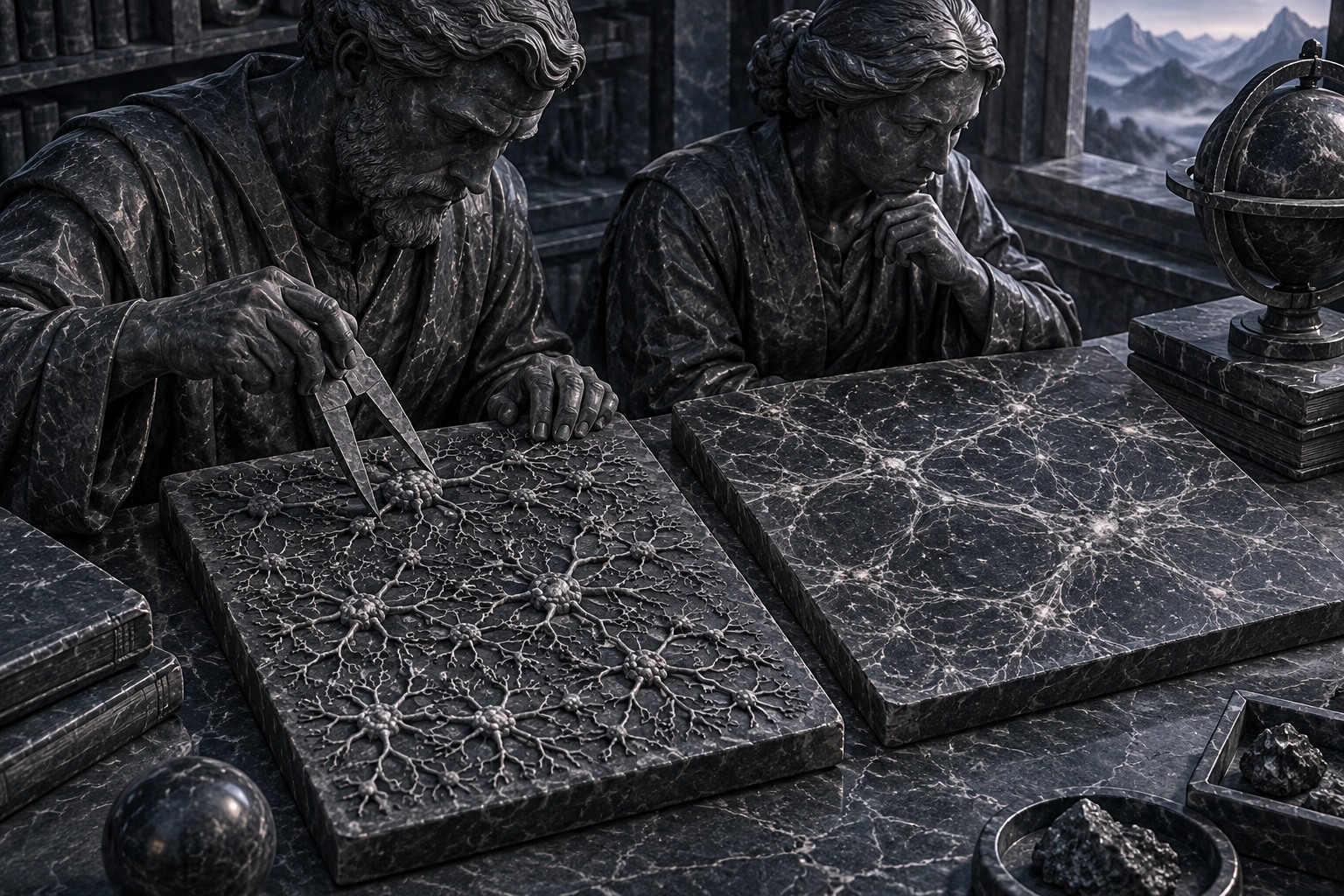
Two images appear side by side: branching brain structures and filaments of the cosmic web. Recognition feels powerful. Could humanity repeat the universe's arrangement, and could the universe think? Similarity has indeed undergone quantitative research, but the relationship investigated is much narrower. This article examines Franco Vazza and Alberto Feletti's work, distinguishing node arrangement, actual connections, dynamics, and function. We then turn to Plato and Maxwell. The first reveals a philosophical image of a living cosmos with its own grounds; the second helps explain why identical mathematical relationships can occur despite different physical natures. Their comparison supports a practical skill in reading analogies. Beautiful form can remain an invitation to question without acquiring permission to determine the answer beforehand. The essential task is identifying what was compared and avoiding extension of one similar feature to an entire system.
I. Recognition comes before clarification
Images sometimes persuade faster than sentences. We see dense nodes, thin filaments, empty spaces, and almost immediately feel we face one order at different scales. This impression requires no knowledge of how images were produced. That makes it both fruitful and vulnerable. It notices a possible connection before checking which connection is available at all.
Imagine a tree photograph beside a family diagram. Branches and branching resemble each other. The analogy helps represent several generations' origins. Yet leaves are not a tree's children in the sense that children belong to a family; seasonal cycles do not repeat biographies. The useful relationship survives when similarity is not made total.
Brain and cosmos offer stronger temptation. Both concern questions difficult to encompass through ordinary experience. One concerns our understanding itself, the other humanity's place in a vast world. A recognizable picture promises to shorten their distance. The unfamiliar universe seems more closely related, and an individual receives apparent confirmation of belonging to the whole.
This human significance need not be mocked. An image can prompt reading, investigation, and discussion of scales and connections. Significance for a viewer, however, differs from a measurement's content. A feeling of closeness does not mean researchers measured humanity's closeness to the universe or the universe's capacity to experience its existence.
The first useful question is simple: what does each half depict? A specimen, model, reconstruction, density map, or artistic illustration? What was made comparable? Which features remained outside? These questions retain recognition while turning it from a ready answer into inquiry's beginning. Wonder remains, connected now with an object that can be specified rather than only a confident feeling of resemblance.
II. Research compares specially prepared representations
In Vazza and Feletti's 2020 work, images of histological sections of human cortex and cerebellum were compared with thin sections of a simulated cosmic web. The authors used statistics describing structure across scales and some graph measures. The cosmic side involved numerical modeling rather than a photograph of the entire universe; the neural side involved small samples rather than a complete brain map.
This preparation is necessary for comparison, rather than a defect making the work meaningless. Quantitatively comparing different subjects requires defining a shared form of description. Microscope magnification and cosmological-model scale do not coincide by themselves. Researchers choose relationships considered comparable. Conclusions must nevertheless remain connected with that procedure.
Suppose you compare two city plans, reducing one diagram, enlarging another, and identifying intersections and roads. Similar intersection density may emerge. Travel times, transportation systems, and residents' behavior have not yet been studied. The prepared map answers a selected structural question rather than every question about a city.
Brain and cosmic images likewise are not transparent windows displaying objects without selection. They already contain methods, scales, ways of identifying structures, and comparison rules. This is no claim of arbitrariness: procedures can be described and checked. But they determine which conclusion is presented and which conclusions remain unpresented.
Scientific honesty does not require abandoning bold comparisons. It requires preserving their scope. A study may be interesting precisely because very different processes yield comparable representational features. Identical process natures need not be proved. Instead, different mechanisms make a substantive question possible: which relationships survive the transition between scales, and which disappear when we specify the objects? Research begins with resemblance and continues through distinctions.
III. Node proximity is not an operating connection
The authors' qualification matters particularly: their procedure approximated neuronal connections using spatial proximity. Complete actual connectivity was not reconstructed; long-range connections remained outside that description. Being nearby and interacting in a particular way are different features. Even a detailed arrangement image cannot replace a map of every relationship.
Imagine an apartment building. Two neighboring households never speak, while someone across the city helps one daily. A network based on distances between doors maps adjacency. A network based on regular help maps something else. Both can correctly answer different questions. Error enters when one quietly replaces the other.
A network requires an edge definition: what does a drawn line mean? Proximity, direct connection, signal transmission, joint activity, agreement, or convenient display? Without a definition, “connection” produces more certainty than knowledge. A beautiful diagram invites many readings; research chooses a particular one.
In The Human Connectome, 2005, Sporns, Tononi, and Kötter propose describing neural elements and connections together with physiological parameters. This is a historical structural-description project, rather than a completed present-day map. The relevant principle is that a line alone does not specify direction, strength, delay, and other properties important to a process.
Similar nodes therefore cannot establish similar thinking in one step. Operating relationships, their changes, and what they support must first be demonstrated. This is additional work rather than a formality preceding a known answer. It can reveal new similarities and differences the initial diagram hid. The stronger our desire for shared life across two networks, the more important the reminder: a graph stores the relationships supplied to it, not every meaning a viewer might assign.
IV. Shared language helps compare while reducing the object
Mathematical language can separate a relationship from familiar surroundings. A graph can represent routes, acquaintances, or device components. We can ask how many neighbors a node has, how interconnected they are, and where groups arise. Abstraction deliberately excludes much of what distinguishes these objects.
In his 1870 address, Maxwell describes this possibility: mathematical forms of relationship can coincide although quantities differ physically. Knowledge in one science can consequently help another. Shared form supports inquiry without requiring the compared quantities to be one substance.
If a bus-route diagram resembles a friendship network, route accessibility can be investigated in both graphs. Talking with a friend does not thereby become passenger transport. An edge represents transport connection in one case, human relationship in the other. Identical form alone cannot establish whether acquaintance is mutual, conversation safe, or a meeting welcome.
Losing detail can be an advantage when suited to the question. A driver's biography is unnecessary for calculating transfers. Biography and circumstances may matter for understanding conflict. Generalization cannot be judged merely good or bad: ask what it lets us discover and which task it serves.
In brain-cosmos comparison, shared language makes an impression checkable through selected features. It reduces the objects for that check. Forgetting the reduction and assigning the resulting diagram all content of the original systems turns advantage into error. We read the model as though it preserved precisely what was deliberately excluded.
A useful skill involves two movements. Let abstraction reveal a relationship hidden by detail, then return to the subject and check what it means there. Mathematics becomes a way of asking more precise questions rather than a seal of universal identity. Different physical natures do not invalidate learning through formal resemblance.
V. Function cannot be read from contours alone
Similar objects can perform different work. Window mesh blocks insects, road networks enable movement, acquaintance networks help negotiation or create pressure. An external pattern selects no common function. Establishing function requires examining process, conditions, consequences, and sometimes whose purpose is served.
“Memory” is especially easy to expand. It can mean retaining traces of a previous state, storing records, retrieving information, or personal recollection. These meanings may connect substantively without becoming identical. A physical system retaining information about its past does not thereby provide an account of experienced remembering.
Consider a scratched stone, call log, and person remembering a conversation. Each relates to the past. The stone does not reread a scratch as a personal meeting; the log reports no feeling; a person can revise their understanding of lived events. A shared capacity to retain some trace does not exhaust these differences.
Claims of a conscious cosmos need the same distinction. Even research describing complex organization must separately define what counts as consciousness and which observation establishes its presence. A structural measure does not acquire that power because viewers find complexity impressive. Replacing “structure” with “experience” cannot preserve the same justification.
The consciousness question need not be prohibited in advance. Philosophical positions and research hypotheses can be proposed, provided status and additional premises are identified. Scientific comparison of forms does not prove the whole position. It can supply one reason to discuss it, rather than a completed answer.
The distinction also matters closer to home. Calling a team a living organism may reveal interdependence, but does not authorize managers to treat people as body parts lacking independent goals. Extending functions and meanings has consequences. Check an analogy's boundary before it becomes an argument about how to act.
VI. Plato's living cosmos has its own grounds
Timaeus describes the cosmos as a living being possessing soul and intelligence. The image develops through reasoning about a good maker, order, and a model, rather than comparing neurons and galaxies. Plato offers a philosophical cosmological account. Reading it as a caption for contemporary visualization loses his actual argument.
Substantive dialogue begins by restoring difference. The ancient text asks why an ordered world is better than disorder and how intelligence relates to soul. The modern study concerns selected statistical features of prepared representations. Both discuss the world through different means and answer different requests.
Readers may feel contemporary resemblance confirms ancient wisdom. That conclusion requires identifying which ancient propositions were tested. Does comparison investigate the maker's goodness, world-soul, or original-image relationship? If absent, confirmation has been assigned by impression rather than established through a matching question and result.
Instead ask what a living-whole image changes in human attitudes. Does it encourage care rather than mere use? Which arguments support care independently of the image? How can distinct living beings be retained when the world is one whole? These questions continue philosophy without making it early neuroscience.
An ancient text need not win a contemporary experimental dispute to deserve reading. It can reveal a way of constructing broad explanations, tension between order and change, and a narrator's degree of confidence. We can accept some premises and discuss others. Readers retain freedom.
Using Plato only as old confirmation of a beautiful picture reduces philosophy to a slogan. Preserve two grounds side by side: form research and reasoning about the whole. Their encounter may produce another question, but no completed shared answer follows yet. The absence of a predetermined identity makes comparison substantive.
VII. Similarity can generate a checkable question
Rejecting a broad conclusion does not mean an analogy gave us nothing. It can identify a feature to measure, a difference to test, or a new descriptive method. The route from image to knowledge begins when impression becomes a question permitting an unexpected answer.
Suppose two diagrams display dense groups and sparse transitions. We can ask whether grouping matches on a chosen measure, then whether changing node definitions changes the answer. A procedure-dependent reversal is an important result about comparison's conditions. If some similarity persists, grounds emerge for investigating further.
Identify beforehand what might weaken the guess: another scale, sample, omitted connections, or a control object unexpectedly giving the same measure? Readers need no complicated formulation. The point is preventing a result from becoming invariant regardless of checking.
Imagine comparing two teams through organization charts. Both show one leader and several departments. Next ask how decisions actually move. One department obtains approval for every detail; another acts independently. Similar pictures concealed an important difference. The initial analogy remained useful by framing the next clarification.
Network research can likewise matter without promising cosmic intelligence. It finds a specific similarity and shows what available description excludes. Further inquiry depends on expanding objects, preserving comparability, and retaining mechanism differences. The open question is substantive itself.
Readers may follow this work without choosing a metaphysical side beforehand. Comparative approaches can be recognized as interesting while unsupported extensions are rejected. Seeing a question's fruitfulness does not mean its first impressive answer exhausts it. Knowledge retains room to surprise, including through discovered dissimilarity.
VIII. A partial result easily becomes a story about everything
Expansion follows a short ladder. First, images share features. Then, systems are organized identically. Next, they perform the same work. Finally, the universe is conscious and humanity its miniature copy. Every transition adds a claim. Without added grounds, the final conclusion rests much more weakly on the initial image than it appears.
A similar ladder concerns people. Several sharp replies become observed behavior, stable character, an explanation of an entire life, and finally a prediction that conversation is pointless. Some conclusions may prove correct, but their expansion requires checking. Several messages contain no completed biography.
The analogy concerns inference form. A specific feature gains permission to speak for the whole. Notice where that permission arose. Additional information sometimes justifies it. Sometimes confident tone and repetition of an attractive image supply everything.
Rewrite the ladder as separate sentences and ask what observation supports each. Not everything needs a laboratory answer; philosophy can proceed through argument. A measurement reference, however, cannot remain in place once the subject has become entirely different. A reference should accompany its claim rather than every story following it.
This also prevents the reverse error. Unconfirmed cosmic consciousness does not invalidate the comparative finding. A broad conclusion may be excessive while a partial similarity was investigated. Criticism should stop at the insufficiently grounded transition.
Precision makes discussion less combative. Form measures, mechanisms, functions, and philosophical significance can be discussed separately. Disagreement on one point need not destroy all interest. People can revise particular beliefs while remaining curious, without defending every detail of a favorite grand story as part of their identity.
IX. Belonging does not require identical arrangements
Why do we want to see the brain within the cosmos? Sometimes we want to belong rather than feel an accidental isolated point. A similar pattern offers a quick answer: you are arranged like the whole. Yet belonging need not rest on structural repetition. We can share history and conditions while retaining our own forms and possibilities.
People depend on air, water, other living beings, work, and language. These are varied relationships rather than one filament type. Each can be investigated: what supports life, enables decisions, or permits joint action? Different relations do not abolish connection; they make it substantive.
Imagine an ensemble. Violin, voice, and percussion differ while participating in one performance. Calling them miniature copies of the conductor would erase their cooperation's basis. Belonging lies in coordinating different capacities. This analogy concerns human participation, not cosmological modeling. Unity need not demand sameness.
The image's scientific boundary need not produce emotional loss. Wonder at worldly diversity can survive and deepen when connection arises through real differences rather than erasure. The question becomes which relationships join what differs, rather than why everything is one brain.
For practical care this may matter more. Recognizing someone within a whole does not remove their disagreement. Universal networks cannot cancel autonomy. Connection can create responsibility for consequences without permission to decide on someone's behalf.
A good analogy reveals relationships while letting participants differ. A poor analogy absorbs differences, making them mere appearances. Brain-cosmos comparison then concerns our thinking about unity beyond spectacular pictures. We can desire a shared world without requiring it to repeat human consciousness at immense scale.
X. Wonder grows more precise when we return to the objects
After comparing, look at each half separately again. What did we learn about brains? About the simulated cosmic web? Which shared question arose? Which attractive assertion stayed outside? Returning retains the encounter while checking whether common form concealed its subjects.
Reading can resemble translation. A translator conveys a relationship in another language while tracking lost meanings. Exact correspondence may be absent; commentary may be needed. Comparing sciences likewise requires attention to what transfers and remains. Without it, translation replaces one subject with another.
Maxwell's formal-similarity insight helps here. Shared mathematical relationships permit transfer of investigative methods. Different physical natures require returning to objects. Keeping only the first produces broad overreach; keeping only the second removes comparative learning. We need both possibilities together.
Readers need not reproduce every calculation to read attentively. Begin with accessible distinctions: image provenance, data type, connection rules, scale, and conclusion's subject. This supplies no full expertise, but protects against the simplest substitution—presenting an investigated feature as an entire object.
A check may make an image less appealing, or more interesting when a subtler question emerges behind a loud headline. Both involve independent reading. Neither admiration nor debunking was obligatory beforehand; clarification could change your response.
Philosophical questions may remain open: is the cosmos alive, what counts as consciousness, how should humanity's place be understood? Each has its own approaches. Form comparison can enter without answering everything. This limit brings freedom: new results can support, refine, or weaken particular ideas, while wonder need not depend on every resemblance becoming final proof of unity.
What this means in practice
Next time images are compared, read captions first. Photographs, sections, simulations, and artistic diagrams relate differently to objects. “Brain” may conceal a small tissue sample; “universe” a numerical model. Clarification does not worsen an image, but changes legitimate inference's scope.
Identify one similar feature without grand interpretation: dense groups joined by elongated structures, for example. Ask how resemblance was evaluated. If only impression is available, label it so. If measurement exists, find its definition and methodological limit.
Separate mechanism, function, and personal significance. An answer about one does not settle another; personal meaning replaces neither scientific question. Feeling connected with the world need not confirm a preferred cosmological hypothesis.
Apply this attentiveness to speech. Calling a team the project's brain should clarify information coordination, decision-making, and the right to object. An image helps while preserving actual roles and autonomy. Sometimes retain the metaphor afterward; sometimes replace it with direct description.
Discussion of a beautiful image need not immediately debate universal consciousness. Begin with shared interest: what was compared, and what should be learned next? Hear personal belonging separately from a scientific account of its cause. This preserves relationship and precision. Thinking together does not demand immediately accepting one mechanism for everything. Inquiry begins when resemblance receives another question rather than the last word.
Key quotation
“the physical nature of the quantities may be utterly different”
James Clerk Maxwell, address to the Mathematical and Physical Sections of the British Association, Liverpool, September 15, 1870; short fragment checked against the text.
The context concerns matching mathematical forms of relationship. This qualification preserves analogy's usefulness without making compared objects identical.
Connections between traditions
| Comparison | Substantive connection | Limit |
|---|---|---|
| Maxwell and comparative network research | Formal language investigates relationships in systems of different natures. | Shared mathematical description does not establish one physical mechanism. |
| Timaeus and cosmic web | Both can prompt questions about the whole's arrangement. | Plato's living cosmos follows philosophical premises, rather than histology and numerical modeling. |
| Connectome project and proximity comparison | Defining connections determines what a network stores. | Node adjacency does not replace physiological properties and long-range connections. |
| James on experience and brain images | Structure and experience descriptions can enter a broader human question. | Images or similar topology alone do not establish another system's experience. |
Primary sources and research
- Vazza, Franco; Feletti, Alberto. “The Quantitative Comparison Between the Neuronal Network and the Cosmic Web.” Frontiers in Physics 8, 2020, 525731. Full text, DOI 10.3389/fphy.2020.525731. Abstract, methods, network analysis, and limitations discussion were read. Approximating connections through spatial proximity is the main relevant boundary.
- Sporns, Olaf; Tononi, Giulio; Kötter, Rolf. “The Human Connectome: A Structural Description of the Human Brain.” PLOS Computational Biology 1(4), 2005, e42. Text, DOI 10.1371/journal.pcbi.0010042. Project formulation and “Scales and Levels of Structural Description” were used; the project's 2005 status is not projected into the present.
- Maxwell, James Clerk. “Address to the Mathematical and Physical Sections of the British Association,” Liverpool, September 15, 1870. In Five of Maxwell's Papers. Discussion of quantity classification and formal resemblance was read; the quotation belongs to that discussion.
- Plato. Timaeus, 27d–30b. Benjamin Jowett's translation, Internet Classics Archive. Reasoning about the cosmos and probable narration's status was used; epigraph at 29d.
- James, William. Psychology: Briefer Course, 1892, chapter XI. Text. Historical experiential description compares levels, rather than confirming cosmic consciousness.
Tags
brain, cosmos, cosmic web, neuronal network, form, analogy, graph, node, connection, proximity, connectome, scale, image, section, simulation, dynamics, function, memory, consciousness, Vazza, Feletti, Maxwell, Plato, Timaeus, living cosmos, mathematical description, inference limits, unity, difference, belonging, independent reading.
About the authors
Andrey Zarinsh is the author and founder of United Wisdom. He explores inner transformation, the unity of traditions, intercultural dialogue, and contemporary spiritual discipline. Instagram: @andrey.zarinsh.
Maria Evilkut is a coauthor of United Wisdom. Alongside her research, she seeks to test these ideas in practice and observe how principles of unity and mutual understanding work in real life between people and cultures. Instagram: @ilkutki.
Keep what resonates with you.