
Traditions and Worldviews
A Galaxy in the Cranium: Why Similar Pictures Do Not Make the Universe a Thinking Bowl of Aspic
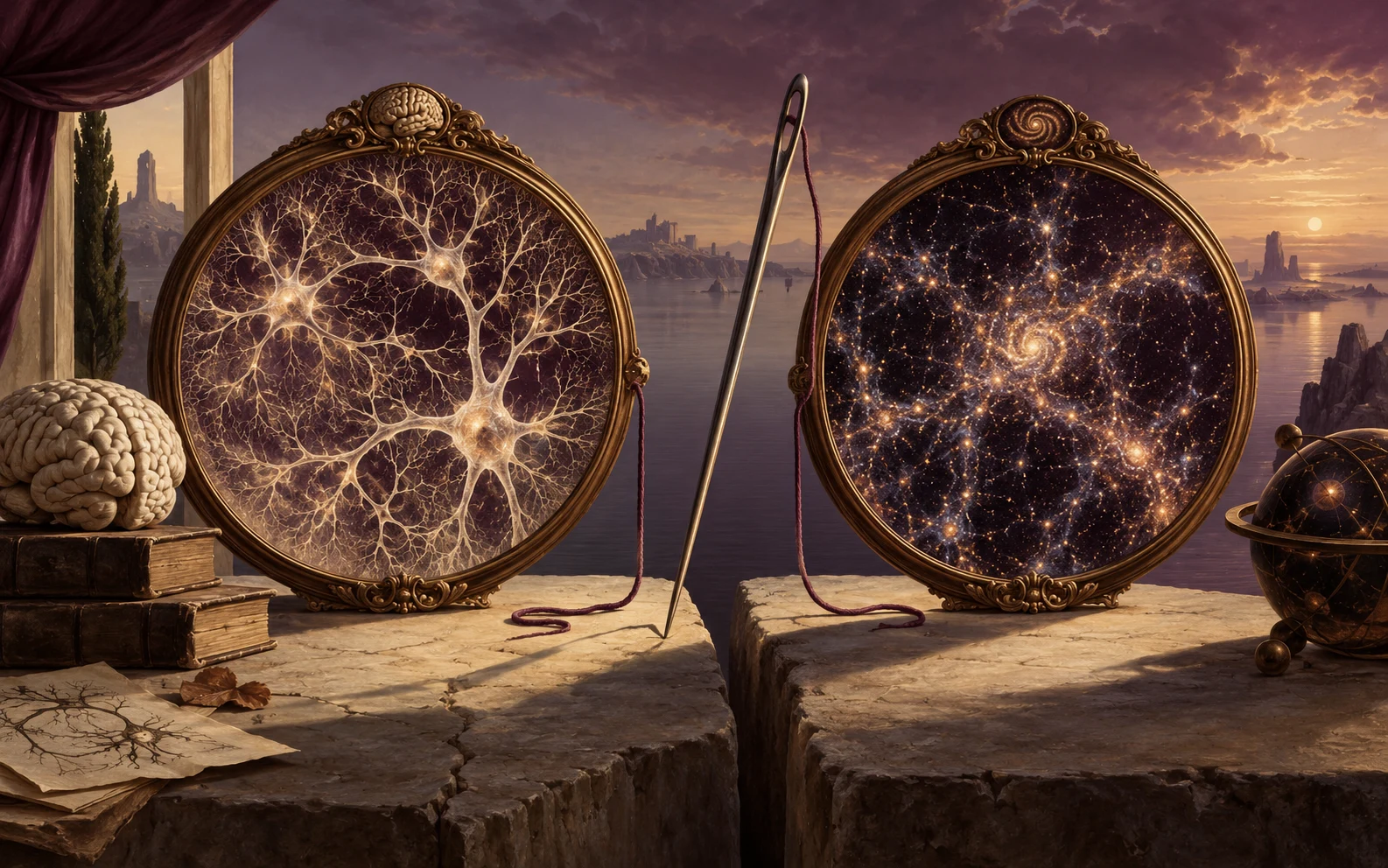
The internet loves visual hypnosis: place a microphotograph of neurons on the left, slap a render of cosmic filaments on the right, and presto!
Epigraph
“We ought to accept the likely story.”
Plato, Timaeus, 29d; rendered into English via the Russian text, based on the English version by Benjamin Jowett, dialogue text.
In Timaeus, this phrase is an honest acknowledgment of the modest status of his own cosmological myth, rather than a carte blanche for online philosophers to substantiate any wild conjecture with a pretty collage.
What This Article Is About
The internet loves visual hypnosis: place a microphotograph of neurons on the left, slap a render of cosmic filaments on the right, and presto! “We are stardust, and the Galaxy thinks through us!” In such an ecstatic retelling, it is all too easy to miss what physicist Franco Vazza and neurosurgeon Alberto Feletti actually wrote about. The real research is far more modest and sober: it compares very specifically prepared slices, not acts of thought. Below, we examine why the geometric resemblance of graphs does not endow nebulae with consciousness, why Plato conceived of a living cosmos without the aid of microscopes, how James Clerk Maxwell warned against confusing a formula with a physical essence, and why searching for the unity of the world does not require turning your next-door neighbor into a mute cell of a single super-brain.
I. The Wow Factor Outruns the Brain Turning On
A familiar shape can seduce one into a hasty conclusion: we spot a bundle of threads and a couple of glowing spheres, and the urge arises to exclaim, “Why, they are identical!” Images are difficult to argue with; they strike straight at emotion long before the critical apparatus engages.
Consider a stylized domestic scene: you place a photograph of a sprawling oak tree next to your family tree chart. Branches bifurcate, trunks divide—a striking depth of resemblance! Yet if we were to take the logic of online enthusiasts literally, your children would be required to photosynthesize in spring, while your grandfather would shed his leaves and demand a top-dressing of cow manure. In genealogy, the image of a tree remains useful so long as we keep its conventional nature in mind. The moment we start hacking at relatives with an axe for firewood, the metaphor snaps with a resounding crack.
With the brain and the cosmos, the temptation to slip into a trance is stronger still: one object hides inside the skull, while the other looms billions of light-years above it. Joining them in a single frame makes one immediately feel like an essential component in a cosmic drama rather than an accidental bipedal primate perched on a speck of dust.
In itself, it would be foolish to mock this profound human experience—it is poetic and helps lift one's gaze above mundane squabbles. Something else entirely deserves sarcasm: passing off a sacred reverence for shape as a rigorously measured scientific fact. If an image gave you goosebumps, that reflects your emotional impression, not that the authors of the paper documented mental activity in the Virgo Cluster. Before dissolving into the cosmos, ask three tedious questions: what exactly is depicted (a real organ or a computer calculation)? What was adjusted to fit the same scale? And what miles of fundamental differences were simply tossed beyond the eye-catching frame?
II. The Scale Game: Comparing Cutouts, Not Things
In the 2020 study by Vazza and Feletti, nobody placed the Universe under a microscope, nor did anyone scan the cranium through a telescope. The researchers took razor-thin histological slices of the human cortex and cerebellum and compared them with slices of a numerical computer simulation of the cosmic web. To reiterate for clarity: not a Hubble telescope photograph, but a simulation; not a living, thinking brain in dynamic action, but fixed histological preparations of minute tissue samples.
This is entirely standard research methodology, not charlatanism. One cannot directly compare the incommensurable: you are dealing with vastly different spatial metrics, different physical processes involving gravity and electrochemistry. One must deploy the scissors of abstraction, normalize scales, reduce densities to dimensionless statistical distributions, and analyze power spectral density and graph properties.
Imagine a stylized urban planning exercise: you take a map of ancient Roman alleys and a schematic of blood capillaries from a fingertip, rescale both to fit a single drawing sheet, and marvel that the density of forkings matches. Does this mean gladiators race chariots through your capillaries, or that blood platelets congregate inside the Colosseum? No. You have examined the branching geometry of channels within defined bounds, not the logic of urban traffic or the biological properties of erythrocytes.
The paper by Vazza and Feletti is valuable precisely for its careful inquiry: what similar geometric patterns can emerge across disparate media under the influence of fundamentally different physical forces? But for this question to remain scientific, the boundaries of the chosen method must be explicitly stated.
III. The Neighbor Down the Hall Is Not Your Best Friend: Why Geometry Lies About Connections
The chief methodological caveat in Vazza and Feletti’s work—the very rock on which esoteric raptures founder—is that network edges in their neuronal model were established purely by basic spatial proximity rather than reconstructed physical wiring.
Consider another stylized scene: the landing of an apartment building. Living right behind the thin wall is a sullen man in trackpants. You are situated roughly five feet apart through concrete, yet over twenty years you have never exchanged so much as a polite greeting. Meanwhile, every evening you spend hours on calls exchanging gigabytes of project files with a colleague sitting in Vladivostok or Pattaya. If a topologist draws a network graph strictly based on distance between front doors, you and the sullen neighbor appear as an immensely tight, monolithic cluster. In reality, no connection exists there—only a blank wall.
In an actual brain, what counts is not merely physical closeness, but short and long axonal pathways, synaptic strength, neurotransmitters, and precise signal timing. In the programmatic 2005 paper “The Human Connectome”, Sporns, Tononi, and Kötter outlined the challenge of mapping the connectome: accounting for elements, their real physiological parameters, directionality, and intensity. Notice: this was a manifesto and a research proposal, by no means an announcement that the brain's exhaustive wiring diagram had already been completed and filed away in an archive.
If a graph is constructed merely on the rule of “whatever is spatially adjacent gets connected,” it reflects packing density, not signal transmission. Jumping from geometric node similarity to a “shared mind” is like declaring a dry bundle of spaghetti to be a supercomputer simply because the noodles lie parallel to one another.
IV. Mathematics Tolerates Everything: Shared Formulas Under Divergent Physics
Mathematical formalism is marvelous because it does not care in the slightest what it computes: debt ledgers, sheep, dark matter distributions, or glial cells. It strips away an object’s physical flesh, leaving behind a bare skeleton of relations. Yet for this universality, one must pay by attending separately to physical context.
The great James Clerk Maxwell, in his address to the British Association in 1870, pointed out this very paradox: the mathematical forms of equations can be entirely identical for phenomena whose physical nature may substantially differ.
If we imagine that a transit district's bus route graph coincides with the network topology of rumors traveling through a convent, that does not imply the bus conductor transports passengers through the power of gossip, nor that the nuns subsist on Euro-5 diesel fuel. A formal analogy is useful for computing network resilience against disruptions. But the moment you lose sight of the reduction, the mathematical method turns into an absurdity mill.
The comparison between brain and cosmos holds value strictly as long as we remember: the selected statistical measures allow us to compare structural patterns arising from disparate physical processes. They do not turn dark matter into the protein tubulin.
V. Don't Judge by the Outline: Why Chain-Link Fencing Catches No Thoughts
External shape alone does not define an object’s purpose. A chain-link fence in a garden, a fishing net in a river, and a neural network trained to recognize kittens share a similar cell-like topology. Yet try catching a bucket of carp with garden fencing, or protecting a strawberry patch from neighboring hens using a machine learning algorithm.
Manipulations involving the word “memory” appear especially comical. Physical memory in the form of plastic deformation is the dent left by a hammer on a copper basin; flash drive memory is the distribution of charges across memory cells; human memory is a dynamic, emotionally laden, continuously reconstructed process of personal experience. A dented cooking pot certainly “remembers” falling off the table, but it does not indulge in nostalgia on rainy evenings, nor does it visit a therapist to process the trauma of impacting the linoleum floor.
The same applies to the “conscious Universe” hypothesis. To declare the cosmic web thinking, it is not enough to present a graphic showing similar clusters. One must rigorously define what consciousness is, what physical markers confirm its presence, and what empirical test could differentiate this hypothesis from alternatives. Substituting the phrase “complex topology” with “cosmic mind” is a sleight of hand, not a scientific breakthrough.
In daily life, this fallacy crops up constantly: in a stylized workplace scenario, a department head proclaims that “our team is a single living organism,” only to demand selfless martyrdom from employees for “the good of the liver,” utterly ignoring that workers are autonomous individuals with families and payroll accounts, not white blood cells manning the barricades.
VI. Plato’s Timaeus: A Philosophical Myth Is Not a CT Scan Blueprint
Enthusiasts eager to uncover ancient prophecies in every modern science paper adore quoting Plato’s Timaeus (passages 27d–30b): look, they say, the great Greek thinker knew two and a half millennia ago that the cosmos is a living, ensouled creature!
Let us restore historical integrity. In Plato’s work, the cosmos is not ensouled because the philosopher peered into an electron microscope or computed an N-body gravitational simulation. His reasoning rests upon classical speculative metaphysics: there is a benevolent Craftsman (Demiurge), order is intrinsically superior to chaos, an intelligent whole is regarded as more excellent than an unintelligent one, and intelligence, by these premises, cannot exist apart from soul; hence the Craftsman places intelligence within soul, and soul within the body of the cosmos. This is a coherent philosophical cosmology with its own strict premises, not an ancient alien encounter or clairvoyance into cerebellar tissue slices.
Plato himself honestly delineates his parameters in 29d: what we have before us is a “likely story” (eikôs mythos)—a probabilistic myth, a narrative accompanied by a caveat concerning the limits of human precision when evaluating the becoming, physical world. Turning refined Hellenic cosmology into an illiterate caption for an article from Frontiers in Physics does violence both to ancient philosophy and modern scientific method.
Plato’s text remains remarkable for its internal coherence: it sets an ethical stance toward the whole, contemplating harmony and proportion. But attempting to defend an astrophysics dissertation by citing the Demiurge is just as preposterous as treating appendicitis with Socratic dialogues.
VII. Not a Reason for a Cult, but an Opportunity for Measurement
If we decline to assert a cosmic supermind on the basis of a single matching graphic, does that mean the work of Vazza and Feletti is useless? By no means. The beauty of science is that sobriety does not kill curiosity; it channels it into testable waters.
Instead of ecstatic social media posts, morphological resemblance offers an excellent research impetus: why do such vastly disparate systems exhibit shared traits across selected morphological and network metrics? What happens if the sampling scale is varied? What occurs if node failure is modeled—will both networks respond identically under critical breakdowns? And if we introduce a control specimen—say, the foam in a glass of beer or parched clay in a desert—might they yield the same distribution statistics?
A stylized everyday parallel: consider two corporations sharing an identical organizational chart in human resources—a CEO, three vice presidents, five line managers. On paper, they are twins. Yet in one outfit, any operational decision takes three months to clear through mountains of memos, while in the other, staff resolve problems within five minutes via instant messaging. The chart provided a starting point for comparison, but the true reality was revealed only by analyzing actual dynamic processes.
Scientific interest in network analogies endures without any obligation to acknowledge galaxies as thinking entities. An open question is valuable in its own right: it affords nature the opportunity to genuinely astonish us with novel mechanisms of material self-organization, rather than prematurely validating a favored hypothesis.
VIII. The Slippery Slope of Grand Overgeneralization
The human mind harbors an unfortunate habit of constructing monumental castles atop a single grain of sand. The ladder of this intellectual inflation looks disquietingly uniform:
-
Fact: On specifically prepared slices of a cosmic simulation and tissue slices of the brain, similar morphological and statistical characteristics are identified.
-
First Leap: “These two systems are organized upon an identical principle!”
-
Second Leap: “They serve the same function!”
-
The Grand Finale: “The Universe is a gigantic thinking brain, and man is its holographic cell!”
Observe: empirical data supported only the initial step; everything thereafter was pure poetic escalation unsupported by a single shred of new proof.
In mundane life, we perform the exact same acrobatics. A stylized scenario: a new colleague walks past without greeting you in the hallway (a fact). A minute later, you decide he is an arrogant boor (generalizing behavior). By lunchtime, you have attributed to him a shady criminal record (invented biography). By evening, you are advising the entire department to avoid him like the plague lest he burn the office down (sweeping forecast).
When reading science, it is vital to check oneself at every flight of stairs. Ask: to which specific step does the empirical citation actually point? If Vazza and Feletti write about the power spectrum of density fluctuations, their authority cannot be invoked to justify telepathic communication with quasars. At the same time, tossing the paper into the trash simply because of overexcited readers is equally unjustified: the specific finding remains sound research within the bounds of its method.
IX. Harmony Without Cloning: Why Humans Ought to Remain Distinct
The motif of a “cosmic brain” may appeal to an individual who finds it difficult to feel like an insignificant speck amid cosmic emptiness. This is a possible personal reading, not an explanation of what motivates every proponent of the hypothesis. A graphic of resembling neurons provides sweet solace: “I am not alien; I am a microcosm of Everything!”
Yet why must unity invariably demand mindless structural duplication?
Picture a jazz quartet: the saxophone doesn’t panic and sprout strings out of jealousy toward the double bass, nor does the drummer stuff his kick drum with piano hammers to look more sophisticated. The music actually works not because everyone is cloned in the conductor’s image, but because radically different voices figure out how to lock in together, knowing precisely when to shut up and make room for the groove. It’s not some grand cosmological proof, just a grounded human analogy: unity doesn’t require turning everyone into identical carbon copies.
A human being is integrated into the Universe not because their neurons mimic galaxy cluster filaments. We are woven into the world through respiration, metabolism, gravity, cultural language, and collaborative labor with fellow human beings. This tangible, earthly interconnection is far richer than a primitive visual rhyme.
Furthermore, brandishing a mystical “universal network” can be socially perilous: by declaring everyone “cells of a single organism,” individual autonomy is easily crushed underfoot. Why care about what you desire, after all, if the cosmic brain has already determined everything? Absolutely not: interconnection fosters ethical responsibility for one’s actions, but bestows no right to cancel the liberty and boundaries of others.
X. A Sober Perspective: Returning to Reality
After a session of debunking analogies, it is healthy to return to the source objects and view them without rose-tinted glasses. What do we have left in the final tally?
We have the human brain with its nerve cells and connections. And we have the large-scale cosmic web, in whose formation gravity plays a role. The shared morphology of chosen images does not erase the differences between these phenomena.
We can admire how mathematical tooling allows us to characterize such vastly different phenomena within a single language of equations. As Maxwell reminded us, a shared mathematical form paves the way for transferring methods across disciplines. But the divergence in the physical nature of these objects demands an immediate return to reality the moment calculations conclude.
The ability to stop in time and refrain from projecting one’s thoughts onto the cosmos is a hallmark of intellectual hygiene. You can reflect in awe upon the mystery of existence, revisit Plato or William James meditating on the phenomenology of consciousness, without being compelled to turn a paper in computational astrophysics into a brand-new religion. Genuine wonder before the world begins where cheap illusions of identity dissolve, opening up space for real inquiry.
What This Means in Practice: Voluntary Options for Action
The next time your newsfeed detonates with a headline along the lines of “Scientists Prove the Cosmos Thinks Just Like Our Brains!”, you may entirely voluntarily choose one of the following steps:
-
Option 1: Examine the image credentials. Take the trouble to read the full caption beneath the illustration. Clarify whether you are looking at artistic concept art, an actual optical photograph, electron microscopy of a tissue slice, or the result of a numerical simulation. This inquiry clarifies what is actually being compared.
-
Option 2: Register pure geometry without metaphysics. State the resemblance as dryly as possible: “nodal structures connected by filamentary bridges.” Ask yourself: does this convey anything beyond the observation that selected images show similar configurations?
-
Option 3: Separate mechanism, function, and emotion into different corners. Remind yourself that an electrochemical action potential along an axon and the gravitational collapse of a hydrogen cloud represent fundamentally distinct physical mechanisms. A subjective impression of kinship with the cosmos can remain your personal poetic experience without needing validation from peer-reviewed journals.
-
Option 4: Test your own metaphors for autonomy. If you catch yourself uttering phrases like “our venture is a single neural network and we are its nodes,” examine whether this elegant metaphor is being used to excuse someone’s negligence, dilute individual accountability, or infringe upon the personal boundaries of colleagues.
-
Option 5: Engage in dialogue without fanaticism. When discussing such publications with friends, there is no need to instantly brand your interlocutor an obscurantist. Inquire calmly: “Visually, the pictures do look alike. But what specifically do you think the scientists measured, and where does the boundary of that analogy lie?” This maintains both human warmth and clarity of thought.
Key Quote
“The physical nature of the quantities may be completely different.”
James Clerk Maxwell, Address to the Mathematical and Physical Sections of the British Association, Liverpool, 15 September 1870; rendered into English via the Russian text, based on the original address.
Back in 1870, Maxwell was already poking fun at every theorist’s favorite trap: just because two equations share the exact same mathematical outfit doesn’t mean they’re the same creature underneath. Borrowing sleek formulas from a neighboring science is wonderfully convenient, but just because fluid dynamics neatly mirrors an electromagnetic field doesn't mean your high-voltage cable has turned into a leaky copper pipe. The math might match right down to the decimal point, but that won't turn your plumber into an electrodynamicist.
Connections Across Traditions
| Comparison | Substantive Connection | Limitation |
|---|---|---|
| Maxwell and comparative network analysis | The formal language of graphs and statistics allows analysis of complex structures of fundamentally different nature. | Mathematical equivalence of equations does not prove a shared physical or biological mechanism. |
| The Timaeus and the cosmic web | Both conceptions address the orderliness of the whole; this shared question does not establish teleology in the cosmic web. | Plato’s image of an ensouled cosmos is derived from speculative metaphysics, not brain histology or dark matter simulations. |
| The connectome project and proximity-based comparison | An attempt to formalize the architecture of complex information systems using topological graphs. | Basic geometric proximity of nodes in a slice does not substitute for real physiological synapses and long-range axonal pathways. |
| James on experience and brain imagery | Consideration of the phenomenon of subjective experience and attempts to relate it to material substrates. | Neither an attractive slice photograph nor similar network topology demonstrates the existence of subjective experience or thought in a physical system. |
Primary Sources and Authors
-
Vazza, Franco; Feletti, Alberto. “The Quantitative Comparison Between the Neuronal Network and the Cosmic Web.” Frontiers in Physics 8, 2020, 525731. Full text, DOI 10.3389/fphy.2020.525731. Key study: comparison between slices of a cosmic web simulation and tissue slices of cortex/cerebellum. Chief methodological limitation: modeling neuronal connections based on geometric proximity without reconstructing functional wiring or long-range pathways.
-
Sporns, Olaf; Tononi, Giulio; Kötter, Rolf. “The Human Connectome: A Structural Description of the Human Brain.” PLOS Computational Biology 1(4), 2005, e42. Full text, DOI 10.1371/journal.pcbi.0010042. Fundamental proposal for creating a structural map of the brain taking into account physiological parameters and levels of description; the formulation of a scientific research program rather than a report announcing completion of the map.
-
Maxwell, James Clerk. “Address to the Mathematical and Physical Sections of the British Association,” Liverpool, 15 September 1870. In Five of Maxwell’s Papers. Classic reflection on the classification of quantities and formal likeness: coincidence of mathematical form does not signify identity in the physical nature of phenomena.
-
Plato. Timaeus, 27d–30b. Translated by Benjamin Jowett, Internet Classics Archive. Philosophical cosmology concerning the Good Craftsman, the paradigm, and a living ensouled cosmos; the status of a “likely story” (29d) highlights the premise-based nature of the discourse.
-
James, William. Psychology: Briefer Course, 1892, Chapter XI. Full text. Classic analysis of the stream of consciousness and subjective experience, illustrating the chasm between identifying a material configuration and establishing the presence of an act of thought.
Tags
Brain, cosmos, cosmic web, neural network, form, analogy, graph, node, link, proximity, connectome, scale, image, slice, simulation, dynamics, function, memory, consciousness, Vazza, Feletti, Maxwell, Plato, Timaeus, living cosmos, mathematical description, limits of inference, unity, difference, belonging, self-guided reading.
About the Authors
Andrey Zarinsh is an author and the founder of the United Wisdom project. He explores themes of internal transformation, the unity of traditions, intercultural dialogue, and modern spiritual discipline. Instagram: @andrey.zarinsh.
Maria Evilkut is a co-author of United Wisdom. Alongside research work, she seeks to test these ideas in practice and observe how principles of unity and mutual understanding operate in real life between people and across cultures. Instagram: @ilkutki.