
World & consciousness
Pyrrhonian Skepticism: Suspension of Judgment
Sextus’s Pyrrhonian skepticism investigates opposing grounds and suspension when they are equipollent. The article shows the connected work of the five modes, distinguishes appearance and assertion, and explains ataraxia and its limits; contemporary actions and the Madhyamaka comparison retain their own boundaries.
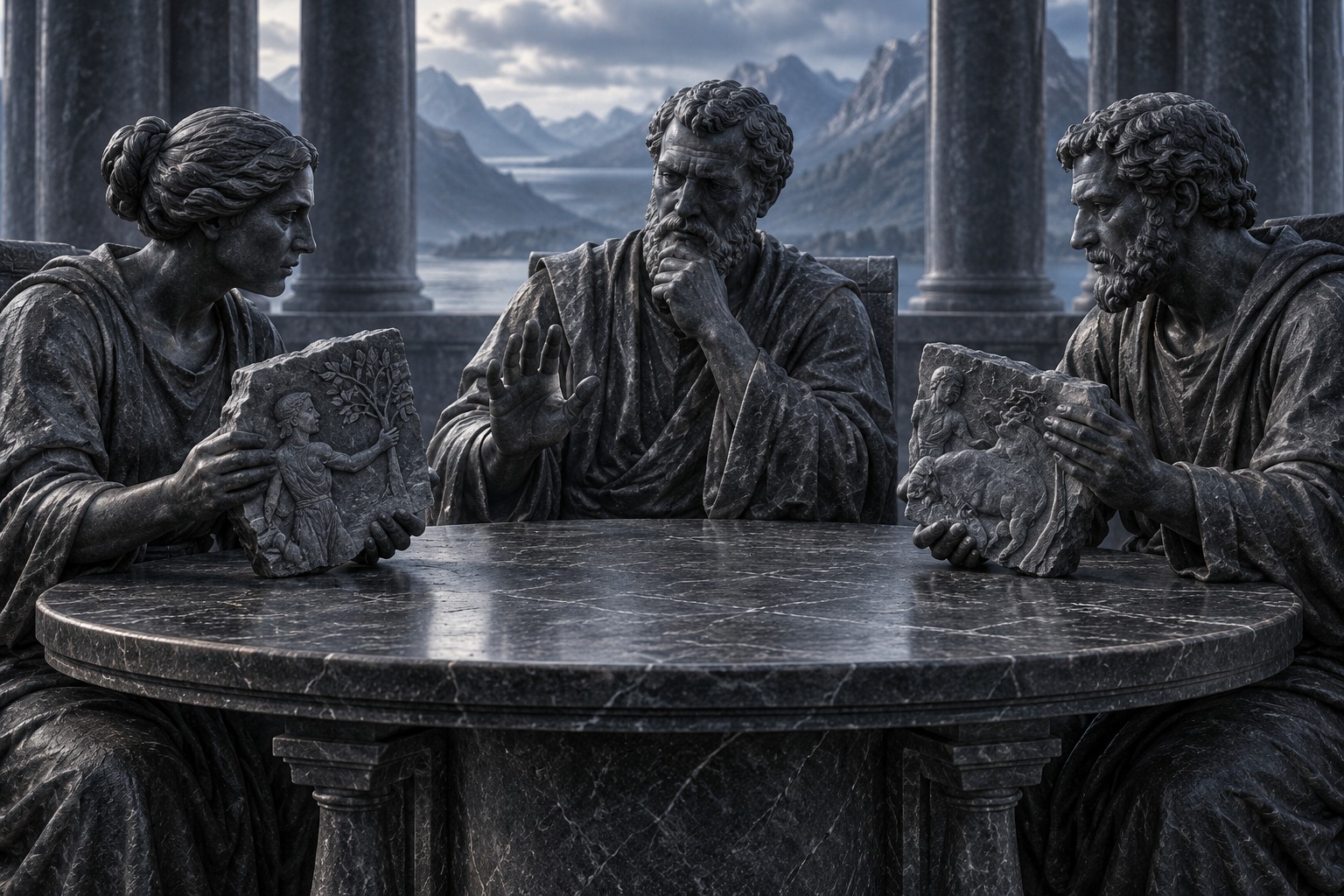
A question can remain open while we remain involved in what is happening.
United Wisdom · Andrey Zarinsh & Maria Evilkut
Epigraph
“Those who still seek it are the Sceptics.”
Sextus Empiricus, Outlines of Pyrrhonism, I.3. English translation by Mary Mills Patrick, 1899.
What this article is about
In an argument, we are often asked to take a position before we have grounds for an answer. Two cropped screenshots of a conversation and several confident voices are enough: we must already name the culprit, choose a side, and explain someone else's intention. Refusing an immediate verdict looks suspicious, as though we were avoiding involvement. Yet involvement and a final conclusion do not always require the same knowledge.
Pyrrhonian skepticism explores the possibility of suspending judgment when opposing grounds do not allow us to prefer one to the other. In Sextus Empiricus's account, this is neither a conviction that truth does not exist nor a proposal to disregard our sensations. It is a demanding way of continuing inquiry without turning our present inability to settle a question into the structure of the entire world. We will consider how it distinguishes an appearance from an assertion, why it need not bring ordinary life to a halt, and where qualifications are needed before bringing it into a contemporary situation. Responsibility remains a separate question: not knowing someone's motive does not release us from attending to the consequences of an action.
I. How a ready answer becomes a condition of involvement
Imagine a hypothetical scene. A record of an argument arrives in a group chat. A few lines are visible; the beginning of the conversation is missing. One participant writes that everything has long been clear. Another demands that no one defend the obvious culprit. A third recalls a similar incident. Within minutes, the account of an event becomes a test for its readers: a decent person must immediately feel the proper indignation.
The record itself may contain significant information. Someone's words really are rude; a promise really has been broken. But it does not yet follow that we know the whole sequence, understand the motive, or have reconstructed the history of the relationship. Several different conclusions are assembled into a single package. We are invited to agree with one only by agreeing with all the others.
This is how the pressure of a completed story works: the roles, cause, moral assessment, and expected action have already been assigned. Asking what has been confirmed looks like a delay when the group is moving toward a resolution.
Suspension begins with refusing to buy the whole package at once. We can acknowledge that the published words cause pain without knowing why they were spoken. We can propose ending public humiliation without declaring one participant blameless throughout the whole history. We can refrain from sharing the record until its origin and completeness are clear. Each of these actions has grounds of its own.
This contemporary example is not an episode from an ancient treatise. It illustrates the question that makes the treatise worth consulting: must our action be accompanied by a complete explanation of reality? Sometimes the demand for a complete explanation is precisely what makes us assert more than we know.
There is an opposite trap as well. Caution can easily be performed as superiority over everyone who has already chosen. But arrogant distrust does not become inquiry simply because its tone is restrained. If someone does not read what is available, ask a clarifying question, or allow an answer to be anything but naive, an open question becomes a closed posture.
The work that remains after refusing a verdict therefore matters. What exactly do we still not know? What information could change our assessment? Which conclusion is already supported, and which has merely been attached to it? The pause acquires meaning through these questions. Delay alone proves nothing.
II. Pyrrho and the image of a person who decides nothing
The school's name is connected with Pyrrho of Elis, who lived in the fourth and third centuries BCE. Yet Pyrrhonian skepticism cannot be read as a transcript of his own words. Pyrrho left no writings; the accounts of him must be distinguished from later forms of skepticism. Katja Vogt, Ancient Skepticism, §4.1.
Diogenes Laertius, IX.62, offers a useful example of this difficulty. He transmits a story of Pyrrho failing to avoid carts, precipices, and dogs, leaving his friends to look after his safety. The same passage provides another account: Aenesidemus maintained that Pyrrho did not lack foresight in everyday actions. The source itself preserves the disagreement.
The first story is easily made into a caricature: a skeptic doubts the existence of danger and therefore walks under the wheels. But this caricature has already chosen one version and forgotten the other. An ancient biography does not become a reliable record of behavior merely because its subject seems well suited to our point.
The main foundation of this article is the later account of Sextus Empiricus, who probably lived in the second or third century CE. His Outlines of Pyrrhonism describes a skeptical way of reasoning; the exact dates of his life remain uncertain. Benjamin Morison, Sextus Empiricus, §§1–2.
The distance between these figures already warns against the convenience of a single voice from antiquity. Pyrrho's name, stories of his life, and Sextus's arguments are connected but are not identical kinds of evidence. When discussing suspension of judgment, we will rely on a particular text by Sextus rather than attribute every proposition personally to Pyrrho.
This distinction itself belongs to the article's subject. The history of philosophy can also provide a confident answer before the evidence warrants one. We can establish that a story existed without yet establishing that the event happened exactly that way. A source does more than supply information: sometimes it reveals the limit of what we are entitled to reconstruct.
This leaves the reader with a more interesting interlocutor than either an impeccable sage or a comic denier of the obvious. We encounter a way of investigating that can be examined, rather than a character whom we must either imitate or ridicule.
III. Negation can also become a dogma
At the beginning of Outlines of Pyrrhonism, I.1–4, Sextus distinguishes those who regard truth as found, those who declare it unattainable, and those who continue to seek. This is his classification of philosophical positions; it should not be taken as an impartial description of all Academic skeptics. For our subject, the third possibility is what matters.
There is a considerable leap between acknowledging insufficient grounds and declaring knowledge impossible. To say that a particular investigation has produced no answer, we need only know its present result. To say that no answer can ever be possible, we must justify a much stronger proposition. The failure of a search does not itself supply that justification.
Sextus defines skepticism as an ability to oppose what appears and what is thought. The skeptic examines arguments, finds counterarguments, and investigates their persuasiveness. When the opposing grounds appear equipollent, epochē arises: suspension of affirmation and negation in the question being investigated. This is the sequence described in I.8–10. A mere lack of information does not yet reveal the full extent of this work.
The word dogma also requires explanation here. In I.13, Sextus distinguishes unavoidable assent to what is experienced from accepting a proposition about a non-evident subject of philosophical inquiry. The skeptic need not deny feeling cold. But asserting what a thing is by nature poses a different question. In this debate, dogmatist names a philosophical position; it is not an insult aimed at a self-assured person.
Accepting a negation would be as definite an answer as accepting an affirmation. If the skeptic seeks an argument against a proposition, this does not yet mean that the argument becomes the skeptic's own doctrine. Changing sides is not the same as suspending the choice between them.
Consider a hypothetical position: someone believes no account of human generosity. Every act of help is explained in advance by a hidden benefit. This can look clearheaded, especially alongside credulity. Yet the impossibility of discovering a selfless act has been secured here by a rule: every action will be redescribed so as to exclude it. Distrust already knows the answer before encountering the circumstances.
We can examine a particular action differently. We know that a person helped; we do not know what they expected; some of their subsequent actions give us grounds to suspect an interest. Such an account admits refinement. Caution within it does not erase the distinctions between what is confirmed, what is probable, and what remains unresolved.
This is the authors' application, not Sextus's teaching about social motives. It lets us notice that negative certainty also requires examination. Saying that trusting everyone is dangerous does not by itself establish that no one can be trusted. Between these propositions remain particular people, particular information, and different grounds for trust.
Openness in this sense requires allowing new evidence to change our answer. Otherwise, doubt merely guards a decision already made.
IV. Honey does not lose its sweetness to a philosophical question
One of Sextus's clearest examples concerns honey. In I.19–20, the skeptic does not deny the sweetness that is sensed; what is investigated is the assertion that honey is sweet by nature. The experienced appearance and an assertion about what the thing is by nature are distinguished. Keeping the question open does not require pretending that the sensation has disappeared.
This boundary matters for human experience. Imagine a conversation that leaves someone hurt. Acknowledging the hurt does not establish the other person's intention, the full cause of the response, or the relationship's future. Yet not knowing these things does not cancel the hurt either. A question about interpretation should not become a demand to deny what is being experienced.
There is no ready ancient psychotherapy here. We are proposing a contemporary distinction: describing a state and explaining its origin serve different purposes. We can say that a remark was heard as humiliating and then investigate its context. We need not immediately choose between the other person's unconditional guilt and blaming ourselves for perceiving incorrectly.
At the same time, appearance is not an infallible record of the external world. Recalling a conversation later, someone may confuse the words; a recording may clarify the sequence; the other person may explain their intention. Preserving the experience does not prohibit correcting the reconstruction of the event. It only prevents a correction at one level from being presented as the disappearance of all the others.
Skeptical attention changes the form of the question. Instead of a hasty move from sensation to an assertion about a thing's nature, we can notice: this is what appears to me now; this is what I assert about the circumstances; this is what the information does not yet prove. These three lines need not coincide.
But this scheme cannot become a new infallible instrument either. We cannot always describe our own state precisely, and saying that something seems a certain way can conceal a quite definite accusation. Cautious words do not substitute for honesty of content. Sometimes a person needs to clarify exactly what they mean by their description.
The distinction helps by leaving room for both movements: acknowledging what is happening within us and continuing to investigate what happened between us. Neither a final theory of feelings nor a refusal to feel is required.
V. How opposition works
In I.31–32, Sextus presents an argumentative move that shows us more than advice to take our time. One thinker infers the existence of providence from the order of the heavens. The skeptic opposes this with an argument: worthy people suffer misfortunes, while bad people prosper. If the world is governed by benevolent care, why does the distribution of events look like this?
Here we are paraphrasing Sextus's philosophical example, not reporting an established explanation of the world. The first argument connects order with providence. The second questions this connection by attending to what happens to people. The negative conclusion serves as a counterargument; the skeptic need not accept it as a personal belief. The work consists in investigating whether either line of reasoning can be preferred.
A defender of providence may offer a reply: the visible pattern of misfortunes does not reveal the whole design. A further question then arises: what gives this reply an advantage? If an unknown design is introduced precisely to rescue the original conclusion, it cannot be treated as an already established ground. The negation also requires examination: does it assume that any providence must distribute prosperity as the thinker expects? This is our explanation of a possible continuation of the dispute, not an additional quotation from Sextus.
Suspension arises where the opposing grounds appear equipollent—isostheneia—in the inquiry conducted. In I.8–10 and 196, Sextus describes a lack of advantage in persuasiveness and a report of how the grounds appear at present. He does not propose first declaring any two opinions equally valid and then calling this skepticism.
Neither the existence of an objection nor giving two speakers equal space therefore establishes equipollence. Inquiry remains between constructing a counterargument and arriving at equipollence. Sextus himself allows in I.34 that an answer to an argument currently strong may yet be found; an unfinished search does not become an assertion that the question is forever insoluble.
We can now return more precisely to contemporary checks of information. In a hypothetical dispute about a meeting, a recording and confirmations from participants cannot be equated with an unsupported remark that the recording might have been fabricated. This is our norm for assessing particular evidence, rather than a ready rule derived from Sextus's entire philosophy. Sensible caution here compares grounds and allows a check to produce a result. The Pyrrhonian challenge goes further: it also asks what entitles us to regard the criterion of choice itself as established.
VI. Five ways to ask about a ground
In I.164–169, Sextus lists five modes: disagreement, an infinite continuation of justification, relativity, assumption, and circular reasoning. A mode here is a way of questioning the ground of an assertion. They are traditionally associated with Agrippa, although Sextus himself speaks of later skeptics. Vogt, Ancient Skepticism, §4.3. In I.170–177, he shows how these moves work together.
Let us begin with a disagreement: some trust sensory perception as a route to truth, others trust reasoning, and still others allow both. Behind this scheme lies the question of how to establish that an object really is as the chosen way of knowing represents it. Disagreement does not yet prove that all answers are equally good. But the confidence of one side does not itself resolve the dispute.
Suppose we check one perception by another. One observation, for instance, confirms another. This may be useful for an ordinary task. But it is now the reliability of the sensory route as a ground of truth that is being examined. What establishes the reliability of the confirming observation? If another piece of sensory evidence does, it again requires the same check. An infinite continuation of justification arises: each link rests on the next, while no established starting point has yet been found.
We can appeal to reasoning: perception is reliable because reason has proved it so. But the reliability of reasoning is disputed as well. If sensory experience confirms it, a circle results: experience justifies reason, and reason justifies experience. If, instead, each piece of reasoning is checked by further reasoning, the infinite chain repeats. This is a paraphrase of Sextus's construction in I.171–172; the particular check of an observation serves as an explanatory example.
What remains is to stop the chain at an initial assumption: this way of knowing is accepted as reliable without further proof. This is precisely where the mode of assumption operates. The skeptic asks why such a starting point should be accepted when an opposing starting point has not yet been ruled out. The decision to stop does not itself give it an advantage over its rival. In I.173–174, Sextus directs this question at an interlocutor who expects to settle the dispute with an unproved premise.
The mode of relativity adds another difficulty. An object appears in relation to the perceiver and accompanying circumstances; even reasoning is presented through a particular thinker. Moving from this appearance to an assertion about the object's nature requires a ground. Naming the conditions of perception helps, but for Sextus the question does not end there: how do we choose the conditions that establish the nature of the object itself?
The five modes thus form a connected examination. Unresolved disagreement leads to the search for a criterion; a proposed criterion leads to the question of its ground; answers may return us to a chain, a circle, or an assumption. Until a preference has been established, the skeptic suspends judgment. This is an account of the argument's course, not our proof that all knowledge is impossible. Sextus continues to investigate, including examining his own formulas.
The difference from everyday caution becomes visible here. A person can accept an initial premise, check its consequences, and solve a problem while remaining ready to revise it. Such a choice is often necessary, but it does not yet answer the full Pyrrhonian challenge. To draw a practical question from that challenge, we need only ask: on what ground does the decision rest, and what exactly do we regard as established? We can name a working basis without declaring it the final foundation of knowledge.
VII. Can incompleteness bring tranquility?
Sextus connects suspension with ataraxia, freedom from disturbance in matters of opinion. In I.25–30, he relates that tranquility came to skeptics unexpectedly. They sought it by resolving disagreements but received it after being unable to prefer one answer. This is a philosophical account, not the outcome of a trial with contemporary participants.
The connection, however, is not exhausted by relief that a dispute has finally ended. In I.27–28, Sextus considers the belief that something is good or bad by nature. A person who accepts this proposition seeks what they regard as an unconditional good, fears losing what they have acquired, and is distressed by the presence of what they regard as an unconditional evil. A judgment about its ultimate value is added to what happens itself. Suspension concerns this judgment too.
In I.29–30, Sextus distinguishes an unavoidable experience from an opinion added to it. Cold or thirst remains; the thought that what is experienced is evil in itself need not add a second disturbance to it. His account of the goal therefore has two parts: freedom from disturbance in matters of opinion and moderation of feeling in what arises by necessity. This is not a demand to regard every event as pleasant or to stop noticing suffering.
The same passage includes a story about the painter Apelles. Unable to depict the foam at a horse's mouth, he threw a sponge at the picture, and its accidental mark produced the desired image. In Sextus, the story explains an indirect route to tranquility. It does not prove that abandoning effort generally produces a good result.
A contemporary application can be more modest. Someone rereads a conversation, trying to establish what the incident ultimately says about themselves and the other person. Examining an event becomes a search for a verdict on existence as a whole. We can notice this transition and examine what has been added to the known circumstances. Such attention takes effort: the familiar version already promises certainty and calls on us to defend it.
In this limited sense, we propose a discipline of attention to our own judgment. The historical account of ataraxia does not establish that this work will automatically calm someone or eliminate aggression. Not knowing can be painful, an event's consequences remain, and a feeling of relief may also arise from avoiding unpleasant information. It does not itself establish the correctness of a conclusion.
An open question allows us to avoid adding to a present experience the demand to explain the entire world immediately. We can finish today's inquiry and identify what new information would lead us back to it. An important distinction remains: Sextus's philosophical argument about opinion and our organization of everyday attention serve different purposes.
VIII. Living without a final theory of life
Sextus answers the objection that action is impossible by describing everyday life. In I.21–24, he names sensation and thought, unavoidable states, customs and laws, and instruction in the arts. Hunger leads to eating; an acquired skill allows work to be done. Philosophical suspension does not mean that all this stops.
But the question of the skeptic's beliefs remains disputed. Exactly how can someone act without accepting propositions as true, and what ordinary beliefs does Sextus allow? Scholars answer differently. Morison, Sextus Empiricus, §3.4. Turning this difficulty into simple contemporary advice would conceal part of the problem.
Descartes shows a different path. In the first and second Meditations on First Philosophy, doubt is directed toward finding an indubitable foundation; the second meditation discovers the certainty of one's own existence while thinking. A similar movement away from previous certainty therefore does not make the Cartesian and Pyrrhonian projects one philosophy.
Comparison with Stoic attention to judgments also requires caution. Epictetus, Enchiridion, §§1 and 5, connects action with distinguishing what depends on us and with assessments of what happens. Stoic reasoning presupposes a particular understanding of the proper attitude toward the world. Sextus's question also concerns what such an understanding is entitled to rest upon. Similarity between some questions does not eliminate disagreement between the answers.
Another connection can be explored with the Madhyamaka of Nāgārjuna, a Buddhist thinker of the second and third centuries CE. His critique of intrinsic nature, svabhāva, examines the claim that things possess an independent basis for existence of their own. Comparison with Sextus is interesting where both approaches examine the grounds of assertions and the possibility of using ordinary language without definitively fixing the nature of things. But suspension of judgment and the Buddhist investigation of emptiness cannot be regarded as one answer. In Nāgārjuna, emptiness has a particular philosophical content and is connected with the goal of liberation in Buddhist practice. Jan Westerhoff, Nāgārjuna, §§1–2.
The distinction between two truths in Madhyamaka is not another name for Sextus's distinction between an appearance and an assertion either. Its meaning is debated within the Buddhist tradition itself; approaches to arguing for one's own position also differ. We therefore identify a limited connection between questions while preserving differences of method and purpose. Similarity does not establish historical borrowing or make one school a compulsory preparation for another. Richard Hayes, Madhyamaka, §§1, 4–5.
A contemporary reader need not become a thoroughgoing Pyrrhonist to consider this challenge seriously. We can accept a more limited possibility proposed by the authors: acting on grounds sufficient for the situation while keeping the explanation open to revision. This is already a choice of our own rather than a literal reconstruction of life according to Sextus.
For example, fulfilling a promise does not require first discovering the ultimate nature of justice. We can know that another person is relying on the agreed action, understand our own capacities, and clarify the conditions. The philosophical question about justice remains. Different levels of work need not be completed at the same time.
This choice comes at a cost: we take responsibility for acting without sheltering behind an absolute guarantee. There is another cost too: our custom may be a bad one. Following familiar life does not release it from criticism. If a rule causes harm, its familiarity does not itself settle whether it should be preserved.
IX. What this means in practice
Let us return to the record of the argument. We may still not know what preceded it, why someone said a particular phrase, or who is right across the whole history. But we can now name the unknown more precisely. It need not encompass everything that is happening simply because one part remains unclear.
It helps to formulate the available information, the conclusion, and the possible action separately. A published remark is visible. The full sequence is unknown. We are not prepared to circulate incomplete material further. These propositions can coexist without a hidden decision about the entire story. Sometimes involvement consists precisely in not increasing the damage through the speed of our own verdict.
If a decision must be made today, the cost of waiting also needs to be identified. A pause acceptable while reading a dispute may be unacceptable where an obligation must be fulfilled or observable harm stopped. An unknown motive does not make the action itself invisible. We can address what is happening without declaring ourselves experts on someone else's inner life.
Suspending a broad verdict therefore cannot serve as a universal excuse for indifference. This is a boundary the authors place on contemporary application. In a situation of real danger, we need not complete a metaphysical inquiry before choosing available protection. At the same time, measures and accusations have consequences; they too should be proportionate to what is confirmed.
For a question that remains open, we can identify a reason to return: a full recording, a participant's answer, or new evidence. If no new information is expected, it is important to notice what is continuing: a search or a repetition of previous thoughts. Refusing to replay the same material does not establish the truth; it establishes the limit of today's work.
Such a practice does not guarantee tranquility or make caution a virtue under all circumstances. Sometimes we will be mistaken because we decided too early. Sometimes we will be mistaken because we waited too long. An honest relation to the unknown includes the possibility of assessing the consequences of our choice and revising it.
Ultimately, the skeptical question concerns more than other people's assertions. It concerns our need for every conversation to contain a whole world already: a person's final character, the meaning of an event, a predicted future. Communication sometimes needs less: understanding what happened now without attaching everything that has not yet been checked.
We can turn off the screen without having the last word. The people in the dispute remain people rather than completed roles in our version. The question remains a question. Yet one quite definite decision has been made: not to treat a lack of information as permission to bring someone else's story to an end.
Key quotation
“I determine nothing.”
Sextus Empiricus, Outlines of Pyrrhonism, I.197. English translation by Mary Mills Patrick.
Sextus explains this formula as a report of the present state in the question being investigated, rather than a new absolute proposition. In I.206–208, he includes skeptical formulas within the scope of their own operation. Refusing dogma must not become a dogma about the correctness of every refusal.
Connections between traditions and ways of understanding
| One side | Another side | Connection and boundary of comparison |
|---|---|---|
| Pyrrhonian suspension in Sextus | The assertion that knowledge is impossible | A present inability to choose an answer does not establish that an answer is impossible altogether. |
| The appearance the skeptic follows | A proposition about a thing's nature | Acknowledging what is sensed is not a final explanation of what exists. |
| Pyrrhonian inquiry | Cartesian doubt | Descartes seeks an indubitable foundation; a similar beginning does not establish a shared goal. |
| Attention to judgment in Sextus | Epictetus's Stoic reasoning | Judgment matters in both approaches, but the grounds of acceptance and moral orientation differ. |
| Examination of grounds in Sextus | Critique of intrinsic nature in Madhyamaka | The examination of what assertions claim can be compared; epochē and emptiness have different contents and purposes. Historical continuity is not established here. |
| Equipollence of opposing grounds | Equal space for any versions | Symmetry of presentation does not itself establish equal persuasiveness. |
| Contemporary action with incomplete knowledge | The entire ancient program of skepticism | The proposed application preserves responsibility and revision; it is not identical to Sextus's entire philosophy. |
Primary sources and scholarship
-
Sextus Empiricus. Outlines of Pyrrhonism, Book I, §§1–4, 7–15, 19–35, 164–177, 196–208. Mary Mills Patrick's English translation in Sextus Empiricus and Greek Scepticism, Cambridge, 1899, Project Gutenberg, ebook 17556. The relevant passages of the translation of Book I were used; Patrick's scholarly discussion and the translated text are distinguished. No claim is made to having read all of Sextus's works. Historical explanations in Russian are paraphrases; two brief quotations are marked separately.
-
Diogenes Laertius. Lives of Eminent Philosophers, IX.61–62. English translation by R. D. Hicks, Loeb Classical Library, 1925, LacusCurtius. The connection of the name with Pyrrho and differing accounts of his foresight; the story is not presented as an independently confirmed fact about his behavior.
-
Katja Vogt. Ancient Skepticism, Stanford Encyclopedia of Philosophy, revision of September 21, 2022, §§4.1 and 4.3. The historical boundary between Pyrrho and later Pyrrhonism; the traditional attribution of the five modes. Academic scholarship, not another ancient text.
-
Benjamin Morison. Sextus Empiricus, Stanford Encyclopedia of Philosophy, revision of March 12, 2026, §§1–2, 3.2, and 3.4. Dating, surviving works, the ability to construct oppositions, and the dispute about the skeptic's possible beliefs. The specified sections were used; differences between scholarly interpretations are preserved.
-
René Descartes. Meditations on First Philosophy, Meditations I–II. English text of Elizabeth S. Haldane's translation / the Haldane–Ross edition, 1911, Boston University. Doubt as a path toward an indubitable foundation; the beginning of Meditation I and the central move of Meditation II were used, without surveying Descartes's entire metaphysics.
-
Epictetus. Enchiridion, §§1 and 5. English translation by Elizabeth Carter, Internet Classics Archive. The distinction of what depends on us and the role of judgments; a limited comparison, not a claim that Stoicism and Pyrrhonism are identical.
-
Jan Westerhoff. Nāgārjuna, Stanford Encyclopedia of Philosophy, revision of May 31, 2026, §§1–2. Dating, intrinsic nature, and emptiness; a limited comparison based on academic scholarship, without claiming a complete reading of Nāgārjuna's works.
-
Richard Hayes. Madhyamaka, Stanford Encyclopedia of Philosophy, revision of August 18, 2023, §§1, 4–5. The distinction between two truths and disagreements about methods of argument within the school; the specified sections of the study were used.
Tags
Nāgārjuna, Madhyamaka, Pyrrho, Pyrrhonism, Sextus Empiricus, skepticism, ancient philosophy, epochē, suspension of judgment, inquiry, equipollence, ataraxia, appearance, belief, knowledge, dogma, negation, ground, evidence, uncertainty, modes, Agrippa, circular reasoning, relativity, Descartes, Epictetus, action, responsibility, revision, history of thought.
About the authors
Andrey Zarinsh is the author and founder of United Wisdom. He explores inner transformation, the unity of traditions, intercultural dialogue, and contemporary spiritual discipline.
Instagram: @andrey.zarinsh
Maria Evilkut is a coauthor of United Wisdom. Alongside her research, she seeks to test these ideas in practice and observe how principles of unity and mutual understanding work in real life between people and cultures.
Instagram: @ilkutki
Keep what resonates with you.