
Relationships
The Union of the Magician and the High Priestess
Will and intuition through sacred marriage, Jungian union, a couple's possibilities, and the risks of losing boundaries.
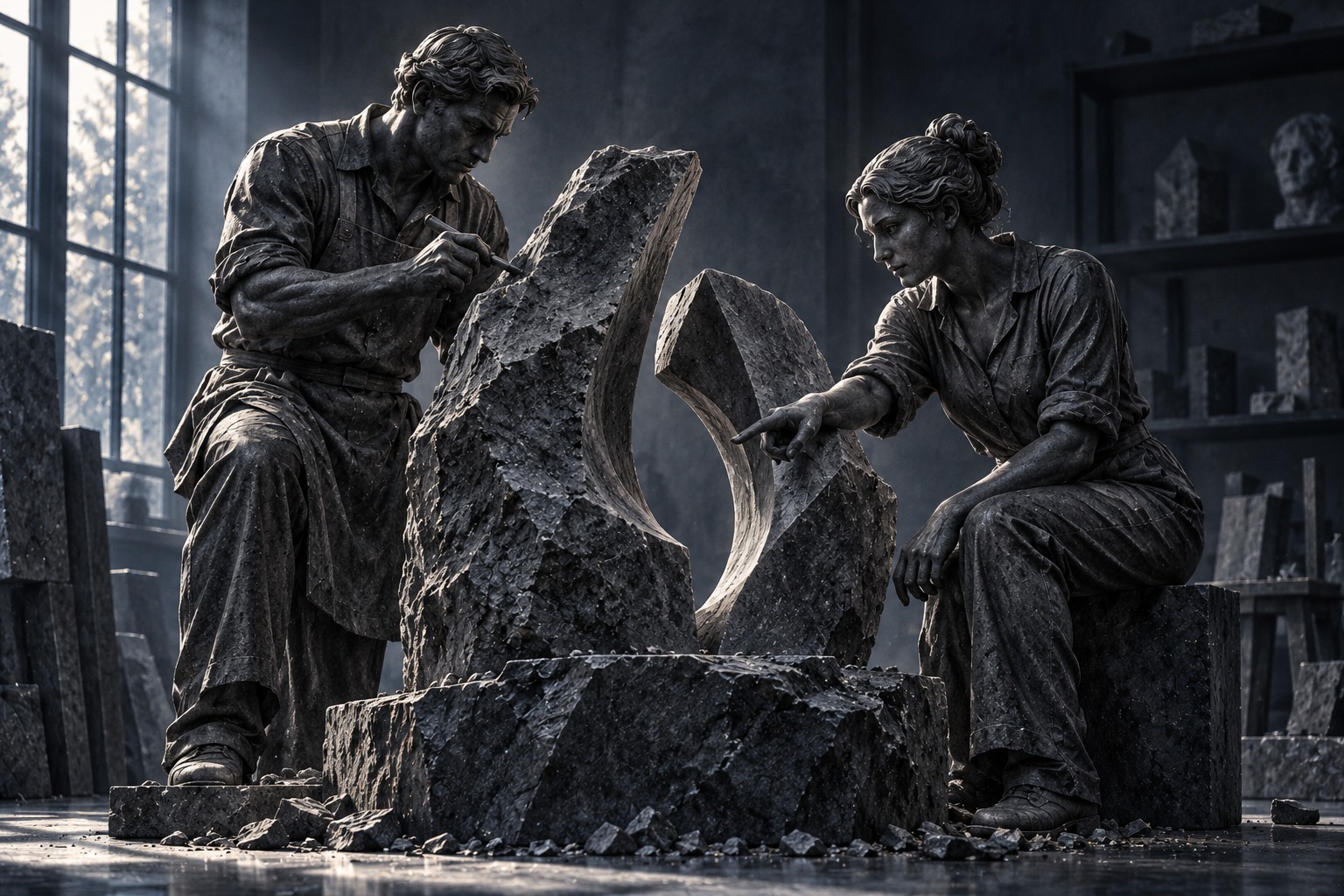
The sacred marriage of will and intuition — what is born when two poles meet
Andrey Zarinsh & Maria Evilkut
United Wisdom · Inner Transformation · An original series
Archival editor's note. This is a full translation of the supplied archive. The gendered archetypes, common origins and cross-tradition equivalences proposed here are the authors' symbolic interpretation, not established descriptions of all people or relationships. Historical accounts, quotations and psychological claims have not been independently reverified. Clinical terms do not diagnose a couple. The “Two Chairs” exercise is an editorial suggestion, not a validated treatment; its instruction not to doubt must not override consent, safety, new evidence, or the freedom to reconsider a decision.
“Shiva, united with Shakti, gains the power to create. Without her, he cannot even move.”
— Soundarya Lahari, verse 1, attributed to Shankara (Soundarya Lahari)
What this article is about
We have already met them separately: the Magician, the archetype of will, focus, and bringing an intention into material form, the one who makes reality change; and the High Priestess, the archetype of intuition, silence, and hearing what is hidden, the one who knows before the world announces itself. The Magician knows “how” and “now.” The Priestess knows “what” and “why.” Each is powerful alone, yet incomplete: without listening, the Magician becomes blind force; without action, the Priestess becomes silent knowledge. This article explores what happens when the two poles become a loving couple. It concerns both an actual union between two people and the inward integration of masculine and feminine principles within one soul. We will move from the sacred marriage of ancient traditions and Jungian alchemy through Indian, Chinese, Kabbalistic, and Sufi thought to the psychology of a couple, its strengths and shadows, and the central question: what can these two accomplish together?
I. The oldest story: sacred marriage
The idea that the world is born from the union of two principles is older than any philosophy. The Greeks called it hieros gamos (ἱερὸς γάμος), “sacred marriage”: a ritual union of god and goddess whose joining produces fertility and cosmic order (Hieros gamos). The oldest documented rite is Sumerian: the city's king joined with the high priestess embodying the goddess Inanna, and their union at the annual festival was understood as a pledge of the land's fertility for the coming year. The priestess knew, the king acted, and together they upheld the order of the world. In classical Greece, Zeus and Hera embodied the same motif; their sacred marriage was celebrated at the Heraion on Samos.
The same image lives in tantric Buddhism as yab-yum, Tibetan for “father-mother”: male and female deities embracing. Here the distribution of roles reveals the essence of the union: the masculine principle symbolizes compassion and “skillful means,” upāya, its active side, while the feminine symbolizes insight-wisdom, prajñā, its understanding side (Hieros gamos). This is the Magician and the Priestess: method and wisdom, hand and eye. Their union within the practitioner's body is experienced as inner wholeness.
II. The alchemy of union: Jung and the chemical wedding
Carl Gustav Jung explored the psychological meaning of this union most deeply by reading the language of alchemy as a map of the soul. Alchemists called the joining of opposites coniunctio oppositorum and depicted it as the marriage of the Sun-King, Sol, the masculine active principle, and the Moon-Queen, Luna, the feminine receptive principle. In the sixteenth-century series of engravings Rosarium Philosophorum, the “Rosary of the Philosophers,” Jung saw a psychodrama: two principles meet, merge, die, dissolve, and are reborn as one being (CW16). He devoted The Psychology of the Transference (1946) to this subject, as well as the culminating work of his life, Mysterium Coniunctionis (CW14, completed in his eighty-first year).
These poles are personified within every person's psyche. The anima is the feminine image in a man's unconscious; the animus is the masculine image in a woman's unconscious. Accepting and becoming conscious of one's inward “opposite” principle is a necessary step toward the Self, Selbst, the whole center of personality (Mysterium Coniunctionis). In an actual couple, we initially project anima or animus onto the other person — the first spark of falling in love — and then, if fortunate, turn projection into mutual recognition.
The key concept is the transcendent function. Jung described it as early as 1916: “The psychological transcendent function arises from the union of conscious and unconscious contents” (CW8, §131). From the tension between two opposing positions comes not a compromise but a third thing: a new symbol, a new attitude that resolves the conflict, “a living birth leading to a new level of being” (Transcendent Function). This is the hidden mechanism of the union between Magician and Priestess, to which we will return in the central section.
III. Echoes across traditions: two principles create the world
It is striking how dissimilar cultures independently arrived at the same thought: reality rests on the union of polarities, neither of which is self-sufficient.
In Indian Tantra, Shiva, Śiva, is pure consciousness, the motionless pole, while Shakti, Śakti, “power,” is creative energy. Without Shakti, Shiva is barren. A popular saying plays on Sanskrit words: “Shiva without Shakti is shava, a corpse” — remove the vowel from Śiva and śava remains (Shakti). Their unity is captured in Ardhanarishvara, Ardhanārīśvara, “the Lord whose half is woman”: a figure divided down the middle, the right side masculine and the left feminine. “The universe arose from the union of the sexes,” says the Mahabharata (Ardhanarishvara).
In China these are yin and yang: opposing but complementary principles whose interaction is not struggle but a dynamic balance in which the whole exceeds the sum of its parts. “The Dao gives birth to one, one gives birth to two, two give birth to three, three give birth to the ten thousand things” (Dao De Jing, Chapter 42) (Yin and yang). The taijitu symbol shows the essential point: each principle contains the seed of the other.
In Kabbalah, the masculine and feminine aspects of God — the sefirot Tiferet, “Beauty,” and Malkhut/Shekhinah — must reunite. This union is called yichud, “unification,” and restores the world's wholeness, tikkun olam (Yichudim). The Shekhinah is welcomed as the Sabbath Bride: “Come, bride, come, bride!” (Shekhinah). In Egypt, Isis, the embodiment of magic and wisdom, gathers and revives the body of the murdered Osiris and conceives Horus, whose enthronement restores maat, the world's order (Osiris myth). In the Symposium, Plato gives Aristophanes the oldest Western definition of love: human beings were once whole creatures, Zeus cut them in two, and ever since each has sought their other half; love is “longing for lost wholeness” (Symposium). The Sufis carried this to its limit: for Rumi, love is “the astrolabe of God's mysteries,” and the image of the Beloved is a metaphor for a union that dissolves every duality (Rumi).
IV. The bright side: what makes the couple strong
When the Magician and the Priestess meet, science describes several sources of their strength.
The first is complementarity. In Mate Selection (1958), sociologist Robert Winch proposed that people are attracted to those whose traits and needs complement rather than duplicate their own (Winch, 1958). The Priestess's perception and the Magician's action cover each other's blind spots: she sees what he misses in his haste; he embodies what she only senses. A qualification matters here: empirical support for Winch's hypothesis is mixed, and similarity in values also matters. We are discussing an ideal pole of complementarity, not a law.
The second is joint thinking. In 1985, psychologist Daniel Wegner described transactive memory: within a close couple, each becomes the keeper of particular areas of knowledge, and the system's shared memory is broader and more effective than either person's alone (Transactive memory). The Magician and the Priestess literally think as one mind: one remembers where the facts and tools are, the other where meanings and risks are hidden. Together they make fuller decisions than either does alone.
V. The dark side: shadows of the union
Every light has its shadow, and the union of two strong poles has even more shadows than a person alone.
The first is the echo chamber. When two people stop testing each other's thinking and only confirm it, their union becomes a closed circuit of illusions. Psychiatry knows an extreme case, folie à deux, “madness of two,” described by Lasègue and Falret in the nineteenth century: delusional beliefs pass from one person to the other, and partners reinforce each other's mistaken beliefs (folie à deux). Shared blindness takes the place of synergy.
The second is fusion and the loss of boundaries. Murray Bowen introduced differentiation of self: the lower the differentiation, the stronger the emotional fusion, an “undifferentiated ego mass” in which partners can no longer distinguish whose feelings are whose (Bowen). Then the poles collapse: the Priestess begins to force action without listening to intuition, while the Magician freezes in indecision. Bowen's paradox is that the tighter the fusion, the sharper the hidden conflict.
The third is codependency. In Codependent No More (1986), Melody Beattie described the pattern in which people arrange their entire inner life around another person, losing contact with their own needs. In our couple this happens when the Priestess hands her will entirely to the Magician — “he knows better” — or the Magician makes the Priestess his sole source of direction without developing his own ability to listen. The union remains alive while both preserve their own pole.
VI. The central question: what they can accomplish together
Here is the heart of the article. Everything so far has concerned who they are and what they risk. But the union's true meaning lies not in adding their strengths together, but in the birth of something that does not exist in either of them separately.
Buckminster Fuller brought the word synergy into wider use and defined it precisely: “the behavior of whole systems unpredicted by the behavior of their parts taken separately” (Synergetics). Synergy is not 1 + 1 = 2 but 1 + 1 = 3: the emergence of a new quality that belonged to neither component. This is exactly what the Jungian transcendent function describes in the language of the psyche: tension between the Magician's conscious will, “what to do,” and the Priestess's unconscious intuition, “what is true,” gives rise to a “living third”: a decision, idea, or work neither would have created alone. “The unconscious striving toward light and the conscious striving toward substance” work toward one result (CW8, §168) (Transcendent Function).
The alchemists called this outcome rebis, “the double thing”: the androgyne in whom Sun and Moon, King and Queen, are fused into one. Jung showed that the Great Work culminates not in a return to the original two, but in a New Birth, a third thing, a new level of being (CW16). Here is the formula for their shared power, unfolded step by step:
- The Priestess sets the direction: in silence she hears what is true and why, catches what is hidden, reads the risks, and senses the right direction before it becomes obvious.
- The Magician supplies the force: he takes this knowledge and, through focused will, turns it into action — a product, project, or deed here and now.
- A complete cycle of creation emerges, from invisible intention to embodied result, without gaps. Without the Magician, the Priestess has an insight with nobody to carry it out; without the Priestess, the Magician expends tremendous force on the wrong thing. Together they close both gaps.
- A “third” is born: neither his project nor her premonition, but something new growing from their union — the synergistic quality, the rebis.
Structurally, this coincides with the Daoist principle of wei wu wei, “action through non-action”: the greatest effect arises when force moves in precise accord with the emptiness that opens space for it. The taijitu makes this visible: yang carrying a seed of yin and yin carrying a seed of yang form not a static sum but a living circulation. The Magician who has learned to listen and the Priestess who has learned to act cease to be halves and become a whole that creates.
VII. A lesson for the reader: a practice for two
The union of Magician and Priestess is not only about two people. It is about two forces within you: the ability to listen and the ability to act. Most of us lean too far toward one pole: we either analyze endlessly without daring to decide, the stuck Priestess, or rush ahead without listening, the blinded Magician.
The “Two Chairs” practice: before an important decision, divide it into two moves. First sit in the “Priestess's chair”: switch off your phone, spend time in silence, and ask yourself honestly not “What benefits me?” but “What is true here, and what do I really want?” Write down the first thing that comes, without judging it. Then move to the “Magician's chair” and ask just one thing: “What first concrete step will I take within the next twenty-four hours to bring this into being?” Never confuse the chairs: in the first, you must not act; in the second, focus on choosing a step while keeping it open to reconsideration. If you are doing this together, let one truly hold the Priestess's pole and the other the Magician's, while both understand that the aim is not to defeat one another but to give birth to a third thing.
And here is the conclusion. The Magician teaches mastery of the outer world. The Priestess reminds us that without union with the inner world, any success will be hollow. Together, however, they are more than the sum of these two lessons. They are that ancient story underlying every tradition: a whole split in two and longing for itself. When will finally listens and intuition finally acts, the gulf between “I know” and “I have done” disappears. This is the sacred marriage: not the wedding of two people, but the reunion of two forces from which a world is born.
Key quotation
“The confrontation of the two positions generates a tension charged with energy and creates a living third thing… a living birth leading to a new level of being.”
— C. G. Jung, on the transcendent function (CW8, §181) (Transcendent Function)
Connections between traditions
- Hieros gamos (Sumer, Greece) ↔ yab-yum (Tantra: upāya + prajñā) ↔ Jung's coniunctio: the union of action and wisdom as an act of world creation shared by the oldest cultures.
- Shiva–Shakti (India) ↔ yin–yang (China) ↔ Tiferet–Shekhinah (Kabbalah): three independent traditions concerning one truth, that reality rests on the union of active and receptive poles.
- Jung's anima/animus ↔ Plato's androgyne (Symposium) ↔ the alchemists' rebis: wholeness as the reunion of divided masculine and feminine principles.
- The transcendent function (Jung) ↔ synergy (Fuller) ↔ wei wu wei (Daoism): the union of opposites gives birth to a third thing that cannot be predicted from the parts.
- The Magician, will and doing, ↔ the Priestess, intuition and listening: two neighboring United Wisdom archetypes that together form the full cycle from intention to embodiment.
Primary sources
- Sacred marriage, hieros gamos; Sumer, Inanna–Dumuzi; Zeus and Hera; tantric yab-yum. Hieros gamos.
- Jung, C. G. Mysterium Coniunctionis (CW14, 1955–56); coniunctio oppositorum, rebis. Mysterium Coniunctionis.
- Jung, C. G. The Psychology of the Transference (CW16, 1946); Rosarium Philosophorum, Sol et Luna. CW16 abstracts.
- Jung, C. G. The Transcendent Function (1916/1957, CW8 §§131, 168, 181). Transcendent Function; Academia: CW8 §168.
- Shiva and Shakti; Soundarya Lahari, verse 1; “Shiva without Shakti is shava.” Shakti.
- Ardhanarishvara, Ardhanārīśvara; Mahabharata; Purusha and Prakriti. Ardhanarishvara.
- Yin and yang; Dao De Jing, Chapter 42; taijitu; wei wu wei. Yin and yang.
- Kabbalah: Tiferet, Malkhut/Shekhinah, yichud, tikkun olam; the Zohar, Luria. Yichudim; Shekhinah.
- Isis and Osiris; Pyramid Texts; Plutarch; maat. Osiris myth.
- Plato, Symposium, 189c–193e; Aristophanes' speech, androgynes. Symposium.
- Rumi (1207–1273); “Love is the astrolabe of God's mysteries”; sama. Rumi.
- Ibn Arabi (1165–1240); wahdat al-wujud. Ibn Arabi.
- Winch, R. F. (1958). Mate Selection; theory of complementary needs. Social Work review.
- Wegner, D. M. (1985). Transactive memory; the couple as a single cognitive system. Transactive memory.
- Folie à deux (Lasègue and Falret, nineteenth century); shared psychotic disorder. Shared psychosis.
- Bowen, M. (1978). Family Therapy in Clinical Practice; differentiation of self. Bowen theory.
- Beattie, M. (1986). Codependent No More; codependency. Codependency.
- Fuller, R. B. (1975). Synergetics; definition of synergy. Synergetics.
Tags
union of archetypes, sacred marriage, hieros gamos, coniunctio, transcendent function, rebis, anima, animus, Self, Shiva and Shakti, Ardhanarishvara, yin and yang, taijitu, Tiferet, Shekhinah, yichud, Isis and Osiris, Platonic androgyne, Rumi, synergy, complementarity, transactive memory, folie à deux, differentiation of self, codependency, Magician, High Priestess, Jung, United Wisdom
About the authors
Andrey Zarinsh (@andrey.zarinsh) and Maria Evilkut (@ilkutki) are the authorial couple behind United Wisdom. We bring together scientific precision and the depth of traditions to speak about inner transformation without esoteric oversimplification: with names, dates, and verifiable sources.
Andrey Zarinsh & Maria Evilkut · United Wisdom · Laboratory of United Wisdom.
References inherited from the archive
Recovered from supplied archive metadata; not newly read or verified.
Keep what resonates with you.