
Relationships and Shared Life
The Magician and the High Priestess: How to Befriend the Itch for Action with a Vague Hunch and Not Lose Your Mind
Popular esotericism loves smearing mystical pathos in a thick layer over every mundane domestic squabble: if a man hammers a nail, it is inevitably heralded as "the materialization of the primordial Will of the…
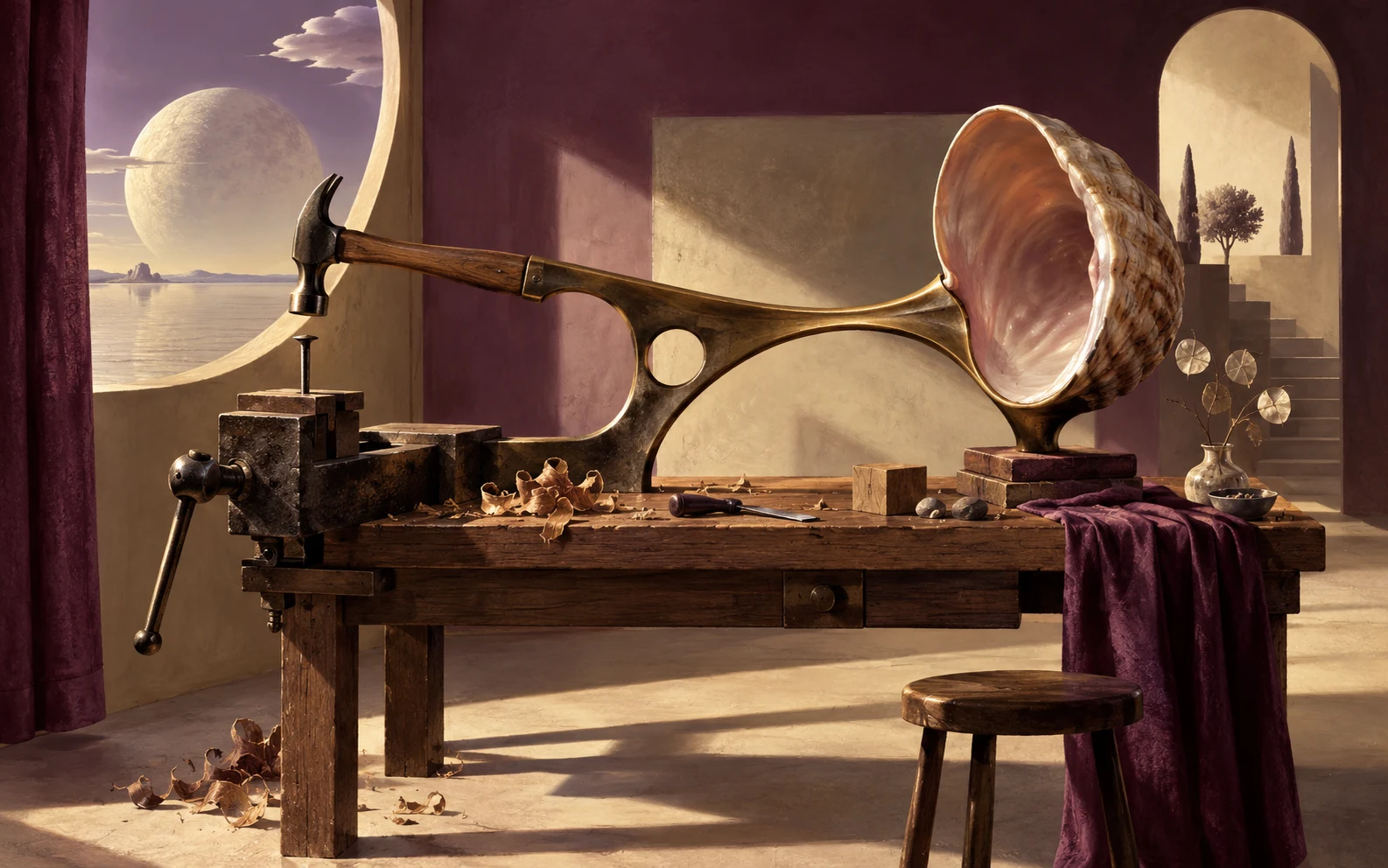
Popular esotericism loves smearing mystical pathos in a thick layer over every mundane domestic squabble: if a man hammers a nail, it is inevitably heralded as "the materialization of the primordial Will of the Magician," and if a woman stares blankly out the window, we are allegedly witnessing "the silent mystery of the High Priestess tapping into cosmic vibrations." Let’s strip the cheap tinsel off this topic right away.
In this context, the Magician and the High Priestess are strictly authorial metaphors for psychological faculties available to any human being of any gender: the capacity to reshape the world through willpower, focus, and drive (our provisional Magician), and the capacity to pause, tune in to hidden currents, and register context (our provisional High Priestess). This is not an edict from the marriage registry: a man is under no obligation to impersonate an unstoppable freight train around the clock, nor is a woman condemned to the role of a passively sighing amoeba. What is more, to become a psychologically whole creature, you do not need to urgently hunt down a romantic partner to serve as a missing psychic prosthetic. These two forces can maintain a perfectly fruitful dialogue inside a single skull.
At the same time, both faculties deserve to be brought firmly back down to earth. Intuition is a fickle beast: it can easily misfire, mistake wishful thinking for reality, or simply broadcast accumulated fatigue; it is by no means an infallible conduit of cosmic truth or built-in household telepathy. On the flip side, the Magician’s will is hardly a universal remote control for reality: no matter how desperately you strain your forehead or visualize success, nobody is handing over total control of the universe.
I. The Oldest Trope: Sacred Marriage and Historical Realism
Since time immemorial, humanity has adored explaining how the cosmos works through the union of two opposing principles. The Greeks coined the term hieros gamos (ἱερὸς γάμος)—the "sacred marriage," a ritual union of male and female deities meant to order the cosmos and promote fertility.
Sumerian royal and love hymns celebrated a sacred union linking royal authority with the goddess Inanna and the broader myth of Inanna and Dumuzi. The assumption that a priestess actually participated belongs to modern historical reconstructions of the rite. This motif was tightly bound to the Inanna–Dumuzi cycle. Yet armchair romantics hunting for steamy ancient gossip should dial back their enthusiasm: the notion that the monarch literally copulated with a high priestess on an annual schedule to guarantee a bumper barley harvest is merely one contentious academic reconstruction, not a documented, universal civic routine observed in every single city-state. In classical Greece, Zeus and Hera played out the same dynamic at the Heraion of Samos, but that hardly proves that the Greek hieros gamos was the sole fountainhead of all subsequent world philosophy and natural science.
Turning eastward, Tantric Buddhism presents the iconography of yab-yum (Tibetan for "father-mother")—a divine couple locked in inseparable embrace. Here, the masculine principle embodies compassion and skillful means (upaya, the active, practical aspect), while the feminine principle represents transcendent wisdom (prajna, the pure insight into the nature of reality). Yet this is the subtle symbolic grammar of very specific meditative and contemplative traditions. Treating yab-yum as an off-the-shelf clinical manual for couples therapy or a handy guide to bedroom acrobatics is a foolproof way to make any serious scholar of Asian studies cringe. These are comparable cultural metaphors, not empirical proof that Mesopotamian priests and Tibetan lamas independently derived a unified Newtonian law of relationships.
II. The Alchemy of Union: Jung, Woodcuts, and the Chymical Wedding
Carl Gustav Jung thoroughly overhauled this landscape, reading alchemical iconography as source material for his own psychological theories. This was his personal interpretative framework: historical alchemists were neck-deep in chemical substances and religious cosmologies, not merely playing at disguised psychotherapy over smoking retorts.
The alchemical archetype of the coniunctio oppositorum ("conjunction of opposites") was traditionally depicted as the mystic marriage of the Sun-King (Sol, the active impulse) and the Moon-Queen (Luna, the receptive principle). Examining the sixteenth-century woodcut sequence in the Rosarium Philosophorum ("The Rosary of the Philosophers"), Jung identified a progressive psychodrama: the meeting of two polarities, their union, an inevitable descent into the dark night of the soul, the dissolution of outmoded ego-structures, and the ultimate emergence of the rebis ("the double thing")—an androgynous emblem of transformed consciousness. Jung unpacked these themes at length in The Psychology of the Transference and his magnum opus, Mysterium Coniunctionis.
Let us remain level-headed, however: the concepts of Anima (the archetypal feminine imprint within a man’s psyche) and Animus (the archetypal masculine within a woman’s) represent a historical psychological model of its time, deeply tethered to the cultural mores and gender assumptions of Jung’s own milieu. It is a theoretical scaffolding for interpretation, not an anatomical dissection of the central nervous system or a mapped cluster of cerebral lobes. Nor does it follow that falling for the person living next door is automatically a profound, archetypal projection bubbling up from your collective unconscious.
The same sobering grain of salt applies to Jung’s celebrated transcendent function (formulated in 1916). In Jung’s formulation, when a conscious stance ("I intend to force my agenda through") collides head-on with resistance from the unconscious ("I have a rotten gut feeling and my eyelid won't stop twitching"), the result is not supposed to be a miserable, gritted-teeth compromise, but a radically new psychological attitude that transcends and dissolves the conflict. It is an elegant model for dialogue between layers of the psyche. But it remains a psychological hypothesis, not verified neurobiological mechanics—and certainly not a guarantee that every domestic squabble over dirty dishes will effortlessly launch a couple into a higher plane of enlightened being. Sometimes people are simply yelling because somebody left the toothpaste cap off again.
III. Echoes Across Traditions: A Parade of Metaphors Without Shoehorning
Cultures across the centuries have turned this duality over in their hands, yet each did so in its own idiomatic way. Claiming that disparate civilizations independently "proved" the exact same scientific principle is sheer intellectual overreach.
-
Indian Tantra: Shiva is static, detached pure consciousness; Shakti is dynamic, roaring creative kinetic power. A well-known Sanskrit pun notes that without Shakti, Shiva is reduced to shava (śava, a corpse)—a shift of a single vowel that completely flips the meaning. Note the contrast with tired Western Tarot tropes where the feminine is perpetually cast as passive: here, the feminine is the unstoppable, world-shaping dynamo. Their ultimate synthesis is crystallized in the half-male, half-female form of Ardhanarishvara. And while the verses of ancient Indian hymns are sublime, attributing stray quotations to the Mahabharata without rigorous textual verification is a scholar's minefield.
-
Chinese Philosophy: Yin and yang are neither rigid gender binaries nor personality types along the lines of "he is harsh, she is gentle." They represent the fluid dynamics of natural cycles, continuously shifting into one another, with the familiar taijitu symbol serving as a graphic reminder of the seed of the opposite nesting inside every state. It denotes an active, continuous balancing act, not a comatose absence of tension.
-
Jewish Mysticism: In Kabbalah, the union of the sefirah Tiferet ("Beauty," traditionally masculine) with Malkhut or the Shekhinah (the divine feminine presence in immanence) is termed yichud ("unification"). This is an explicitly sacred theological act aimed at restoring cosmic order (tikkun olam), not a secular weekend retreat for harmonizing your internal subpersonalities.
-
Egypt and Greece: Isis scours the earth to gather the dismembered limbs of Osiris, breathing life back into him through magic to secure the reign of Horus. It is a grand mythological epic of resurrection and cosmic equilibrium (maat), not a lifestyle template for modern romance. Meanwhile, in Plato’s Symposium, the comic playwright Aristophanes spins a myth about primordial, eight-limbed androgynes split in two by Zeus for their insolence, doomed to wander the earth yearning for their missing halves. It is a brilliant, satirical dinner-party speech delivered at an Athenian drinking feast, not an axiom of evolutionary biology, and certainly not holy writ proving that the universe has assigned every person exactly one preordained "soulmate."
-
Sufism: The poetry of Jalal al-Din Rumi, in which love is praised as "the astrolabe of the mysteries of God," celebrates the ecstatic dissolution of the individual ego into the divine Beloved. Dragging ecstatic Sufi mysticism down to serve as a domestic troubleshooting checklist for two corporate project managers is, to put it mildly, a bit of a stretch.
IV. The Bright Side: Complementarity and Why Two Notebooks Beat One
If we set metaphysics aside, what actually happens when the drive to act joins forces with the capacity to listen?
The first kernel of rational sense lies in the idea of complementarity. In 1958, sociologist Robert Winch proposed that people are drawn to partners whose psychological needs complement their own. It is an appealing premise: one partner charts the hazards while the other builds the bridge. Yet subsequent empirical research has demonstrated that Winch’s hypothesis is anything but absolute. The folk adage that "opposites attract" operates with serious caveats: compatibility in fundamental values, worldviews, and daily habits can also matter for a partnership's longevity as having someone cover your cognitive blind spots.
A far sturdier framework is the concept of transactive memory, introduced by psychologist Daniel Wegner in 1985. Long-term couples and established teams routinely divide their cognitive workload: one person remembers utility passwords and where the passports are filed, while the other keeps track of family birthdays and social subtleties among mutual friends.
To test this empirically, Wegner, Erber, and Raymond investigated memory performance in 118 participants in 1991, comparing natural couples against strangers assigned to perform memory tasks under varied organizational conditions. The performance edge of real couples depended on the task conditions and organization of remembering. The study examined coordinated memory, not mystical telepathy. When researchers disrupted that organic division with artificial memory assignments, the system faltered. There is no "universal tandem hive-mind" at work here—just pragmatic, ordinary cognitive division of labor.
V. The Shadow Side: When a Tandem Becomes a Cult of Two
When the dynamic tilts out of alignment, the partnership devolves into caricature. Here are three core shadows that can afflict any system:
-
The Echo Chamber (Mutual Cheerleading). The partners stop reality-checking their assumptions against the outside world. When one declares, "I think the neighbor looked at us funny; he must be green with envy over our success," and the other enthusiastically chimes in, "Absolutely, let's pour salt under his doormat!", the feedback loop snaps shut. In clinical psychiatry, the extreme manifestation of shared delusion is cataloged as folie à deux ("induced delusional disorder," identified by Lasègue and Falret in the nineteenth century), where one person’s psychotic delusions are adopted by another. A domestic echo chamber is unquestionably unhealthy, but it is not clinical delusional psychosis; do not go plastering psychiatric diagnostic labels over every petty kitchen conspiracy against mutual acquaintances.
-
Boundary Enmeshment. When all personal distance evaporates, personal boundaries dissolve into mush. The concept of "differentiation of self," formulated by family systems pioneer Murray Bowen, describes an individual’s ability to maintain autonomous thinking and emotional stability while remaining intimately connected to others. When differentiation is low, partners sink into a shared emotional swamp: one person's foul mood instantly triggers a downward spiral in the other. Bowen’s model, however, is a theoretical framework within systemic family therapy, not a rigid litmus test for pronouncing a relationship doomed the minute voices are raised in the kitchen.
-
Abdication of Will or Direction. A dynamic where one person completely powers down their critical faculty and says, "Your intuition is so much deeper than mine, you decide how we should live," or conversely, "You're the doer, I'm just a quiet passenger." The term "codependency," popularized by Melody Beattie in 1986, quickly became an all-purpose buzzword. It is worth remembering that not every instance of mutual reliance, attachment, or emotional vulnerability in a relationship amounts to clinical pathology. The real danger begins when a person surrenders the right to choose, to doubt, or to say no. That is a critique of a dysfunctional dynamic, not a diagnostic label to slap on someone based on a single paragraph.
VI. The Core: The Birth of the "Third" and Where Synergy Actually Comes From
The genuine value of a functional partnership does not lie in one party dictating terms while the other nods along.
Architect and systems theorist Buckminster Fuller popularized the term synergy as a systemic concept: "behavior of whole systems unpredicted by the behavior of their parts taken separately." The popular catchphrase "1 + 1 = 3" is merely a neat heuristic metaphor for emergent properties, not an ironclad mathematical law guaranteed to every pair of humans sharing a roof. Daoism offers an echoing principle in wu wei (effortless action or non-contention with the natural grain of things), but that is a distinct philosophical concept from an entirely different tradition, not a scientifically proven identical mechanism.
What, then, is the practical essence of this emergent "third"? In an open, candid exchange, a solution occasionally surfaces that was neither the initial plan of the first person nor the vague foreboding of the second. It is not a mechanical compromise between "his push" and "her pause," but an entirely different exit from an apparent impasse.
Consider a hypothetical everyday scenario. Picture a couple—Alex and Elena. Alex (fueled by the restless itch of the Magician) gets fired up: "We need to take out a personal loan and remodel the living room right now; I already found a contractor!" Elena (occupying the High Priestess seat) listens, frowns, and hesitates: "Look, that crew seems shady, your company is going through restructuring, and I have a persistent bad gut feeling about this. Let's hit the brakes."
-
The worst-case scenario: Alex explodes, accusing Elena of suffocating his drive, while Elena retreats into wounded, passive-aggressive silence.
-
The "third solution" scenario: They sit down at the table without pointing fingers. Alex lays out the hard facts (estimates, timelines), while Elena unpacks her intuitive hesitation (shaky household finances, the contractor's total lack of verified references). In the course of hashing it out, an option emerges that neither had envisioned at the start: "We leave the walls alone and skip the loan. This weekend, the two of us repaint a single accent wall, spend a couple hundred bucks on new lighting, and see how we actually feel in the refreshed space over the next three months."
Neither Alex nor Elena walked into the room with that compromise on paper. That is precisely the birth of the "third"—the product of momentum colliding with situational context, resolving into grounded, practical action.
VII. A Takeaway for the Reader: The "Two Chairs" Practice
To keep this from floating off into abstract clouds, this dynamic can be rehearsed in real life—either solo or as a pair. Keep it grounded: this exercise is strictly voluntary and meant for a specific, relatively modest practical question (picking a vacation destination, buying a kitchen appliance, rearranging chore duties), not for resolving the overarching meaning of existence.
-
The Priestess Chair: You sit down, exhale, and deliberately halt the frantic rush. Your sole task is to honestly dump your unvarnished internal assumptions, desires, vague misgivings, and contextual observations onto a sheet of paper. Remember: in this chair, doubt is welcome; you may question your assumptions. Whatever you write down is not infallible scripture; it is raw material that needs checking. Furthermore, no one is required to take responsibility for a partner's "intuition" if it is unsupported by observable reality.
-
The Magician Chair: You switch chairs and switch on your sober, analytical intellect. You weigh the recorded hunches against hard data, evaluating real-world risks, available resources, and tangible constraints. If a viable solution crystallizes, define a small, strictly reversible step to test the hypothesis in the real world—and only if that step genuinely fits the situation.
This practice comes with clear ground rules:
-
No arbitrary ultimatums demanding that everything must be resolved within 24 hours. Any decision can be paused, re-evaluated, or scrapped altogether at any time.
-
If you try this together, the roles are interchangeable: either person can gather the context and flag concerns, and either can examine possible action.
-
Every participant retains an absolute right to decline, to question, to seek outside perspective, to defend their boundaries, and to gracefully step away from the conversation whenever constructive dialogue runs dry.
Finale
All the grand rhetoric of the "sacred marriage" ultimately comes down to a straightforward truth. Willpower that refuses to listen to its surroundings risks cracking its skull against the nearest brick wall. And intuition that shrinks from taking a single concrete step in the material world risks evaporating as unproductive mental vapor.
The union of the Magician and the High Priestess is neither a cosmic audition for your predestined twin flame nor a lifetime contract with outdated gender tropes. It is simply basic psychological maturity: having the presence of mind to stop and listen when it counts, and then having the composure to take the next practical step.