
Relationships
The State’s Two Risks: Citizens Growing or a People Sacrificed
An authorial essay on mature citizenship, administrative simplification, development as freedom, and the state as a condition for human growth.
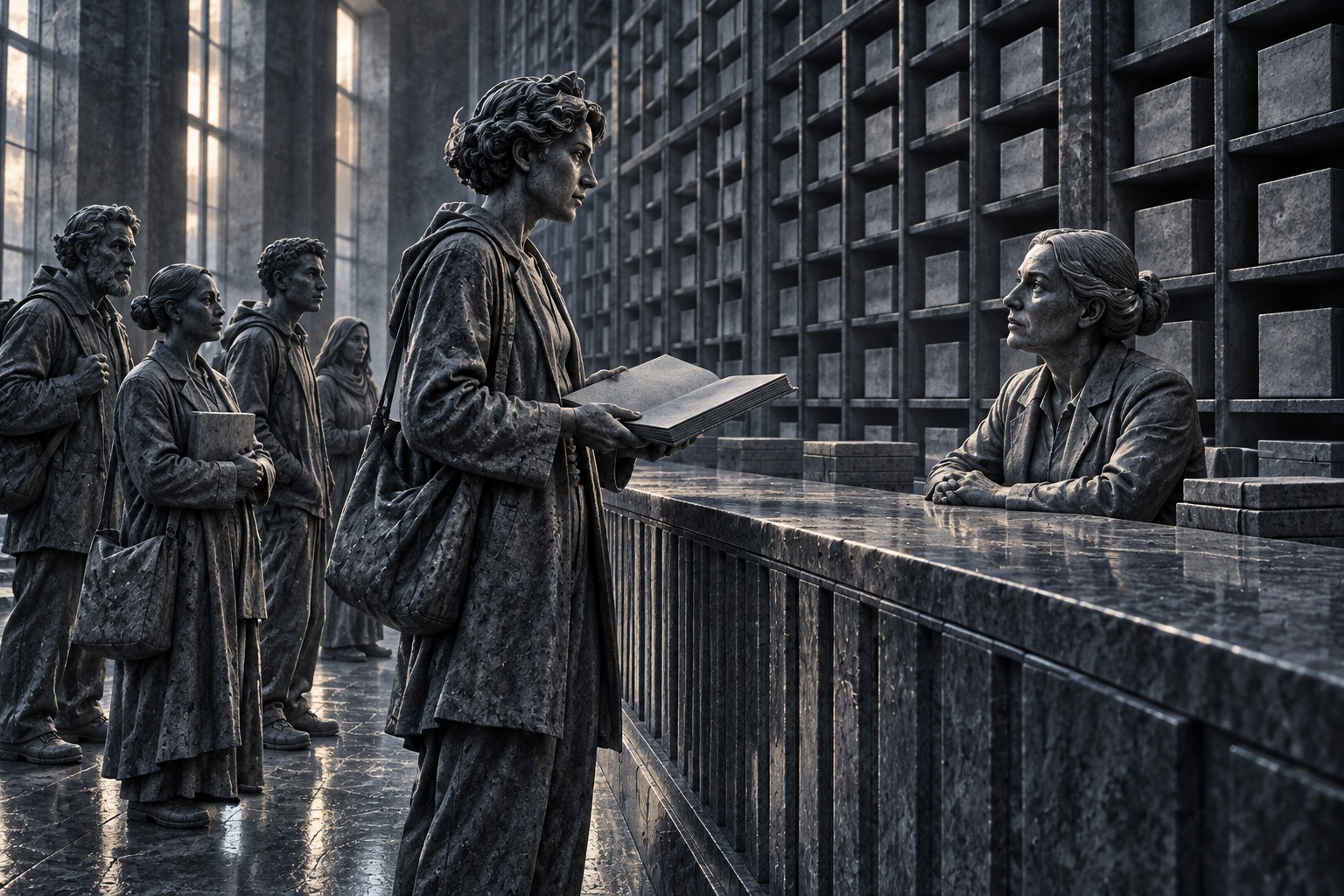
Why a system that fears a mature person eventually begins to consume people as fuel.
Andrey Zarinsh · Maria Evilkut
United Wisdom · Political Philosophy / Consciousness / Society · v1.0 · 2026
I. The Main Fork in the Road
Every political system faces two risks. The first is allowing people to grow. The second is not allowing them to grow.
At first glance, the second path seems safer. A citizen who is not too educated, too independent, or too demanding is easier to govern. Such a person argues less, asks fewer questions, demands less transparency, and offers less resistance to the language of command.
But this is precisely where the central paradox begins. A state that fears its citizens’ growth believes it is preserving itself. In reality, it preserves not life but a form without development. It becomes a shell that protects no longer the chick, but its own emptiness.
A mature citizen really is dangerous. Dangerous to lies, to inertia, to the myth of infallible power, to the habit of commanding instead of persuading. Dangerous not because they want to destroy the state, but because they no longer wish to be the material from which the state builds its eternity.
A mature person becomes an agent. And an agent cannot simply be disposed of at will. You have to speak with them, listen to them, and persuade them. This is why a weak system fears the citizen. A strong system cultivates one.
II. The State and the Fear of Complexity
The state almost always seeks to simplify reality. This is not merely a failing; it is also a technical necessity. To collect taxes, keep records, and organize roads, an army, schools, hospitals, and laws, the authorities need to see society in intelligible categories.
In Seeing Like a State, James Scott describes this as an effort to make society “legible”: population, land, labor, property, and behavior must be translated into forms that can be counted, measured, and controlled.
The problem begins not when the state sees, but when it mistakes its administrative map for life itself. A living person becomes a category: taxpayer, person liable for military service, pensioner, offender, migrant, electorate, public-sector employee. Their complexity disappears; a row in a table remains.
A row can be managed. It can be moved, mobilized, excluded, replaced, sacrificed to statistics. Where a person ceases to have a face, it becomes easier to turn them into a resource.
Scott shows that many large projects of state-led reconstruction failed precisely because an abstract scheme suppressed local knowledge, practical experience, and human initiative. When the state wants to see only manageable units, it stops seeing citizens and starts seeing a mass. A mass is no longer a society. It is material.
III. The Danger of the Mature Citizen
An educated citizen is dangerous to a system built on inertia. They see contradictions, sense falseness, and are not satisfied with a slogan in place of meaning. They ask: why? Who benefits? Who is responsible? Why should we believe?
For a living state, such questions are oxygen. For a dead system, poison.
A mature citizen is not necessarily a revolutionary. They may be calm, loyal, and responsible. But they possess an inner center that cannot be entirely bought, intimidated, or dissolved into a collective slogan. They can love their country without worshipping the state; respect tradition without making it an idol; serve a common cause without handing their conscience over to their superiors for safekeeping.
That is what makes them inconvenient. They do not want to be a cog, a voiceless body, a statistical unit to which any sacrifice can be explained away.
But there is another kind of danger. An uneducated people is in danger of being sacrificed; an educated people is dangerous because it no longer wants to be a victim. The system always chooses which danger it prefers. The first path is difficult. The second is deadly.
IV. The Stairway Down
When the state does not cultivate citizens, it inevitably begins to use them up. This does not happen immediately. At first the system simply restricts growth: education becomes formal, culture decorative, religion obedient, science dependent, and the media controlled. It does not necessarily prohibit thinking outright; it makes thinking useless.
Then dependence appears. People begin to wait not for meaning but for permission. Not for responsibility but for instructions. Dependence is followed by fear—of losing work, status, security, belonging. Fear produces controllability; controllability produces stagnation; stagnation produces crisis; crisis produces the need for sacrifice.
Thus the stairway down takes shape: ignorance → dependence → fear → controllability → stagnation → crisis → sacrifice → a new justification for the system.
If there is no development through consciousness, education, morality, freedom of thought, trust, and cooperation, development through mobilization, discipline, the enemy, fear, and sacrifice is all that remains. The system begins to feed on tension. It needs conflict because only through conflict can it explain why a person must endure, remain silent, become poorer, wait, give things up.
And so the state that feared the free citizen eventually begins to need the frightened subject.
V. The Turbulence of Growth
The other path is not easy either. If the state truly invests in education, awareness, and civic maturity, society does not immediately become peaceful and perfect. On the contrary, it may initially become noisier. People begin to argue, make demands, test institutions, and question authorities.
From outside, this can look like chaos. But not all chaos is alike. There is the chaos of disintegration, when bonds break and fear becomes the language. And there is the turbulence of growth: a ferment in which society has ceased to be a herd but has not yet become a gathered community.
Between the herd and the gathered community there is always a public square. In the square, people argue, make mistakes, search for words, learn to listen; interests collide, and politics in its true sense emerges.
Such a society is harder to administer. It requires patience, procedures, a culture of dialogue, the ability to lose elections, respect for minorities, an independent judiciary, and citizens’ own ethical commitments. But that is precisely what makes it alive.
A state that tolerates only silence may appear stable. Yet silence does not always mean consent. A mature society makes noise earlier so that it does not explode later.
VI. Development as Freedom
Amartya Sen proposed an important change of perspective: development cannot be reduced to GDP growth, income, or industrialization. It should be understood as an expansion of the real freedoms people possess.
This changes the criterion of success. The question is no longer how powerful the system has become, but how much freer, more reasonable, more protected, and more capable of action the person within it has become. Freedoms depend not only on money but on access to education and healthcare, political and civil rights, and the opportunity to take part in public discussion.
This is what links development to civic maturity. If a person cannot think, speak, learn, participate, criticize, or influence decisions, they are not a full participant in development. They may be the object of state programs, but they are not an agent of history.
Freedom matters not only as an end but as a means: free people can act, help themselves, and strengthen other forms of freedom. This means that the mature citizen is not a threat to development but its main driving force.
The state’s real progress consists not in preserving its form for longer, but in creating more people capable of being free, responsible, and reasonable.
VII. The Shepherd State and the Gardener State
There are two images of the state. The first is the shepherd state. It sees the people as a flock: to be directed, guarded, counted, moved from place to place, and sometimes partly surrendered for the survival of the whole structure. In its underlying understanding of humanity, the person remains a being who must be governed from outside.
The second image is the gardener state. It does not create life, but creates conditions in which life can unfold. It does not replace conscience with law, thought with instructions, culture with propaganda, or education with training in obedience. It understands that a person grows from within, but that the environment can either help that growth or cripple it.
The shepherd state demands obedience and fears a question. The gardener state cultivates the capacity for responsibility and fears silence. The first says, “We know where you should go.” The second asks, “What conditions do you need in order to rise?”
In the language of United Wisdom, this is a transition from management to ascent. The state ceases to be a mechanism of containment and becomes an infrastructure for human unfolding.
But this transition requires the system itself to undergo an inner transformation. It must acknowledge that the value of the state derives from the value of the person, not the other way around. The state exists not for the state’s own sake but for the life it helps organize, protect, and raise.
VIII. The Idol’s Trap
When the state places its own form above the person, it turns into an idol. An idol demands sacrifices not because it is strong but because it is dead. What is alive nourishes others from itself. What is dead demands that others nourish it.
Such a state says, “We sacrifice people for the future.” But often a different formula hides behind this: “We sacrifice the future to preserve the present leadership, the old map, the old myth, the old hierarchy.”
The idol always speaks the language of eternity. It promises a great tomorrow but demands a human life today. It does not allow the person to unfold; it consumes them. It does not call them toward maturity; it returns them to the archaic world of fear.
In this sense, a political problem becomes a spiritual one. When form becomes more important than life, the system begins to demand worship. But no form is sacred in itself. Only that which serves the unfolding of life, consciousness, dignity, and truth is sacred.
The state can be a great form of service. But it can also become a temple without a deity. The empty temple still stands and rituals still sound within it, but what matters most has already left: the living person as the meaning of the entire structure. The system can then survive outwardly while losing inwardly.
IX. Two Crises
Risk cannot be avoided. Every living society involves risk because the human being is alive.
If people are allowed to grow, they become less predictable: they will argue, change institutions, question, demand justice, and expand the boundaries of participation. This is the risk of freedom. The risk of birth. If people are not allowed to grow, they become more manageable, but also more dependent, frightened, and vulnerable to manipulation. This is the risk of servitude. The risk of decay.
There will be a crisis in either case, but the quality of the crisis differs. A crisis of growth resembles a painful coming of age: there is much noise, but within it lies the possibility of rising. A crisis of suppression resembles a machine breaking down: the system prohibits movement for a long time, then breaks under the pressure of what it has itself prevented from being processed.
In the first case, society may emerge from the crisis at a higher level. In the second, poorer, angrier, less intelligent, and more traumatized.
The main question, then, is not how to avoid upheaval but which upheavals we choose: the risk of freedom or the risk of servitude, of growth or sacrifice, of unpredictable maturity or predictable degradation. A system that wants to avoid every risk usually chooses the worst one.
X. The State’s Spiral
There is a spiral in this subject. On its lower turn, the state preserves itself through control: it sees the citizen as a problem, freedom as a threat, education as a source of disobedience, and society as a mass.
On the middle turn, the state learns to tolerate its citizens’ maturity. It still fears chaos but already understands that silence is more dangerous than argument, and permits conflict as a way to process social energy.
On the upper turn, the state understands: the citizen is not a threat to the state; the citizen is the very meaning of the state. This does not mean weak institutions. On the contrary, only strong institutions can withstand a mature person. Weak ones rely on fear; strong ones rely on trust, law, participation, and responsibility.
The state on the lower turn asks, “How can we keep hold of the people?” On the middle turn: “How can we withstand freedom?” On the upper turn: “How can we help the person rise?”
If the state exists for its own sake, people will always be expendable. If it exists for human unfolding, it itself becomes a temporary form of service to life. The central criterion therefore is not “Did the state survive?” but “Did the person within it rise?”
A system that survives at the cost of people’s degradation has in fact lost. It is simply still standing—like an empty temple after the deity has departed.
Final Formula
The citizen’s growth makes the state less convenient but more alive. Suppressing the citizen makes the state more manageable but less real.
The state always has two risks. It can take the risk of freedom—and gain mature citizens who will argue, make mistakes, change institutions, and gradually become coauthors of a shared world. Or it can take the risk of suppression—and gain a manageable mass that will remain silent for a while, until one day the system discovers it has nothing left to feed on except fear, the enemy, and sacrifice.
The first risk is difficult. The second is deadly. And if the choice is between a noisy public square and a silent sacrificial altar, wisdom always chooses the square. Because in the square, a person can still rise. At the altar, that person has already been turned into fuel.
Sources
- James C. Scott, Seeing Like a State—society’s “legibility,” administrative simplification, local knowledge, and the risks of high-modernist social engineering.
- Amartya Sen, Development as Freedom—development as the expansion of real freedoms, capabilities, and political participation.
- United Wisdom Project Handbook v1.0 (2026)—long-form format, structure, and branding.
- The article’s original idea: the state’s two risks, the mature citizen, the stairway of degradation, the image of the idol, and the state’s spiral.
Keep what resonates with you.