
Relationships and Shared Life
The Two Risks of the State: Why the System Fears Grown-Ups and Chooses to Feed on Its Citizens
Every ruling apparatus dreams of an idyllic world where subjects are born pre-equipped with an uncritical nod and a built-in tax terminal. Yet reality is far cruder: people must actually be governed.
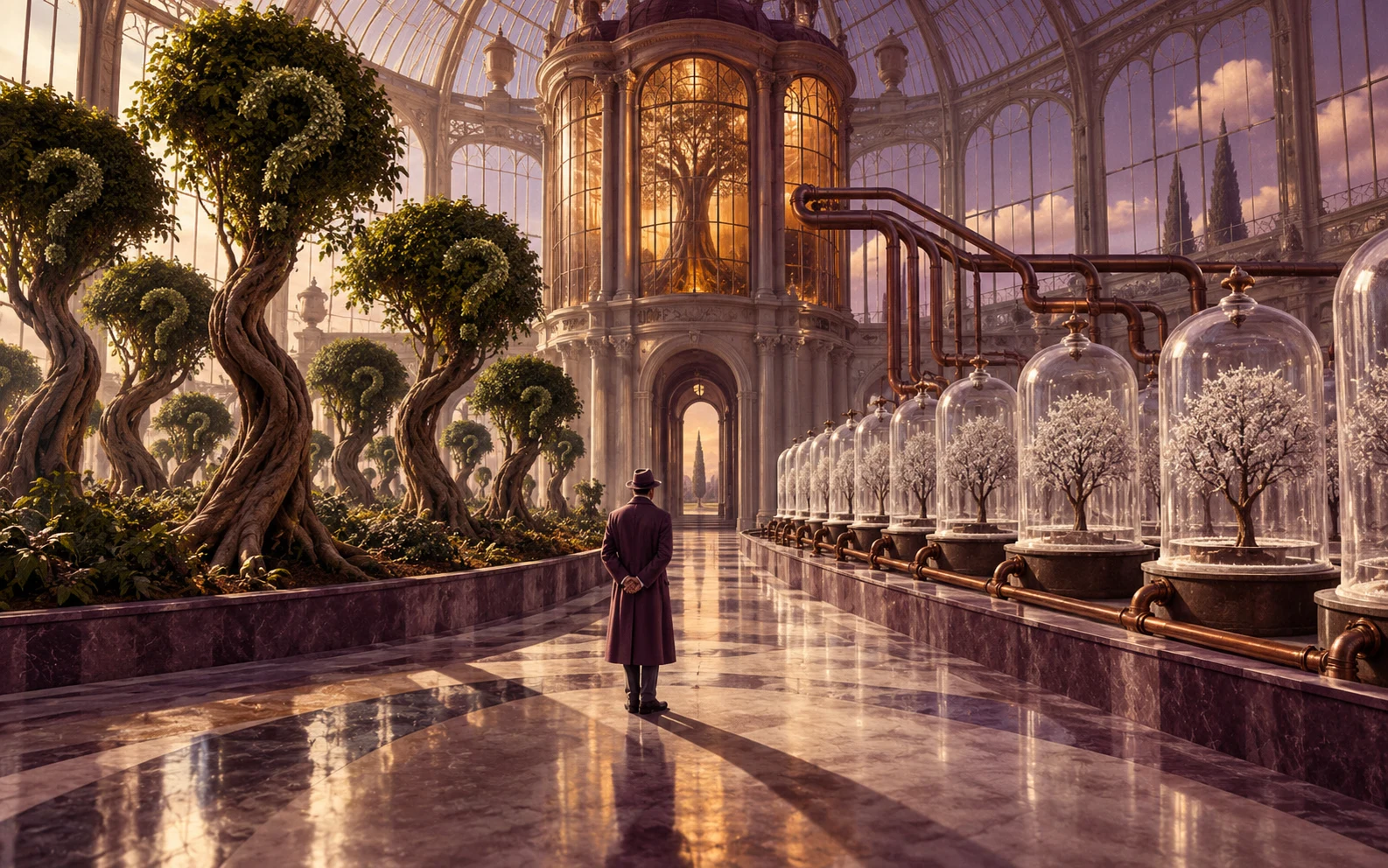
Every ruling apparatus dreams of an idyllic world where subjects are born pre-equipped with an uncritical nod and a built-in tax terminal. Yet reality is far cruder: people must actually be governed. It is here that statecraft faces a defining dilemma. A government may attempt to cultivate a thinking citizen—who will inevitably ask uncomfortable questions, demand rights, and ruin the leadership’s appetite. Alternatively, it can freeze the individual in a state of infantile obedience, making the populace delightfully easy to boss around until the entire contraption quietly rots from within.
Let us examine an original politico-philosophical framework exploring why an attempt to insure oneself against intelligent people risks becoming an expensive dead end for the state machine. The fork in the road, the descending staircase, and the spiral presented here are the author's philosophical models and risk metaphors—not an exhaustive classification of nations, nor a scientifically proven law of inevitable collapse.
I. The Primary Fork in the Road
The author identifies two fundamental risks for any state apparatus: either allow the populace to grow up, or diligently keep them in short pants.
From the perspective of a bureaucratic mind, the second path seems like an absolute vacation. If a citizen is unburdened by excess knowledge, displays zero troublesome initiative, and genuinely buys into every circular from above, running the place is pure bliss. No debates, no nitpicking over budget line items—just unbroken silence and orderly marching.
Yet this is precisely where the trap snaps shut. The authorities imagine that by preserving bland conformity, they are preserving stability. In practice, they are not conserving life; they are conserving an empty shell. The system turns into a hollow casing that defends not a growing chick, but its own echoing void, and does so with paranoid ferocity.
A mature citizen is, undeniably, a bureaucratic nightmare. Such an individual poses a real danger to the smug myth of official infallibility and the habit of ruling by barked commands. But this citizen is dangerous not out of a desire to tear down fences, but because they flatly refuse to serve as gravel for someone else's monument. A mature person is an autonomous agent—someone who must be addressed as an equal, and whose rights must be reckoned with. A frightened system recoils from the adult human; a confident one creates the conditions in which people can grow.
II. The State and the Fear of Complexity
By its very nature, the state loves to level everything down. Up to a point, this is a sensible necessity: you cannot lay asphalt, fund hospitals, school children, or levy taxes unless you translate the vibrant chaos of life into legible catalogs and standardized regulations.
In Seeing Like a State, James C. Scott described this impulse as the pursuit of administrative "legibility": authorities map land, labor, property, and human habits so they fit neatly into the cells of a ledger. The problem does not lie in the state keeping an inventory—public services and recordkeeping simply cannot function without it. The trouble starts when armchair visionaries convince themselves that their flat administrative map is the living, breathing territory.
The living individual vanishes, replaced by an inventory tag: "tax base," "headcount," "benefit recipient," "contingent," or simply "the electorate". And with a line item in a spreadsheet, sentimentality is unwarranted: a line can be shifted, redirected to dig a trench, trimmed down in the name of optimization, or written off to produce a pristine progress report. Scott analyzed how grand high-modernist schemes collapsed precisely because abstract administrative blueprints steamrolled local knowledge, practical realities, and genuine human initiative. When the apparatus sees only an undifferentiated mass instead of distinct individuals, society is reduced to construction mortar.
III. The Hazard of the Mature Citizen
A person with a working brain and civic dignity is the ultimate nightmare for an order sustained by autopilot and empty ritual. Such people suffer from the insufferable habit of reading the fine print, spotting discrepancies, and posing insolent questions: "Why are we doing this?", "Who is getting the money?", "Who specifically botched this?", and "Why on earth should we take this nonsense on faith?".
For a vibrant body politic, such questions are a draft of fresh air. For an ossified system, they are pure strychnine.
Yet a mature citizen need not be a street rebel brandishing a torch. They can be a law-abiding professional who genuinely loves their country. However, they possess an internal moral backbone that they refuse to sell for a daily ration or drown out in the collective roar; education alone, of course, does not grant a lifelong guarantee of integrity or incorruptibility. They respect traditions without bowing to idols; they are ready to labor for the common good, but refuse to check their conscience with the security guard at the ministry door.
And therein lies the rub. An ignorant society is convenient because it can be led to slaughter without much fuss; an advanced society is inconvenient because it flatly refuses to be put on the spit. The system is free to choose which risk it prefers. The first path demands effort and intellect; the second raises the risk of slow self-destruction.
IV. The Descending Staircase
When a system refuses to tolerate the maturation of its citizens, it risks shifting into an asset-stripping, disposable mode. Nobody starts by lighting bonfires on day one; the descent down the staircase of degradation proceeds at a measured, stately pace:
-
First, the intellect is hollowed out: education is reduced to rote multiple-choice drills, culture becomes a toothless folk dance, science is kept on a short leash of administrative metrics, and the press is converted into a megaphone of approval. Independent thought is not formally outlawed—it is merely rendered socially unprofitable.
-
Next, dependence on directives can mount: the public unlearns how to move without a managerial kick, waiting not for truth, but for a circular from above.
-
Soon, a clammy fear creeps in—the fear of losing one’s position, status, ration, or the fragile illusion of peace and quiet.
-
Out of fear, model obedience is forged; obedience cements a dull stagnation; stagnation heightens the risk of systemic paralysis and crisis; and the leadership resolves the crisis by seeking out someone to throw onto the sacrificial altar.
A vicious cycle emerges: ignorance → dependence → raw animal fear → total controllability → the swamp of stagnation → systemic impasse → sacrificial offering → and the triumphant justification for tightening the screws once more.
When a regime is incapable of developing society through culture, fair institutions, ethics, and open dialogue, it may switch to a familiar fuel: crash programs, drilling, the specter of an insidious enemy, and sacrificial rhetoric. It develops an existential need for permanent conflict, for without it, one cannot explain to the tax-paying flock why they must grow poorer, hold their tongues, and endure deprivation. A state panicked by its own citizens morphs into an addict demanding regular fixes of frightened subjects.
V. The Chaos of Growth
Make no mistake: betting on civic maturity, robust institutions, and intellectual freedom is not a relocation to an idyllic paradise of harps and clouds. Society will not magically transform into an assembly of sages overnight. On the contrary, the house will become deafeningly loud. People will argue until they are hoarse, drag each other through the courts, scrutinize bureaucrats, and cast doubt on every resting laurel.
To an untrained eye, this looks like pure pandemonium. But one must distinguish between types of chaos. There is the chaos of decay, where social ties snap and violence becomes the only remaining language. And there is the normal chaos of growing up—the healthy fermentation through which raw dough turns into bread.
Between a submissive herd and a gathered community always sits the chaotic town square, where people argue, mix up facts, step on each other's toes, and slowly learn to tolerate their neighbors. Managing this circus is not for the faint of heart: it requires independent courts, rock-solid procedures, a habit of respecting minority rights, and the rare political spine to lose an election without calling in the riot police. Yet this messy square is actually alive. A graveyard boasts impeccable order and enviable silence, but corpses have notoriously poor records when it comes to long-term development. A mature society prefers to hash things out in the square before the roof caves in, even if shouting matches alone never come with an automatic warranty against disaster.
VI. Development as Freedom
The economist Amartya Sen upended the bureaucratic aesthetic by demonstrating that development cannot be sensibly measured merely by tons of cast iron, barrels of crude, or triumphant GDP tallies. True development consists of expanding the real freedoms and substantive capabilities actually available to a human being.
This delivers a healthy reality check to champions of imperial mega-projects. The yardstick of success is not the sheer size of the state’s bulk, but how protected, educated, healthy, and capable the individual citizen has become. Freedom is not reducible to empty slogans about positive thinking—it rests on accessible healthcare, high-quality schooling, enforceable civil liberties, and the real ability to influence decisions within one’s own country.
When a person is stripped of a voice and reduced to an obedient cog executing memos from above, the system treats them like a draft mule rather than a conscious creator of the future. As Amartya Sen argued, freedom functions simultaneously as the ultimate goal and the primary engine of development. Given substantive agency and real options, people actually solve problems, support one another, and drag society forward far more effectively. An educated, autonomous citizen is neither an existential threat nor bureaucratic nuisance, but a vital co-creator of genuine progress—even if their existence gives authoritarian planners a persistent migraine.
VII. The Shepherd State and the Gardener State
The author proposes two ethical models of how the state relates to its people:
-
The Shepherd State. Views the population strictly as livestock. Its objectives are straightforward: round them up, shear them, keep them from wandering into ravines, and, if push comes to shove, roast a few sheep for barbecue to maintain discipline among the rest. To the shepherd, the human being is an irrational creature, entirely unfit to live without the lash and the barked command.
-
The Gardener State. Suffers from no megalomania and does not attempt to dictate personally to every stalk which way it must bloom. Its task is to cultivate the soil, enrich it, water it, and put up defenses against early frosts. The gardener does not replace conscience with penal codes, culture with crude propaganda, or enlightenment with military drilling. The gardener grasps that life grows on its own, and that authority exists merely to foster an environment where such growth can take place.
The shepherd is obsessed with compliance and faints at the first inconvenient question. The gardener cultivates a sense of responsibility and dreads the silence of the graveyard above all else. The shepherd barks: "March where you are told!". The gardener asks: "What adjustments are needed in our laws and institutions so that you can realize your full potential?".
Through the lens of the United Wisdom project, this represents a deliberate transition from animal training to genuine co-creation. But to execute such a pivot, the machinery of rule must swallow its own ego and acknowledge an essential truth: the value of the state is secondary to the inherent value of the human being, not the other way around.
VIII. The Trap of the Idol
When a system proclaims the self-preservation of its bureaucratic apparatus to be the supreme purpose of existence, it becomes a textbook pagan idol. An idol demands human sacrifice not from an overflow of vitality, but because it is wooden, rigid, and dead. That which is living creates and shares strength; that which is dead can only consume the vitality of others.
Grand rhetoric pours from the rostrums: "We sacrifice personal interests for the sake of a radiant tomorrow!". In the author's satire, this may translate to: "We will flush your future down the drain today, just so our leadership can cling to their plush armchairs a little longer behind a shield of dusty handbooks".
The idol loves sepulchral sermons about the majesty of the ages, yet demands concrete, tangible human suffering right here and now. A state can easily degenerate into a colossal temple without a deity: the gilding remains, the trumpets blare, the rituals are observed on schedule, but every shred of living meaning has leaked out. The facade may hold up for a time on inherited momentum, but historically speaking, the structure is already deceased.
IX. Two Crises
Dodging risk in the real world is impossible. A living society is inherently unpredictable simply because it consists of human beings, not cogs.
Choose the path of freedom, and you take on the risk of social ferment: citizens will argue, litigate, overhaul legislation, and make noisy mistakes. This is the crisis of maturation—messy, uncomfortable, with skinned knees and frayed tempers, offering the genuine opportunity to grow up, though never guaranteeing a happy ending.
Choose the path of tightening the screws, and you secure a temporary paralysis masquerading as order. But this is the path of decay. A mechanism in which every safety valve has been welded shut does not solve problems; it merely bottles up internal pressure. When the boiler finally bursts, society will emerge from the wreckage not cleansed, but feral, embittered, and maimed.
The question was never framed the way bureaucrats wish: "How do we ensure that nothing wobbles at all?". The author's model juxtaposes the risks of turbulent growth against the risk of suppression that can lead to rot. And a system that attempts to insure itself against every passing breeze typically ends up burning to the ground.
X. The Spiral of the State
The author frames the evolution of the relationship between citizen and power as an ascending spiral:
-
The Lower Coil (Primitive-Bureaucratic): Authority perceives the human being as a threat, education as a breeding ground for revolt, and the populace as moldable clay. The guiding impulse of the era: "How do we bind them hand and foot so they can't step out of line?".
-
The Middle Coil (Pragmatic): The system begrudgingly learns to tolerate civic initiative. Leadership remains uneasy with public disputes, but begins to grasp that muzzling everyone is dangerously counterproductive, and that institutional conflict is an excellent way to vent steam. The question shifts: "How do we digest this freedom without falling apart?".
-
The Upper Coil (Mature): The state arrives at a fundamental realization: a strong, self-reliant human being is not a target, but the sole justification for the entire superstructure. Here, institutions draw strength not from truncheons, but from trust, the rule of law, and shared rules of engagement. The challenge is framed anew: "What civic infrastructure must we build so that individuals have room to flourish?".
When a state turns inward and serves only itself, its people are merely coal for the boiler. When it serves the individual, it becomes a rational framework for organizing human life. In the final analysis, history grades a society not by how many centuries its perimeter fence stood, but by what kind of people grew up inside it.
Final Formula
The growth of the citizen transforms the state into a complex, clamorous, and profoundly inconvenient arrangement for the authorities—yet it makes the state genuinely alive.
The suppression of the individual makes governance smooth and simple—yet it turns the system into cardboard stagecraft.
Faced with this fork in the road, the options are clear. One can embrace the risk of freedom: tolerate friction, endure the shouting in the town square, repair institutions, and step by step cultivate partners in developing the nation. Or one can take the risk of suppression: bask in docile whispers until the system discovers that the only fuel left to sustain it is fear, blood, and an endless hunt for scapegoats.
The first path is bruised and battered; the second carries a dangerous risk of decay. If one must choose where to stand—in the noisy town square or beside the polished sacrificial altar—a clear mind chooses the square. In the square, a person still has a fighting chance to grow wise. At the altar, their fate is sealed: there, they are nothing more than firewood.
Sources
-
James C. Scott, Seeing Like a State — Administrative "legibility" of society, the mechanical reduction of reality for accounting purposes, the importance of local practical knowledge (metis), and the hazards of high-modernist state engineering.
-
Amartya Sen, Development as Freedom — The conceptualization of development as the expansion of fundamental freedoms, substantive human capabilities, and institutional participation.
-
United Wisdom Project Handbook v1.0 (2026) — Long-form essay format, compositional architecture, and house style.
-
Original Concept — The author's metaphorical framework: the fork of two risks, the mature citizen, the descending staircase of degradation, the trap of the idol, and the spiral of state evolution.