
Relationships
Different Religions and Shared Family Celebrations
How to arrange a family celebration among different religions while distinguishing invitation, presence, ritual, and profession of belief.
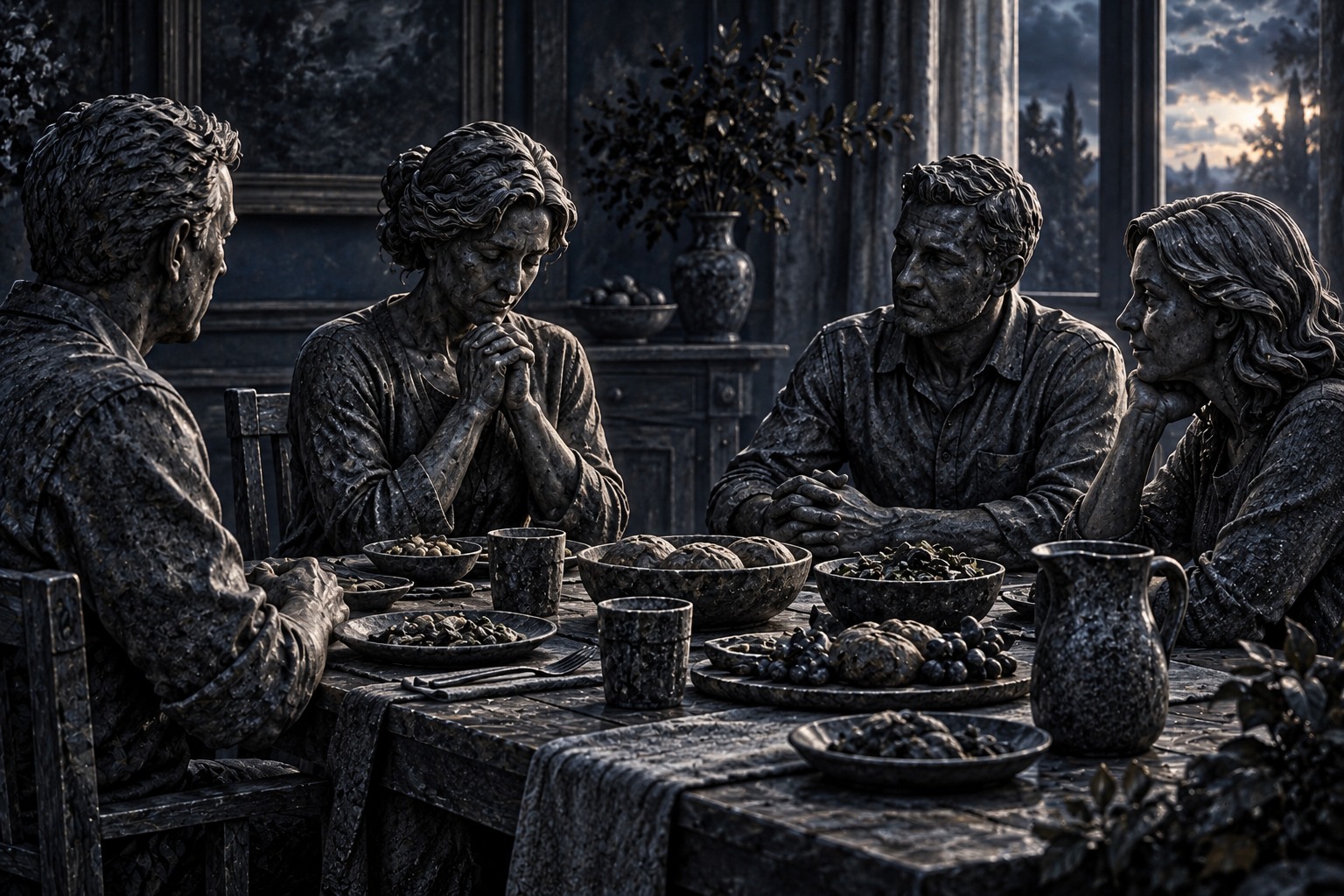
Epigraph
…We are friendly…
E.M. Forster, A Room with a View, chapter I; fragment of the fictional Mr. Beebe's answer about Emerson.
What this article is about
One festive table can bring together people who understand the celebration differently. For the host it commemorates a religious event; for her brother it offers a chance to see relatives; for a guest of another faith it means an invitation to a cherished home. Sometimes the difference passes almost unnoticed. Sometimes it emerges at a particular moment: everyone gathers to say a prayer, and someone does not want to speak words they do not profess. Refusal can easily be taken as rejection of the family; participation can easily be taken as agreement with the hosts' faith. Between those conclusions there is room for a more precise understanding of the gathering.
Here we consider a shared family celebration among people with different religious convictions, including no religious affiliation. A literary conversation, a Catholic declaration, and a New Testament distinction between a meal and participation in worship retain their own foundations. They provide no general permission for every rite and do not represent every religion. The domestic story below is hypothetical; the practical map is editorial. It helps distinguish invitation, presence, action, and profession of belief, without promising agreement, preservation of relationships, or a safe outcome. A shared gathering may have several available forms; sometimes there will be no joint arrangement on this occasion.
I. Invite a person without assigning their beliefs
Imagine Nina, who is hosting a festive lunch. For her, the day is connected with Christian faith and memories of her mother. Her brother Timur follows another religious tradition; his wife Lena is not religious. Previously they came after the service, helped set the table, and talked with relatives. This time Nina wants to begin with a shared prayer. She considers it a natural part of the celebration and does not notice that the invitation has changed. Timur knows about the prayer but does not yet understand whether he is expected to say particular words or whether being nearby is enough.
His question does not necessarily mean hostility. Timur may want to visit his sister while also refusing to imitate her profession of faith. Nina may sincerely share something important while understanding her guest's consent too broadly. While they debate who respects the family, the subject slips away: what action is proposed at the beginning of lunch? They can name it without judging the other's entire faith. An invitation to a gathering that includes prayer and a request to say a prayer are different proposals. The second needs its own answer; it does not follow automatically from the first.
This distinguishes our topic from R35, which considers family belonging based on different foundations. Timur need not prove that he remains a brother through a particular ritual action. Nina need not abandon her religious meaning to recognize her brother either. Here the subject is the arrangement of one gathering. What happens, who participates, who is present without participating, and where can someone join later? These distinctions do not guarantee a calm response. They make it possible to notice an actual mismatch before the celebration turns into a public test of belonging.
It helps to announce a significant part of the program in advance, especially if it has changed. A domestic invitation need not become a long questionnaire about convictions. Naming a prayer, service, or another action that affects someone's ability to participate may be enough. A guest can clarify a personal limit without explaining their whole biography. A host can acknowledge being unwilling to change a particular part of the evening. Such honesty does not remove the difference, but leaves the person an answer. An unspoken assumption does not become an obligation merely because the gathering is called a family event and the intention was kind.
II. One gesture can carry different meanings
For Nina, shared prayer expresses gratitude to God. For Lena, speaking those same words would look like affirming a faith she does not hold. If Nina calls them simply a beautiful tradition, that does not cancel her original meaning. If Lena calls every prayer coercion, that does not describe the host's voluntary action precisely enough. Both meanings can remain: prayer matters to Nina as prayer, and Lena need not profess its content. Participation is easier to discuss when the action is named honestly, without minimizing it or attributing a hostile intention.
The meaning of presence also differs. One person considers remaining silently nearby a mark of respect; another understands it as participating in a rite; a third sees no religious affirmation in it. This article does not decide that question for a particular tradition or a person's conscience. We cannot universally declare silence permissible for everyone, nor automatically label it a profession of faith. If the distinction matters, actual personal conditions need to be established and an available arrangement explained. This is a separate task, which our convenient domestic distinction between speech and presence cannot replace.
In chapter ten of First Corinthians, an ordinary meal at an unbeliever's invitation and participation in a cultic meal receive different treatment. Verses 27–29 also introduce the declared origin of food and conscience. This is Christian instruction within its own religious context, rather than a universal code for family celebrations. It helps show why merely describing an object as food may be insufficient. The action's meaning and its announced context can matter to a believer. We do not transfer biblical judgments about another cult onto contemporary guests or present them as a shared neutral vocabulary.
This provides no ready list of permissible actions for Timur. His tradition has not been researched here, and Nina should not become its self-appointed interpreter. It is enough to acknowledge that the availability of participation cannot be determined by a gesture's outward simplicity. Requesting a convenient version of someone's faith for a group photograph is a poor substitute for asking. He can clarify his conditions with an appropriate knowledgeable person if he considers that necessary. The decision should not be extracted through pressure at the festive table, when refusal already means bearing everyone's attention at once.
III. Respect does not require declaring differences insignificant
Sometimes peace in a family is offered in exchange for saying that all religions essentially teach the same thing. Some people welcome that formula, but it cannot be a condition of invitation. Nina may regard her profession of faith as specific and significant; Timur may decline her religious propositions. Lena may share neither. A common lunch need not settle this dispute. If respect is possible only after agreeing that differences are empty, people are being offered another belief, which they also need not accept for the family's convenience.
In the Catholic declaration Nostra aetate of 1965, respectful regard for other religions and a call to dialogue appear alongside a Christian profession of faith. Section 3 notes a difference between Christian and Muslim understandings of Jesus. The document neither makes religious propositions identical nor replaces each tradition with its own map. For our topic, the limited example matters: dignity and the possibility of collaboration can be discussed while differences in conviction remain. This is the position of a particular Church document, rather than agreement we have discovered among all religions or permission for a joint rite.
Nina can therefore explain the religious meaning of her day without requiring guests to call it their own. Timur can say that he values the gathering without promising to participate in prayer. Lena can come without pretending that personal pleasure makes her religious. These responses are not fully symmetrical: the host arranges her event, while the guest decides about personal participation. Neither role should silently appropriate the other's beliefs. In our hypothetical scene, respect is tested through how honestly real choice remains available, rather than through identical vocabulary.
Comparative conversation has limits too. Not every celebration is suitable for discussing theological disagreements. People may want to talk about a significant event without being ready to defend their whole tradition before relatives. A guest does not become the representative of everyone who follows their religion, nor the host an obligatory lecturer. A broad dispute can be postponed or declined. This does not prohibit interest. A question can be sincere and still untimely; agreement to explain one action creates no obligation to endure an unlimited evening of tests and objections.
IV. Being present, observing, and participating are different proposals
Nina clarifies the program: a short prayer at the beginning, followed by lunch and family photographs. Timur prefers to come for lunch. Lena is willing to remain nearby during prayer without saying it. Nina does not yet know whether this arrangement suits her. Different answers are possible here, and the article appoints no exemplary one. What matters is that the initial invitation has become several concrete proposals. People can accept them differently. Refusal of one action need not automatically be translated into refusal of the entire gathering if an actual wider arrangement is available.
Yet presence without participation is not always feasible. The space may be small, the action indivisible, or the person may regard observation itself as incompatible with a personal limit. A spectator's position should not be assigned as an obligatory compromise. A host may also be unwilling to divide an important part of the celebration into fragments convenient for everyone. Then acknowledging the mismatch is more honest than imitating agreement. A separate gathering on another day sometimes remains possible; sometimes a person declines that too. Togetherness cannot be established through a cleverly invented schedule against participants' answers.
If several forms are available, they can be explained without ranking closeness. A relative arriving after prayer is not automatically less loved. A person remaining silently present is not automatically a better mediator. Someone speaking the words should not gain priority in family conversation as a more proper guest. This is an editorial ethical framework, rather than a factual law of all families' behavior. It protects the meaning of voluntary action: consent matters precisely because another answer is possible. If refusal is charged in advance with public humiliation, a polite invitation does not sufficiently describe the real conditions.
The possibility of leaving early can also be clarified. A guest agreed to lunch without knowing that a new religious action was planned later. Changing the program creates no new consent retrospectively. The host can announce it, and the person can choose whether to continue. They need not debate the correctness of that choice in front of everyone. If circumstances restrict departure or raise concern, our festive practice does not become obligatory. No protection plan for a particular situation has been constructed here; it is enough not to declare staying until the end proof of love that must be provided regardless of conditions.
V. Hospitality has a material side
Lunch requires time, ingredients, and work. Different dietary restrictions can become a separate practical task, but they cannot be guessed from religious affiliation alone. Timur can name a particular condition he observes; Nina can say what she can actually prepare. This article establishes no dietary rules for each religion and does not guarantee a dish's suitability. Ingredients, preparation, and the guest's personal judgment need separate consideration. The host's warmth does not turn an unknown ingredient into a verified one, nor does a question about it necessarily mean distrust of all her hospitality.
If the host cannot meet a condition, an available alternative can be considered: a separate dish, participation without eating, or another day. No option is prescribed. An offer to bring one's own food also has a cost: the person must prepare and transport it, and the host must accept that arrangement. The task should not be called resolved while work has simply been moved to the guest without consent. On the other hand, a voluntary small contribution may suit both. We distinguish actual feasibility from an unspoken assignment of duty, without measuring love through the amount of festive labor.
Such precision also applies to time. Different celebrations have different dates, and people have work, journeys, and other relationships. A common family calendar need not compress them into one correct gathering. Nina can arrange her day, Timur invite people to another, and Lena participate where it suits her. Not every refusal concerns faith; sometimes a person is simply unavailable. Lateness should not be explained as religious disrespect without factual grounds. Repeated inability to take part may also require a separate conversation, rather than endless hope that another invitation will remove incompatible schedules.
A shared celebration should not become an obligation to serve every event in the same way each year. Capacities change. One available contribution can be agreed, then reconsidered later while accounting for tasks already accepted. Sometimes someone wants only to send greetings; sometimes to visit briefly. These forms may not fully satisfy the host; the article does not promise that a precise explanation will remove disappointment. It does help avoid treating availability as unconditional devotion or making an invitation a hidden subscription to permanent work as proof of respect for the whole family history.
VI. A child is not assigned to join the adults' religions together
When a child attends, adults may react especially strongly to participation. Some see prayer as a continuation of upbringing; others as acceptance of another belief. This is a separate question of adult responsibility, actual age, conditions, and the family's specific circumstances. We establish neither legal authority nor one procedure for religious upbringing. A general article about a celebration does not permit unilateral changes to previously agreed conditions. If a decision is significant and disputed, it cannot be hidden inside a festive game in the hope that the child's presence itself will supply the desired answer without adult discussion.
A child should not be appointed judge of whose faith is better, or messenger who persuades one adult for another. The child may be interested in objects, ask about a song, or enjoy a gift. Such actions should not automatically become a public declaration of an entire future affiliation. Yet neither can they be declared meaningless in advance when adults genuinely attach religious meaning to them. An honest explanation of the relevant action is better than a concealed test. It needs to account for the child's understanding; this article provides no age-specific recommendations and does not replace necessary specialized knowledge with a general formula of freedom.
In our scene, adults can decide in advance to discuss differences without competition before the child. Nina can speak about her own faith, Timur about his, and Lena honestly name her lack of affiliation. It does not follow that the child must immediately choose among them. The gathering can show that several adult answers exist without becoming an examination. Such a conversation nevertheless does not guarantee freedom from confusion or tension. If a significant upbringing question remains open, it should not be declared resolved merely because lunch ended calmly.
It helps to distinguish explaining a difference from mockery. A child's question does not require humiliating an absent relative or their tradition. An adult can acknowledge not knowing a particular custom and postpone the answer. Nobody must invent an exact rule for someone of another faith. This applies to adults themselves too: a guest should not be forced to publicly prove the correctness of refusal before a child to preserve the host's authority. If conversation becomes a means of pressure, it can end. Caring for a child does not mean one participant must sacrifice an honest answer for a convenient appearance of universal agreement.
VII. Literary friendliness leaves room for disagreement
In the first chapter of Forster's A Room with a View, Mr. Beebe explains his attitude toward Emerson. He speaks of friendly relations while acknowledging disagreement on important matters. Nearby, a particular offer to exchange rooms is discussed; Miss Bartlett fears accepting it as an obligation. This is a fictional conversation about people and conventions, rather than an example of a contemporary interfaith celebration. We use only the limited possibility of distinguishing goodwill, disagreement, and a particular proposal. Characters' judgments, class conventions, and Emerson's insistence do not become our recommendation.
Nina may find precisely that distinction useful. She need not consider Timur's beliefs correct to want to see him. He need not accept her prayer to help carry chairs. Yet a particular contribution should not purchase access to all ritual actions either. If Timur helped, Nina has not obtained consent to a profession of faith. If Nina cooked lunch, her brother has not acquired authority to alter her religion. A friendly exchange has a limited subject. Festive gratitude does not silently expand it to every matter people still understand differently.
This does not mean a kind tone is always easy to maintain. Nina may find refusal painful because she connects prayer with her mother's memory. Timur may dislike the expectation that he must explain a previous limit again. Their feelings do not require immediate cancellation of the other's choice. They can acknowledge the moment's significance without agreeing to the proposal. Sometimes time is needed to reconsider the program; sometimes the answer remains negative. The article does not determine which feeling establishes correctness. It suggests not making pain automatic permission to assign another person's religious action.
The topic is adjacent to R33 on different worldviews, but here the decision concerns a particular event and its sequence. We are not constructing a general model of shared life. R32 also considers changing a family tradition; our task is narrower and more concrete: distinguish hospitality, ritual, observation, and profession of belief within one festive invitation. These links name neighboring subjects rather than an obligatory reading route. If lunch has a religious component, changes to decoration or recipes do not themselves settle what someone understands by their participation.
VIII. A shared portion need not replace a personal celebration
Nina decides to retain prayer for those who want it before her brother arrives. Timur comes for lunch; Lena helps set the table. This is one possible arrangement in the hypothetical scene. It is not better than every alternative merely because everyone ended up together. Nina could have preferred another form, and Timur could have declined the proposed time. What matters is that the religious portion was not renamed neutral for convenience, and guests' participation did not become a fictitious profession of belief. A shared portion was found through available answers; it was not declared proof of final unity among all views.
Sometimes people want to invent an entirely new shared celebration. It may mark a family gathering, gratitude for a particular event, or completed work. Such a decision is voluntary and need not cancel participants' religious holidays. A new shared ritual also does not automatically become free of convictions. If a symbolic action is proposed, people may understand it differently. Meaning and availability should be clarified as honestly as in the previous form. Changing a name does not resolve consent if the expectation remains that everyone must speak the same significant words.
Not every family needs a new tradition. Sometimes several separate gatherings and calm acknowledgment that a common day was not found are enough. Absence of one table does not prove absence of closeness, but neither does it guarantee its preservation. People may lack time together; that real need matters without appointing one religious way to meet it. Another available occasion can be chosen. If the other person declines, the answer cannot be replaced by a beautiful plan that exists only on paper and is presented as family peace already achieved.
Our distinction does not require endless negotiations. A host can state particular conditions for the gathering, and a guest give an answer. A full explanation of refusal need not be pursued when the matter is already clear and further discussion is inappropriate. Where humiliation, threats, or coercion are present, a joint celebration does not become an obligatory goal. Protection does not wait for a successful exercise; specific help needs consideration according to actual circumstances. A general framework cannot replace it. The possibility of not participating must remain real, including when the invitation has no form acceptable to the person at present.
IX. After the gathering, examine a particular experience
If lunch takes place, people can later notice what happened. Timur came at the agreed time; Nina retained a portion significant to her; Lena did not say the prayer. These are factual events in our story, rather than proof that every religious disagreement has been settled. Perhaps someone felt uncomfortable even though nobody argued openly. They can ask about one such portion without demanding confirmation of the whole family's success. A guest's silence does not guarantee consent; warm thanks do not mean agreement next time to every change in the program.
A check may reveal a new limitation. A group photograph reached people who interpreted it as religious participation. That was not the original intention, but the meaning of distribution also exists. We do not establish legal rules for images; the intended audience for photographs and captions can be agreed separately. A person should not be presented as a representative of a shared rite without their answer. Merely appearing in a picture gives no complete account of beliefs. The article does not promise to control every conclusion others draw: one's own message can be clarified, rather than identical understanding guaranteed for every audience.
Next year may need another form. Someone's convictions may change, someone may be busy, or someone may want less frequent gatherings. The earlier lunch remains real but creates no indefinite consent. A successful portion can be retained while a changed part is clarified again. This does not necessarily devalue the past. Tradition lives through repetition, yet it repeats through people with present capacities. If conditions are unknown, leaving them open is more honest than treating festive memory as a ready promise that applies without further conversation in any circumstances and at any cost.
The shared result can be modest. Nina and Timur know which part of a gathering they are invited to by each other, without having to call the other's celebration their own. Lena can be honestly present without proving belief or unbelief. Not every difference has disappeared; some remain important. A family gathering does not replace personal profession of faith or cancel the dignity of someone with another conviction. A possible next step is arranging a particular shared portion without assigning additional meaning to another's action. Sometimes that step will be a separate day or refusal. A real answer matters more than an obligatory picture of identical celebration.
What this means in practice
If you wish, choose one upcoming gathering. Separately name its personal meaning for you, the proposed actions, and guests' expected participation. Do not evaluate every religion. Clarify only what affects the event's availability: its religious portion, time, food, new actions, and the possibility of coming later or leaving. If you do not know the conditions, name the uncertainty instead of promising everything will certainly suit everyone. There is no need to disclose convictions beyond the selected question or carry out the exercise under threats, humiliation, or actual coercion.
When discussion is appropriate, propose a specific form while preserving the other's right to decline. Being present, participating in a particular portion, meeting separately, or refusing may be possible, provided these options are actually available and compatible with personal conditions. Observation is not assigned as an obligatory compromise. Do not ask a child to resolve the adults' disagreement. Do not present agreement to lunch as agreement to prayer, recording, or public representation of beliefs. This practice is editorial; religious, age-related, legal, and dangerous circumstances may require independent competent consideration.
Later, examine one portion of the actual experience if the gathering took place. Did the announced program and actions match? Was an honest answer preserved? What work or cost went unnoticed? The answer may be incomplete. There is no need to confirm a happy outcome that did not happen. The framework does not guarantee agreement, closeness, safety, preservation of faith, or relationships. Its limited aim is making a particular invitation clearer, without turning a shared family celebration into an obligation to imitate religious unity that participants never affirmed.
Key quotation
…I differ from him…
E.M. Forster, A Room with a View, chapter I; opening fragment of Mr. Beebe's statement about disagreeing with Emerson. The remainder of the sentence is omitted.
Connections between traditions
| Source | Limited question | Difference and limit |
|---|---|---|
| Forster, chapter I | Friendly relations and disagreement can be named separately | Fictional conversation; no study of family celebrations or justification of the character's insistent pressure |
| Nostra aetate, sections 2–3 | Respect and dialogue alongside a Catholic profession of faith | Particular Church document; no identity of doctrines, representation of all religions, or permission for every rite |
| First Corinthians 10 | An ordinary invited meal, cultic participation, and conscience have different contexts | Christian instruction; no contemporary rule for all traditions, judgments of another cult are not adopted as neutral vocabulary |
| Article's proposal | Invitation, presence, action, and profession of belief differ | Editorial map of one gathering; does not guarantee agreement and preserves free refusal |
Primary sources
-
E.M. Forster — A Room with a View. Project Gutenberg 2641, English original. The displayed opening context of chapter I, web lines 37–150, was read, including Beebe's answers at 119 and 131. Two short fragments belong to this character; embedded works are not quoted. The whole novel is not claimed as read; PG availability establishes no legal status in every country.
-
Vatican — Nostra aetate. Declaration of Paul VI, 28 October 1965, English version. The entire displayed page, sections 1–5 and notes, was read. Sections 2–3 are used narrowly; linked documents were not researched. The Catholic perspective retains its own foundation; there are no direct quotations of the document or claims of agreement among all religions.
-
1 Corinthians 10 — King James Version. The whole chapter, verses 1–33, was read, particularly 14–29 in context. Narrow paraphrase without direct quotation. Christian foundations and limits remain; local religious, legal, dietary rules and the conditions of a particular rite are not established by this article.
Tags
family, celebration, religion, different convictions, invitation, participation, presence, rite, prayer, conscience, hospitality, food, time, calendar, children, respect, differences, dialogue, free response, refusal, choice, tradition, memory, shared table, Forster, A Room with a View, Nostra aetate, Corinthians, United Wisdom, R32, R33, R35
About the authors
Andrey Zarinsh is the author and founder of United Wisdom. He explores inner transformation, unity of traditions, intercultural dialogue, and contemporary spiritual discipline. Continue the conversation: @andrey.zarinsh.
Maria Evilkut is a coauthor of United Wisdom. She researches and practically tests approaches to unity and mutual understanding among people and cultures. Continue the conversation: @ilkutki.
Keep what resonates with you.