
Relationships and Intimacy
Different Religions and Shared Family Celebrations
The family dinner table is a minefield with a mayonnaise dressing. The host is celebrating a sacred event, her brother has dropped by for a hot meal and a catch-up, and a guest of another faith is trying to work out…
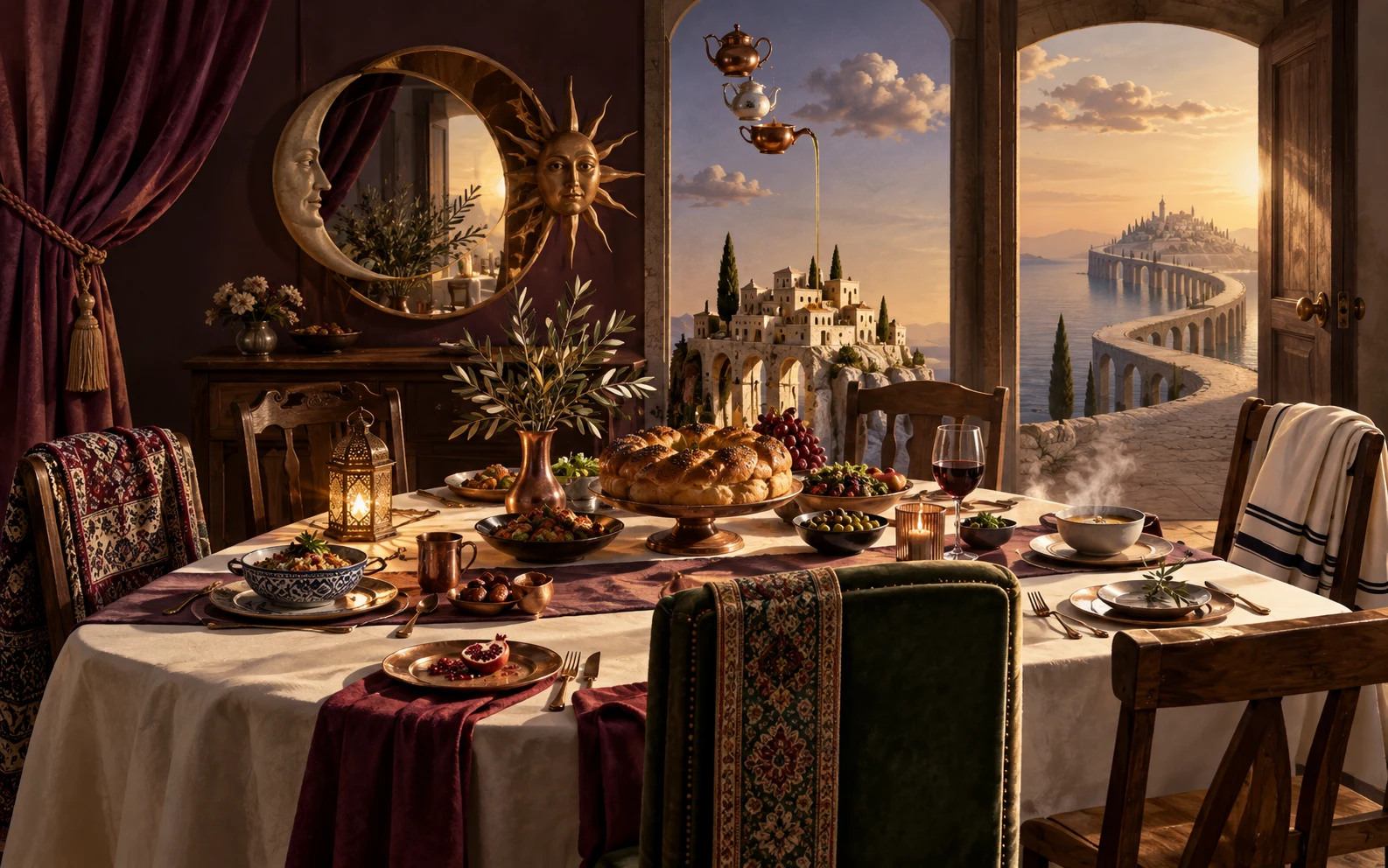
Epigraph
…We are friendly…
E.M. Forster, A Room with a View, chapter I; fragment of the fictional Mr. Beebe's answer about Emerson.
What This Article Is About
The family dinner table is a minefield with a mayonnaise dressing. The host is celebrating a sacred event, her brother has dropped by for a hot meal and a catch-up, and a guest of another faith is trying to work out when dinner became an initiation ceremony. Decline to say a prayer over the potato salad and suddenly you are “disrespecting your mother and destroying the family.” Agree merely to stand nearby and someone has already added you to the parish mailing list.
Let's work out how to eat together when your religious convictions differ—or you have no religious affiliation—without staging an inquisition or a preliminary hearing over the inheritance. Spoiler: nobody is guaranteeing universal harmony. Sometimes staying home is the sanest available plan.
I. Inviting Someone to Lunch Is Not a License to Rewrite Their Faith
Meet our fictional Nina. She is hosting lunch on a day bound up with her Christian faith and memories of her mother. In a burst of spiritual enthusiasm, she decides to open the meal with a communal prayer. Her brother Timur follows another religious tradition; his wife Lena is not religious. They used to arrive after the church service, shift chairs, cut the pie, and chat with the family. Nina sincerely sees prayer as a natural part of the gathering and barely notices that the familiar invitation has changed. Meanwhile, Timur hovers in the hallway, assessing the scale of the operation: is he expected to join the choir with feeling, or will the role of a silent bedside cabinet with folded hands suffice?
Not wanting to pray to someone else's god does not mean hating your sister. And your sister wanting to pray does not make her a tyrant—unless she starts taking hostages.
- The basic distinction: an invitation to a meal that includes prayer and a demand that you say the prayer are two very different offers.
- Timur does not have to earn his good-brother badge through ritual singing. Nina does not have to hide her icons in a cupboard to prove that she loves him, either.
- Basic housekeeping: announce the program beforehand. An unexpected exorcism before the main course is a lousy surprise for your guests. “We pray at two and eat at quarter past” is more honest than daring relatives to prove their loyalty with a fork already in their hand.
II. One Gesture, Ten Reasons for Paranoia
For Nina, prayer means thanking God. For nonreligious Lena, speaking those same sacred words would mean signing up to a faith she simply does not hold. If the host insists, “Oh, it's just a lovely little tradition—can't you mumble along to be nice?”, she diminishes her own religious meaning. If Lena declares every voluntary prayer Nina says to be totalitarian oppression and a domestic concentration camp, she invents a hostile intention and goes wildly overboard. Call things by their names, without the sugary diminutives: one person holds this sacred; the other does not have to profess it.
Standing silently in the corner causes much the same trouble. One person sees politeness, another sees complicity in heresy, and a third is thinking about the traffic home. Even in First Corinthians, chapter 10, Paul takes time to distinguish an ordinary invited meal from participation in a sacrificial feast, with conscience central to the question. That is a Christian distinction in its own setting, not a universal dinner permit or a label to slap on today's guests.
Do not invent a convenient set of religious permissions for Timur just to improve the group photo. If he needs to, he can clarify his own limits with someone knowledgeable in his tradition—preferably before eight pairs of judgmental eyes are aimed at him across the table.
III. Respect Is Not the Fairy Tale That “All Religions Say the Same Thing”
One terrible way to make peace is to launch the cartoon-cat chorus: “Deep down we all believe the same thing, there's one God, and the sun shines on everyone.” No, people need not believe the same thing. Nina has her doctrines, Timur has his, and Lena is putting her trust in the laws of physics. Lunch does not require them to subscribe to your reassuring jingle.
Even the Catholic declaration Nostra aetate in 1965 managed to speak of respect for Muslims and dialogue without chucking Christian doctrine into a skip. It openly recognized that views of Christ differ while still calling for cooperation. That is the position of one Church document, not a stamp certifying that every religion has merged or every shared rite is now approved.
Respect looks like Nina not making her guests cross themselves, Timur not rolling his eyes, and Lena not delivering a lecture on the opium of the people. And for heaven's sake, the dinner table is a dreadful venue for a theological cage match. Your relative of another faith is your relative, not an accredited ambassador required to answer for every decision made by patriarchs and caliphs over the past two thousand years.
IV. Spectator, Participant, and Late Arrival Are Different Roles
Dividing the celebration into parts can work, but it is no universal cure: the spectator compromise is not always available. In a tiny apartment kitchen, there may be nowhere to retreat; the action itself may be indivisible; and even silent observation may cross the guest's own limit. The host can also decline to slice her sacred moment into convenient secular canapés. Better to admit the mismatch than stretch fake unanimity over it: a separate meeting over tea might suit people, or it might be firmly declined. Togetherness does not materialize by magic because someone wrote a clever line in the schedule.
- Prayer at 2:00.
- Lunch at 2:20.
- Family stories at 3:00.
Timur arrives for act two; Lena is willing to sit quietly in an armchair during act one. Do not turn the seating plan into a family loyalty chart: “The loudest prayer gets the favorite-child medal; anyone arriving for the salads has betrayed the bloodline.”
And remember: if an unannounced religious procession around the summer house suddenly appears between courses, a guest can quietly call a taxi. Freedom to enter is worth very little when the exit has been blocked. A new item on the program does not manufacture consent retroactively.
V. Hospitality Runs Into the Fridge and the Delivery Schedule
Lofty spirituality rapidly trips over the ingredients in a sausage. Do not guess a relative's food restrictions from their beard or surname. Use the revolutionary mouth-to-ear method: ask.
- If Nina cannot cook kosher, halal, or vegan food without losing her mind at the stove, she can honestly say, “I can't manage that.”
- Options such as bringing your own container or just having tea may be available. But offloading the cooking onto a guest by default because “you're the special one” is bad manners, not a compromise. The guest has work to do; the host also has to accept the arrangement. An unknown ingredient stays unknown, however lovingly the dish was prepared.
- The calendar works the same way: Timur's absence is not necessarily a manifesto against Christianity. His quarterly report may simply be on fire.
VI. Do Not Make the Child a Spiritual Referee
Among the worst things adults can do is turn children into a human shield or ammunition for an argument:
- “Look how Auntie prays, darling—copy her!”
- “Tell Daddy whose God is the most important, son!”
A child is not a peace dove, a hostage to family feelings, or a Supreme Court justice ruling on which god wins. They may genuinely enjoy an unfamiliar hymn or a present; adults should not treat that as a lifetime oath of allegiance. Nor should they dismiss the interest as meaningless when the family attaches real spiritual significance to it. Above all, do not quietly rewrite agreed arrangements for the child's upbringing under cover of party games and dancing. An unresolved disagreement does not dissolve in the clink of wine glasses. An honest conversation must take the child's understanding and the parents' responsibility seriously, rather than administering a loyalty exam over a plate of mashed potatoes.
VII. British Politeness: Friends Without Identical Views
In Forster's A Room with a View, Mr. Beebe illustrates a useful distinction: you can be on excellent terms with someone while disagreeing on the important questions. This is a literary conversation, not the minutes of a successful modern interfaith summit.
Household help does not buy someone else's soul. If Timur hauls three sacks of potatoes up five flights and sets out the chairs, Nina has not acquired the right to demand a profession of faith. Nor does Nina's generous lunch buy Timur a license to lecture her on how she should arrange her altar.
Yes, it may hurt the host that her brother does not share a sacred moment connected with her mother's memory. Someone else's emotional pain is still a lousy reason to bulldoze a person's convictions.
VIII. A Shared Celebration Need Not Erase Personal Boundaries
This is just one possible ending, and it does not automatically become the gold standard because the whole family made it to dessert in the same room. Nina could have preferred another arrangement without splitting the event; Timur could have declined the proposed timing altogether. The point is not a victory parade for ecumenism or a promise of everlasting harmony. It is that faith was not demoted to light entertainment, nonreligious Lena carrying a loaf was not required to perform fake repentance, and a real shared portion of lunch was found without lying or twisting anyone's arm.
Do not frantically invent a “new neutral family holiday” with politically correct candles if the small print still requires everyone to march in formation. Sometimes family maturity means admitting, “A shared Christmas table isn't going to work for us. How about bowling in February?” That is contact with reality, not proof that the family has collapsed. The bowling alley has lanes, not a department for guaranteeing family unity.
IX. The Debrief After Everyone Has Left
Once the dishes are done, it is worth switching honesty back on:
- Nobody fought: a victory of sorts. But were people comfortable?
- Was Timur's silence a sign of respect, or was he spending the evening suppressing his gag reflex during his cousin's lectures?
- A special cauldron awaits anyone who posts a photo of a relative sitting quietly in the corner with the caption, “Praise the Lord! Timur is finally with us in Christ!” Do not market other people's faces as trophies of your religious victory. Who sees the photograph and what the caption claims are separate questions from who agreed to lunch.
Last year's successful dinner does not grant an eternal indulgence. Next year things may change, and the arrangement will need another conversation.
What This Means in Practice: Three Steps Without Fanaticism
- Before the celebration: sober reconnaissance. State your plan, menu, and program without fog machines. If prayer is planned, say when and what participation is expected, but promise no miracles: if ingredients or conditions are unknown, admit that instead of guaranteeing everything will suit everyone. An invitation need not be an ultimatum; arriving later or declining may be real options when the format does not fit. If there are threats, harassment, or actual violence, stop trying to rescue the party. What matters then is safety in the real circumstances, not a table-manners drill.
- During the celebration: keep some distance. Do not corner people or assign compulsory silent-spectator duty “for Grandma's sake.” Agreeing to come for potato salad is not a secret subscription to a rite, a profession of faith, or a family photo shoot. Do not make children arbiters of adult disagreements. Leave a guest the possibility of stepping aside or quietly leaving when their own limits are being pushed; a beautifully printed schedule does not make an unavailable option real.
- After the celebration: sober up. Do not stretch a picture of blissful harmony over an evening that supplied none. Check one concrete piece of what happened: did the announced plan match the actions, and what did it cost people? Do not dump disputed photos online without clear agreement from those pictured. Three steps do not deliver a factory-sealed package of safety, preserved faith, and eternal family harmony. The family's strength is not measured by identically folded hands, but by knowing when to bite your tongue and pass the next person a plate.
Key quotation
…I differ from him…
E.M. Forster, A Room with a View, chapter I; opening fragment of Mr. Beebe's statement about disagreeing with Emerson. The remainder of the sentence is omitted.
Connections between traditions
| Source | Limited question | Difference and limit |
|---|---|---|
| Forster, chapter I | Friendly relations and disagreement can be named separately | Fictional conversation; no study of family celebrations or justification of the character's insistent pressure |
| Nostra aetate, sections 2–3 | Respect and dialogue alongside a Catholic profession of faith | Particular Church document; no identity of doctrines, representation of all religions, or permission for every rite |
| First Corinthians 10 | An ordinary invited meal, cultic participation, and conscience have different contexts | Christian instruction; no contemporary rule for all traditions, judgments of another cult are not adopted as neutral vocabulary |
| Article's proposal | Invitation, presence, action, and profession of belief differ | Editorial map of one gathering; does not guarantee agreement and preserves free refusal |
Primary sources
-
E.M. Forster — A Room with a View. Project Gutenberg 2641, English original. The displayed opening context of chapter I, web lines 37–150, was read, including Beebe's answers at 119 and 131. Two short fragments belong to this character; embedded works are not quoted. The whole novel is not claimed as read; PG availability establishes no legal status in every country.
-
Vatican — Nostra aetate. Declaration of Paul VI, 28 October 1965, English version. The entire displayed page, sections 1–5 and notes, was read. Sections 2–3 are used narrowly; linked documents were not researched. The Catholic perspective retains its own foundation; there are no direct quotations of the document or claims of agreement among all religions.
-
1 Corinthians 10 — King James Version. The whole chapter, verses 1–33, was read, particularly 14–29 in context. Narrow paraphrase without direct quotation. Christian foundations and limits remain; local religious, legal, dietary rules and the conditions of a particular rite are not established by this article.
Tags
family, celebration, religion, different convictions, invitation, participation, presence, rite, prayer, conscience, hospitality, food, time, calendar, children, respect, differences, dialogue, free response, refusal, choice, tradition, memory, shared table, Forster, A Room with a View, Nostra aetate, Corinthians, United Wisdom, R32, R33, R35
About the authors
Andrey Zarinsh is the author and founder of United Wisdom. He explores inner transformation, unity of traditions, intercultural dialogue, and contemporary spiritual discipline. Continue the conversation: @andrey.zarinsh.
Maria Evilkut is a coauthor of United Wisdom. She researches and practically tests approaches to unity and mutual understanding among people and cultures. Continue the conversation: @ilkutki.