
Relationships
Repeating a family pattern: a hypothesis worth examining
Examining a proposed family norm through alternatives, limits of knowledge, and voluntary present choice.
Epigraph
the logical sifting of evidence
Joseph Jastrow, Fact and Fable in Psychology, Preface, pageviii; a short contiguous phrase. The preface concerns distinguishing psychological knowledge from unreliable explanations. This is a historical methodological position, rather than modern family diagnosis.
What this article is about
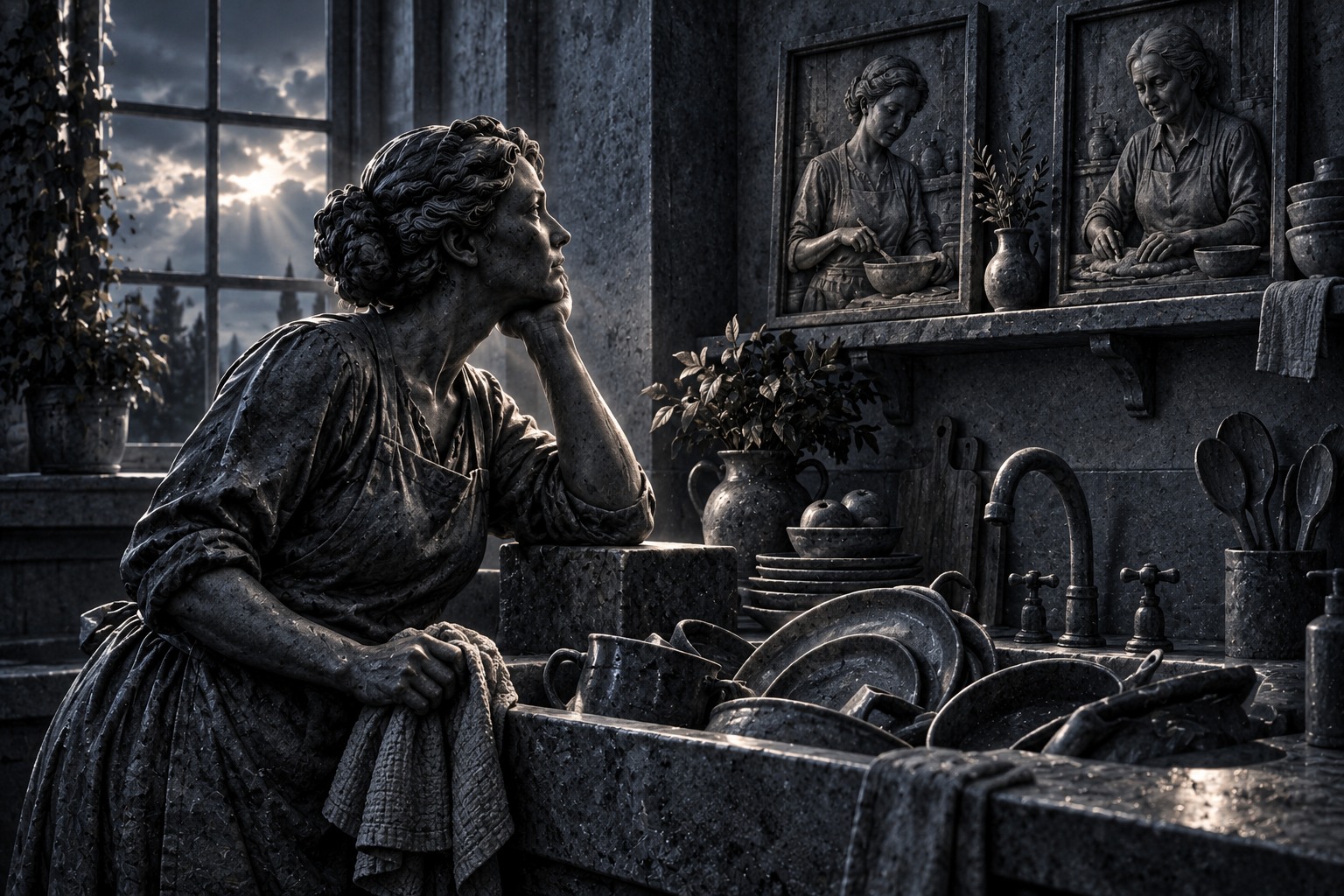
Sometimes a family resemblance seems too obvious to question. Your grandmother gathered everyone around a table, your mother did the same, and now you are once again preparing a celebration alone. Three generations, one kitchen, familiar exhaustion. It is easy to move from these images to a broad explanation: in our family, caring always means forgetting yourself. That explanation may name an experience accurately while connecting the events less accurately. We do not yet know who chose to cook, what resources were available, who offered help, or what happened on other occasions. Family history deserves attention. An account of it does not become the established cause of a present action simply because it sounds convincing.
This article treats a family pattern as a working hypothesis: a suggestion about how a familiar norm might have contributed to a particular action. The suggestion can be refined, narrowed, or left unconfirmed. This is not a diagnosis of generations, a search for an ancestor to blame, or a promise that one written note will free you from a pattern. The task is to distinguish resemblance, a proposed connection, and a present decision. You need not assemble a complete family biography, demand relatives' confessions, or postpone your right to rest until you have fully explained your past.
I. Family resemblance does not yet explain its cause
Consider a fictional example. Vera prepares a large Sunday lunch and resents the fact that nobody has joined in again. Late that evening she remembers her mother silently washing dishes after guests had gone, and her grandmother rarely sitting down with everyone else. Vera sees a repetition: the women serve the gathering while everyone else attends it. That is a significant observation in her account. Yet it combines a present evening she knows in detail with a few selected memories. She knows little about earlier arrangements, other helpers, or what the women themselves thought. We can respect her exhaustion without treating three images as complete accounts of three generations' lives. The resemblance calls for a question, rather than an immediate verdict on the family.
It helps to name the recurring element as precisely as the information permits. Vera remembers her mother cleaning up after certain celebrations. Today she herself cooked and cleaned after one lunch. That is not yet equivalent to saying that neither woman ever asked for help, or that the men refused to take part as a matter of principle. The distinction may seem small until the explanation depends on it. If help was offered and declined, one question arises; if a request was refused, another; if the work was never discussed, a third. Shared exhaustion does not erase those different sequences. A broad label may bring them together, but individual events show which question now needs an answer.
In this scene we also need to distinguish an action from its meaning. Cooking for loved ones may be an enjoyable choice, a way of sustaining a gathering, a demand from others, or a duty someone considers unconditional. The same action can have different grounds in different years. Vera need not declare her pleasure in cooking false in order to recognise an unwanted burden. Nor must she prove that the earlier women suffered exactly as she does today. She can retain two facts: she likes bringing people together, and the present amount of work does not suit her. That already gives her grounds to reconsider the arrangement. The cause of the family resemblance remains a separate question. It may be interesting, but answering it is not a prerequisite for that decision.
II. What we mean by a family pattern
In this article, a family pattern does not mean a hidden programme forcing someone to live in a particular way. It refers to a possible connection between a familiar family rule and a present way of acting. For example, Vera wonders whether her family considered someone a good hostess only if she managed without asking; perhaps she too takes on all the work in advance because she associates receiving help with insufficient care. This is a more specific proposal. It names a norm, a possible transition, and a current action. Yet each element has a different status. A relative's words may be a reported fact; their meaning may be an interpretation; their contribution to today's choice is a hypothesis. The elements fitting together does not establish the connection.
This hypothesis differs from a description of the family's character. It does not require all relatives to be alike or apply to every relationship Vera has. Perhaps she comfortably distributes tasks at work but struggles to ask at home. Perhaps the rule concerned celebrations rather than everyday life. Narrowing its scope does not dismiss the observation. It makes the explanation more useful in conversation: a particular action under particular conditions is at issue. We can examine it without assigning the family an unchanging essence. If the word “pattern” gets in the way and sounds like destiny, “familiar norm” or “possible habit” may work better. Precision does not depend on an expressive term, and it does not require a professional vocabulary.
The opposite mistake is to call everything unpleasant a pattern and everything convenient a free choice. Then the concept stops distinguishing events and becomes a general judgement. Family influence may also be proposed in something a person values, such as hospitality. But neither a positive nor a negative judgement confirms an action's origins. We can ask which connection we want to examine and why it matters to a decision. Vera may want to preserve the lunch while changing the workload. She need not demonstrate complete independence from her family. Someone can choose to continue a familiar custom voluntarily without that choice automatically becoming less their own. The question concerns the conditions of participation, rather than competing with one's ancestors over whose life is more original.
III. A convincing account can defend itself
In Book I of Novum Organum, particularly aphorisms XLV–XLIX, Francis Bacon discusses the mind's tendency to find order and support an already accepted proposition. This is historical philosophy of knowledge, rather than contemporary research on family relationships. A limited analogy matters here: an explanation can shape which cases we notice. Vera may begin remembering only women standing alone at sinks. An evening when her mother rested looks like an accident; her grandfather's participation seems insignificant. The proposal is protected in advance. We need not consider our memory dishonest to recognise that the rule by which we select cases also deserves attention, especially when the conclusion goes beyond the available information.
A hypothesis that can be examined permits revision. If Vera thinks she never asks for help, an accessible memory of a clear request should narrow that wording. If she believes requests are always rejected, agreed participation at another lunch matters. This need not invalidate every connection with the family norm. Perhaps it operates only with certain guests, or when time is short. But an exception cannot be discarded each time merely to preserve an attractive explanation. It helps to understand beforehand what would prompt a revision. When no possible event changes a conclusion, the account no longer serves inquiry. It may express pain or a need for recognition, but that is a different function, which can also be named honestly.
Examining a hypothesis here does not mean testing people. Vera need not silently arrange another overloaded celebration to see whether the others guess that she wants help. That would add expectations and irritation without separating family influence from today's arrangements. Nor should she deliberately request the impossible, provoke rejection, or collect evidence of other people's selfishness. She can work with cases already available. Sometimes relevant information will emerge in an ordinary voluntary conversation; sometimes it will not. Lack of confirmation does not oblige her to keep searching. A practical decision can rest on her current workload whether or not its origins have been clarified. The right not to organise a large lunch does not require a successful experiment on relatives.
IV. Research across generations and personal history have different scales
Intergenerational resemblance is also studied empirically. Neppl, Conger, Scaramella and Ontai's 2009 study examined particular parenting behaviours in data from 187 second-generation adults, their mothers, and their children. The official abstract describes a longitudinal design, observational and self-report assessments, relationships between parenting behaviour in two generations, and investigated mediating pathways. That is a specific research question. It differs from the general claim that someone repeats any family destiny. Vera's lunch does not measure the same indicators. The number of generations in an everyday account does not turn memories into a longitudinal investigation. We can recognise the research question while preserving the limits of applying it to one situation.
For this article, the complete official abstract and bibliographic information were read, rather than the full paper, detailed methods, or original data. There is therefore no account of unverified procedures, estimate of Vera's probability, or conclusion about the sole cause of her behaviour. The statistical relationships reported in the abstract do not establish inevitability or demonstrate the effectiveness of our practice. We retain the precise subject: parenting and the connections proposed by the researchers, rather than a universal pattern of every family duty. The source helps avoid two extremes: dismissing any possible intergenerational connection as imaginary, or treating every resemblance as confirmed inheritance. Between them remains the need for relevant information, which can be limited and incomplete while still mattering to today's question.
A scientific reference should not increase certainty about something it did not examine. Vera may read about parenting and feel a sense of recognition. That experience is valid, but it is not an individual result of the study. Her account of three generations cannot separate learning, a shared environment, resources, and other possible circumstances. We need not choose a biological, psychological, or spiritual explanation simply because one sounds more profound. First we can name the known event and the unknown connection. Such restraint leaves room for action: today's allocation of work can be discussed directly. The research supports intellectual caution. It does not authorise us to explain relatives on their behalf or declare a present decision a mandatory scientific conclusion.
V. Alternatives should change the question
A possible family rule is only one perspective. Another concerns the organisation of the current gathering. Vera set the time herself, chose a complicated menu, and said she would prepare everything. That does not prove free consent to any amount of work, but it identifies a sequence worth considering. The participants may have understood the offer literally without knowing the expectation behind it. Or they may have heard a request and failed to keep a promise. The distinction matters: the first situation calls for clearer distribution of work; the second for consideration of a specific broken agreement. A family explanation should not erase present answers. Sometimes the current arrangement explains one episode better even while the historical resemblance remains. An alternative is useful when it changes our attention, rather than simply completing a formal list.
A third perspective concerns resources. At different times, the family may have had more free time, neighbours' help, money for prepared food, or fewer restrictions on travel. What looked like the same lunch could have required different amounts of effort. We cannot reconstruct these differences through guesswork. We can only record what is known and where information is missing. In the present situation, too, it matters whether the chosen amount of work is manageable. When resources are limited, dropping part of the programme can be a decision in its own right. It does not necessarily indicate that a family norm has been overcome. A smaller menu may simply accommodate today's evening, without becoming a historical act of liberation that anybody must prove.
Another possible alternative concerns the event's meaning. Vera may have invited guests to her new home for the first time and wanted to do everything herself. After exhaustion, a voluntary plan began to feel like a repetition of a family duty. This does not remove regret or prohibit changing plans. Yet today's interpretation should not replace yesterday's intention with confident hindsight. In a different situation, the decision may indeed have been made under pressure. Relevant information is needed to distinguish these possibilities. Recognising several explanations does not require treating them as equally supported. We can retain a personal proposal that seems more plausible while noting what it does not explain. Uncertainty need not prevent us from recognising that the chosen arrangement proved too demanding and no longer suits us.
VI. Other people's memories need not become our evidence base
Relatives may remember events differently. Vera's mother might say, for example, that she enjoyed cooking and that Vera's father normally cleaned up the next day. This is a fictional continuation of our scene, rather than an established correction to any real family history. The reply changes the available material without requiring us immediately to choose the one true memory. Perhaps Vera saw only the late evening; perhaps her mother is now describing a customary arrangement that was not always followed. We can retain both accounts with their sources and limits. A family court is unnecessary for making a personal question more precise. Different memories can narrow confidence without necessarily settling who has invented the past.
A conversation about family history is permissible as voluntary participation, rather than an obligation to provide evidence for your explanation. Someone may not remember, may not want to discuss the matter, or may consider it private. Such an answer neither confirms a hidden pattern nor proves dishonesty. We should not obtain information through children, inspect correspondence, or interview relatives behind someone's back to complete a scheme. For a personal decision, one's own limited material is often sufficient. When unknown details concern painful events, curiosity especially should not become a demand for disclosure. We can acknowledge not knowing and continue living without closing every page of family history. Access to somebody else's past is not a prerequisite for changing today's plans.
At the same time, respect for privacy does not remove the possibility of naming your own experience. Vera can say that cooking alone is difficult today even if her mother disagrees with her explanation. She does not need the family's approval of the hypothesis. What matters is distinguishing a statement about her workload from an assertion about somebody else's motives. The first can be expressed directly; the second calls for caution and may remain unknown. A conversation about the present need not begin with everyone acknowledging a historical cause. Tasks can be distributed without declaring that the family has exploited women for generations. This is not a demand to soften real harm. It prevents a disputed general theory from becoming the compulsory entrance to a specific agreement.
VII. Examination should not become self-blame
A working hypothesis can draw attention back to one's own action. With it may come the temptation to assume responsibility for everything: if I repeat something familiar, I must be creating whatever happens. That conclusion is too broad. Someone can choose some actions without controlling other people's responses, available resources, or pressure from those around them. If a request was expressed and an agreement broken, this cannot be explained solely as Vera's failure to free herself sufficiently from family history. The participants' responsibilities remain distinct. She need not prove complete independence in order to expect a clear promise to be kept. Reconsidering her own step does not give others permission to cross boundaries or make an injured person the author of harm done to them.
The opposite temptation is to use a historical explanation to excuse any present action. A familiar norm may help us understand a difficulty, but it does not exempt consequences from examination. If Vera promised a small lunch, then silently changed the plan and demanded participation, that sequence matters too. She can acknowledge it without humiliating herself. Understanding a possible influence is compatible with taking responsibility for a specific promise. This is not about assigning equal blame regardless of events. It is about keeping each person's actions within their own scope. Family history should become neither an indictment of one individual nor a universal certificate cancelling every current obligation and consequence of one's choices.
It is especially important not to use an investigative form where protection is needed now. In the presence of threats, coercion, or violence, the origins of behaviour need not be established before ending dangerous participation and seeking appropriate local help. A conversation with a dangerous person should not be prescribed to refine a hypothesis. This article provides no clinical or legal protocol and does not establish the cause of an experience. If reflecting alone becomes difficult, it can be set aside or discussed with a suitable qualified professional. Seeking support does not require accepting a diagnosis of a family pattern in advance. Someone need not explain all past harm to have a right to safety, help, and a decision appropriate to today's circumstances.
VIII. Different traditions understand inheritance differently
In the Analects, family continuity is discussed within a Confucian order of relationships and ritual conduct. In James Legge's English translation, I.11 connects filial piety with preserving a father's way, while II.17 distinguishes knowledge from acknowledging what is not known. These passages should not be combined into a contemporary therapeutic instruction. They let us see a tension between respect for continuity and precision about one's knowledge. The historical norm has its own grounds; it does not prove that Vera today must maintain a particular allocation of work. Our comparison is limited to asking which words describe a relationship with the past and which report what is actually established in the current situation.
Bacon considers obstacles to investigating nature, whereas the Confucian text addresses moral learning and relationships in another historical world. They do not offer an identical method for examining family causes. Contemporary parenting research differs from both in its subject and in how data are obtained. Their proximity in this article is editorial: philosophy helps us notice an explanation defending itself, the tradition distinguishes continuity from knowledge, and research preserves the specificity of measured resemblance. None of these strands confirms the others as evidence of a family's destiny. Preserving differences matters because different questions cannot honestly be settled by a single expressive formula. A reader need not accept a religious or philosophical teaching in order to use a limited distinction.
A spiritual language of inheritance may have personal meaning and deserve a respectful conversation. Yet a belief about a family's ancestral purpose does not become an established causal connection through a few similar events. We need not ridicule the belief or translate it into a scientific term to make it look proven. Belief, metaphor, and available observation can be named separately. Vera may understand the family table as a symbol of connection across generations. That does not remove the questions of time, help, and voluntary participation. The symbol can remain meaningful with a changed menu and a different distribution of tasks. Respect for history does not require every form of expressing it to remain unchanged or make an everyday change a betrayal of one's origins.
IX. Changing an action does not confirm the entire theory
Suppose that before the next small lunch Vera invites each willing participant to choose one manageable task in advance. One brings food, another helps clean up, and a third honestly says they can only attend briefly. The gathering becomes easier. This is an outcome in our fictional scene, rather than a promise to the reader. It shows that the arrangement of participation changed in this example. It does not establish that the original explanation of the family norm was entirely right or that the pattern has disappeared forever. Perhaps clearer agreements helped; perhaps different guests attended. A good outcome, too, needs a precise description. Otherwise the hypothesis gains confirmation even when a different action was examined, rather than the historical causal connection.
If things do not become easier, that also does not prove the depth of a family programme. Someone may have declined, schedules may have changed, or the allocation may have remained inconvenient. Not every unsuccessful result should be explained as unconscious resistance or Vera's insufficient maturity. An available answer can be considered literally. A smaller gathering, another time, or declining to organise may be needed. Nobody should be required to repeat a practice until it finally confirms the desired explanation. The proposed step is not a validated procedure for changing family behaviour. Its meaning is limited to examining a present agreement when participation is voluntary and safe. Lack of a result can mark the limits of the available arrangement, rather than a defect in someone who failed to rewrite history correctly.
An action can be revised while its earlier cause remains unknown. Vera understands that a large lunch prepared alone does not suit her now; exactly what led to her habit of taking it on is still unclear. This is a substantive result. It is less dramatic than finally discovering the family's destiny, but it matches the extent of her knowledge. New information can change the explanation without invalidating her decision. Sometimes further investigation will be useful; sometimes it will not. Every ordinary choice need not become a test of generations. Someone has a right to spend Sunday differently, and also to choose cooking again when conditions suit them. Freedom preserves the possibility of different decisions instead of requiring people always to do the opposite of their relatives.
X. History remains when the explanation changes
Return to the three kitchens at the beginning. They no longer have to form one inevitable line. Vera sees particular similar actions, different amounts of information, and a possible rule about caring. She can value her mother's and grandmother's hospitality, remain unaware of some circumstances, and choose a different distribution of work. Respect for the past does not require exact repetition. Revising a hypothesis does not make the original recognition pointless either: it helped raise a question that now has boundaries. Gratitude, pain, and uncertainty can coexist in a family history. None of these feelings has to become evidence for a sole cause. A more precise account can be less definitive while serving today's decision better.
The principal limit concerns the investigation itself. Private reflection does not become a scientific diagnosis however many generations appear in a diagram. Events can be recorded, sources of memories distinguished, and an alternative and a condition for revision named. But this does not guarantee clarity, relief, or suitable behaviour from others. Not everything important can be verified, and not every unknown needs resolving. Sometimes someone chooses to leave the subject for other tasks in life. Recognising a limit does not mean that family history does not exist or affects nobody. It means something more modest: the available information is insufficient for this conclusion. That is enough to avoid treating a hypothesis as somebody's already revealed destiny.
The question can end with a small distinction rather than a declaration of breaking a pattern: I know what happened today; I propose a connection with the past; I see another possible cause; I am willing to change the explanation if certain information emerges. This position does not oblige anybody to confirm your account or require rejecting your family membership. It leaves room for new information and independent choice. Vera can invite loved ones again, arrange the gathering differently, or decline to organise it. These are different permissible possibilities, rather than stages of compulsory healing. Inherited history stops being the only author of today's action when we retain the right not to know its entire cause while deciding within the available present.
What this means in practice
If the subject is appropriate now, choose one small episode and one proposed family rule. You can record separately what you observed yourself, what you remember approximately, and what you heard from somebody else. Specify the time and limits of the material as far as possible. Do not reconstruct unknown details merely to complete a scheme. Then try to name a connection without saying “always”: perhaps under these conditions I take on this task because I associate it with this familiar demand. This is an editorial form of reflection, rather than a diagnostic questionnaire. It can be changed, kept in mind, or left unused. A note can remain private and does not require discussion with relatives.
Name one alternative that could change your understanding of the episode: for example, the present agreement, a limited resource, or your original intention. Then ask what accessible observation would prompt you to refine the first hypothesis. Do not prescribe a dangerous encounter, a provocation, or a search for somebody else's private information. If suitable material is unavailable, record that. Separately choose a present condition that matters regardless of the causes: the size of a task, available time, the option to decline, or a clear response to an offer. A definitive next step is unnecessary. Sometimes the practice ends by recognising that there is already enough information for a present decision while the past's explanation remains open.
If a step is needed, let it fit the current question and your resources. You can suggest a smaller alternative arrangement, state your availability, or decline an optional task. Do not test relatives on their ability to prove a new theory. Afterwards, consider what actually changed without assigning the result to the entire family history. Neither success nor failure has to confirm the original pattern. You can stop if the reflection creates strain. In danger, safety and appropriate help take priority over continuing a note. The result can be brief: this is known, this is proposed, this remains unknown, and this matters now. A fuller account is not required for the right to make your own decision.
Key quotation
bad logic as of defective observation
Joseph Jastrow, Fact and Fable in Psychology, Preface, pageix; a contiguous phrase within his sentence about misconceptions. He distinguishes errors of reasoning and observation; this is his historical argument, rather than a statistical finding about our fictional family. His generalisations and historical classifications beyond this question are not adopted here.
Connections between traditions
| Strand | Connection with this article's question | Difference and limit |
|---|---|---|
| Bacon: Novum Organum, I.XLV–XLIX | An accepted explanation can direct attention towards confirmation | Historical philosophy of natural inquiry; a limited analogy here, rather than family diagnosis |
| Jastrow: Preface to Fact and Fable in Psychology | Evidence and the way of reasoning are considered separately | Historical methodological position; neither a family causal model nor current efficacy evidence |
| Confucianism: Analects, I.11 and II.17 | Continuity and acknowledging what is not known have different meanings | The moral and ritual context differs from modern personal choice and does not establish its obligations |
| Neppl and colleagues' study, 2009 | Intergenerational resemblance needs a defined subject and data | Abstract read; parenting was studied, rather than any family destiny |
| Editorial practice | Separates observation, hypothesis, and a present condition | Neither validated therapy nor a common teaching of these strands |
The sources' proximity does not establish their agreement or the effectiveness of the proposed note. It helps preserve different questions and different grounds for answering them.
Sources
- Francis Bacon. Novum Organum; or, True Suggestions for the Interpretation of Nature. Edited by Joseph Devey. New York: P. F. Collier & Son, 1902. Project Gutenberg 45988, released 15 June 2014, updated 24 October 2024. Read: title/metadata, Preface, selected Book I XLV–XLIX and nearby context; not whole book. Translator not separately established from accessed title page. Historical argument about inquiry, not empirical family causation. Worldwide reuse rights UNKNOWN; no full-source import or embedding. Actual text.
- Confucius and disciples. The Analects of Confucius, English translation James Legge, Project Gutenberg 3330, released 1 July 2002, updated 8 January 2021. Read: metadata and selected Book I–II context including I.11, II.15, II.17; not full Chinese critical text or full book. Accessed print edition year not established. Historical normative comparison; no direct quotation. Worldwide reuse rights UNKNOWN. Actual text.
- Tricia K. Neppl, Rand D. Conger, Laura V. Scaramella, Lenna L. Ontai. “Intergenerational continuity in parenting behavior: mediating pathways and child effects.” Developmental Psychology 45(5), 2009. DOI 10.1037/a0014850; PMID19702389. Read: complete official abstract and metadata via Europe PMC API; full paper/methods/data unread. Prospective observational/self-report investigation of specified parenting; no individual diagnosis or efficacy claim. Rights UNKNOWN, scientific direct quotation zero. PubMed record; actual abstract access.
- Joseph Jastrow. Fact and Fable in Psychology. Boston and New York: Houghton, Mifflin and Company, copyright1900; a separate printing year was not established. Project Gutenberg48869. Read: title metadata and the complete Preface, pagesv–xi, rather than the whole book. Both brief quotation roles come from the author's own sentences; historical methodology, rather than family diagnosis or a validated practice. Rights UNKNOWN; no universal licence inferred. Actual text.
Tags
family pattern, family history, hypothesis, observation, repetition, generations, continuity, parenting, norms, hospitality, care, workload, agreement, alternative explanation, memory, uncertainty, revision, choice, voluntary participation, boundaries, responsibility, safety, support, present, Bacon, Novum Organum, Confucianism, Analects, Legge, Neppl, research, United Wisdom
About the authors
Andrey Zarinsh is the author and founder of United Wisdom. He explores inner transformation, the unity of traditions, intercultural dialogue, and contemporary spiritual discipline. Instagram: @andrey.zarinsh.
Maria Evilkut is a co-author of United Wisdom. Alongside research, she seeks to test these ideas in practice and observe how principles of unity and mutual understanding work in real life between people and cultures. Instagram: @ilkutki.
Keep what resonates with you.