
Relationships and Intimacy
Repeating a family pattern: a hypothesis worth examining
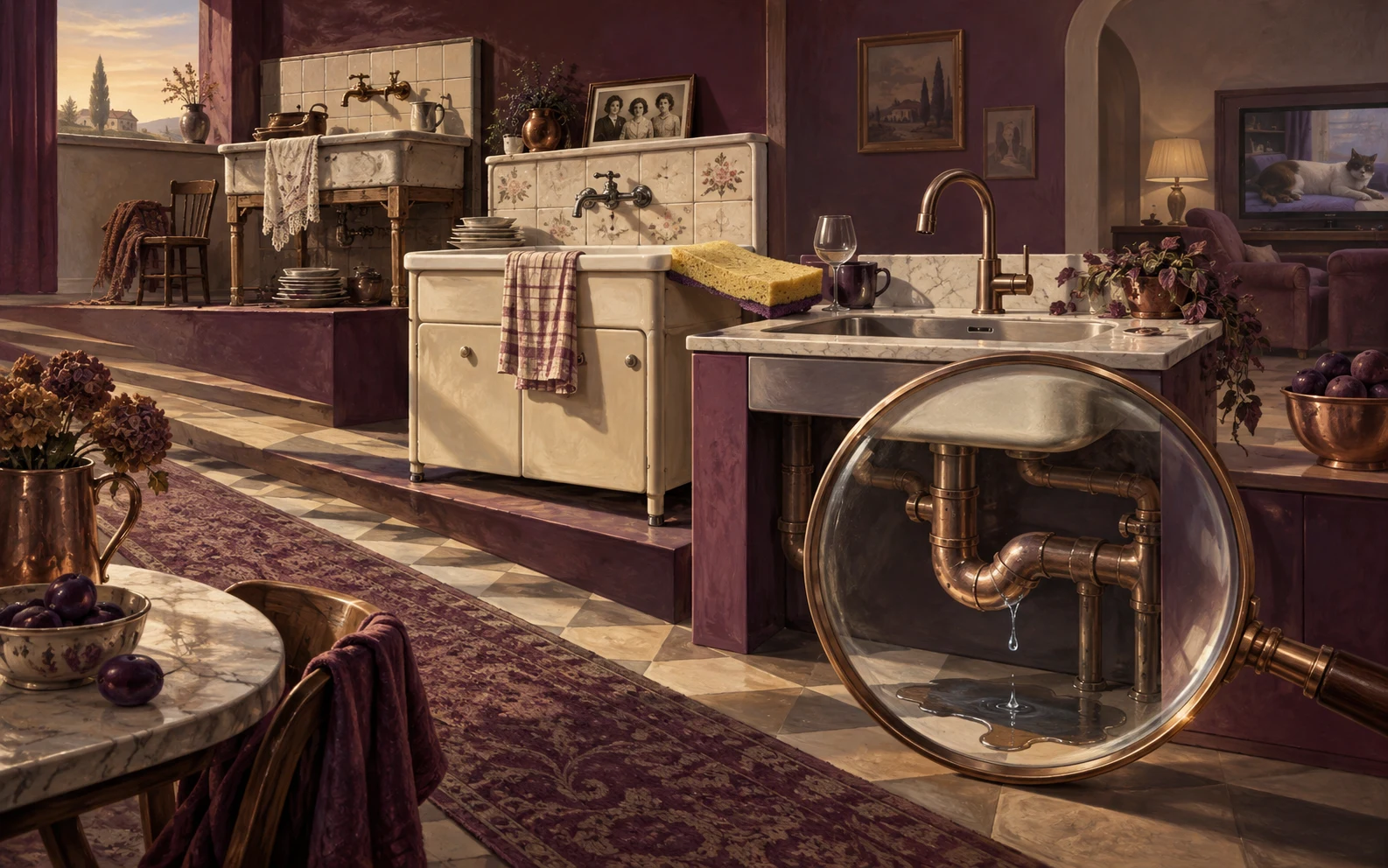
Grandma stood at the sink after the guests left. Mum stood at the sink after the guests left. Now you stand at the sink while the guests recline in front of the television, digesting your hospitality.
Epigraph
the logical sifting of evidence
Joseph Jastrow, Fact and Fable in Psychology, Preface, pageviii; a short contiguous phrase. The preface concerns distinguishing psychological knowledge from unreliable explanations. This is a historical methodological position, rather than modern family diagnosis.
What this article is about
Grandma stood at the sink after the guests left. Mum stood at the sink after the guests left. Now you stand at the sink while the guests recline in front of the television, digesting your hospitality. Three generations, one sponge—the family detective rubs his hands: “An inherited pattern! The women in this family must care for everyone until they scrub away their personalities along with the non-stick coating.” A convincing story, particularly at midnight over a burnt saucepan. So far, though, we have a few similar pictures. Who wanted to cook, who was offered help, what money and time were available, and what happened on other evenings remain questions. Your exhaustion is still real. The sink simply hasn't testified to the one true cause of it all.
A family pattern here is a suggestion we can refine, narrow, or leave unconfirmed. It is neither a secret code in your surname nor a posthumous diagnosis for Grandma, and a notebook entry will not cure three generations. Let's separate what resembles what, how it might be connected, and what you want to do today. Permission to rest does not require interrogating the entire bloodline, extracting a confession from your aunt, and establishing who first refused to wash a roasting tin in 1968. You can change Sunday before the family archives declassify the state secret of the meatballs.
I. Three kitchens do not make a three-volume criminal case
Imagine Vera. She cooked a large Sunday lunch, got stuck with the clearing up, and feels angry: once again, nobody joined in. She remembers Mum doing the dishes and Grandma rarely sitting down with everyone else. A familiar scene emerges: the women serve; the rest attend with healthy appetites and philosophical serenity. Vera knows today's evening well. Earlier arrangements, other helpers, and what the women themselves thought are much less clear. Three selected memories cannot replace three complete biographies, any more than three dirty plates can replace an archaeological expedition. You can acknowledge exhaustion without sentencing every relative back seven generations.
“Mum cleaned up after several celebrations” and “Nobody ever helped women in this family” are indictments of very different sizes. Today Vera cooked and cleared up after one lunch. Help may have been offered and declined; she may have asked and been refused; perhaps nobody discussed the work, trusting the family's brain-to-brain Wi-Fi. Those are three different stories, despite the shared finish: a person with a sponge and a murderous expression. If help was declined, one question arises. If a clear agreement was broken, another. If everyone relied on telepathy, a third. The word “pattern” must not grind them into a single evidential meatball.
Cooking itself is not always hard labour disguised as love. You can enjoy gathering people together, take pleasure in a pie, and still dislike spending the rest of your weekend in the sanitation department. In another situation, someone cooks under pressure or believes they must, even while developing a personal hatred for every carrot. You needn't declare your enjoyment counterfeit or assign Mum and Grandma the same suffering Vera feels today. Two perfectly compatible things will do: “I love our lunch” and “This amount of work doesn't suit me.” You can already reconsider the gathering. The historical provenance of the apron can wait.
II. A “pattern” is a working theory, not lifelong firmware
Vera's more precise thought might be: “In my family, I think a good hostess was praised for managing without asking. Perhaps I take everything on in advance too, because getting help feels like failing to care.” Now we have a question, rather than a cursed ancestral printer churning out identical Sundays. Even here, there are different levels: a relative's words are what was said or remembered; their meaning is our interpretation; their role in today's action remains a hypothesis. A neatly assembled story does not receive a certificate of truth merely because all its corners line up.
Perhaps Vera delegates comfortably at work but impersonates the only functioning appliance at home. Or this concerns celebrations, while nobody heroically rescues the weekday pasta single-handed. Then we are discussing particular conditions, not the family's eternal essence, ready to be bottled and donated to a museum. A narrower scope makes the question clearer. If “pattern” immediately conjures an iron destiny, stamped and signed, call it a “familiar rule” or a “possible habit.” The soup will survive without a professional term. Sometimes the thought becomes clearer too.
Nor should we sort life into “everything unpleasant is a pattern” and “everything convenient is my magnificent free choice.” That turns the hypothesis into a dustbin with a degree. Family influence may also be suggested in hospitality we love, but neither pleasure nor disgust proves where an action came from. Vera can keep the lunch and change the workload. Freely continuing a good custom is her choice too. Independence does not require a competition in annoying the ancestors: if Grandma baked pies, you needn't celebrate liberation by chewing cardboard.
III. A convenient theory knows where to hide the inconvenient dishes
Bacon's Novum Organum, I.XLV–XLIX considers how the mind seeks order and supports an explanation it has already accepted. This is philosophy of natural inquiry, rather than a fresh report on Vera's family. Still, a limited analogy works: once every woman has been assigned eternal kitchen servitude, the internal investigator may remember only useful footage. Mum rested? An accident. Grandpa helped? Remove the extra; he's ruining the tragedy. Memory needn't be deliberately lying. Sometimes its selection process simply provides exceptionally attentive service to the favourite theory. That process deserves a look too.
If “I never ask” meets a clear past request, “never” needs downsizing. If “They always refuse” meets agreed help at another lunch, that lunch cannot be dismissed as a technical glitch in the family evil. Perhaps the rule operates only with certain guests or when time is short; an exception needn't demolish the whole hypothesis. But something must be able to change it. Otherwise this is no longer inquiry: it is a fortress where every incoming fact is recruited into the garrison. A story may express pain and a wish to be heard, and that matters. Expressing pain and establishing a cause still have different jobs.
Examining a suggestion does not mean sending undercover shoppers to audit the family's selfishness. Don't silently cook another impossible feast and wait to see who guesses that the hostess needs rescuing. Don't request the impossible, provoke a refusal, and gleefully file it as evidence. Available cases may be enough; something may emerge in an ordinary voluntary conversation, or nothing may emerge at all. You can stop searching without confirmation. Today's workload is enough reason to decline a large lunch. Your relatives needn't successfully fail your secret humanity test first.
IV. A research paper cannot issue a hereditary title deed to the sink
Intergenerational resemblance really is studied. For example, Neppl and colleagues in 2009 examined particular parenting behaviour using data from 187 second-generation adults, their mothers, and their children. The official abstract describes a longitudinal investigation, observations, self-reports, associations, and possible mediating pathways. That is a defined subject, rather than “every family destiny repeats itself; pay at the counter.” Vera's lunch does not measure the same indicators. Three generations around a salad bowl do not constitute a longitudinal study, even if you stick four scientific surnames on the bowl.
The basis here is the official abstract and publication information, rather than a full examination of the paper, detailed methods, and original data. Squeezing a precise probability for Vera out of that would be like determining an engine's fate from the cover of its manual. The reported associations do not establish inevitability, a sole cause, or a demonstrated effect of our kitchen exercise. Nor do they establish the opposite claim that notebook salesmen invented all family influence. The study concerned parenting and particular associations; a personal history needs its own material, however limited. Science was hired neither to certify every ancestral legend nor to burn down the entire family archive.
Recognising yourself in a description is not receiving your personal study result. Vera's one account cannot separate learning from a shared environment, money, help, and other circumstances. A biological, psychological, or spiritual theory does not win because it sounds deeper and requires a more expensive frame for its certificate. Start with the known event and the unknown connection. Today's work can be discussed directly. A scientific reference encourages caution; it does not appoint its owner head of other people's motives or make that person's decision binding on the whole family.
V. Sometimes the problem is the thirteen-course menu, not the bloodline
Suppose Vera chose the time herself, designed an elaborate menu, and said, “I'll prepare everything.” This does not prove she freely signed up for any workload until death. But the guests may have taken the offer literally, without its invisible enclosure: “Actually, I expect help. Work that out yourselves.” Or they may have heard a request, promised, and failed to deliver. In the first case, tasks need clearer distribution; in the second, a particular broken promise needs naming. An ancestral theory should not erase today's replies with an eraser the size of Grandma's saucepan. Sometimes the present arrangements explain an evening better, even if similar evenings happened before.
People may also have had different amounts of money, free time, neighbours' help, and freedom to travel in different years. Similar tables do not mean identical effort. Don't invent Grandpa's unknown pension, Grandma's secret household staff, or your own exceptional historical mission. Note what is known, what you don't know, and whether today's workload is manageable. If it isn't, part of the menu can go. Dropping the third side dish may simply mean allowing for your energy that evening. Not every cancelled courgette must become a monument to the liberation of the bloodline.
There is another possible story: Vera invited guests to her new home for the first time and wanted to prepare everything herself. By midnight, that voluntary plan began to resemble hereditary kitchen duty. You can regret it and change the next plan; you cannot treat present irritation as exact knowledge of your earlier intention. In another case, pressure may indeed have been involved. That takes information, rather than choosing the most impressive theory. Alternatives needn't be equally well supported. You can prefer one, notice what it fails to explain, and acknowledge a simple point: the arrangement turned out to be too demanding. The family mystery needn't issue its final verdict first.
VI. Mum does not have to surrender her archives for your forensic examination
In a hypothetical continuation, Vera asks Mum, who says, “I liked cooking. And your father usually cleared up the next day.” The detective panics: a living witness has arrived with a different story. This does not order us to recognise Mum's memory as the one true account. Vera may have seen only the late evening; Mum may now be describing a customary arrangement that wasn't always followed. Keep both accounts and their limits. Making a question more precise does not require convening a family court to discover who forged the past with a fork. Conflicting memories can reduce certainty without a verdict that somebody is lying.
Mum may not remember, may not want to discuss it, or may regard it as her private past. Refusal is not a confession: “Yes, daughter, the cursed programme exists, but I'm bound by a non-disclosure agreement.” Don't interrogate children, rummage through messages, or assemble a secret panel of relatives behind someone's back, particularly around painful events. Someone else's biography needn't open up before you are allowed to change your lunch. The unknown can stay unknown while life continues. Family history is not an escape room where the bathroom door opens only after the last confession.
You can still name your own workload. “Cooking alone is difficult for me today” is not the same as “Now I finally know why you all do this to me.” The first statement does not require family approval of the theory; other people's motives may remain unknown. Sharing tasks can be proposed without the compulsory preamble, “Our bloodline has exploited women for centuries.” This is not a request to shut up about real harm or make it more respectable. A specific agreement simply shouldn't have to wait for every relative to sign your dissertation, complete with a forty-eight-roasting-tin appendix.
VII. Neither self-flagellation nor an ancestral get-out-of-jail-free card
Having noticed a possible habit, it is easy to conclude, “If I'm repeating something familiar, I must have created absolutely everything.” Congratulations: you have quietly been promoted from sponge operator to dispatcher of the universe. But you do not control all other people's replies, money, resources, or pressure. If Vera asked, somebody promised, and they didn't do it, that is not a flaw in her efforts to achieve final liberation from Mum. Another person's promise remains their promise. You can reconsider your own step without granting others permission to cause harm. Having a family history does not make an injured person the author of the harm done to them.
The opposite extreme is, “I have a pattern, so all my present actions are automatically written off.” The bloodline does not issue a blanket power of attorney for every escapade. If Vera promised a small lunch, silently inflated it into a banquet, and demanded other people's participation, that sequence matters too. She can acknowledge it without a ritual of spitting on herself. Possible influence from the past is compatible with responsibility for a particular promise. Blame needn't be divided equally like leftover salad, regardless of what happened. Each person can retain their own scope of action. A family theory becomes neither a whip for one person nor a certificate cancelling every obligation.
Where there are threats, coercion, or violence, investigating the origins of behaviour gives way to safety and appropriate local help. Don't prescribe a conversation with a dangerous person to complete the “condition for testing” box neatly. The notebook can wait; dangerous participation needn't wait for the ancestral riddle to be solved. If the reflection itself becomes difficult, it can be postponed or discussed with an appropriate qualified professional. Support does not require an admission ticket bearing the diagnosis “family pattern.” Help should not greet a person with, “First prove Great-Grandma's influence. Then we'll discuss what's happening now.”
VIII. Confucius, Bacon, and the kitchen sponge never signed a joint agreement
In James Legge's translation of the Analects, I.11 connects filial piety with preserving the father's way, while II.17 distinguishes knowledge from acknowledging what is not known. This is a historical moral and ritual world, rather than a guide to lightening Sunday's kitchen workload. We can see a tension between continuity and precision about knowledge. But the ancient norm does not summon today's Vera to lifelong service at the sink. Respect for the past and knowledge of the cause of a current action are different questions, however tempting it is to settle both with one wise bookmark.
Bacon discussed investigating nature; the Confucian text addressed moral learning and relationships; Neppl and colleagues measured particular parenting behaviour. They did not team up to rescue Vera's lunch or confirm each other's findings about her family destiny. Their proximity here is our comparison of different questions: how explanations defend themselves, what continuity means, and how specific studied associations can be. Tip everything into a blender and produce “one ancient scientific method” if you like. It will look attractive, but it is an intellectual smoothie made from incompatible grounds. You can use a limited distinction without being required to adopt anyone's philosophy or faith.
A spiritual language of inheritance can matter deeply to someone. It needn't be ridiculed or hastily repainted as science to look more convincing. Vera may see the table as a symbol of connection across generations. A symbol remains a symbol, belief remains belief, and observation remains observation. A few similar lunches do not prove an ancestral purpose. Even a meaningful table cannot answer who has time and who freely takes on the work. You can honour loved ones' memory and change the menu. Not every shop-bought pie betrays the ancestors so grievously that the family crest must be removed from the fridge.
IX. An easier lunch does not earn the family theory a Nobel Prize
Suppose that before the next small lunch Vera invites willing participants to choose a manageable task. One brings food, another helps clear up, and a third honestly can only drop in briefly. In our fictional scene, the gathering becomes easier. This is an example, not a guarantee for your Sunday. The arrangements changed; the cause of the earlier habit has not been proved, and the pattern has not evaporated forever with the steam from the soup. Clearer agreements may have helped, or different guests may have attended. A good outcome needs a precise description too: a relative washed the plates, rather than issuing a finding on the validity of your entire family model.
If things don't become easier, don't declare the unconscious a particularly deep mine just yet. Someone may have declined, timings may have changed, or the allocation may have proved inconvenient. Those are answers and conditions, rather than compulsory evidence of Vera's immaturity. You can reduce the gathering, move it, or choose not to organise it. Repeating the exercise until the theory wins a confession is like washing one plate until it says, “Yes, the bloodline is to blame for everything.” Examining today's agreement is not a validated therapeutic method. Participation needs to be voluntary and safe; sometimes no result simply reveals the limits of that arrangement.
You can change an action and leave the cause open: “A large lunch prepared alone doesn't suit me now. Why I got used to taking it on—I don't yet know.” That is a substantial outcome, though a little short on glitter for the ceremonial “Ancestral Destiny Broken” diploma. Later information may change the explanation without cancelling today's decision. You can also choose cooking again when the conditions suit you. Freedom is not a compulsory reversal of every action Grandma took. It leaves room for different choices instead of requiring a lifelong oven boycott to prove independence.
X. Family history will survive the closure of the detective's office
The three kitchens can remain three meaningful memories rather than one inevitable line. Vera values Mum's and Grandma's hospitality, doesn't know some things, and distributes work differently. The initial recognition needn't become meaningless when the hypothesis is refined: it raised a question. Gratitude, pain, and uncertainty can coexist in family history. There is no need to evict two of them to establish the monarchy of the one true cause. A more precise account may sound less final. It may nevertheless be better at deciding who peels today's potatoes, without assigning the potatoes a historical destiny.
A private diagram of ten generations does not turn into a scientific diagnosis because it needs a longer roll of paper. You can distinguish events, sources of memories, an alternative, and a condition for revision. This promises neither clarity, relief, nor convenient replies from relatives. Not everything important can be checked, and not every unknown must be eliminated. Sometimes people have things to do besides investigating Sunday lunches. Insufficient material does not mean history influences nobody. It means something smaller: there isn't enough information for this conclusion. The hypothesis can stay in the “We don't yet know” folder instead of being engraved on the family tombstone.
This ending is enough: “This happened today; I suggest this connection with the past; here is another possible cause; this information would change my explanation.” Relatives needn't confirm your story, and you needn't disown them. Vera can invite people again, arrange the gathering differently, or not hold it. These are options, not compulsory stages of healing with an inspection stamp at every stop. The past remains part of the history. It simply needn't write today's menu alone. The right not to know the entire cause is compatible with the right to choose what you can actually manage now.
What this means in practice
1. One episode, rather than a census of every dead relative
If the subject is appropriate now, choose a small episode and one proposed rule. Separate what you observed, what you remember approximately, and what you heard from someone else. Name the time and limits of your information as far as you can, without reconstructing unknown details to beautify the diagram. Avoid “always”: “Perhaps, under these conditions, I take on this task because I connect it with this demand.” This is not a diagnostic questionnaire offering a “Guilty Grandma” prize. You can change the form, keep it in your head, or not use it at all. A note can remain private; the compulsory family evidence hearing is not included.
2. Let one inconvenient alternative through the door
Name another theory that would actually change your understanding of the episode: the current agreement, a missing resource, or your earlier intention. What available information would make you refine the first suggestion? Don't obtain it through provocation, a dangerous encounter, or breaking into someone else's messages. If the material isn't available, write “unavailable” instead of hiring imagination as deputy archivist. Separately name a condition that matters today: the workload, time, the option to decline, or a clear reply. A definitive step is optional. Sometimes there is already enough information for a decision about today's workload, while the family mystery still sits in the cupboard refusing interviews.
3. Change today's lunch instead of stress-testing the bloodline
If a step is needed and available, suggest a smaller arrangement, state your participation, or decline an optional task. Relatives needn't sit an exam in confirming the new theory. Afterwards, name what actually changed: neither success nor failure has to prove the whole pattern. You can stop if it becomes taxing. In danger, safety and appropriate help matter more than a finished line in the notebook. The ending can be short: “I know this, suggest this, don't know this, and this matters now.” Making your own decision does not require closing the investigation into the bloodline. The saucepan has already cooled down. It is allowed to be just a saucepan.
Key quotation
bad logic as of defective observation
Joseph Jastrow, Fact and Fable in Psychology, Preface, pageix; a contiguous phrase within his sentence about misconceptions. He distinguishes errors of reasoning and observation; this is his historical argument, rather than a statistical finding about our fictional family. His generalisations and historical classifications beyond this question are not adopted here.
Connections between traditions
| Strand | Connection with this article's question | Difference and limit |
|---|---|---|
| Bacon: Novum Organum, I.XLV–XLIX | An accepted explanation can direct attention towards confirmation | Historical philosophy of natural inquiry; a limited analogy here, rather than family diagnosis |
| Jastrow: Preface to Fact and Fable in Psychology | Evidence and the way of reasoning are considered separately | Historical methodological position; neither a family causal model nor current efficacy evidence |
| Confucianism: Analects, I.11 and II.17 | Continuity and acknowledging what is not known have different meanings | The moral and ritual context differs from modern personal choice and does not establish its obligations |
| Neppl and colleagues' study, 2009 | Intergenerational resemblance needs a defined subject and data | Abstract read; parenting was studied, rather than any family destiny |
| Editorial practice | Separates observation, hypothesis, and a present condition | Neither validated therapy nor a common teaching of these strands |
The sources' proximity does not establish their agreement or the effectiveness of the proposed note. It helps preserve different questions and different grounds for answering them.
Sources
- Francis Bacon. Novum Organum; or, True Suggestions for the Interpretation of Nature. Edited by Joseph Devey. New York: P. F. Collier & Son, 1902. Project Gutenberg 45988, released 15 June 2014, updated 24 October 2024. Read: title/metadata, Preface, selected Book I XLV–XLIX and nearby context; not whole book. Translator not separately established from accessed title page. Historical argument about inquiry, not empirical family causation. Worldwide reuse rights UNKNOWN; no full-source import or embedding. Actual text.
- Confucius and disciples. The Analects of Confucius, English translation James Legge, Project Gutenberg 3330, released 1 July 2002, updated 8 January 2021. Read: metadata and selected Book I–II context including I.11, II.15, II.17; not full Chinese critical text or full book. Accessed print edition year not established. Historical normative comparison; no direct quotation. Worldwide reuse rights UNKNOWN. Actual text.
- Tricia K. Neppl, Rand D. Conger, Laura V. Scaramella, Lenna L. Ontai. “Intergenerational continuity in parenting behavior: mediating pathways and child effects.” Developmental Psychology 45(5), 2009. DOI 10.1037/a0014850; PMID19702389. Read: complete official abstract and metadata via Europe PMC API; full paper/methods/data unread. Prospective observational/self-report investigation of specified parenting; no individual diagnosis or efficacy claim. Rights UNKNOWN, scientific direct quotation zero. PubMed record; actual abstract access.
- Joseph Jastrow. Fact and Fable in Psychology. Boston and New York: Houghton, Mifflin and Company, copyright1900; a separate printing year was not established. Project Gutenberg48869. Read: title metadata and the complete Preface, pagesv–xi, rather than the whole book. Both brief quotation roles come from the author's own sentences; historical methodology, rather than family diagnosis or a validated practice. Rights UNKNOWN; no universal licence inferred. Actual text.
Tags
family pattern, family history, hypothesis, observation, repetition, generations, continuity, parenting, norms, hospitality, care, workload, agreement, alternative explanation, memory, uncertainty, revision, choice, voluntary participation, boundaries, responsibility, safety, support, present, Bacon, Novum Organum, Confucianism, Analects, Legge, Neppl, research, United Wisdom
About the authors
Andrey Zarinsh is the author and founder of United Wisdom. He explores inner transformation, the unity of traditions, intercultural dialogue, and contemporary spiritual discipline. Instagram: @andrey.zarinsh.
Maria Evilkut is a co-author of United Wisdom. Alongside research, she seeks to test these ideas in practice and observe how principles of unity and mutual understanding work in real life between people and cultures. Instagram: @ilkutki.