
Meaning & path
Taste, Education, and the Right Not to Understand a Work of Art
How education shapes our experience of art, why understanding need not lead to admiration, and how to stay curious without turning taste into a test.
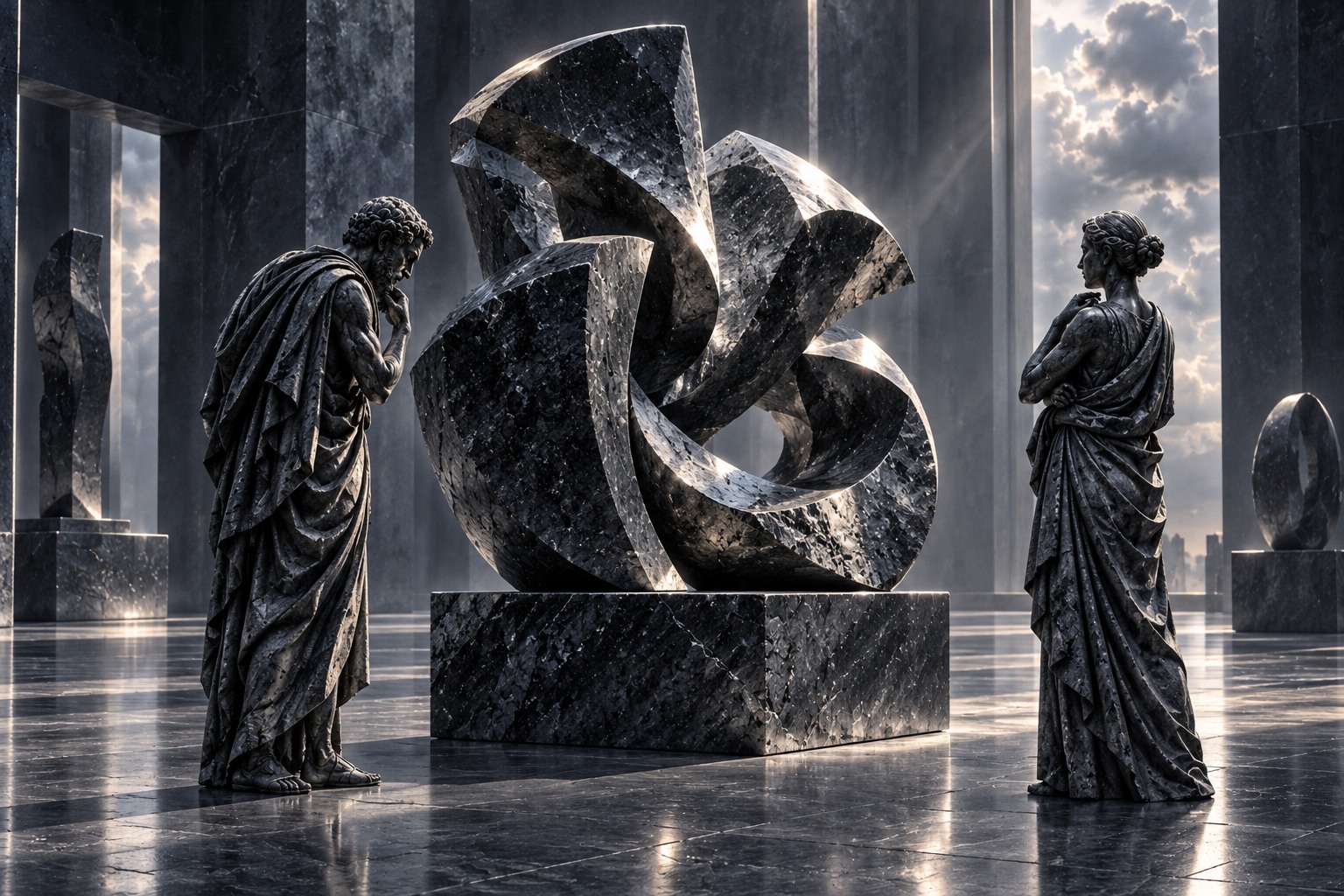
What makes an encounter with form meaningful?
United Wisdom · Meaning and the Path · P-20-N03
About this article
A celebrated work of art can put you in an awkward position: you know it is great, yet you feel nothing in particular. The guide's explanation makes sense, its historical importance is convincing, and your own response remains politely blank. You might conclude that you lack the necessary education. Or dismiss the whole thing as something connoisseurs invented to distinguish themselves from everyone else. Either response brings the encounter to a quick end. Neither answers the more interesting question: what has to happen between a person and a work of art for its form to become meaningful?
This article distinguishes understanding, judgment, pleasure, and personal response. It explores what can be learned, why expertise gives no one authority over another person's admiration, and how to remain curious without having to love everything that is acclaimed. Philosophical arguments sit alongside limited psychological evidence. The everyday scenes are hypothetical examples, not accounts of research participants.
1. When a museum becomes an examination
Imagine visiting an exhibition with someone who knows painting well. They recognize the artists, distinguish periods, and explain how approaches to color have changed. You listen with interest. Then you stop before a painting they particularly love. “Look at this. Isn't it extraordinary?”
You look. You see colors, figures, a few unusual details. You may understand the explanation. But whatever is happening to your companion is not happening to you. The silence grows awkward. It feels as though something important about you is about to be exposed: you are insufficiently educated, superficial, not ready for this. Your attention shifts from the painting to your own cultural credentials.
An encounter with art can become an examination without anyone announcing it. The work acquires another function: it seems to divide people into those who can see and those who are not yet entitled to speak. “It doesn't speak to me” sounds like an admission of defeat. Agreeing is easier. So is attacking the object: “Anyone could paint that.”
In this imaginary scene, the argument begins before anyone has described the experience precisely. “I'm bored,” “I don't understand how this works,” “I understand it but don't share its purpose,” and “I don't know what to say” all collapse into “I don't understand.” Yet each phrase describes a different situation. Someone might need an explanation, more time, freedom from having to account for their response, or no further encounter at all.
The right not to understand begins with permission to describe what is happening without belittling yourself. It does not make your first impression final or cancel your companion's knowledge. It makes room for a question that an examination atmosphere almost rules out: “Show me what you notice here.” That question can take you toward the work and away from a verdict on your worth.
2. What are we trying to understand
Understanding art involves more than decoding a message wrapped in an attractive package. Learning a story, a symbol, or the background to a historical dispute can help. Sometimes, however, what matters happens through rhythm, scale, a pause, or the distribution of light. A summary can tell us what happened while preserving almost nothing of how the work lets us experience it.
Consider two invented sentences: “He waited for her until morning” and “By morning, the cup opposite him still stood untouched.” They could describe the same situation. The first states an action directly. The second leaves the person outside the sentence and invites us to notice a trace of waiting. The reader has to make a small imaginative move. Form contributes to meaning by choosing the distance from which we encounter an event.
Four questions are worth separating. What am I encountering, and what is its context? How is it made? How do I judge the result? What happens to me as I encounter it? The answers connect, but they cannot substitute for one another. You can admire craftsmanship and remain unmoved. You can be deeply affected by something whose weaknesses you recognize. You can enjoy a work without being able to explain how it works.
Helmut Leder and colleagues describe aesthetic experience through several processes, including perception, classification, cognitive mastering, and evaluation. Their psychological model distinguishes aesthetic emotion from aesthetic judgment. That distinction is useful here; it is not a proven universal sequence every viewer must follow. This article draws on the model's published abstract. Leder and colleagues, 2004.
“Did you understand it?” is often too narrow a question. After a film, one viewer may reconstruct the events accurately, another notice how editing changes our trust in the narrator, and a third find an image for their own loneliness. This does not make every interpretation equally well supported. It means that before judging an answer, we should establish what kind of understanding we are asking about.
3. What education can offer
Education in the arts can expand the distinctions available to our attention. We begin to notice things that previously merged into an overall impression: the construction of space, the return of a musical theme, a shift in narrative voice. Naming a technique is useful when it helps us return to what we can hear or see and discover something specific.
In “Of the Standard of Taste,” David Hume connects the development of judgment with practice, comparison, delicacy of discrimination, and freedom from prejudice. He also emphasizes revisiting a work: relationships between its parts may remain unclear on a first reading. This is a philosophical argument for cultivating taste, not the finding of an educational experiment. Hume, 1757, sections 18–23.
Consider a hypothetical example. You listen to a piece of music and hear only insistent repetition. A friend suggests following one line: when it returns, which instruments join it, where an expectation is interrupted. The next time you listen, your attention has something to follow. The repetition is no longer an undifferentiated stretch of sound. You begin to hear its structure.
This kind of help can be tested directly. After the explanation, you can notice something for yourself, point to it, and even disagree: “Yes, I hear the change, but it seems too predictable.” Knowledge has made your judgment more independent. An explanation that leaves you with only another formula of deference works differently: “This is complex, so you must appreciate it.”
Learning to distinguish takes time and opportunity. Someone who grew up among books, musicians, or conversations about museums may have acquired some of that preparation without noticing. This provides no reason to treat others as less sensitive. In an ordinary conversation, identifying a missing piece of experience is more useful than measuring someone's supposed level of culture.
Learning need not end in shared preferences. Two people can hear the same technique, understand its function, and judge the result differently. Education makes their disagreement more substantial. They can now discuss the work instead of deciding which of them belongs in the room.
4. Why admiration cannot be imposed by argument
Knowledge has limits to its authority. An expert can correct a date, reveal an overlooked detail, or explain a technique's significance in art history. The accuracy of that information does not oblige someone else to feel delight. A work's historical importance and its importance in my life are different questions.
In the Critique of Judgement, Immanuel Kant insists on the independence of a judgment of taste. Other people's approval may prompt me to scrutinize my assessment, but it cannot replace it. In sections 32–34, he examines why proofs and rules cannot compel someone to find something beautiful. Yet Kant does not reduce beauty to arbitrary preference: for him, a judgment of beauty still lays claim to others' agreement. That tension belongs to his philosophy. Kant, 1790, sections 32–34.
For our purposes, this suggests a modest distinction. I can offer reasons for my judgment without acquiring authority over your feelings. You can decline to share those feelings without thereby refuting the reasons. A genuine disagreement becomes possible, with no need for either person to pretend.
Imagine saying, after a long explanation, “Now I understand why that was a bold choice. But looking at the painting still doesn't interest me.” There is no necessary contradiction. Your knowledge has changed. Your experience has not yet changed. Demanding the second as a receipt for the first turns a gift of knowledge into a debt.
Honesty does not require an immediate public verdict, either. Between respectful silence and “This is worthless,” many precise responses remain available: “I can see the skill”; “This way of expressing it puts me off”; “I need another way in”; “I don't want to give this my time today.” Each makes the limits of your experience clearer, along with what remains open to discussion.
5. Looking again at a familiar wave
Sometimes one precise observation is enough to make a familiar image more than something we recognize. Take Katsushika Hokusai's The Great Wave off Kanagawa, from the series Thirty-six Views of Mount Fuji. The Metropolitan Museum of Art dates its impression to approximately 1830–1832 and draws attention to the play of perspective: the immense mountain appears as a small triangle within the curve of the wave. The Met's object record.
Recognition might be where we stop: Japanese print, blue wave, famous image. Or we might linger over the relationship of sizes. Something immense and enduring is placed in the distance; something momentary fills the foreground. The following reading is our interpretation of the composition: it lets us sense how scale depends on the observer's position. It is not a claim about Hokusai's one true intention.
The explanation offers no secret password. It proposes a movement of attention that a reader can repeat and check against the image. You may agree, see a different relationship, or remain indifferent. The conversation now concerns particular aspects of form: distance, juxtaposition, placement within the field of vision.
It is tempting to turn this immediately into a lesson for life: every anxiety is merely a matter of perspective, so take a wider view. The work proves no such thing. A beautiful comparison does not dissolve real danger, and greater distance is not always better. If the image resonates with a personal situation, it begins a reflection that still needs to be tested against the circumstances.
Here an encounter with form can become meaningful without a compulsory solution to a riddle. We notice how the visible world has been arranged and discover another way of looking. Sometimes that brings pleasure; sometimes unease, curiosity, or simply greater precision. Sometimes nothing happens. Each outcome allows us to discuss a particular work without inventing a story of spiritual transformation.
6. Between boredom and curiosity
Difficulty does not always mean that a work will remain inaccessible to us. Sometimes we have found a point of interest but cannot yet get hold of it. We sense something unusual and have no way to approach it. A small explanation may help here more than a long lecture about the artist's importance.
In “What is interesting?”, psychologist Paul Silvia investigated interest in relation to appraisals of novelty and complexity, and of one's ability to understand the object. The abstract reports that four experiments using different materials supported the proposed model. The same appraisal structure did not predict enjoyment, which was treated as distinct from interest. Only the abstract was read for this article, so we make no additional claims about effect sizes or applicability to every museum visitor. Silvia, 2005.
For everyday encounters, this offers a useful question rather than a universal prescription: am I wholly uninterested, or do I not yet see what there is to explore? In a hypothetical example, a viewer is invited to compare two areas of one work rather than to “understand contemporary art.” Which feels denser? Where does movement appear? What changes when you step back? A limited task emerges, with a result accessible to your own perception.
The possibility of such a shift creates no obligation to keep working until interest arrives. Attention has competing demands. After a difficult day, someone may prefer familiar music. That choice tells us nothing conclusive about their capacity to grow. Someone else may want challenging material precisely that day. Context matters, but using it in advance to explain every response would be presumptuous.
Nor should every effort come with a promised reward. You might read a commentary, return to a work, and understand it better while becoming more certain that it is not for you. The effort has still changed something: your refusal is more informed. Discovering the limits of your interest is a possible outcome of an encounter, even if museum shops do not print it on postcards.
7. When knowledge becomes a claim to superiority
A conversation about taste changes when the title of a favorite work starts standing in for knowing a person. “That's all he listens to.” “She hasn't even read this.” “They go to those exhibitions.” A preference quickly becomes a description of an entire personality. We stop discussing what someone noticed and decide which group they belong to.
This need not involve deliberate arrogance. In an imaginary conversation, someone may sincerely want to share a favorite book and still say, “You can't read it and remain the same.” If the listener has remained the same, an uncomfortable choice follows: challenge someone close to them, admit to insensitivity, or perform a transformation. The stronger the insistence on a required experience, the less room remains for an actual response.
The next remark offers a useful test. “What did you notice?” opens the conversation. “How could you miss that?” calls for a defense. “This detail helped me” offers support. “Any educated person understands this” establishes an admission requirement. You can hear the difference even when both speakers know the subject equally well.
The Confucian tradition brings a different, ethical question to culture. In Analects 3.3, Confucius connects ritual and music with humaneness, or ren. In the next passage, 3.4, depth of grief takes precedence over meticulous observance in mourning. These remarks belong to the moral and ritual order of ancient China. They cannot be turned into a modern theory of museum experience. Analects, Book III, translated by James Legge.
Our comparison is narrower: mastery of cultural form does not settle how someone treats another person. Fine musical discernment and the humiliation of an inexperienced listener can coexist in one scene. We might therefore assess cultural education partly by what becomes possible in conversation: can we notice more precisely, ask more freely, explain more patiently? This is a proposed criterion for interaction, not a test of morality based on favorite artists.
8. Why personal taste does not settle everything
The right to your response does not make every statement about a work equally accurate. If I overlook a recurring motif, someone can point it out. If I confuse the author or the plot, the error can be corrected. If I attribute a meaning that important details contradict, my interpretation is open to challenge.
“I'm bored” describes an experience. “Nothing happens here” describes the work's structure. “The artist has nothing to say” adds an assumption about another person. The phrases may follow one another as though they were almost synonymous, but the second and third need further grounds. My lack of response does not automatically establish a lack of content.
The reverse also holds: a strong feeling does not validate every explanation of that feeling. If a film makes me cry, that establishes neither historical accuracy nor the depth of all its ideas. It may have touched an important memory, used a familiar technique, or offered a particularly convincing scene. We should not choose one explanation as settled without looking further.
Imagine a disagreement about a novel. One reader says the protagonist changes abruptly and the author has not prepared the turn. Another points to earlier episodes in which the change is already taking shape. The first reader may revise their judgment of the book's construction and still find the transition emotionally unconvincing. They need not end with a shared rating. Their conversation has already become more precise by separating the presence of preparation from the strength of its effect.
Taste has room to develop when we let it have its own history while remaining open to objections. Both sides can close down: the connoisseur who already knows the correct answer, and the viewer who treats every explanation as an infringement of freedom. Between them lies the possibility of paying attention together. There, someone else's expertise can be acknowledged without surrendering your experience, and a factual error corrected without a demand that you love the work afterward.
9. How art returns to everyday life
A work's significance does not always become apparent while we are in front of it. Imagine leaving a film with an uncertain impression. A week later, during an ordinary conversation, you remember one of its long pauses. For the first time, you notice someone searching for words and how quickly you usually fill the silence. The film offered no instructions. It left a form through which you could recognize something in your own life.
At the beginning of Art as Experience, John Dewey sets out to restore the connection between art and everyday events, actions, and experiences. He warns against treating a classic work in ways that let its prestige obscure the human conditions of its creation and its effects in experience. This is a philosophical account, not a promise of measurable improvement after a museum visit. Dewey, 1934, chapter I.
In the account proposed here, form becomes meaningful when relationships between its parts disclose a distinction that matters to our experience. Near and far, repetition and change, what is said and what is left out cease to be abstract categories. We encounter them in a particular color, inflection, or movement. Sometimes that gives a name to a familiar experience. Sometimes it interrupts an explanation that has become too familiar.
The encounter need not produce practical benefits. A painting may hold our attention for a few minutes on a shade we had never made room for. Music may offer pleasure in movement that leads nowhere beyond its own sounding. Demanding a lesson from every encounter would create another examination, this time for the work.
Personal significance does not turn art into a mirror in which we find only ourselves. A work can resist our habitual questions. Another time, another experience, an unresolved ambiguity may remain within it. Attentive reading sometimes ends with an admission: “I see more than I did, but I still cannot bring it fully within my understanding.” Something can remain unfinished even when a real encounter has taken place.
10. The right to leave and the possibility of returning
You can end an encounter with art without concluding that something is wrong with you. You can close the book, leave the room, or stop the recording. In this article, “the right” refers to personal freedom over attention. It is not a legal claim or an exemption from specific educational or professional responsibilities.
Yet leaving voluntarily can carry different conclusions. “This is not for me today” leaves one set of possibilities open. “There is nothing here to understand” closes more than the experience establishes. Your words need not be diplomatic at any cost, but it is useful to notice how far your conclusion has traveled beyond what actually happened.
Returning requires no promises, either. You may play the music again a year later and hear it exactly as before. You may suddenly love what once irritated you. You may understand a former enthusiasm better and discover that it has run its course. None of these trajectories, on its own, proves growth or decline. To assess the change, we would need to ask what has become available to attention and what grounds the judgment now has.
Return to our imaginary exhibition. Your companion still loves the painting. You still do not share their delight. But now you can say, “Show me where the movement begins for you.” They point to a relationship between details. You notice one for the first time and see another differently. The conversation continues without requiring identical conclusions.
Perhaps this will be the visit's most important event: the work has become a place where two people can look more attentively without making one person's vision submit to the other's. Or you may simply move on, keeping one small observation. Taste need not produce a progress report after every cultural evening. It can remain open to encounters of its own: sometimes difficult, sometimes joyful, never guaranteed by someone else's authority.
What this means in practice
If you want to give an unfamiliar work another chance, try a brief exercise in looking or listening. This is a way to observe, not a validated psychological method or an obligation to finish everything you begin.
First, describe your reaction as precisely as you can. “I don't understand” might mean that you cannot recognize the story or see the connections; that you are bored or irritated; or that you are interested but cannot find words. You do not have to choose just one feeling. Greater precision does not yet explain its causes.
Then choose one accessible detail: a change in light, a repeated word, a shift in tempo, the distance between figures. Stay with it briefly. What is actually there, and what changes when you give it attention? Before searching for symbolic meaning, allow yourself to see or hear the thing you are discussing.
If you want help, take one substantive explanation from a reliable commentary, or ask someone to show you a particular moment. Then return to the work. Check what the explanation has made discernible and where you still disagree. The amount of background information you remember need not measure success.
Finally, separate the results: what do I now understand; how do I judge what has been made; what do I feel; do I want to continue? Any honest answer is possible, including no change. If you came with someone, exchange observations before judgments. “Where did your attention linger?” often gives a conversation more to work with than “Did you like it?”
Another day, you may choose a different approach entirely: reading for the story, listening for pleasure, looking without commentary. Being able to analyze does not require constant analysis. Education adds possibilities for engaging with art. Freedom of taste survives when those possibilities include pleasure without explanation, disagreement after understanding, and the untroubled choice to walk on.
Connections between approaches
| Approach | What it helps distinguish | Limits |
|---|---|---|
| Hume, Of the Standard of Taste | Practice and comparison refine judgment | The philosophical argument does not guarantee shared preferences after education |
| Kant, Critique of Judgement | Other people's approval cannot replace one's own judgment | Kant's autonomy of taste does not reduce beauty to personal whim |
| Leder and colleagues | Aesthetic emotion and aesthetic judgment are distinct | The theoretical model prescribes no compulsory sequence for every viewer |
| Silvia's research on interest | Interest, understanding, and enjoyment are not identical | The available abstract does not allow a full assessment of the experiments' limitations |
| Analects, Book III | Cultural form is considered in relation to humaneness | Ritual ethics is not a theory of contemporary museum experience |
| Dewey, Art as Experience | Art is considered in relation to human experience | Personal significance guarantees neither practical benefit nor moral change |
This comparison brings different questions to a shared topic. It does not claim that these authors offer one theory or experimentally validate one another.
Primary sources and research
-
David Hume. Of the Standard of Taste. 1757. Hume Texts Online. Read excerpts from sections 18–23 on practice, comparison, and judgment inform the article. A philosophical primary source; the author's historical vocabulary and cultural hierarchies are not adopted as contemporary norms.
-
Immanuel Kant. Kritik der Urteilskraft. 1790. Critique of Judgement, translated by J. H. Bernard, sections 32–34. Passages on the independence of taste and the limits of proof were checked. The article paraphrases the English translation; it does not reproduce direct quotations.
-
Katsushika Hokusai. Under the Wave off Kanagawa. Approximately 1830–1832. The Metropolitan Museum of Art, JP1847. The object record, series identification, and museum commentary on perspective were checked. The article's connection to personal experience is an interpretation, not an established claim about the artist's intention.
-
Leder, H., Belke, B., Oeberst, A., Augustin, D. A model of aesthetic appreciation and aesthetic judgments. 2004. British Journal of Psychology, 95, 489–508. Publisher page and abstract. DOI: 10.1348/0007126042369811. Only the abstract was read. Use is limited to its distinction between emotion and judgment and its general description of the model.
-
Silvia, P. J. What is interesting? Exploring the appraisal structure of interest. 2005. Emotion, 5(1), 89–102. PubMed abstract. DOI: 10.1037/1528-3542.5.1.89. Only the abstract was read; the full text at the located repository link was unavailable. No effect sizes or claims of applicability to all viewers are presented.
-
Confucius. Analects. Book III, 3.3–3.4. James Legge's translation, hosted by UCLA. The relevant passages were checked. An erroneous Lao-Tse attribution on the hosting page is excluded. The work belongs to the Confucian tradition. The article paraphrases rather than quotes the translation.
-
John Dewey. Art as Experience. 1934. Available scan of the Perigee edition, chapter I, printed pages 3–4. The opening passage on the relation between art and lived experience, including the effects of prestige on perception, was read. The complete book was not examined.
Tags
Aesthetics, taste, aesthetic experience, understanding art, arts education, cultural experience, attention, form, content, interpretation, personal response, aesthetic judgment, emotion, interest, enjoyment, curiosity, autonomy, cultural authority, dialogue, painting, music, literature, Hokusai, Hume, Kant, Dewey, Confucius, United Wisdom.
About the project authors
Andrey Zarinsh is the author and founder of United Wisdom. He explores inner transformation, the unity of traditions, intercultural dialogue, and contemporary spiritual discipline. Instagram: @andrey.zarinsh.
Maria Evilkut is a co-author of United Wisdom. Alongside her research, she seeks to test these ideas in practice and observe how principles of unity and mutual understanding work in real relationships between people and cultures. Instagram: @ilkutki.
Keep what resonates with you.