
Meaning and the Path
Taste Without Sacred Reverence: How to Stop Faking Cultural Orgasms in Front of Canvas
A familiar scene: you stand before a canvas universally hailed as a masterpiece of world culture, wearing the polite, knowing grimace of a cultured individual, while a hollow ringing void echoes inside your skull.
Art, Conscience, and Impostor Syndrome
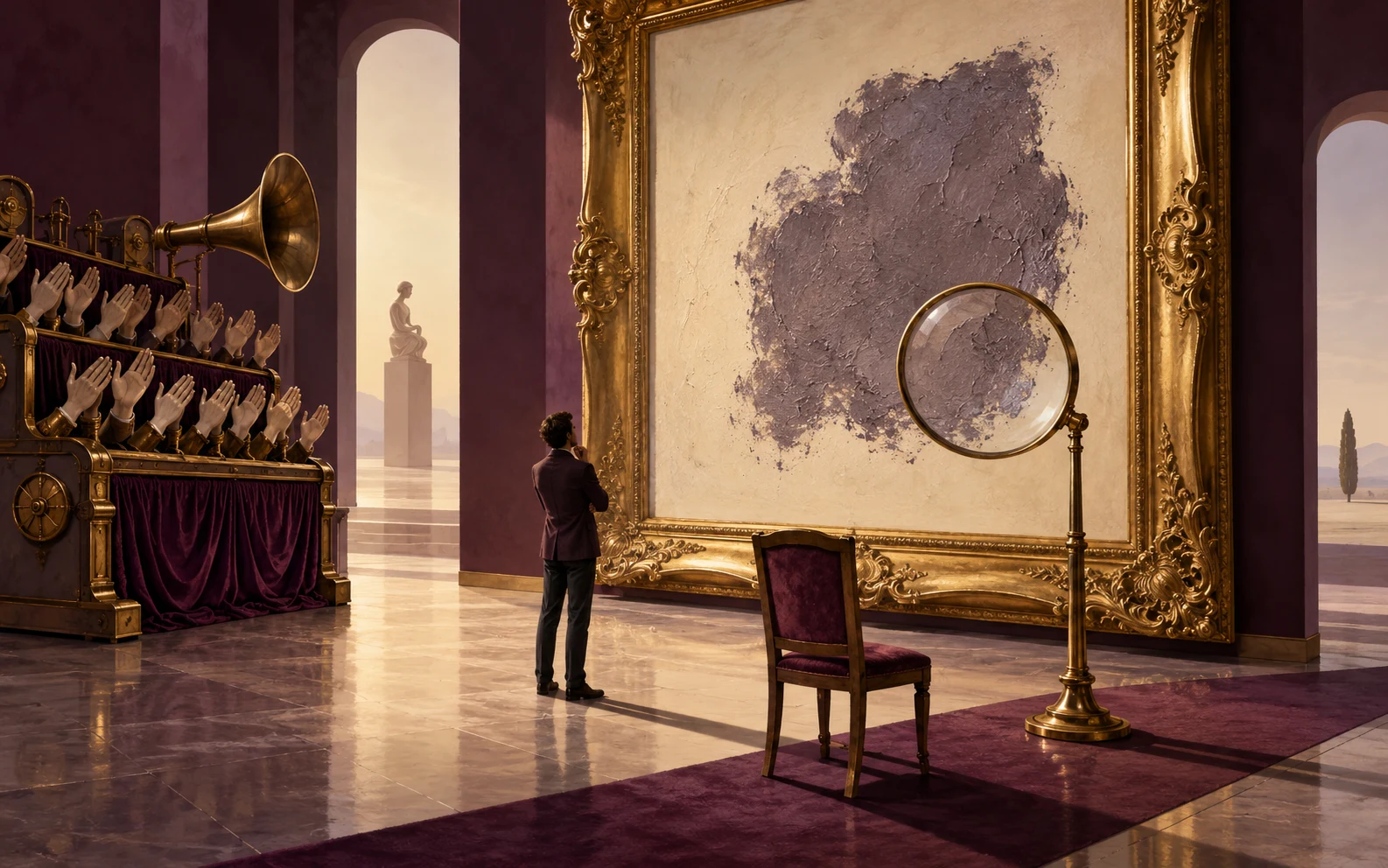
A familiar scene: you stand before a canvas universally hailed as a masterpiece of world culture, wearing the polite, knowing grimace of a cultured individual, while a hollow ringing void echoes inside your skull. The tour guide trills like a nightingale, the auction price tag runs well into seven figures, and a treacherous voice inside your head whispers: "Well, it’s a smudge. A grey smudge. So what?"
At this juncture, people usually split down one of two dead-end alleys. The first is to meekly resign yourself to the verdict that you are an irredeemable philistine, simply unfit to ascend to the cultural elite. The second is an offended snort: "My five-year-old nephew could smear that together; the whole racket is run by frauds puffing up their cheeks." Both paths lead straight into a wall. Let’s dissect where genuine comprehension ends and cheap intellectual snootiness begins, why an encyclopedic background is under zero obligation to trigger drooling ecstasy, and how to stand before a painting without feeling like a fraud—and without any contractual obligation to fall head over heels for it.
1. The Museum Interrogation: Squeezing Out a Confession
Picture a hypothetical scenario: an aesthete friend drags you to an exhibition. He peppers the air with high-minded jargon, distinguishes early-period hues from late-period palettes, and freezes in front of a gloomy smear with a languid gasp: "Good lord, what a piece! Just look at it!"
You obediently stare into the frame. You see paint strokes, a pair of crooked diagonals, perhaps you even grasp the historical context. Yet there is no ecstasy. The air thickens. Silence feels agonizingly awkward, because admitting "this really doesn't speak to me" feels like voluntarily submitting an IQ test scored at absolute zero. And instead of looking at the painting, you begin frantically scanning your own cultural inadequacy.
The gallery suddenly morphs into an examination hall where aesthetes casually draw their exam tickets while uninitiated guests get kicked to the curb. In this hypothetical situation, entirely distinct phenomena get mashed into an indiscriminate ball: plain boredom, missing context, calm disagreement with the concept, or banal disorientation.
The right to "not get it" is not a bulletproof vest for willful ignorance; it is ordinary intellectual honesty. It lets you skip both compulsory worship and venomous cynicism, and simply turn to your enraptured companion and ask: "What specifically are you seeing here?"—shifting the spotlight right off your self-esteem and back onto the canvas itself.
2. What Are We Trying to Grasp: Behind the Secret Code Curtain
Art is not an elementary school riddle where the creator cunningly encoded a moral fable, obliging the viewer to grab a magnifying glass and decipher "what the author meant to say." Subject matter and historical squabbles are useful, but form itself—rhythm, distribution of shadow, compositional pauses—is what dictates precisely how we experience what we see.
Compare two made-up phrases describing the exact same event:
-
"He waited for her until dawn."
-
"By dawn, the cup across the table remained untouched."
The first bluntly reports information head-on. The second forces the reader to perform mental labor, reconstructing the muted desolation of the room. Form creates distance.
To avoid tripping over your own testimony, it helps to distinguish four separate questions:
-
What is physically lying or hanging in front of me (context)?
-
What technical machinery holds it together (structure)?
-
How do I evaluate what was achieved?
-
What personally happens to me upon contact (emotional response)?
These four do not march in lockstep. You can fully acknowledge an artist’s jewel-like technical mastery while remaining colder than liquid nitrogen, just as you can weep over an awkwardly stitched piece of kitsch.
In the cognitive model proposed by Helmut Leder and colleagues, aesthetic experience splits into perception, classification, cognitive mastering, and evaluation. In this framework, aesthetic emotion and aesthetic judgment represent distinct processes. Let’s emphasize: this is simply a theoretical model (the source referenced here relies solely on its published abstract, not the full study text), and by no means a mandatory factory assembly line down which every gallery visitor's psyche is forced to slide.
Consequently, the question "Did you understand it?" is hopelessly narrow: one spectator extracts the plot, another spots an editing trick, and a third latches onto a metaphor for their own existential dread. Do not kid yourself, however: it does not follow that any baseless fantasy spun in a gallery qualifies as a "fully legitimate reading."
3. Why Bother With the Homework: Optics Versus Blindness
Gaining cultural literacy is not meant for turning up your nose at your neighbors; it exists to train your optics to detect gradations. It fine-tunes your vision: you begin noticing the modulation of a leitmotif, a fracture in perspective, the direction of a brushstroke.
Philosopher David Hume, in his essay "Of the Standard of Taste," argued that sound judgment is honed by practice, the comparative survey of works, and purging the mind of prejudice. He also stressed the utility of repeated acquaintance. Note the caveat: this is an eighteenth-century philosophical treatise, not a randomized controlled trial run on a cohort of undergraduate students.
A hypothetical illustration: you listen to an intricate piece of music and hear nothing but a bleak, monotonous grind. If an informed guide whispers, "Listen for the bass clarinet line: note when it re-enters, how it fractures the bar," the chaos suddenly resolves into an intelligible architecture. Focus emerges. You are then entirely free to counter: "Right, I hear that trick now, but it still strikes me as wholly derivative."
Competent knowledge equips you with independence, not a slave’s habit of chanting: "This is difficult, therefore bend the knee." Someone raised among easels and dense volumes simply received this calibration earlier in life, but that does not automatically elevate them into a superior being. Furthermore, education offers zero guarantee that everyone will burst into harmonious consensus: you might dismantle a technique down to its last screw yet continue to dispute its artistic worth.
4. Why You Can't Hammer Ecstasy with a Crowbar
Expertise comes with strictly bounded jurisdiction. An authority has every right to correct a mangled historical date, excavate the origin of a pigment, or locate a canvas within the chronicles of an era. But deducing from these facts a legal obligation to squeeze out tears of tender ecstasy is sheer snake oil.
Immanuel Kant, in his Critique of Judgement, defended the autonomy of taste with uncompromising rigor. No proofs, syllogisms, or appeals to authority can coerce an individual into finding an object beautiful. Caution: this is a philosophical argument, not an empirical finding; nor did Kant ever sanction the lazy excuse that "everything is subjective, so whatever arbitrary whim strikes me qualifies as beauty." For him, a judgment of taste paradoxically lays claim to universal agreement.
The distinction is foundational: a critic can pile up a mountain of compelling arguments to support their evaluation, but that does not crown them sovereign over your visceral feelings. Simultaneously, your indifference does not reduce their structural arguments to ash.
It is entirely valid to declare after an hour-long guided tour: "I now understand why this was a groundbreaking revolution in 1910. Personally, looking at it still makes me nauseous." Knowledge deepened, yet no emotional spark caught fire. Demanding sincere adoration as payment for a delivered lecture is simply bad manners.
5. Dissecting the Japanese Wave Without Drowning in Moralizing
Sometimes a single precise anchor can pull a hackneyed visual cliché out of its state of comatose familiarity. Take Katsushika Hokusai’s iconic woodblock print Under the Wave off Kanagawa from the series Thirty-Six Views of Mount Fuji. According to museum dating by The Metropolitan Museum of Art, this impression dates to approximately 1830–1832. Curators draw attention to its compositional perspective: the gigantic, sacred Mount Fuji is compressed into a miniature blue triangle directly framed within the jaws of a violent surge of water.
First, you see a t-shirt graphic. Then you spot the compositional trapdoor: the eternal and immovable is shoved into the remote background, while a fleeting crest of foam dominates the entire universe. We might extract a tidy life metaphor from this: the apparent scale of things depends on the observer's vantage point.
Pump the brakes, though: that is our contemporary reading of the composition, not a proven historical intention left behind by the master. Still less should we inflate this into cheap self-help wisdom along the lines of "your problems are tiny, just view the storm from a safe distance." Real tsunamis and storms do not dissolve under clever metaphors, and emotional detachment is hardly a universal cure.
Pleasure here can stem simply from watching how physical space is configured, completely free of any obligation to undergo a dramatic catharsis.
6. Between a Coma and a Chase: The Anatomy of Curiosity
When your hands drop in resignation before an artwork, it is not always proof that "this isn't for me." Sometimes, our eyes simply have nothing to latch onto: the brain senses an anomaly but holds no key to fit the lock.
Psychologist Paul Silvia investigated the nature of interest through cognitive appraisals of novelty, complexity, and a person's subjective coping potential—the belief in one’s ability to understand it. Let’s be transparent: the source cited here rests solely on the published abstract of his four-experiment paper rather than the full text, so we won't throw around wild declarations regarding effect sizes. Silvia's crucial takeaway: interest is not identical to pleasure. You can dissect a complex work with genuine investigative thrill without reaping any immediate hedonic buzz from it.
Instead of bellowing the abstract battle cry "Learn to love the avant-garde!", giving a spectator a micro-task is far more productive in our hypothetical gallery: "Compare the texture of these two patches. Which carries more visual weight? What changes if you take one step backward?" Suddenly, the eye has concrete territory to explore.
Yet nobody is under orders to engage in grueling hard labor at the foot of every single frame until sweat pours from their brow. If your head is throbbing after an exhausting workday, choosing a bubblegum pop track over a polyphonic fugue is not a treasonous crime against culture; it is basic mental hygiene. Crucially: even the most meticulous breakdown guarantees no fairy-tale ending. You might decipher the precise inner workings of a piece only to conclude with iron conviction: "Yes, I comprehend it completely, and I thoroughly despise it." Drawing the exact borders of your personal distaste is also a stellar result.
7. Cultural Snootiness and the Human Exam
A peculiarly toxic pastime is converting cultural preferences into caste-system calipers: "He hasn't read Joyce? There's nothing to discuss with him," or "She listens to that? That tells me everything." The conversational partner vanishes, replaced by a cheap label.
A person in an everyday dialogue might enthusiastically recommend a masterpiece, tacking on: "This book will completely transform your soul!" What happens if no spiritual rebirth occurs? The listener is herded into a humiliating trap: confess to emotional dullness, fawn and lie through their teeth, or brace for outright friction.
Contrast these two prompts:
-
"What caught your eye here?" (an open invitation to speak).
-
"How tone-deaf does someone have to be not to appreciate this?" (a bouncer checking badges at the cultural door).
In the Analects, ritual form is scrutinized in direct relation to humaneness. In Analects 3.3, Confucius directly ties music and ritual propriety to humaneness (ren), while in 3.4 he insists that in mourning, genuine sorrow far outweighs pristine outward display. Bear in mind: this is ancient Chinese ritual ethics, not a modern field manual for strolling through the Tate Modern.
The lesson is elementary: an encyclopedic command of the classics does not prevent someone from acting like a pompous jerk in real life. Genuine refinement is measured by how we speak to others, not by how many impressionists we can identify by a single fleck of paint.
8. "I'm the Artist, That's My Vision": Why Not Every Delusion is Legitimate
Abandoning faux reverence does not mean sliding into a swamp of total relativism where "every opinion holds equal weight."
If you say "I find this boring"—that is an incontrovertible subjective fact about your state of mind. But the moment you claim "nothing happens here" or "the author is an incompetent hack," you step onto the terrain of factual assertion. If you slept through a recurring rhythmic motif, missed the century entirely, or slapped a moral onto a novel that the written text explicitly contradicts, your mistake can and should be challenged. The absence of your personal emotional response does not prove the absence of structural design.
The reverse holds just as firmly: if a film successfully wrings a bucket of tears from your eyes, that alone does not render it a masterpiece of historical truth. It might simply have stamped hard on a cheap sentimental pedal.
Imagine two readers arguing over a novel: one complains that the climax was pulled out of thin air, while the other points directly to three earlier chapters where the author methodically planted narrative foreshadowing. The first reader might concede that the setup was present on the page, yet maintain that the emotional execution of the scene fell flat. Out of such debate comes clarity: we separate the tangible fabric of the text from our personal emotional receipt.
9. How Art Lives in Daily Life
Works of art rarely dispense neat, practical recipes for everyday living. In a hypothetical example, you walk out of a cinema mildly bewildered by a tedious arthouse film. A week later, you catch yourself holding a deliberate silence in a conversation with someone close to you—noticing their quiet hesitation instead of rushing in with frantic chatter. The film didn't hand you an instruction manual, but it gifted you a shape of attention.
American philosopher John Dewey, in Art as Experience, championed rescuing classical art from gilded pedestals and returning it to dynamic continuity with ordinary human experience. Keep the caveats straight: Dewey’s framework is a philosophical outlook on culture, not a binding guarantee that touring a gallery will instantly transform you into an upright citizen or fatten your paycheck.
Art is under no obligation to yield immediate utilitarian dividends. A melody can exist simply for the intrinsic beauty of its sound. Furthermore, a masterpiece is not obliged to act as an obliging mirror reflecting only your own thoughts. An authentic cultural artifact pushes back, retains the stubborn residue of an alien historical experience, and reserves the right to remain forever unsolved.
10. The Right to Leave and the Choice to Return
Anyone is free to shut a dull book, hit pause on a track, or walk out of an exhibition hall. To be clear, we are talking about the freedom of personal aesthetic perception: if you are sitting for an art history exam or producing a paid client design, this freedom does not excuse you from academic or occupational duties.
Be honest in how you frame your departure, however. The thought "this isn't clicking for me right now" leaves the doorway unlocked. A sweeping "this is meaningless trash" slams it shut with a heavy padlock forged out of your own delusions.
Five years down the road, you might replay that symphony and find yourself in sheer awe, or you might realize with even colder certainty that it leaves you completely numb. Neither outcome makes you superior or inferior to anyone else.
Return to our hypothetical pair before the canvas: you do not share your companion's ecstasy, but you ask them to show you where the rhythm begins for them. You notice a detail, agree, or stick to your original view. Perhaps the pivotal event has already taken place: you engaged with form without abasing yourself, and without committing violence against another's perspective.
Practical Field Test: A De-Mystified Run
If you encounter a challenging work and genuinely wish to give it an unforced chance, try this test. This is not a clinical therapeutic protocol; there are no passing scores, and experiencing zero personal transformation at the end is a perfectly respectable outcome.
-
Name the reaction without shame. Instead of a sullen "I don't get it," specify: Is it boring? Does the heavy-handedness irritate you? Is the historical context opaque? Are you lacking words to describe what you see?
-
Isolate one single detail. Forget about the Meaning of the Universe. Pick a solitary focal point: the way a highlight catches on a sleeve, how a word recurs in the third stanza, how a drumbeat hesitates. Look only at that.
-
Borrow a micro-clue. Read one paragraph of dependable historical commentary or ask a companion about a specific structural element. Return to the object and check: did this help you spot the underlying architecture?
-
Unpack the categories. Ask yourself four questions: What do I now know factually? How do I evaluate the work? What do I actually feel? Do I want to invest more time here?
If you are exploring with a companion, asking "Where did your eye land?" will save a mountain of friction compared to the loaded question: "Well, is it a masterpiece or what?"
Comparative Optics of Ideas
| Concept / Source | What It Helps You Notice | Boundaries of Application |
|---|---|---|
| David Hume, "Of the Standard of Taste" | Practice and comparison bring precision to critical judgment. | A philosophical thesis; extensive experience does not ensure identical tastes. |
| Immanuel Kant, Critique of Judgement | Autonomy of taste: external authority cannot substitute for personal response. | Does not imply "every whim is beauty"; Kant’s judgment still lays claim to universal agreement. |
| Leder et al. (Aesthetic Model) | Aesthetic emotion and aesthetic judgment operate as distinct processes. | The model does not dictate a mandatory assembly-line checklist for every viewer. |
| Paul Silvia (Research on Interest) | Interest, complexity, and pleasure are not identical. | The referenced source rests on an abstract; cannot be casually transposed onto every museum outing. |
| The Analects, Book III | Ritual and music are evaluated in inseparable connection with humaneness (ren). | Ancient ritual ethics, not a modern visitor's guide to a contemporary art biennale. |
| John Dewey, Art as Experience | The continuous link between art and lived human experience. | A philosophy of experience, not a promise of moral saintliness or practical profit. |
Primary Sources and Research
-
David Hume. Of the Standard of Taste. 1757. Hume Texts Online. Referencing §§ 18–23 regarding practice, comparison, and the judgment of taste.
-
Immanuel Kant. Kritik der Urteilskraft. 1790. Critique of Judgement, translated by J. H. Bernard, §§ 32–34. Referencing the autonomy of taste and the limitations of external proofs.
-
Katsushika Hokusai. Under the Wave off Kanagawa. Circa 1830–1832. The Metropolitan Museum of Art, JP1847. Object record, dating, and notes on compositional perspective.
-
Leder, H., Belke, B., Oeberst, A., Augustin, D. A model of aesthetic appreciation and aesthetic judgments. 2004. British Journal of Psychology, 95, 489–508. Publisher page and abstract. Referencing the published abstract distinguishing aesthetic emotion from judgment.
-
Silvia, P. J. What is interesting? Exploring the appraisal structure of interest. 2005. Emotion, 5(1), 89–102. PubMed Abstract. Referencing the published abstract regarding interest, novelty, and complexity without extrapolating beyond the abstract.
-
Confucius. The Analects. Book III, 3.3–3.4. Text translated by James Legge via UCLA. Referencing passages on ritual, genuine mourning, and the category of humaneness.
-
John Dewey. Art as Experience. 1934. Perigee edition scan, Chapter I, pp. 3–4. Referencing the introductory passages on the continuity of art and ordinary experience.
Culture exists for human beings, not human beings to serve museum pomp. Retaining the calm liberty to walk past what leaves you cold preserves your personal integrity, while allowing art to retain its authentic value.