
Growing up
Age, skill, and circumstances: why development is not a single ladder
Seven-year-old Nina invents elaborate stories but struggles to get her belongings together before leaving home. Her cousin, the same age, gets ready without reminders but hesitates to join an unfamiliar game. At a family dinner, these observations quickly become a ladder: one…
Epigraph
Growth is not something done to them; it is something they do.
John Dewey, Democracy and Education (1916), chapter IV, §1. English original. This is a philosophical argument about a child's active participation, not a promise of a uniform developmental pace.
What this article is about
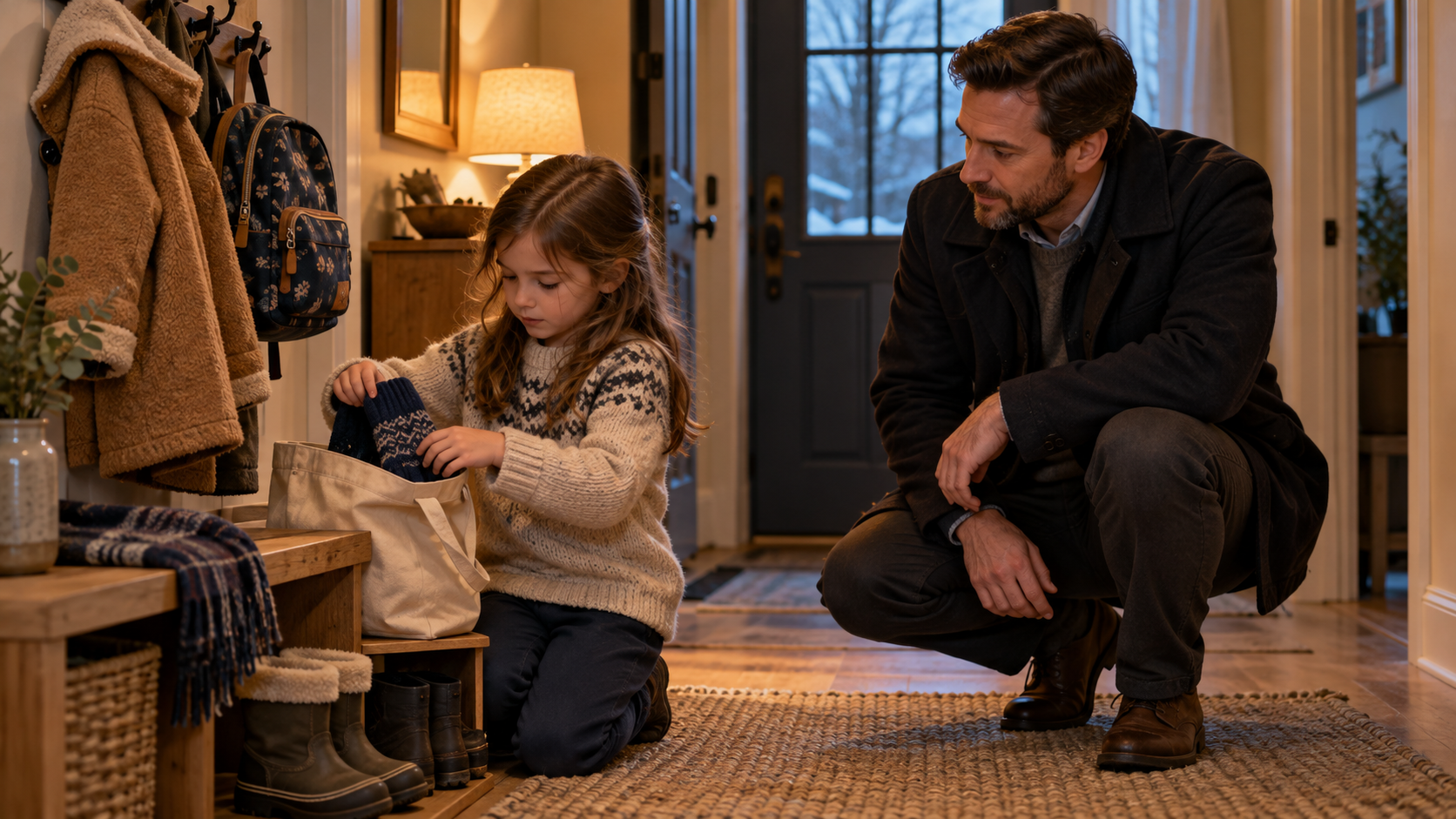
Seven-year-old Nina invents elaborate stories but struggles to get her belongings together before leaving home. Her cousin, the same age, gets ready without reminders but hesitates to join an unfamiliar game. At a family dinner, these observations quickly become a ladder: one child is already grown-up; the other is still little. The ladder then explains every subsequent action. Nina's forgotten gloves supposedly confirm immaturity, while her fluent speech is taken to mean that she should no longer need help. In this fictional scene, the children become less visible just when the adults believe they have finally understood them.
This article helps parents, other caring adults, and readers aged eighteen or over distinguish an age-related reference point, a particular skill, and the conditions in which it can be used. We consider what to observe instead of applying a global label, how to preserve a child's participation, and why respecting variation is compatible with seeking an assessment promptly. The reader gains a way to clarify one everyday task without an expensive programme or endless testing at home. There is a firm limit: loss of a skill, a significant difficulty, or danger cannot be dismissed as “their own pace.” This is educational reflection, not a diagnosis or a timetable for deciding an individual's readiness.
I. The same age does not mean the same task
Age is useful as part of a question, but weak as a complete answer. “She is seven already” does not tell us what is being asked: fastening a zip, remembering an order of actions, keeping track of time, or managing a hurried adult's voice at the door. All these demands can hide inside “getting ready.” When an adult judges only the overall result, the point where help is needed can disappear. Nina may know what to wear and struggle with switching from breakfast to leaving. That differs from not understanding clothes. The distinction does not establish a cause; it makes the description useful for discussion and assessment.
Her cousin's routine looks independent, but he always leaves with the same bag for the same destination. We do not yet know what would happen before an overnight trip. Compare the action and its circumstances, rather than the final words “can” and “cannot.” Who gave a reminder? Was there a chance to practise? What was prepared beforehand? Invisible adult work often forms part of a successful result. Recognising it does not take the achievement away from the child. It helps identify which support cannot quietly be removed and which part of the task the child has actually learned.
Adults also vary across the things expected of their age. Someone may negotiate confidently and ask for help with an unfamiliar application form. This comparison does not erase the difference between childhood and adulthood; it exposes the weakness of a single overall grade. Children have particular difficulty challenging that grade because older people control the rules, schedules, and resources. Replace “act more grown-up” with a description: “The gloves go missing between the kitchen and the door; let's see where keeping them would work better.” There is now a question that can be examined, without treating the child's whole personality as defective.
II. A reference point directs attention; it is not a ranking
Giving up the ladder does not mean giving up developmental information. Age-related reference points can draw attention to something worth discussing and help formulate a professional question. CDC distinguishes developmental monitoring from more formal screening. Observations at home are not equivalent to a professional assessment. Scope matters: the CDC resources discussed here address early childhood, especially birth to five years. They cannot simply become a maturity table for a seven-year-old schoolchild or a sixteen-year-old teenager. A particular concern needs information suited to both the age and the question.
Turning a reference point into a competition between families is unhelpful. Another child's earlier success with one action does not tell us what is happening for yours. It is equally unhelpful to dismiss every concern as comparison that must be abandoned. A parent may notice a real difficulty even if another child first brought it to their attention. What matters is the next move, from comparison to a specific observation. What is difficult? For how long? In which situation? What has changed? This preserves care without a premature diagnosis and without a reassuring prohibition on noticing a problem.
A reference point only makes sense alongside its source's limits. An entertainment post without an age range, context, or provenance does not become a norm because it mentions psychology. An official document also needs its purpose checked: population description, guidance on seeking help, educational resource, or individual conclusion? Nina need not sit a daily home examination against every available chart. An adult can select one relevant question and bring observations to a consultation. Not having a perfect diary does not remove the right to ask for an assessment. Gathering information should make help easier, not become a new entry requirement.
III. Having a skill and using it are different
Knowing how to do something and doing it on a particular occasion are different matters. Nina packed her bag yesterday and forgot a notebook today, after a poor night's sleep and a change of schedule. This establishes neither lost ability nor deliberate disobedience. For now, there are two episodes under different conditions. We can ask what helped yesterday and what interfered today. One success does not show that support can be withdrawn forever; one difficulty does not show that the child can do nothing. This caution preserves the scale of the facts without promising to explain every problem through tiredness.
Several questions can help: does the child understand the task, know how to perform the action, begin without a reminder, maintain the sequence, and have access to the ability right now? These are working questions for an everyday scene, not a diagnostic scale. An adult may discover that the instruction was more complicated than the task: four requests called from another room while the child was tying shoelaces. Changing the adult's delivery is then a reasonable first step. If the difficulty persists, the original explanation does not become proven because it was kind. It needs reconsidering, with room for another cause and professional assessment.
Do not extract proof of ability through coercion. “You did it once, so keep repeating it until you succeed” can turn the morning into a struggle to vindicate the adult. An available trial is smaller: practise one transition at a calm time, let the child show an arrangement that works for them, and agree on an acceptable prompt. If they do not want to discuss it now, necessary belongings can be prepared without a public interrogation, with discussion left for later. Essential care does not wait for perfect cooperation. A child should not be left cold without gloves to produce a persuasive lesson in independence.
IV. The environment participates in the result
Suppose the bag's hook is too high, belongings are kept in three rooms, and leaving begins with “hurry up.” It is insufficient to assess Nina's memory alone. The arrangement can change too. In chapter II, Dewey considers the environment as a medium of education. This is early twentieth-century educational philosophy, not a contemporary trial of a parenting technique. For our scene it raises a question: what action do the surrounding conditions make possible? The answer must be examined in the household, rather than guaranteed by a famous name.
If there is no spare shelf, an ordinary bag by the door may hold the necessary things. Part of the schoolbag might be packed in the evening, if that is actually easier, or a small picture could provide one reminder. Buying an organiser and maintaining a photogenic routine are optional. The relevant questions concern the change: are there fewer transitions, what does the child now do, and has the invisible workload of an already overloaded adult increased? If the arrangement needs an hour's preparation every evening that the family does not have, it fits poorly, however attractive it looks. Help also costs time and energy.
Changing the environment should not erase participation. Everything can be prepared so perfectly that the child merely follows a route they know nothing about. The outcome may be convenient, while what they learned remains unknown. More precise support leaves an accessible action: Nina chooses where the gloves belong, puts them there, and checks the bag in the morning; the adult remains responsible for necessary protection and timing. If ongoing support is needed, the arrangement is not therefore pointless. Its purpose may be accessible participation and a lighter burden, rather than the mandatory disappearance of every form of assistance.
V. Different domains become particularly visible in adolescence
Fifteen-year-old Artyom can argue thoughtfully about an unfair school rule and forget when the last bus leaves. An adult hears a contradiction: “With opinions like that, you should organise everything already.” Yet conviction, planning a journey, and acting under peer pressure concern different tasks. HHS describes adolescent development through several intersecting domains, including cognitive, emotional, and social development. This is an official educational overview, not an individual prediction. It helps us avoid deriving readiness for every task from one conspicuous sign.
This also does not mean teenagers can be trusted with nothing substantial. Invoking unfinished development can become an unlimited prohibition: the adult chooses everything and readiness is impossible to demonstrate. The opposite extreme transfers all responsibility on one day because a young person is tall and can argue. Between them lies specific work: check a route together, invite the teenager to describe a backup, and establish how help can be requested. Age remains part of understanding, but does not replace examining the actual task. Local legal requirements and transport risks need separate attention; no universal age for unaccompanied travel is assigned here.
An adult might say, “I see that you arrange meetings with your friends yourself. Yesterday we didn't know how you would get home. Let's discuss the journey separately; your opinions aren't on trial.” Reading this section together can also be offered, with a right to decline. A teenager may correct the facts: the bus was cancelled and their phone ran out of charge. The correction changes the plan without automatically resolving every concern. The adult retains their part of responsibility and need not demand the content of private messages to discuss the journey. Participation is not bought through complete access to an inner life.
VI. Compare the task with its previous circumstances
A comparison can help when its subject is limited. Last week Nina found her belongings with three reminders; today she needed one. This is an observation about a task, not proof of an overall leap in maturity. Another day may require more help. If the adult's aim is a calmer departure with a manageable part left to the child, fewer arguments and continued participation also matter. Zero prompts need not be the sole measure of success. Someone else's speed does not reveal the cost of their result or whether their arrangement is available to this family.
The child should not become a measurement project. Scores, charts, and comparative reports to relatives are unnecessary. An adult might remember two or three facts, make a brief private note, or discuss one episode with another carer while respecting privacy. What matters is the action, its circumstances, help required, and consequence. “After the morning schedule changed, she couldn't find the notebook; with a short evening prompt, she packed it” is more useful than “irresponsible again.” It permits several explanations and does not make the observer omniscient. The child may add something the adult could not see.
When adults see different things, examine the situations first. A task is familiar at home and takes place among more people at school; one adult warns of a transition and another expects immediate action. Different observations do not necessarily mean someone is lying. But attributing everything to context without assessment is also inadequate. If a difficulty significantly interferes with life, information from different settings can help a professional. Adults can cooperate without discussing the child in their presence as a faulty object. Their own account matters, although it is not the only source and does not remove older people's duty to provide care and appropriate assessment.
How another observer is asked also matters. “Do you also see how irresponsible she is?” supplies an answer in advance. “How does she gather things after class, what does she do herself, and where do you help?” permits a different account. There is no need to assemble several adults into a joint accusation. If a teacher reports success, clarify the circumstances instead of demanding agreement with the household verdict. If they report difficulty, ask about an episode and existing support. When approaching a professional, distinguish observation, someone else's account, and your hypothesis: “She forgot her notebook three times after the schedule changed; her teacher says she needs a prompt after lessons; I wonder about transitions, but I'm unsure.” This short account needs no special form and allows the hypothesis to be examined. Do not post unnecessary details of family conflict in a large school chat. Gathering information for help leaves the adult responsible for its audience and for avoiding public discussion of the child as a problem.
VII. Support is not exchanged for dignity
“If you want your views to count, behave more grown-up” makes respect a reward for convenient performance. A child who needs more help then receives less voice precisely where participation may be especially necessary. Articles 5 and 12 of the Convention on the Rights of the Child connect guidance to evolving capacities and provide for consideration of children's views. This is a normative basis, not a home medical test. Assistance can change with a task while the person using it retains dignity. Responses can also take different forms: showing, choosing among accessible options, writing, or returning later.
Adults may set necessary limits on shared resources. Nina wants a long time to choose a decoration for her bag, while departure is imminent. The decoration can wait without removing her right to choose it that evening. Every inability to fulfil a wish immediately is not a violation of personhood; haste is also not proof that a child should have no preferences. A specific limit might sound like, “We are leaving now; the choice remains yours, and we can return to it after school.” If the adult cannot return then, an exact time should not be promised merely to end the conversation attractively.
Where help is needed over time, the question may be how to make life accessible, rather than how to eliminate support quickly. A child can choose an arrangement while an adult continues checking a bag. A young adult aged eighteen or over can request clear instructions while retaining choices about study or work. This analogy establishes no legal powers; age and context change. The shared moral boundary is that dependence in one action does not transfer authorship of an entire life. Support's usefulness includes the participation it makes possible, not only the independence others can see.
VIII. “Their own pace” must not delay help
Language about variation can reassure too broadly. If a child loses an established skill or a carer has concerns about development, “compare less” is not enough. CDC advises discussing developmental concerns with a healthcare professional and asking about assessment. We do not diagnose a cause from a loss; we identify the limit of a household explanation. The observation needs communicating to someone able to assess it in context. It would be particularly mistaken to postpone contact for an invented period so that a home experiment with a shelf or reminder can be completed.
Emotional well-being is a separate concern. NIMH describes seeking help for persistent emotions or behaviour that cause distress and interfere with ordinary life. Immediate danger requires urgent help, rather than continued family observation. This identifies a level of support, not a checklist for self-diagnosis. It is unnecessary to prove first that the cause lies within the child: health, surroundings, relationships, or several factors may matter. A question for a professional can be stated through facts, including retained abilities, instead of arriving as a completed accusation.
Money, waiting lists, and location can restrict access. This article does not promise that the necessary service is free in every country. While an adult finds the local route through primary healthcare, education, or social services, necessary assistance can remain in place, unnecessary public comparison can stop, and a brief description of the change can be recorded. These measures do not replace assessment. Serious danger needs the local urgent route; ordinary waiting is inadequate. Do not assign the child the job of finding a specialist, paying for help, or persuading adults eloquently that their difficulty deserves attention. Responsible adults organise the care.
IX. Play need not demonstrate progress
When every activity becomes a developmental indicator, a child loses the space simply to draw an unusual city. An adult begins judging whether the bridges are complex enough, what the picture reveals about age, and which skill should be developed next. Curiosity becomes a report. Yet Nina enjoys imagining the people in the houses, and her cousin enjoys making a passage from chairs. We can join without comparing levels or assigning a compulsory educational objective. This is moral permission for shared enjoyment, not a claim that every game treats a difficulty or guarantees development.
Dewey helps us see a child as an active participant, but his historical generalisations should not be treated as current facts about all children and cultures. We retain a limited idea about activity while leaving medical questions to contemporary sources. Respecting a child's activity does not require an adult who is endlessly available and fascinated. They can offer to look at one picture or let the child continue without an audience under suitable conditions. Play does not lose its meaning if no one publishes it or calls it an achievement. Every moment need not be recruited for correction or preparation for the future.
An open-ended activity does not cancel necessary care and protection. A child who struggles with the morning routine may enjoy an evening game; one capacity does not disprove another difficulty. Joy cannot establish that no problem exists, and difficulty should not prohibit enjoyment until everything has been fixed. These parts of life coexist. Sometimes the most accessible family change is to leave a small space without an examination and discuss the particular task at a suitable time. Development is larger than preventing mistakes. It includes connection, discovery, and pleasure in participation, without an obligation to justify them against another person's calendar.
X. More precise help permits revision
Return to Nina's morning. The adults moved the gloves near the door, removed one unnecessary request, and agreed on a short reminder. A few days became calmer, but one notebook was still left behind. This fictional outcome does not establish the arrangement's effectiveness for all families. It shows a different way of understanding a result: part of the task became more accessible, uncertainty remained, and the child did not have to be declared lazy or suddenly mature. A useful support can remain while an unresolved difficulty receives separate attention. Initial improvement does not close a medical question that exists independently.
The aim itself may need revising. Adults may have expected complete independence before providing clear conditions; the support may be insufficient; the task may have been poorly chosen. These possibilities differ, and blame need not be assigned in advance. Ask what is now better understood, what the child describes differently, and which decision depends on that information. If no new information could change the adult's answer, discussion risks becoming a performance of openness. An honest limit is better than a fictitious choice. Limits can still be explained and later reconsidered on actual grounds, rather than fixed forever by one failure.
Respect for pace and timely assistance support one another when each has a subject. We do not compare children's worth; we notice actions and changes. We do not assign a global age to a personality; we examine particular support. We do not promise that convenient surroundings solve everything; we seek assessment for a significant concern. There is no need to choose between anxious acceleration and total non-intervention. Nina retains her story about the city, the adult retains responsibility for care, and a shared morning can become a little more understandable. That may be sufficient for the next decision, while development continues without owing the family an attractive final verdict.
What this means in practice
Choose one ordinary task without a current threat, such as preparing a schoolbag. Replace “not independent” with a description: what needs doing, where the action stops, and what help is already present. Separate an age-related reference point from an individual conclusion. If you use developmental information, check age, purpose, and provenance; do not transfer an early-childhood checklist to a teenager. You do not need a paid programme or a complete profile of the child to clarify one matter.
Offer accessible participation: “Would you like to show me where things go missing, or would later be better?” One condition can change together: location, order, or the number of simultaneous requests. Keep necessary help. With little time, a short sentence and adult preparation may be sufficient; discussion should not delay food, warmth, or essential travel. For a teenager, ask about the actual task: “Which parts of this trip do you organise yourself already, and where is my part needed?” The answer need not include their private conversations.
Consider the actual outcome: did the action become more accessible, was participation preserved, and did one person's burden become unmanageable? Support can remain, change, or be stopped if the trial is unhelpful. Loss of a skill, significant ongoing difficulty, distress, or another substantial concern warrants appropriate assessment without waiting for proof at home. Immediate danger needs urgent local assistance. If making notes obstructs asking for help, tell someone what you remember: perfect observations are not a condition of being heard.
Leave the child an activity without a developmental examination. Curiosity and joy need not wait until every difficulty is resolved. Keep a limit for yourself too: an adult does not have to become a full-time researcher. This article's purpose is smaller: make one next choice more precise and recognise in time when another level of help is needed.
Key quotation
We never educate directly, but indirectly by means of the environment.
John Dewey, Democracy and Education, chapter II, §4. English original. This historical philosophical proposition does not establish a single cause of difficulty or replace professional assessment.
Connections between traditions
| Approaches and texts | A useful distinction | Boundary |
|---|---|---|
| Dewey IV; Convention articles 5 and 12 | Development can include active participation and continuing help | Educational philosophy and normative rights provide different kinds of grounding; neither assigns an individual's readiness age |
| CDC monitoring/screening; everyday task review | A specific observation can be communicated for assessment | Household reflection is not a validated tool; early-childhood information is not an adolescent maturity scale |
| HHS domains; R34 participation by subject | One conspicuous success does not establish independence in every task | An official developmental overview is broader than a moral scene but still not an individual prediction |
| Dewey II; Convention articles 18 and 23 | Conditions of participation and assistance matter | Historical philosophy does not determine current service availability or replace rights and responsibilities |
| NIMH help-seeking; respect for variation | Adults can avoid ranking children while noticing distress | Tolerance of difference does not justify waiting in danger or dismissing a significant concern |
The comparison concerns educational philosophy, contemporary health/educational guidance, and a rights tradition. It establishes no unified doctrine. Religious or esoteric correspondences are not added without researched grounding.
Sources
- John Dewey. Democracy and Education, 1916, Project Gutenberg no. 852. Relevant passages of chapters II and IV were read, not the whole work. Epigraph: IV.1; key quotation: II.4. Historical philosophy; outdated cultural and biological generalisations are not inherited.
- CDC. Developmental Monitoring and Screening, page dated 17 February 2026. Definitions and monitoring/screening sections read. Official early-childhood guidance; the US schedule is not transferred to every country.
- CDC. Concerned About Your Child's Development?, checked 23 October 2026. Reasons to seek help and assessment routes read; particular US services are not presented as worldwide provision.
- HHS Office of Population Affairs. Adolescent Development Explained, overview page, checked 23 October 2026. The overview was read in full; the PDF and linked chapters are not claimed as read. Supports distinguishing domains, not testing an individual.
- United Nations. Convention on the Rights of the Child, 1989; articles 5, 12, 18, 19, and 23 with context. Normative grounding for participation, care, and protection; local legal application remains separate.
- NIMH. Children and Mental Health: Is This Just a Stage?, NIH 24-MH-8085, revised 2024, checked 23 October 2026. Signs, evaluation, and help-seeking sections read. Health information, not a diagnosis of the reader.
- United Wisdom. A child as a distinct person: care that leaves room for participation, R34, active RU revision 1. Read in full; exact material ID and SHA256 in SOURCE_REUSE.json. The distinction between personhood and complete independence is retained; the age-related research discussion is new.
All family scenes are fictional. The practical review is an editorial way to clarify a task, not a proven treatment protocol.
Tags
development, child, teenager, parents, age, skill, circumstances, participation, independence, support, observation, screening, variation, dignity, care, safety, loss of skills, family resources, everyday task, comparison, environment, play, curiosity, joy, John Dewey, Convention on the Rights of the Child, CDC, HHS, NIMH, United Wisdom
About the authors
Andrey Zarinsh is the author and founder of United Wisdom. He explores inner transformation, the unity of traditions, intercultural dialogue, and contemporary spiritual discipline. Instagram: @andrey.zarinsh.
Maria Evilkut is a co-author of United Wisdom. Alongside her research, she seeks to test these ideas in practice and observe how principles of unity and mutual understanding work in real relationships between people and cultures. Instagram: @ilkutki.