
Growing up
Play, speech, and movement in everyday surroundings
In a fictional story, Anya collects activities for her young daughter and worries each evening about omissions. Not everything was demonstrated, not every word repeated, and the walk had no developmental game. Yet the day contained dressing, food, sounds, attempts at movement,…
Epigraph
“Your children are not your children.”
Kahlil Gibran, The Prophet, On Children,1923; whole chapter read. The Russian and Thai versions convey the ownership distinction in meaning, rather than literally rewriting legal parenthood. Spiritual poetry helps discuss separateness, not scientifically explain development.
What this article is about
In a fictional story, Anya collects activities for her young daughter and worries each evening about omissions. Not everything was demonstrated, not every word repeated, and the walk had no developmental game. Yet the day contained dressing, food, sounds, attempts at movement, and encounters. Those experiences failed to enter the report because they did not look like separate lessons.
This article is for parents and adult carers aged18+. Its question is providing manageable opportunities for play, communication, and movement without making early childhood a race of demonstrated results. There is no milestone calendar, video diagnosis, or guaranteed date for speech or movement. Everyday surroundings matter without replacing help for particular developmental or health concerns.
We compare Gibran's account of separateness and attention to another in James with limited contemporary NHS and CDC information. These are different grounds, not a single ancient educational system. One fitting shared moment and, when needed, one precise question may result. Neither adult nor child must be continuously productive for that to matter.
I. Life does not begin when care finishes
Anya thinks all tasks must be completed before development starts. Then there seems no time left. Yet a familiar dressing-time voice, talking about something visible, and safely exploring space already belong to the child's day. This does not make every domestic action automatically beneficial or mere physical presence sufficient. Available interaction matters rather than the period's name.
NHS play ideas say opportunities need not be complex or expensive; books, songs, and adult participation can enter ordinary life. These examples become no compulsory programme here. When necessary care already consumes the family's capacity, another list can add burden. Manageability matters more than a completed report in which someone stopped noticing the child.
An existing moment can be chosen instead of adding a lesson. Anya shows a familiar object and describes what she is doing, leaving room for response. This is no comprehension test or guaranteed training of a function. Looking, turning away, making a sound, or pursuing something else are possible responses. They help decide whether to continue rather than assess the productivity of minutes.
Care need not become continual performance. Sometimes quiet or simply a reliably completed task is needed. An adult need not narrate every movement to preserve a child's future. The more precise question is whether attention and safe opportunities are available, and what support the carer needs where they are difficult to provide. Necessary work and participation can connect without all time becoming a lesson.
II. Play allows initiative as well as correct performance
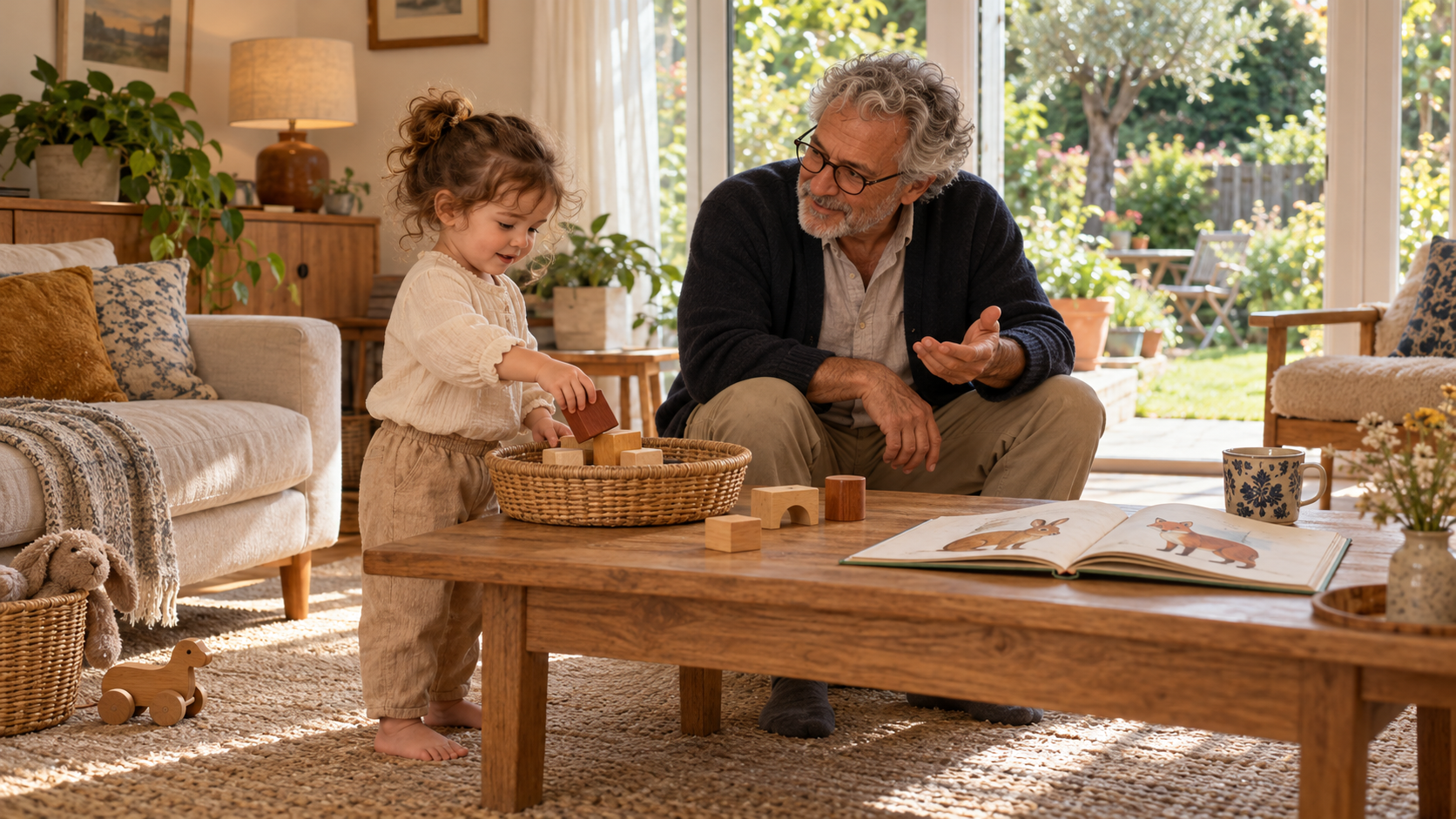
Anya proposes a tower while her daughter moves pieces between places. The session can seem failed because a child did not follow the script. Yet another action is visible, rather than a moral refusal to learn. An adult can notice it and offer participation without demanding the intended result immediately. Object safety remains a condition rather than a reward for playing correctly.
In Gibran's On Children, a child's life and thoughts do not belong to a prepared parental project. This poetic norm proves no educational method. The limited connection is that an adult's offer does not exhaust another person's acceptable answers. Separateness removes no care duty and makes no action safe or equally appropriate.
An action can be named: “You're putting them here”, instead of immediate correction that they belong on top. If contact continues, an accessible proposal can be added. If it does not, finishing a session requires no escalated pressure. This author example treats no refusal and promises no particular skill. A child need not demonstrate enjoyment to validate parental time.
Play can finish before expected. Duration alone proves no benefit. Fatigue, interest, and conditions differ; the reason for declining may remain unknown. An unfinished activity need not become a struggle for obedience. Broader concerns about behaviour or development can be taken to suitable expertise without a diagnosis from one unsuccessful session.
III. Conversation differs from a word examination
“What is this? Say it correctly” can turn every encounter into testing what a child already knows. Another format talks about what is jointly visible, answers an attempted approach, and leaves time for response. NHS language information suggests such everyday opportunities. Its age-specific activities are not transferred as universal requirements.
When a word is attempted differently, an appropriate example can be offered calmly in reply without shame or repeated drills until error-free. This is no correction programme or self-treatment for a speech difficulty. Anya can say a natural sentence instead of issuing appraisals. Communication remains more important than recording a moment as proof of a new ability.
In James1:19–27, listening and action belong to Christian ethics. The narrow analogy is hearing another before prepared speech. This is no religious language-forming technology or doctrinal obligation. A pause in our scene leaves room for an approach, rather than silently waiting until a child produces the adult's desired result.
A multilingual family need not treat its living home language as an obstacle merely because a source's example is English. NHS suggests speaking the language comfortable for the adult. We prescribe no division of languages or personal speech outcome. Concern must not simply be postponed with “we speak several languages”. Relevant information and an appropriate professional conversation are needed.
IV. Movement needs suitable space rather than a race of positions
A video shows another child already performing a movement. Anya thinks her daughter must urgently be taught it. Someone else's result establishes neither readiness, reason for difference, nor appropriate action. Surroundings are not intended to force a body into a desired picture. Movement questions need attention to a particular child's condition, capacity, and safety.
NHS activity information describes opportunities and adult involvement; health limitations may require adaptation and care-team advice. Exercises, positions, minutes, and devices are not prescribed here. A safe accessible movement opportunity differs from training for demonstration. Every new position need not become next week's compulsory target.
The space can be checked: are dangerous objects accessible, does it fit current abilities, and can the adult remain attentive? This is no full home-safety assessment. Toys and equipment need appropriate instructions and restrictions rather than merely a developmental label. Price and promised outcomes do not themselves establish suitability.
Waking movement and sleep positioning are different situations. No play position is transferred into sleep here. A clinical question needs assessment rather than a new home training routine. Someone else's example can become a professional question, not a prescription to accelerate development. Difference and need for support should be distinguished through information rather than parental competition.
V. Inexpensive surroundings do not mean any household object
Toys need not be expensive, but domestic origin guarantees no safety. NHS play information warns about small parts, sharp edges, and batteries; objects must fit a child's abilities. This grants no permission to give an infant anything adults find interesting. Dangerous acts must not be tolerated for independent exploration.
One available book, song, or suitable object can offer shared attention without buying another set. This promises no cheap substitute for all specialist help. Particular needs may require adaptation and professional information. A low-resource option should retain its purpose rather than prove every family must manage without outside support.
Water play requires continuous appropriate adult supervision; NHS explicitly says never to leave a young child alone with water. Suspected swallowed button batteries need immediate local medical help. These limited examples are no complete safety standard. An older child must not be made solely responsible while adults attend to other jobs.
An overloaded adult can choose a less demanding safe opportunity or seek help rather than stage an attractive activity that cannot be supervised. A project's photograph matters less than actual conditions. Another adult may help by freeing some caregiver attention rather than bringing more objects and advice. That task is checked separately from whether the child enjoyed a new activity.
VI. Different abilities need clarification rather than humiliation
A child may interact differently from an article's example. Looking, hearing, or moving in an unavailable way must not be forced. Abilities and condition matter more than a prepared activity format. NHS activity information allows adaptation with professional advice for disability or long-term conditions. This provides no identical substitute for every child and circumstance.
Anya can ask how participation might become more accessible: change an offer, object, or surroundings without appointing a personality to repair. Where causes are unknown, an author's guess becomes no finding. Observation and respect can coexist with appropriate assessment. Declining shame does not mean declining the question, and a question does not make a child a failed project.
“They'll definitely catch up” should not be promised to reassure. That is an individual forecast without enough grounds. Every difference should not become a diagnosis from someone else's table either. Between them lies an action: describe what is observed and discuss it with suitable expertise. A child need not first fit an image to deserve play and attention now.
Comparison with siblings and neighbours may identify that a question arose but cannot determine its answer. Particular information matters rather than merely family position. Dignity is not measured by the speed of gaining a skill. This ethical boundary cancels no timely support. It allows help-seeking without humiliation or demands to justify adults' investment.
VII. Concerns need not wait for successful home activities
CDC recommends discussing concerns about play, learning, speech, and movement with a doctor without delay. It also says milestone checklists do not replace standardised, validated screening. No US screening calendar, free-service entitlement, or local route is transferred here. Available information establishes no service already accessible in one's country.
One example and question can be prepared: “This is what we notice; what needs assessment, and what comes next?” Records and videos are no condition for asking. If available, relevant information should reach an appropriate recipient with privacy considered. A group vote on a domestic recording is no diagnosis, even when participants use professional terms.
While waiting, manageable everyday participation can continue safely. It replaces no prescribed support and proves no indefinite waiting sufficient. Clarify an actual next contact and access conditions. Money, distance, or no replacement making advice infeasible should be named. An attractive institution list does not equal an assessment received.
Acute dangerous health changes require another urgency. Current NHS information includes breathing difficulty, inability to wake, and seizures as reasons for immediate help. The list is incomplete; absence of these examples rules out no illness. Neither developmental observations nor a successful attempt to gain attention must be completed first.
VIII. An adult need not continually produce results
Anya may end a day without a new word or impressive movement. This gives no final assessment of her or her daughter. Which opportunity actually occurred, how did the child participate, and what exceeded capacity? Asking that does not abandon development; it preserves knowledge's scope. A day contains no entire future ability, and a missed plan explains no clinical condition.
When care becomes continual fear of a missed window, the adult may also need support. This cannot be demanded from a child through smiles, achievement, or another recording take. Another adult can accept a task or help arrange professional discussion. That guarantees no vanished worry, but separates adult need from a child's obligation to display correct development.
Privacy remains relevant to a joyful result. Wanting to record a moment creates no need to compare it publicly. An experience can remain within a family without becoming the day's achievement. Participation loses no value through absence of recording. Childhood need not be continually confirmed by reports to count as meaningful.
Initially development waited until real life finished. A more precise question is which safe manageable opportunity this day offers and which separate concern needs support. The answer promises no acceleration. It leaves initiative to play, communication to speech, suitable surroundings to movement, and responsibility to an adult without continuous production of evidence for future success.
What this means in practice
If there is no urgent concern, choose an existing moment: dressing, a book, a safe walk, or ordinary interaction. Offer one accessible action and leave room for response. Require neither a new skill, correct word, nor report recording. An optional proposal can stop when the child does not take it up.
Check safety and fit with abilities. Do not use dangerous small objects, batteries, or equipment without appropriate restrictions, or leave a young child with water. If supervision is currently impossible, choose a simpler safe option. Limited money does not require purchases: a familiar voice or available book may be a manageable beginning without a guaranteed result.
Name a separate concern if present: what specifically is worrying in play, communication, or movement, and whom should it reach? Do not wait for home activities to prove ineffective. Developmental concern needs suitable professional discussion; an acute dangerous state needs immediate local help. Other children are not responsible for adult and infant safety.
After the moment, ask what was noticed, which participation happened, and what remains needed. Speaking can replace a diary. Stop the exercise if it increases burden. It treats no delay, diagnoses nothing, and promises no timing. Its possible usefulness is one more suitable everyday opportunity and one precise next question, without turning a child into a production report.
Key quotation
“let every man be swift to hear”
James1:19, an autonomous imperative clause, King James Version, not the whole verse. The entire1:19–27 passage and selected clause were personally reread24 October2026. A Christian ethical directive including its subject is compared with attention to another, not diagnosis, treatment, or a proven developmental programme.
Connections between traditions
| Texts and approaches | Useful distinction | Limit |
|---|---|---|
| Gibran, On Children ↔ initiative | A child exceeds the parental script | Poetry proves no educational method |
| James1:19–27 ↔ communication | Listening differs from a response examination | No religious language technology |
| NHS play/movement ↔ surroundings | Accessible opportunity matters more than an expensive label | Safety and adaptation need particular conditions |
| NHS language ↔ home | Everyday communication differs from continual testing | No individual forecast or universal calendar |
| CDC ↔ concern | A milestone replaces neither screening nor assessment | A US route is not promised internationally |
Sources
- Kahlil Gibran. The Prophet, On Children, Alfred A. Knopf1923. Whole chapter read earlier. RU/TH epigraphs convey meaning rather than offer a literal legal formula.
- James1:19–27, KJV. Whole passage read earlier; autonomous1:19 imperative clause, religious primary source.
- NHS. Baby and toddler play ideas, reviewed27 August2024. Whole page read23 October2026; video not watched. Simple opportunities and limited safety boundaries; no age tasks or local programmes transferred.
- NHS. Help your baby learn to talk, reviewed26 April2023; next26 April2026 has passed. Whole page read23 October2026; video not watched. Ordinary communication, comfortable home language, and contact with concerns; no age calendar or guarantees.
- NHS. How to keep your baby or toddler active, reviewed9 March2023; next9 March2026 has passed. Whole page read23 October2026; video not watched. Opportunities and adaptation only; exercises, minutes, devices, and ADHD assumptions not transferred.
- CDC. Concerned About Your Child's Development?, reviewed17 February2026. Whole substantive page read23 October2026. Discussing concerns and distinguishing checklists from validated screening; no US timetables, free-service promises, or procedures transferred.
- NHS. When to get urgent medical help for babies and children under5, reviewed6 August2026. Whole substantive text read earlier; limited urgency rather than home diagnosis.
No parent library article was assigned. The first CDC URL failed; the actual concerned page was found, opened, and read rather than reconstructed from search snippets.
Tags
play, speech, movement, everyday surroundings, early years, child initiative, communication, listening, pause, familiar language, multilingual family, book, song, accessible objects, safety, adaptation, different abilities, professional assessment, milestones, screening, concern, adult resources, assistance, privacy, no race, manageable moment, Gibran, James, NHS, CDC
About the authors
Andrey Zarinsh is the author and founder of United Wisdom. He explores inner transformation, the unity of traditions, intercultural dialogue, and contemporary spiritual discipline. Instagram: @andrey.zarinsh.
Maria Evilkut is a co-author of United Wisdom. Alongside research, she seeks to test these ideas in practice and observe how principles of unity and mutual understanding work in real life between people and cultures. Instagram: @ilkutki.