
Growing up
Homework: whose work is it, and what help is needed?
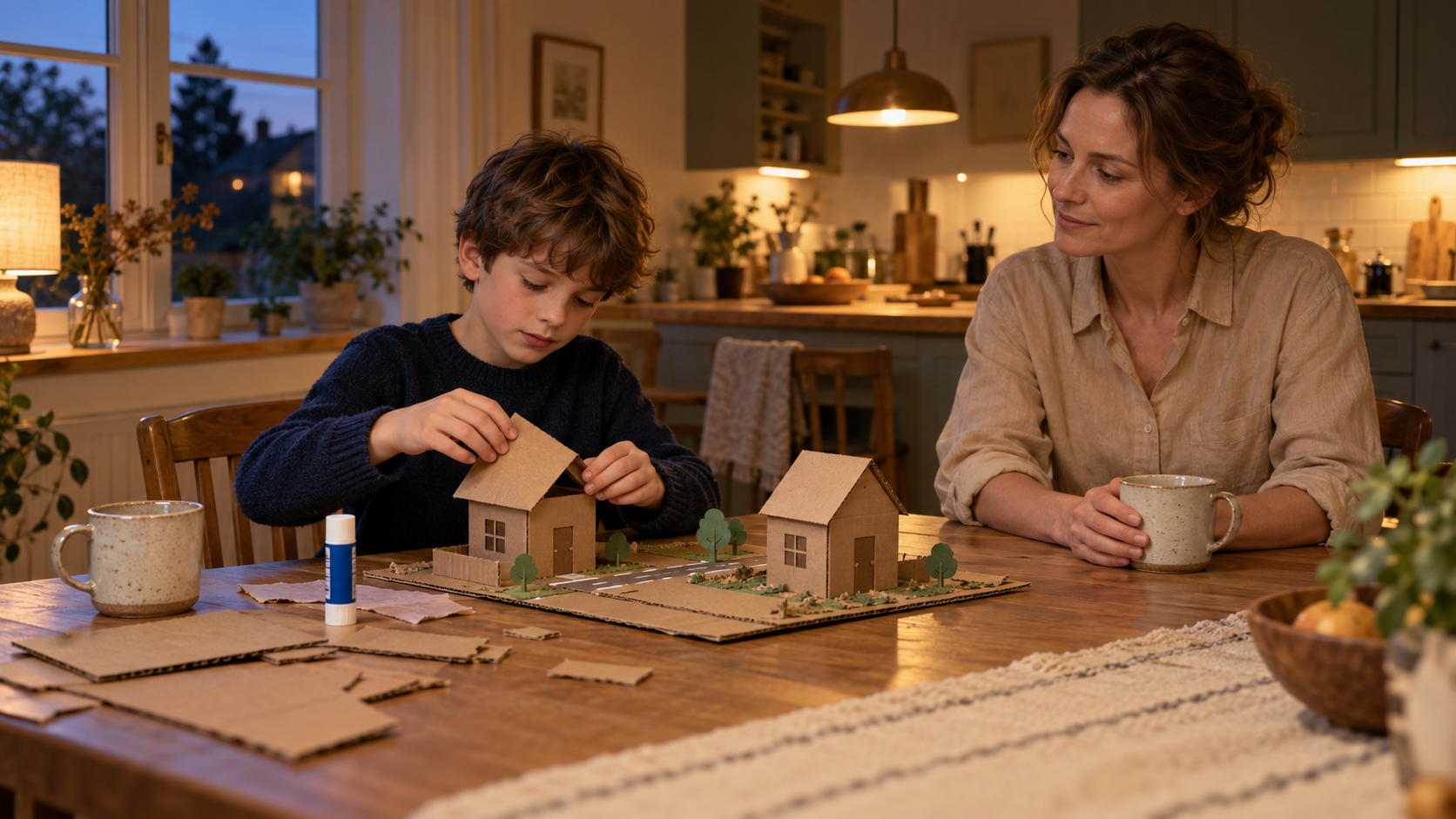
Nine-year-old Denis looks at a mathematics problem while Irina already knows the answer. She wants to supply it so that the evening can finally become free. On another table are materials for a school project: he chose the subject, but an adult could make almost the entire…
Epigraph
“Children are born persons” — Charlotte M. Mason, Home Education, fifth edition, 1906, series preface, principle 1. This is a historical educational position, rather than a diagnostic criterion or a promise that a child will manage everything independently if adults simply stop interfering.
What this article is about
Nine-year-old Denis looks at a mathematics problem while Irina already knows the answer. She wants to supply it so that the evening can finally become free. On another table are materials for a school project: he chose the subject, but an adult could make almost the entire polished product. Help is needed in both situations, yet it can quietly replace the person who is learning. This article concerns primary-school homework, roughly ages six to eleven: clarifying its purpose, supporting an accessible attempt and identifying limits to family involvement. It does not cancel local requirements, set a universal study duration or promise good marks. The particular stories are fictional and no country is specified. Learning, checking independent work, family resources and actual care need distinction. Where there is danger, harm or acute deterioration, appropriate help and protection take priority over an optional reflection on a homework situation.
I. First understand why the work was assigned
Denis’s book says “solve the problem.” That can serve different purposes: practising a familiar operation, understanding a new method, showing reasoning or checking independent mastery. Families cannot always see which purpose was chosen. Before arguing about the amount of help, clarify the objective. A hint appropriate during teaching may change an independent assessment. The outward format alone does not establish the distinction.
Start with what the child knows: what was explained in class, whether there is an accessible example and which part he understood. This does not require a flawless reconstruction of the lesson from memory. If Denis cannot remember, an adult should not invent the teacher’s instruction. Clarify it appropriately. Uncertainty about the family’s role is an organisational question, rather than proof of a poor attitude towards school.
The EEF homework review discusses clear purposes, connections to classroom learning and feedback. It also rates the security of its evidence as low; its stated last review update is August 2021. This provides useful questions, rather than confirmation that any particular homework assignment is effective. The studies behind that synthesis have not been individually re-examined here, nor do averages predict one child’s outcome. EEF
Some tasks intentionally involve family participation: reading together, discussing local history or bringing an available material. Adult involvement need not then replace the pupil. Yet “family project” does not establish the required time, money or specialist skills. Ask what the pupil should do and which part actually anticipates assistance. Another family’s photograph of a perfect product does not have to supply that answer.
Having finished school long ago does not make the objective obvious. Notation may have changed, and the adult’s familiar algorithm may not be the current subject. That does not make previous knowledge useless. It can help after the task is clarified. Irina may solve the problem competently while not knowing what the teacher needs to see in this particular piece of Denis’s work.
II. Organise an accessible attempt
Homework begins before the first answer: finding the task, understanding its scope, obtaining materials and having an opportunity to work. These actions may still need adult involvement. A forgotten exercise number need not become a verdict on independence. Restore the available record together, then discuss how the child could find it next time. Organisation need not immediately become entirely his responsibility.
Agree on an understandable immediate part rather than an evening lasting “until everything is perfect.” Open the relevant page, read the instruction and identify the first question, for example. This is an author’s illustration, not a universal protocol. Offer a genuine choice of order or place where possible. If neither option suits the adult, an invitation to choose should not merely decorate unavoidable pressure.
A condition rather than a lack of discipline may impede the child: noise, an unsuitable surface, missing text or inaccessible communication. Not every barrier can be removed at home. An ideal study is not a prerequisite for learning either. Name the particular obstacle and ask about a workable alternative instead of explaining everything through Denis’s character or Irina’s supposed lack of care.
In a small home with working adults, involvement has real limits. Choose available time, share assistance with adults who have actually agreed, or clarify a school resource if one exists. None can be promised in advance. A library or homework club must be genuinely accessible. Finding its name does not provide travel, a place, accompaniment or the kind of help the child actually needs.
Preparation does not guarantee immediate willingness to work. A child may be tired, distracted, unclear about the purpose or interested in something else. These circumstances merit consideration without automatically cancelling every obligation. An adult can retain a necessary task while changing how it begins. Participation is not measured only by an absence of objections; quiet compliance does not confirm that Denis understood the instruction.
III. Locate the particular difficulty
Irina asks what the problem tells them. Denis names the numbers but cannot understand their relationship. The difficulty may not concern calculation. Identify one unclear step without immediately supplying the answer. Sometimes the issue is a word, sometimes notation, sometimes the mathematical idea itself. Exploration should not become a long sequence of leading questions in which the child can only guess the adult’s preferred answer.
Help with reading differs from help solving a problem. A child may understand a task heard aloud while finding the text difficult, or read fluently without understanding quantities’ relationship. This informs questions about learning, rather than a diagnosis from one evening. When independent reading is the objective, clarify permitted support separately instead of quietly changing the ability that is being assessed through the task.
Nationwide Children’s Hospital’s information suggests discussing work that seems too difficult or lengthy with the teacher. It also distinguishes a preliminary practice example from the homework itself. These limited questions are used here, rather than its entire set of recommendations. The page is not an efficacy study; its medical, timing and reward advice is not transferred into this article’s household suggestions. Nationwide Children’s
When a child cannot explain now, consider one attempt or an accessible way of showing difficulty. An admission of not understanding is not a compulsory price for help. Equally, an adult should not claim certain knowledge of a hidden cause of silence. Observation, the child’s words and a parent’s hypothesis have different origins. Keep them distinct when discussing a task with the teacher.
Everything unclear need not be resolved tonight. Identify the remaining question and an appropriate recipient. This differs from an indifferent “work it out yourself.” Irina remains involved: she helps formulate the question, checks the available communication process and explains which work required support. Denis need not independently obtain a decision from school when that decision belongs within adults’ responsibilities and powers.
IV. Demonstrate a possibility while leaving action to the child
A similar, simpler example may help where it fits the learning objective. The child can then attempt the required action. Similarity matters: a distant example may be unhelpful; an identical one can become the finished answer. This article sets no correct hint size for every pupil. Assistance should address the particular difficulty, beyond speeding the appearance of completed writing on a page.
Ask whether Denis would like someone to examine one step, or offer help with the part he identifies as difficult. Such coordination does not remove adult responsibility for learning and care. It leaves room for the child as an active participant. Irina need not silently watch endless failure; Denis need not surrender the entire assignment in order to receive an explanation of one symbol.
In Analects VII.8, Confucius uses an image of showing one corner and the learner continuing. The complete saying also contains a strict refusal to repeat a lesson when the pupil cannot infer the rest. This is a historical position, not contemporary permission to end support for primary pupils. Discussing the image need not adopt the entire approach or demand identical powers of inference from every child.
Accessibility support need not mean substitution. An agreed arrangement allowing a child to dictate his own answer differs from an adult composing it. Conditions depend on the learning objective and particular agreement. Neither every technical tool is automatically dishonest nor every form of assistance permissible. Clarify whose thought and which skill the resulting work is intended to represent, rather than decide by appearances alone.
Help can vary in amount. Yesterday Denis managed a short example; today a new condition needs explanation. That does not necessarily mean independence has been lost. Transfer understood actions gradually while retaining access to support. A further question neither makes previous help worthless nor obliges an adult to finish the entire assignment every time the child encounters something he does not yet understand.
V. A correct page is not the only result
Irina can dictate the reasoning and Denis copy it neatly. The final record will be correct, while information about independent understanding is inaccurate. Indicate adult involvement through an appropriate school procedure. Independence need not be performed for a mark. Honest information about what is accessible to the child helps identify the next learning question, although it cannot guarantee a prompt response from school.
An error also provides limited information. It can reveal one incorrect step without measuring a person’s worth. Return to the instruction without declarations of complete incapacity or family disgrace. Conversely, respect does not require overlooking mistakes. Consider when and how they are examined, what needs correction and whether further learning remains possible, rather than making shame about the result the only available activity.
Parents need not correct every error before submission. Sometimes a teacher needs to see an independent attempt; sometimes a particular part is to be checked together. Clarify this for the task. A parent need not preserve perfect appearances through rewriting a book. Nor must the child deliberately make mistakes to prove authorship. Ordinary support does not need that kind of investigation at home.
Praise can concern something particular: Denis found information, tried another method or asked an understandable question. There is no need to declare him a genius or permanently independent. Success creates no duty never to need help again. Enjoy the result without turning parental relief into another examination that the child must pass with every subsequent assignment he brings home from school.
When work is incomplete, describe the actual result precisely: what the child attempted, where the adult helped and what remains unclear. That does not automatically remove school consequences or replace communication. It is preferable to hidden adult completion that conceals the difficulty from everyone. Accuracy cannot guarantee a convenient result, but it preserves the subject of further learning and the need for an appropriate next step.
VI. A project should not become a competition between adults
Denis has chosen to describe a familiar place for his project. Irina is good at presentation and could build a complicated model. First clarify what is assessed: observation, handling materials, a story or specifically collaborative work. Otherwise, families’ abilities can be compared instead of the child’s learning. Outward polish does not establish who chose the content or what the pupil actually learned while making it.
Adults remain responsible for safe tools, an accessible place and protecting other people’s belongings. An unsafe operation must not be left to a child to preserve pure authorship. Performing a necessary adult operation does not require taking over the whole project, however. Name the real division: Denis gathered information and described it; Irina helped with an allowed technical part. The description must reflect participation rather than conceal a finished adult product.
A ready-made internet or generated answer can replace reasoning just as parental dictation can. This article cannot establish a school’s digital-tool policy. Clarify permitted uses and the skill being checked. If Denis’s own explanation is required, edited third-party text does not become his thought because it sounds plausible. Equally, every accessible technical aid need not be treated as the same kind of violation.
A project may involve photographs, family accounts or information about other people. An educational objective does not cancel privacy. Do not obtain restricted correspondence, publish another child’s image or disclose private details without an appropriate basis. Clarify a permissible alternative and what is genuinely needed. A pupil must not independently resolve every question about consent and information transfer on behalf of the whole family.
Expensive materials and elaborate printing are not accessible to everyone. If the objective can be met more simply, ask about that rather than promise victory over every limitation. Even a simple alternative may be unavailable today. An honest discussion of possible action is then needed. Limited resources do not establish an absence of interest, nor should they be concealed behind a demand that the child want success more intensely.
VII. A parent’s hope differs from a child’s task
Irina wants her son to do well. This hope can include care, experience, anxiety about the future and a wish to avoid familiar difficulties. Originating with an adult does not make it bad. Yet an expected successful biography cannot explain today’s mathematics problem. Notice when discussion of one action becomes a demand that Denis demonstrate seriousness about his whole future through this particular evening’s performance.
A child need not love every necessary assignment. Help with required work while hearing that it is currently uninteresting. This neither cancels the task automatically nor settles a lack of ability. Interest, skill, a requirement and conditions are different questions. Combining them can lead adults to seek the correct feeling instead of explaining the step that the child actually needs in order to proceed.
Mason’s respect for personality limits adult influence within her historical educational framework. She also retains authority, obedience and religious foundations; a short quotation cannot make the entire book a contemporary standard. The limited question here concerns whether Denis remains a person with his own experience when work misses expectations. This is neither proof of an effective intervention nor permission to discontinue teaching a difficult task.
A parent’s time matters. It does not purchase immediate understanding, a good mark or gratitude. Set an achievable limit to involvement and seek appropriate follow-through among adults. A child must not eliminate parental exhaustion through a correct answer at any cost. One unsuccessful evening does not make all care useless; sincere effort also does not establish that the chosen form of help suits this child and task.
If an adult has shouted or called the child incapable, acknowledge the particular action and change what follows. A dramatic confession requiring Denis to forgive and comfort is unnecessary. Correction concerns treatment: stop humiliation, explain accessibly and reconsider an unsuitable condition. Its result is not measured by the child’s instant good mood or immediate willingness to return to the exercise book and resume learning.
VIII. Pauses and unfinished work need an arrangement
Sometimes continuing today is no longer manageable. Name a pause and an available next arrangement rather than disappear with “then do nothing at all.” No single number of minutes fits every pupil and programme. Consider duration, difficulty, conditions and school requirements together. This article does not present its own preferred duration as a medical or legal rule that applies to every family and educational setting.
A pause should not create another task of proving sufficient exhaustion. Denis need not be brought to tears to qualify for rest, or filmed to demonstrate his condition to a teacher. Describe a particular difficulty and the actual attempt. At the same time, pausing promises no cancellation of requirements. Unfinished work and further assistance remain matters for suitable adults to address rather than abandon.
Food, necessary care, safety and sleep are not prizes for a perfect page. A reasonable routine and responsibility for work can be discussed without withdrawing basic care. When care becomes a means of pressure, the issue extends beyond homework organisation. Harm needs to stop and appropriate support is needed, rather than a more precise reward scheme designed to make a child agree more quickly.
Play need not be valued only as a way to increase performance on the next exercise. Denis has a life beyond school results. A family’s genuine time constraints remain; discussing rest does not automatically create it. Still, recognise it as a need in its own right, instead of making it available only after complete freedom from error and the correct attitude towards lessons have been demonstrated.
Adults also have limits. When Irina feels unable to continue calmly, stop the escalating argument and organise an available continuation while maintaining care. Another adult helps through actual agreement, beyond merely being named. Denis should not reconcile exhausted adults or provide care for younger children as the price of ending his own evening of schoolwork or receiving an explanation he still needs.
IX. Seek help with a particular question
Tell the teacher that Denis read the instruction and found the numbers but could not understand their relationship; a similar example was discussed together, while his own problem remains unfinished. This differs from “the work is impossible” or “he cannot do anything.” The teacher may provide another explanation or missing context. Coordination serves an actual task rather than a contest over who knows the child better.
Recurring difficulty, significant distress or noticeable interference with ordinary life are reasons to seek suitable consideration and help. Every sign need not occur together. The appropriate recipient depends on the actual educational, organisational or health question. New pain must not automatically be called laziness or anxiety. This article cannot diagnose a child or prescribe the same assessment for everyone who struggles with homework.
Violence, threats or acute deterioration may require more than ordinary correspondence about an assignment. Appropriate protection and urgent help have their own urgency. A child should not repeat danger to produce evidence, work out every service’s powers or stop a harmful adult independently. Local duties and an appropriate route require examination in actual conditions, rather than an assumption that every reporting method will be safe or effective.
For ordinary clarification, share necessary information with privacy considered. A whole family history, private messages and recordings of distress are unnecessary prerequisites. Absolute secrecy cannot be promised without knowing the recipient’s duties. Where another professional or responsible adult needs involvement, explain the next step accessibly. Denis must not coordinate adult correspondence or receive a false promise that everything will remain between two people when that cannot be ensured.
A message sent, an answer and help actually received differ. Unclear advice or an unavailable option needs further clarification. A resource’s name does not establish suitability. A small result can still help: an instruction becomes clearer, roles become more honest or one further attempt becomes possible. It need not immediately produce a good mark to matter within the continuing work of learning.
X. Learning results belong within a continuing process
On the next task, Denis names the first step himself. Notice that particular change. It does not prove that every future assignment will need no adult involvement. Irina may understand her role better while still becoming tired. Learning a method, feelings about homework and family routines need not change together. One good evening does not establish a lasting resolution of every difficulty around schoolwork.
If nothing changes, check the original hypothesis and actual action. Was the proposed example accessible? Did the explanation happen? Has the task itself changed? Repeating earlier help ever more sternly needs a reason. Sometimes another suitable perspective is required. Lack of progress does not automatically establish a refusal to learn or an absence of family love, and should not be used as proof of either.
Independence does not mean having no relationships or resources. Denis can complete an accessible part himself and need an adult where another question begins. Distinguish support for his action from replacement of that action. Sometimes help becomes smaller, sometimes larger again. Describe what actually occurs rather than grant a general title of independence that cannot be lost even for a single difficult evening.
The two historical texts do not combine into one method. Mason discusses personality and the limits of authority; Confucius offers an image of instruction and independent continuation within strict assumptions of his own. Contemporary professional materials have another status and their own limits. No quotation allocates family and school duties in a particular country or guarantees the result of this article’s proposed examples.
Homework may end with a solution, a question to a teacher or honestly described incompleteness. Circumstances determine what follows. Every evening need not prove future achievement or unconditional obedience. A child remains a person needing learning, help and ordinary care. An adult retains responsibility without claiming the child’s result or purchasing it at the cost of the dignity of someone who is still learning.
What this means in practice
Clarify one assignment’s purpose and the anticipated family role. Distinguish practice, new explanation, independent assessment and a joint project. Ask what the child can already do and what remains unknown. An absent answer does not establish laziness. Necessary protection, help with acute deterioration or stopping harm must not depend on first completing this optional reflection about an ordinary homework situation.
Organise a feasible attempt with the time, materials and communication actually available. An ideal study or compulsory purchase is unnecessary. Locate one unclear step. A suitable learning objective may allow discussing an example without presenting a ready-made answer as the child’s. Permitted help and technical support depend on the task, beyond a universal slogan about doing everything entirely independently.
Preserve accurate information: what the child did, what the adult demonstrated and what remains unclear. A mark does not measure the whole character. Do not manufacture errors or danger to test authorship. Explain actual project roles while considering safety and privacy. Someone else’s text or an adult’s product does not become the child’s reasoning through an attractive presentation or a claim that assistance was merely technical.
Where a pause is needed, name an available continuation and the question about unfinished work. Basic care is not a prize for a correct page; rest and play do not require an error-free result. When adult resources are limited, seek an actual arrangement without assigning the child the organisation of family life. Learning does not mean becoming responsible for removing every parental worry or feeling.
Recurring difficulty, significant distress or interference with life warrant suitable consideration without waiting for all signs together. Actual danger requires appropriate urgent protection. Sending a message is not receiving help; a proposed resource is not an accessible one. A checkable result is a clearer purpose, more honest participation and an actual next learning step, without requiring anyone first to prove their worth as a person.
Key quotation
“I do not open up the truth to one who is not eager to get knowledge”.
The opening clause of Confucius’s statement in Analects VII.8, translated by James Legge. This is the position of a historical teacher. The passage continues by restricting help to a learner eager to explain himself and refusing repetition when the remaining corners are not inferred from one presented corner. That strictness is not adopted here as grounds for withholding necessary child support. An unclear task does not establish lack of interest: adults clarify accessible help rather than require an independent inference to earn it.
Connections between traditions
| Distinction | Historical basis | Application and limit |
|---|---|---|
| Person and required result | Mason, series preface, principle 1 | An error does not describe a whole person; the historical position is neither diagnosis nor guarantee. |
| Adult authority and its limits | Mason, principles 3–4 | Responsibility remains without licensing every pressure; the entire historical pedagogy is not declared a contemporary standard. |
| A demonstrated step and learner action | Confucius, VII.8 | Participation in understanding matters; inferring the rest from one example is not required of every child. |
| Continuing learning and refusing repetition | Critical reading of VII.8 | Historical strictness is not used to remove accessible explanation or necessary help. |
| Supporting and replacing | Our limited comparison | Consider the acting child and an honest adult role; this is not a validated shared method. |
| Reflection and actual responsibility | Historical questions alongside professional materials | A quotation cannot establish school rules, permissible workload or assistance actually received. |
Sources
- Charlotte M. Mason, Home Education, Project Gutenberg 71087. Fifth revised and enlarged edition, London: Kegan Paul, Trench, Trübner, 1906; metadata and title read. Complete series preface and selected synopsis principles 1–10 read, not the entire work. The title concerns children under nine; religious, physiological and authority assumptions are not transferred into contemporary advice. The epigraph is a brief attributed phrase.
- Confucius, The Analects, James Legge, VII.8, Project Gutenberg 3330. Complete saying and visible neighbouring context read, not the whole work or Chinese original. Electronic update: 8 January 2021. A short fragment is used; refusal to repeat is not adopted as a rule for primary-school support.
- Education Endowment Foundation, Teaching and Learning Toolkit: Homework. Full substantive text and dates read. Review updated August 2021; page generation in October 2026 is not a new evidence review. Its 43 included studies were not individually read here, and evidence security is rated low. No individual months-of-progress gain, uniform frequency or study duration is promised.
- Nationwide Children’s Hospital, Homework Help: Tips for Families. Full substantive text read; HH-IV-243, copyright2021, no separate review date visible. Specific teacher questions and accessible help, rather than an outcome study. Medication, fixed timing, reward and compulsory break arrangements are not adopted; particular US mechanisms are not worldwide procedures.
Tags
primary school, homework, helping children, learning objective, independent attempt, authorship of work, parent role, teacher, understandable instruction, example, explanation, replacing work, errors, feedback, marks, dignity, available materials, family resources, projects, digital tools, privacy, pauses, rest, play, parental expectations, adult responsibility, seeking help, child protection, Mason, Confucius, learning, United Wisdom
About the authors
Andrey Zarinsh is the author and founder of United Wisdom. He explores inner transformation, the unity of traditions, intercultural dialogue and contemporary spiritual discipline. Instagram: @andrey.zarinsh.
Maria Evilkut is a co-author of United Wisdom. Alongside her research, she seeks to test these ideas in practice and observe how principles of unity and mutual understanding work in real life between people and cultures. Instagram: @ilkutki.