
Growing up
Clubs, interests and an overloaded timetable
Nine-year-old Kirill enjoys building robots and used to welcome music lessons. Now, on the way to his teacher, he says, “I don't want this any more.” Marina has already paid and fears that her son abandons everything at the first difficulty. The calendar contains only two clubs,…
Epigraph
“Children are born persons” — Charlotte M. Mason, Home Education, fifth edition, 1906, preface, principle1. This historical educational position invites a question about the child's voice. It establishes neither a contemporary activity limit nor a right to reject every responsibility.
What this article is about
Nine-year-old Kirill enjoys building robots and used to welcome music lessons. Now, on the way to his teacher, he says, “I don't want this any more.” Marina has already paid and fears that her son abandons everything at the first difficulty. The calendar contains only two clubs, yet school, travel and waiting leave almost no free evening. This article is for parents and educators of children roughly six to eleven. It distinguishes interest, a particular difficulty and the organisation of a day. The characters are fictional; no country is specified. There is no talent test, universal club count or diagnosis from resistance. Optional discussion may wait; necessary care, safety and appropriate help continue regardless of the activity decision.
I. A child's interest can differ from an adult's hope
Marina remembers Kirill asking for an instrument himself. That past wish was real, but it was no contract to love music forever. Her hope for a future concert is understandable too, without being his present wish. Both histories can remain visible rather than one being made proof of the other. Children may change their minds; adults still discuss access and responsibilities. A more precise conversation concerns today's activity rather than who knows the boy's true essence. Neither earlier pleasure nor present refusal establishes the final direction of a person's life or cancels the need to hear what has changed.
Not every wish is equally feasible. Kirill wants robotics and more time with a friend; Marina cannot transport him across town every day. A transport limit proves neither interest false. Explain actual options without promising everything. A choice must also be real: if every answer except music costs ordinary closeness at home, participation is only called voluntary. Necessary care, safety and actual school duties need separate discussion. They do not become optional because some activities were chosen for enjoyment. Adults remain responsible for distinguishing these arrangements rather than demanding that a child resolve them alone.
“He has talent” can direct attention to a skill without ending discussion. One good concert establishes no obligation to continue; one difficult exercise proves no lack of ability. A decision needs information about the activity, conditions, accessible help and the child's account. Talent cannot be determined from today's mood. Ask a suitable teacher for professional information about the particular learning task where needed. Even a capable teacher cannot be promised to supply a final portrait of the whole person or the only correct future. Judgement about one performance and a family's practical decision have different subjects.
II. See the day that actually happens
“Music: one hour” omits travel, waiting, packing and the transition from school. Marina can examine an actual day from departure to return without monitoring every minute of Kirill's life. Where does he eat, who meets him, and when can he be without another assignment? These questions create no universal workload calculation. The same hour occupies different places under different conditions. It is unnecessary to measure every smile to notice continual rushing or missing necessary care between two addresses. A neat timetable is information about planned events, not confirmation that the whole arrangement works.
Time that looks empty to an adult is not necessarily available rest. Waiting in a noisy corridor with a heavy bag may feel different. Equally, every journey need not be declared harmful: a familiar safe route can include conversation and interest. Consider actual circumstances rather than allocating a fixed value to each interval. An accompanying adult's time belongs in the picture too. A timetable should not assume a helper will materialise or require a child to close the gap through an unsafe independent journey. An apparently short lesson can rely on substantial arrangements outside its advertised duration.
School, treatment, supervision, family duties and chosen activities serve different purposes. They cannot all be cancelled in the same way. A club sometimes also supplies necessary supervised time. Name that circumstance honestly instead of claiming that the child must love every lesson. An unsuitable format requires an actually available care alternative, rather than a newly empty square on paper. “He won't attend any more” does not answer where Kirill will be, who is responsible and how necessary conditions will be provided. Organisational dependence matters without making acceptance of every activity a child's debt.
III. “I don't want to” does not identify the needed change
Marina asks, “What's hardest about music now?” Kirill does not understand a new exercise and feels embarrassed to ask again. This differs from losing interest in music, exhaustion after travel or mistreatment. Listen without requiring one permanent cause. There may be several, and some remain unknown. Avoid supplying a convenient account: “Nobody's hurting you, are they?” or “You're just being lazy.” An incomplete answer does not cancel care. New pain is not automatically evidence of reluctance or a home diagnosis of anxiety. Its significance needs appropriate consideration rather than a preferred story about motivation.
Clarify a particular moment: which part is unclear, what explanation was given and how can repetition be requested? Parents need not become replacement teachers. Appropriate contact with the teacher may clarify the objective and accessible explanation. A request for help should not automatically become a public performance before the group, however. Kirill can want music and dislike having his mistake discussed before everyone. Marina cannot promise every preference, but can explain real possibilities and the limits of her role. She need not claim complete control over another person to offer meaningful participation and support.
Repeated resistance invites consideration of both the activity and its amount, beyond securing agreement to the next departure. AACAP's afterschool guidance recommends considering individual interests and discussing repeated resistance. This professional advice determines neither a cause nor a diagnosis from one sentence. The information sheet was read, not its underlying studies. Our fictional questions establish no effectiveness of a method. Actual unsafe treatment also exceeds finding a more attractive club: protection needs consideration before testing whether another explanation makes the lesson enjoyable. The reason for refusing and the action needed now may require different kinds of information.
IV. A supported attempt differs from enduring at any cost
Sometimes Kirill wants to attend mainly because a friend is there. This is not necessarily a false interest to expose. A shared activity can have several important sides. A changed teacher or a friend's departure can change its meaning too. Marina can ask what he wants to retain: the skill, company, familiar rhythm or creating something together. His answer does not oblige her to provide every arrangement immediately. It clarifies an actual need rather than requiring proof that an interest is sufficiently pure and serious for the adult to consider his words.
Kirill wants to understand the exercise before deciding about all music. Where suitable, agree an accessible explanation of one part with the teacher. This promises no future concert and is no examination of love for the subject. Establish what help adults will actually provide, beyond encouraging words. Explain what they are trying and whom to ask if it remains unclear. Necessary adjustments and safety are not removed for comparison. This attempt belongs to its conditions; it is no universal stage every child must complete before being allowed to discuss changing a club or taking a break.
Leave room for different results. Kirill might understand and still wish to stop, regain interest but prefer fewer journeys, or need another explanation. None proves ingratitude. A changed decision does not necessarily mean adults wasted time: they learned about a particular part. A completed session is not successful merely because arguing ceased, however. Understanding, participation, safety and wanting to continue need separate consideration and need not arrive together. The result should remain beside the actual question, rather than become a verdict that the child has accepted or rejected everything his family offers.
“We've paid until the end” describes a real condition but creates no duty to tolerate harm. Payment, changed participation and possible refunds follow actual agreements and local rules; no refund is guaranteed here. In an ordinary safe situation, discuss group commitments and an appropriate ending without making every paid lesson a character debt. Danger should not wait for a subscription's expiry. Organisational complexity remains adults' responsibility, not a reason for the child to stop an unsafe leader alone. Financial consequences and a child's need for protection require different consideration rather than being settled by one receipt.
V. Rest need not first be earned through achievement
On a free evening Kirill wants to build without instructions, then simply sit beside his mother. Marina notices the thought that this interval should contain useful development. Why does the absence of another result appear to be a loss? Rest, play and ordinary relationships have value beyond improving the next performance. A child need not turn them into training or demonstrate an acquired skill. Freedom in play still requires suitable supervision, safe space and an available adult. Those conditions need actual provision rather than being created by the attractive label “free time.”
A 2026 Children's Wisconsin article directs attention to routines, rest and signs of difficulty. It is professional advice, not a new examination of this family. Its numerical activity ceiling is not adopted universally here. This article prescribes no equal number of evenings or clubs. Our question concerns room within this day for care, recovery and Kirill's own activities. One child welcomes busy social contact; another needs a different format. Such differences establish no ranking of development, resilience or parenting. Nor does a full calendar automatically prove a problem in every child or settle what a particular symptom means.
Free time has different conditions too. A child may want company without an available friend or safe place. “Just let him play” does not supply the opportunity. A meeting, accessible materials or adult participation may be needed. Temporary uncertainty about what to do proves no disorder and creates no obligation to enrol immediately in another course. Support an available choice without directing every movement. Avoid exchanging one demand for another: Kirill must now look happily independent throughout all free time, otherwise rest will be declared a failed experiment. His emotional display is not the only evidence about whether an arrangement is suitable.
VI. An image of growth grants no power to accelerate everything
A free evening can retain understandable family boundaries: an available place, return arrangements and care for shared possessions. These need not turn every interval into a club. Digital activities require separate consideration of actual rules and access, rather than deductions from one sentence about rest. Children need not choose only leisure an adult can display as exemplary. Equally, calling something rest does not cancel safety or other people's interests. Discuss a particular action without making a total verdict about Kirill's capacity to use freedom. The practical question remains what is permitted and available in these circumstances.
In the read passage of Mencius, IIA2.12–17, pulling growing crops appears in a discussion of moral cultivation. Here it supplies a limited analogy: visible advancement differs from caring for conditions. A plant is no scientific model of a child's brain. The story establishes no lesson count and prohibits neither explanation nor reasonable effort. Its context also criticises neglect, so it should not be reduced to withdrawing all help. Necessary care and teaching remain even when adults wish to avoid rushing a visible result. The historical ethical subject must stay distinct from contemporary developmental claims.
Marina may want quick proof that her investment was justified. Rehearsal for a clear learning objective differs from repeatedly demonstrating family success. Name the actual question: understanding one method, attempting an accessible part or discussing continuation. None grants general permission to increase demands. Performing successfully establishes no suitability for every frequency of travel. Fewer journeys do not cancel an acquired skill or the possibility of music in another available format. What a child can currently do, wants to do and can access are related information without being interchangeable verdicts about the whole person.
Effort can belong within interest; not every lesson will be easy. This does not establish benefits from every form of suffering or authorise a resilience ordeal. Distinguish learning difficulty, logistical inconvenience and harm without automatically using one category to explain the others. Missing information calls for clarification and suitable participation rather than intensifying demands at random. Honest uncertainty leaves the question open. It requires neither a final declaration of incapacity nor a promise that sufficient persistence will make Kirill best and remove every doubt. The next available step needs a more particular basis.
VII. Family expenses and interests need their own conversation
Marina can be exhausted by travel and costs even if Kirill still loves both clubs. That circumstance deserves recognition without an invented story about his inability or insufficient effort. Family capacity limits decisions; it does not determine a child's dignity or purchase gratitude. If one format must end, explain real options and adult responsibilities. Kirill need not soothe his mother by saying it never interested him so the boundary can appear painless. There may be a genuine loss without wrongdoing by either participant, and a practical limit can be expressed without pretending that everyone wanted it.
Mason's statement about personhood is used in a bounded historical sense: an adult project cannot completely replace the child's present participation. Her entire system, age framework and views of authority are not imported as a contemporary rule for six-to-eleven-year-olds. This proves neither benefits from removing every requirement nor development without help. Marina continues to provide care and make real decisions. Respecting her son's voice permits “That option isn't available now.” It does not permit “You chose this yourself” when no suitable choice was actually offered. Authority and honest explanation can remain alongside participation.
Siblings have needs, and accompanying adults have work and rest too. Their time should not be treated as free and unlimited. Discuss travel, distance and another format without private exposure or blame. Kirill need not solve the budget or deny his sister an interest to demonstrate maturity. Fairness need not mean identical club counts. Its practical meaning requires attention to circumstances and available arrangements rather than a permanent family ranking of who deserves investment and who should now receive less attention. A child's success cannot give adults more hours or make another person's obligations disappear.
VIII. A changed timetable must happen in reality
A grandmother bought the instrument and awaits a performance. Acknowledge her contribution without requiring Kirill's desire to remain unchanged. Adults can discuss expenditure and hopes themselves rather than appoint him to restore everyone's mood through a concert. Treatment of a gift and interest in lessons are different questions. He can care for the object after ending lessons. A borrowed instrument has separate return conditions. Changed interest does not authorise breaking another person's agreement; that agreement does not purchase an unchanging feeling or permit withdrawal of ordinary care. Practical responsibilities can be addressed without selling the child's future participation.
Choosing another day creates neither a group place nor somebody to meet Kirill. Marina checks actual availability, travel and an understandable plan. A named helper, sent information and agreed assistance are different states. Cancelling the old arrangement must not leave a gap in necessary supervision. Children should not secretly leave, take an unsafe independent route or negotiate every adult's part alone. Reducing demands should not create danger subsequently described as an independence lesson. A possibility needs confirmation of its actual conditions before the family can rely on it for a particular day.
Explain a changed or ended format to the teacher with sufficient information. There is no need to expose Kirill's private history to everyone, publish a group dispute or prove absence of talent. Consider group commitments under actual conditions. Where a planned performance affects others, discuss an available ending without promising a child's result on his behalf. Unsafe treatment requires protection and appropriate reporting regardless of ordinary politeness. The absence of a public confrontation does not mean consent; public exposure guarantees no solution. The chosen recipient and sufficient information matter separately from how visibly the family demonstrates its seriousness.
After a change, examine what actually differs: a free evening, shorter travel or available explanation. These limited results establish neither an end to every pressure nor discovery of the child's final identity. Remaining difficulty may require consideration of other conditions and suitable support. Marina does not demand immediate happiness as proof that her decision was correct. Kirill can miss familiar people and welcome fewer journeys together. Different feelings neither erase the practical change nor automatically establish an adult error. Conditions, relationships and experience need not change at one speed or provide a single reassuring conclusion.
IX. Some difficulties need help before timetable reflection
There also needs to be a clear arrangement for changing a day already underway. If Kirill will not attend today, adults need to know who received the message and where he stays. A cancelled lesson does not automatically release every accompanying adult; verify actual care transfer. An unexpected delay requires an available responsible person rather than a child's task to repair other people's timetables. A backup depends on real capacity and safety. Somebody's earlier promise to help if necessary does not establish readiness under today's unknown conditions. The child need not carry that uncertainty alone.
New pain, changed condition or difficulty with everyday life is not automatically caused by the calendar. Do not test interest by continuing through pain. Appropriate consideration depends on circumstances; this article supplies no diagnosis, workload, treatment or independent cancellation of necessary help. Recurring difficulty, significant distress or interference with life are grounds to seek suitable support without waiting for all signs together. NHS's child-anxiety page provides a limited help-seeking orientation, not evidence that anxiety explains Kirill's resistance. A physical complaint should not be assigned a convenient psychological cause before suitable consideration.
Threats, violence, humiliation and unsafe conditions require protection. Immediate danger or acute deterioration calls for appropriate urgent assistance. Optional planning stops then. Children need not determine risk alone, confront unsafe adults or gather covert evidence. Not every relative or leader is a suitable recipient. Clarify real local help and actual duties separately. A sent complaint, promise to speak and ended danger are not the same result. Adults retain attention to actual circumstances rather than asking the child to certify that everything is safe because a conversation took place or a timetable changed.
If Kirill declines discussion now, pause without withdrawing food, sleep, ordinary closeness or care. A pause does not end adult action: safety and necessary arrangements continue. Offer a clear next contact if it is genuinely available. Do not turn the week into continuous mood inspection or score pleasure after every lesson. Important changes warrant attention without requiring constant proof of sufficient happiness to approve the schedule, or sufficient misery to consider help. The child's day should retain room beyond explaining whether adults have organised it well enough. Reflection is an option, not a condition of receiving care.
X. An interest can continue without a lifelong decision
Kirill understands part of the exercise and chooses music in another accessible pattern for now. In this fictional story, adults confirmed conditions rather than only expressed agreement. It is one option, not a universal template. Another child may stop, pause or change format. The decision need not determine a future identity. Music can remain outside competitions, and robotics without an occupational commitment. A new opportunity needs examination of its own conditions; earlier participation is no indefinite agreement to everything that follows. The child can reconsider without either history being declared false.
A checkable result concerns something particular: feasible travel, necessary care, clearer work or time for the child's own activities. These observations convey more than “Balance is perfect now.” One unsuccessful part need not erase the others or prove family incapacity. Reconsider a particular arrangement while preserving kept agreements. Better organisation must not conceal continuing harm or a substantial absence of help, however. Moving a calendar entry cannot solve every difficulty. The boundary of the chosen action matters after a convenient result as well as before it, including what remains unknown or unresolved.
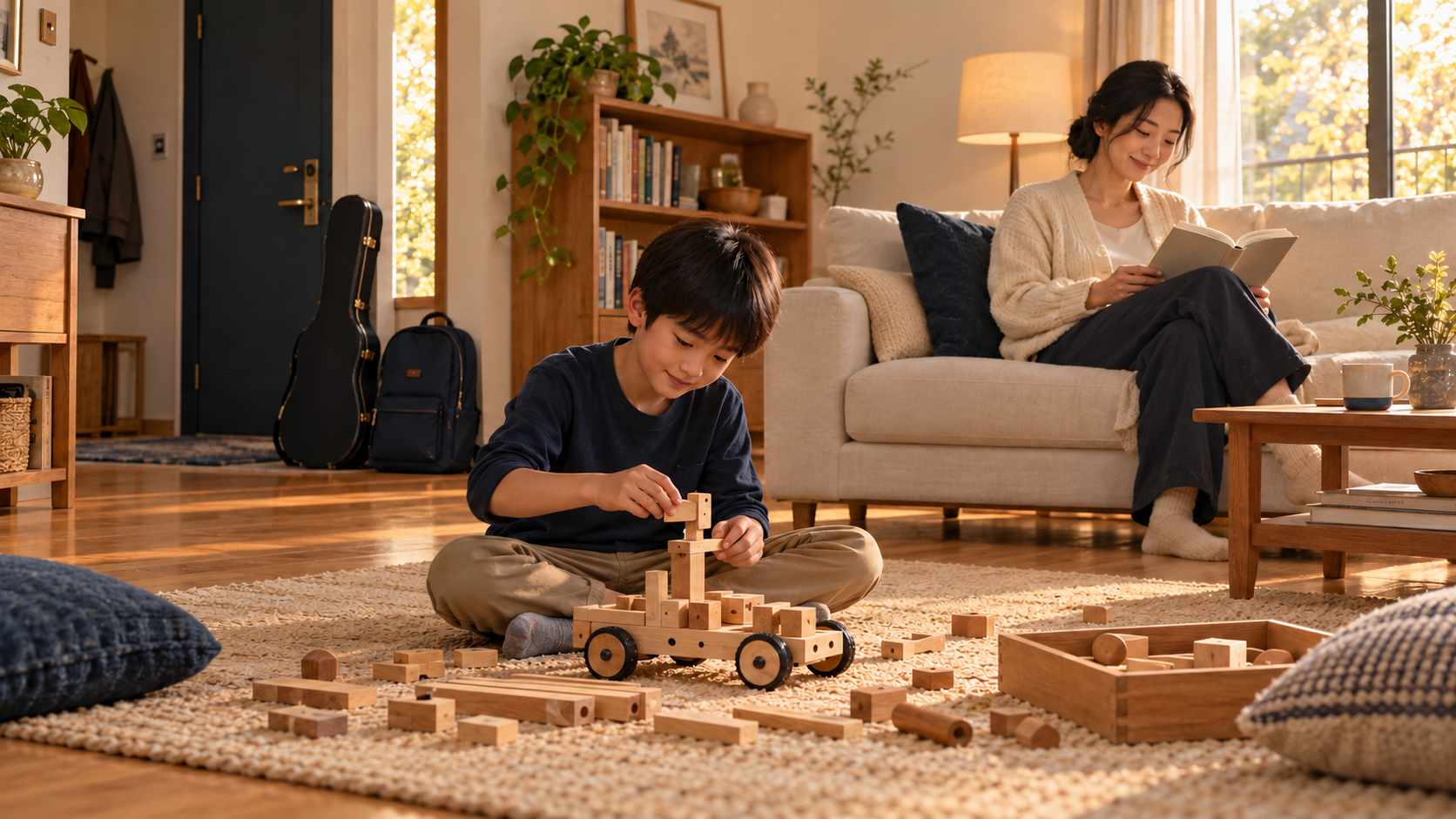
At evening's end, Kirill builds a vehicle that will appear in no performance. Marina does not ask whether the play was sufficiently developmental. Ordinary life continues between organised activities. A child is not the sum of attendance, certificates or withdrawals. Adults can take learning, the child's voice and family capacity seriously together. A next step grows from a particular task and accessible conditions. Neither a complete demonstration of talent, permanent interest nor flawless parenting is required to provide explanation, change a route, make room for rest and keep a promise of care.
What this means in practice
If nothing urgent needs attention and the child is willing, consider one actual day and activity. What happens before and afterwards? Who accompanies, and how are food, necessary care, rest and free time available? Distinguish adult wishes, the child's words and unknowns. One refusal or success establishes neither permanent talent nor interest. Create no distressing event for evidence; a detailed account is not payment for attention.
Choose one accessible question: an exercise explanation, route, travel frequency, format or ending. Name actual adult responsibilities and the child's possible participation. Clarify conditions with a suitable leader and check received help rather than only a message. Promise neither refund, victory, immediate relief nor everybody's agreement. Do not remove necessary supervision to create an empty calendar square.
Optional reflection can stop while care continues. Rest is no prize for success or the right answer. Recurring difficulty, significant distress or interference with life merit appropriate consideration without waiting for every sign. Assign no automatic psychological explanation to new pain. Danger, threatened harm or acute deterioration require suitable protection and help, including urgent assistance according to circumstances. One confirmed change may be the result; it establishes neither perfect balance nor a completed future.
Key quote
“They who assist it to grow long pull out their corn.”
Mencius, Book II, Part I, Chapter II, paragraph16, translated by James Legge. The crop story belongs to moral cultivation, not an agricultural or neuroscientific prescription. Nearby context authorises neither forcing growth nor neglect of necessary care. “Corn” is not identified here as maize.
Connections between traditions
These comparisons identify particular positions in the read passages. Practical questions are our application; historical and professional sources do not become one proven method.
| First ground | Second ground | Link and authorial application | Difference and limit |
|---|---|---|---|
| Mason preface1 treats the child as a person. | Mencius IIA2.12–17 presents moral cultivation needing attention, while pulling seedlings destroys the crop; neglect is criticised too. | Another's growth cannot be reduced to displaying an adult's desired result. Hear Kirill's present interest and examine conditions while maintaining care. | Educational personhood differs from a moral cultivation image. Neither supplies neuroscience, a talent test or a lesson count. |
| Mencius IIA2.12–17 distinguishes care for cultivation from forced acceleration without proposing abandonment. | AACAP116 recommends attending to individual interests, free time and repeated resistance. | Instead of intensifying demands at random, clarify the exercise, conditions and amount. An accessible attempt requires neither withdrawal of help nor endurance of harm. | Ancient moral reasoning does not validate modern advice as an experiment. The2017 sheet diagnoses no refusal cause and establishes no universal ceiling. |
| Mason preface4 limits authority and obedience by respect for the child's personality. | Children's Wisconsin2026 attends to routines, recovery and changed condition while recognising individual differences. | Respect gains an organisational question: where are travel, food, supervision and rest in this day? Adults name resource limits honestly. | Historical education differs from a modern professional article. Neither this link nor our example universalises its numerical ceiling or promises health. |
Primary sources
- Charlotte M. Mason, Home Education, fifth edition, 1906. Actual complete series-preface and selected principles1–10 reading in this assignment reused, not the book. Its historical under-nine framework is no modern medical rule for all six-to-eleven-year-olds.
- Mencius, The Chinese Classics, Volume2, translated by James Legge, London, 1875. Complete IIA2.12–17 reading for GROW-031 in this assignment reused, ebook PDFpage115. Not the whole chapter, book or Chinese. Moral cultivation is no scientific child model; the crop is not identified as maize.
- AACAP, Afterschool Activities: Striking the Right Balance, Facts for Families116, December2017. Entire substantive sheet and use conditions read, not underlying studies. Limited paraphrase, no sheet reproduction, diagnosis, universal activity count or globalised US help pathway.
- Lisa Bosshard, MD, Children's Wisconsin, Overscheduled Kids: How Much Is Too Much?, 18 August2026. Entire substantive article, author and date read. Professional advice rather than a new trial; numerical ceilings and broad causal wording are not adopted as universal rules.
- NHS, Anxiety in children, page reviewed 5 August2026. Entire substantive reading in this assignment from GROW-032 reused. No diagnosis, home treatment or confirmation of a particular local service.
Tags
primary school, clubs, child interests, timetable, outside demands, rest, free play, travel, accompaniment, care, parental expectations, family resources, talent, one episode, choice, learning, accessible help, exercise, continuation, ending activities, privacy, fees, agreement, outcome verification, safety, help, Mason, Mencius, AACAP, Children's Wisconsin, NHS, United Wisdom
About the authors
Andrey Zarinsh is the author and founder of United Wisdom. He explores inner transformation, the unity of traditions, intercultural dialogue and contemporary spiritual discipline. Instagram: @andrey.zarinsh.
Maria Evilkut is a co-author of United Wisdom. Alongside research, she seeks to test these ideas in practice and observe how principles of unity and mutual understanding work in real life between people and cultures. Instagram: @ilkutki.