
Growing up
When ordinary life narrows: a child or teenager loses interest
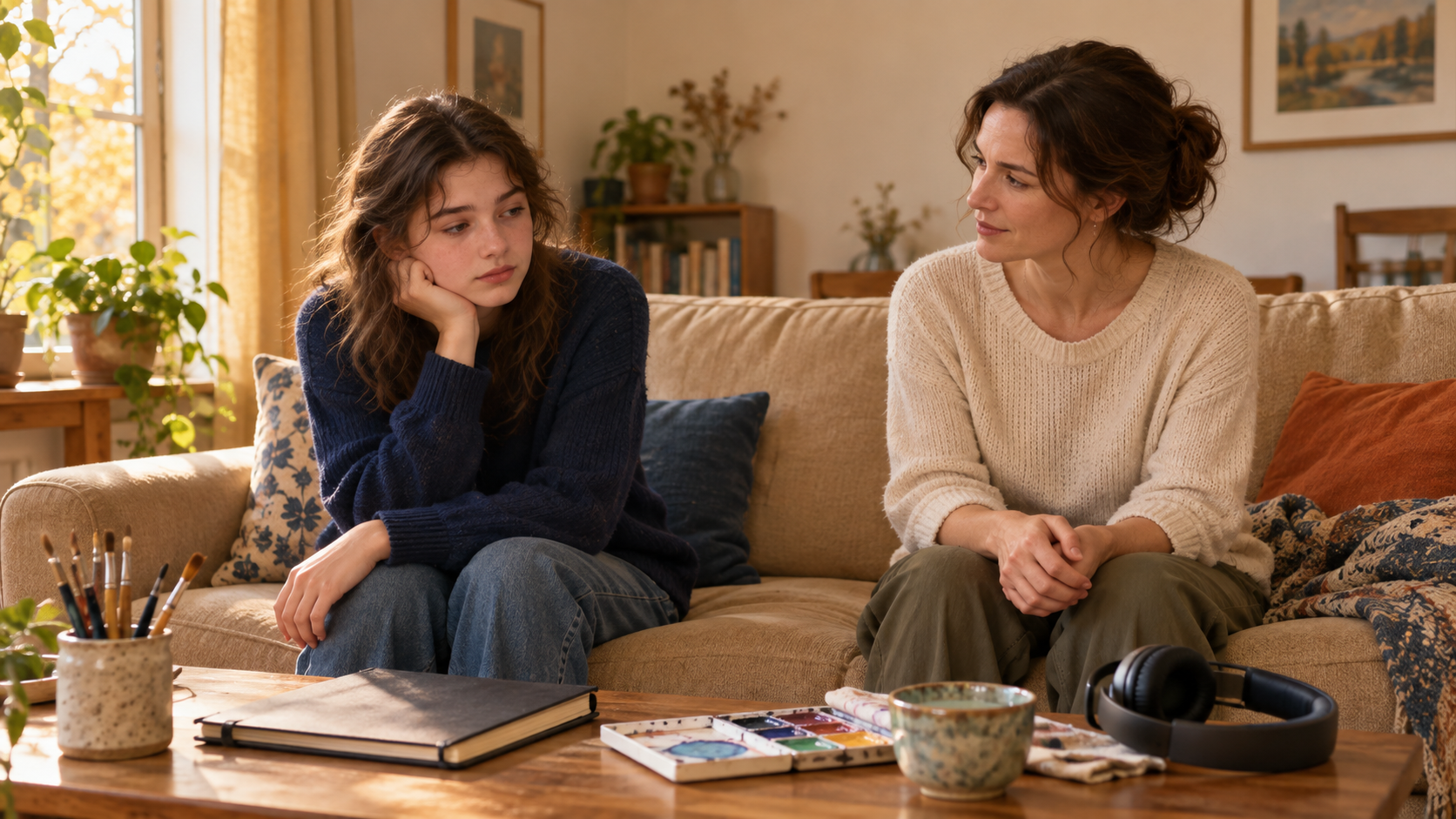
Sixteen-year-old Lena stops attending art class. Her mother thinks she dislikes the teacher; her father blames her phone. Yet Lena also replies less often to a friend, struggles to get ready in the morning, and says even her favourite music has become “just noise.” Her grades…
“I neither know nor think that I know.”
Socrates in Plato's Apology, 21d, Benjamin Jowett's version. The passage concerns the limits of claiming knowledge. It does not recommend ignoring danger or declining help.
What this article is about
Sixteen-year-old Lena stops attending art class. Her mother thinks she dislikes the teacher; her father blames her phone. Yet Lena also replies less often to a friend, struggles to get ready in the morning, and says even her favourite music has become “just noise.” Her grades are holding up. Her parents argue about discipline while the question of what has changed in her ordinary life remains without a listener.
This article is for parents, other caring adults, and young adults aged eighteen and over. Leaving one interest may be an ordinary change; a substantial narrowing of accessible life deserves attention. One sign cannot establish a diagnosis, and the absence of a diagnosis does not remove a need for help. We distinguish observation from explanation, changing an interest from a wider loss, and support from an examination of effort. The practical aim is to describe changes, begin a calm conversation, and seek appropriate assessment without waiting for every area of life to collapse. This is educational writing, not a medical examination or a method of treating depression at home.
I. What exactly has become less accessible?
“Nothing interests her” is too large a claim to check. It may conceal different information: she no longer wants to draw, cannot manage the journey, fears meeting someone in the class, cannot afford materials, or finds enjoyment difficult across many activities. Do not select an answer without conversation. Begin with a small piece of the situation: what the person used to do, what changed, and what she says about it. An observation describes an episode rather than a whole character.
A child who leaves chess but eagerly builds a model and sees friends presents one picture. Difficulty getting up, communicating, eating as usual, and starting even something wanted presents a wider question than one club. That still does not name a disease. It gives reason to examine changes and accessible support more closely. The NIMH material for teenagers includes loss of interest among possible manifestations of depression alongside other changes. Its list does not become a family diagnostic examination.
An adult might say, “Recently you have missed art several times and said music no longer feels enjoyable. I want to understand how things are for you.” “You have become lazy” has already assigned cause and blame. Even if agreements later need discussing, that does not replace understanding the person's condition. A child need not first demonstrate faultless behaviour to have a difficulty heard.
A young adult may begin with a personal description: “I have stopped doing several ordinary things, and it is not only one activity.” An exact explanation is unnecessary at this stage. Useful information may remain incomplete. The first step makes a change visible to an appropriate person; it does not require independently resolving every question about causes and diagnoses before asking for support.
II. Changing an interest differs from losing the capacity to be interested
Childhood interests are not lifelong contracts. Someone may stop wanting competitions while still enjoying swimming, choose guitar over another instrument, or keep drawing private instead of exhibiting. An adult may feel hurt about invested money and effort. That feeling does not prove a duty to continue the old activity to preserve the family's sense of purpose. Discuss practical commitments separately without turning them into a general obligation to experience enjoyment.
In one imagined version, Lena says, “I like drawing at home, but they constantly compare everyone's work in class.” There is a specific condition to consider. Another format or a pause might be possible. A change of group cannot be promised to resolve everything before the rest of her life is understood. Equally, returning to precisely the old format need not become proof of health. Supporting an interest starts with Lena's interest rather than restoration of an adult's preferred picture.
A different account is, “I do not want to draw there or at home, and nothing I used to like feels like anything.” Offering ten new clubs does not answer that message. The NHS discusses loss of previous interests in the context of possible depression in children and young people. Professional consideration of the whole situation matters; matching and counting items at home cannot replace it.
Nor should children be divided into “really ill” and “merely difficult” according to whether one pleasant moment occurred. One funny video does not cancel a difficult period. One abandoned activity does not establish a general loss. Both limits support attention without a premature label. Precision serves the decision about help, rather than a trial over whether someone has earned the right to say that life is difficult.
III. Compare with this person's life, not an ideal teenager
A parent may regard daily sport, large groups, and high marks as normal. A particular person's ordinary rhythm differs. A quiet teenager is not unwell simply because they enjoy solitary activities. An outgoing teenager may substantially reduce contact while still appearing more talkative than a classmate. Consider change in this person's life and experience rather than an average portrait they must resemble. The previous situation may itself have been difficult; it is not automatically a safe standard.
The American Academy of Pediatrics discusses changes in ordinary patterns and cautions that one sign does not equal a full crisis. This guides conversation and help-seeking; it does not authorise waiting until enough problems accumulate. Lena's grades are holding up, but her other messages still matter. One preserved area does not automatically establish the condition of all the others.
Separate three voices: what I observe, what the young person reports, and what remains unknown. “I notice you are not replying to your friend” is a limited observation: the adult does not know every contact. “Talking feels difficult” is her own account. “They have fallen out” is an explanation that has not been confirmed. Plausibility or convenience does not turn that third statement into a fact.
Precision does not demand an all-day spreadsheet. A few examples may help a conversation with a doctor or another suitable professional. There is no need to make a child the object of constant surveillance, secretly inspect every exchange, or rank their activity against classmates. Care keeps its addressee present: the person participates as much as they can, while adults remain responsible for their own decisions and necessary protection. Being concerned does not give an adult unlimited knowledge of another person's life.
IV. Begin without demanding an immediate explanation
An invitation to Lena might be, “I am concerned because several ordinary things have become difficult, beyond missing a class. Is now a suitable time to talk, or would later be better?” Choosing a time fits an ordinary safe situation. Immediate danger requires adult action without waiting for a convenient conversation. Tone cannot guarantee disclosure, but accusation adds another task: defending against a verdict instead of describing an experience.
“I do not know” may mean exactly that. It need not conceal dishonesty or stubbornness. Ask about one understandable area: “In the morning, is waking, getting ready, or going specifically to school difficult?” Avoid a long interrogation through every item in this article. One question and a pause leave room for the person's answer. If they correct the adult's account, hear the correction rather than compete over who knows their life better.
A gentle shared-reading invitation is, “This paragraph distinguishes changing a hobby from finding many things difficult. Would you like to look at it and say whether it fits? You do not have to read it.” This is an invitation, not a test requiring the right admission. Reading does not mean accepting a diagnosis, which the article does not make. Another trusted adult may be a better person to talk with. The NHS explicitly allows this possibility when a child does not want to speak with a parent.
An adult can state limits honestly: “I will not tell everyone. If help is needed for your safety, I will explain who we are involving and why, as far as possible.” Absolute secrecy cannot be promised where safety is threatened. Nor should personal conversation be repeated to relatives for advice without considering necessity. Trust also depends on what the adult does after the opening words.
V. Physical complaints do not require a choice between “real” and “psychological”
Lena mentions weakness and headaches. Immediately calling these an excuse to avoid class would be a mistake. So would deciding from a symptom list that depression explains everything and the body needs no further medical consideration. The general NIMH publication on depression notes that some medical conditions and medicines can produce similar symptoms; a clinician investigates possible causes. This article selects neither tests nor treatment for a particular reader.
Simple information may help prepare for an appointment: when changes began, what interferes with ordinary activities, medicines already taken, and complaints the person considers important. No perfect history is required to qualify for a visit. If speaking is difficult, bring a short note or ask someone accompanying you to help with arrangements. Personal discussion, age-related rules, and confidentiality limits need clarification with the particular service.
A family may argue, “First prove it is not physical,” or, “Stop looking for a physical cause; it is all stress.” Both demands turn uncertainty into an obstacle. An appropriate medical visit provides a place to explore that uncertainty with someone qualified. There is no need to choose one category in advance and persuade every relative. Do not independently stop prescribed medication or try someone else's medicine to test a family hypothesis.
Ordinary participation can continue around an appointment. Help with transport, cost information, or reducing optional demands may be useful. These actions do not prove a particular cause of weakness. They reduce practical barriers to care. A rapid deterioration or apparently dangerous condition needs timely local medical assessment rather than completion of home observation. “We do not yet know” is compatible with taking real action now; it need not postpone action until a satisfactory explanation arrives.
VI. Reducing demands is an agreement, not a reward for illness
When ordinary life becomes difficult, a family may require a confirmed diagnosis before allowing rest. Manageable practical help can be discussed on the basis of a visible difficulty without making it a prize for the correct document. Equally, do not automatically remove everything that still supports the person's life. Ask which obligation is especially exhausting and which ordinary activity they would like to preserve. An arrangement can be temporary and revisable.
One imagined family relieves Lena of organising a holiday performance without banning a short meeting with a friend because “you have energy for friends but not study.” Different activities involve different demands. This is reasoning about a fair conversation, not a rule that every diversion helps or every refusal must be accepted without conditions. Adults continue to address safety and actual commitments while considering the person's condition and available resources.
Limited resources do not require support to take the form of a holiday away. Postponing one optional deadline, preparing simple food, arranging an appointment, or dropping an evening progress report may be possible. Do not promise what the family cannot provide. “I can call the clinic after work” is more concrete than “we will arrange everything.” If something necessary is beyond the family's resources, approach a suitable service or another responsible adult rather than blame the child for needing it.
An agreement is not treatment. It need not immediately restore interest and does not replace assessment when difficulty persists. Later, ask whether the particular demand became more manageable and revise the arrangement. Visible gratitude or a cheerful appearance should not be a condition of support. Even a helpful conversation does not establish that professional assessment is no longer needed. Its actual benefit can be acknowledged without assigning it an effect that has not been demonstrated.
VII. Offer an ordinary activity without examining enjoyment
“Go for a walk and everything will pass” turns an accessible action into a promise of results. If the walk brings no relief, the person may then be blamed for trying incorrectly. In NIMH's teen guidance, ordinary supportive actions accompany seeking professional help rather than replacing it. We are not prescribing an activity programme. We are considering how to invite manageable participation without presenting a household initiative as treatment.
Invite Lena to walk to the shop together or sit nearby with her sketchbook. She may say that today does not work. Agreeing should not become a test: “You are drawing, so everything is fine.” Someone can do something familiar without its former pleasure, or have brief enjoyment while still needing help. Keep the limited meaning of the event rather than draw a conclusion about the entire period from one moment.
Participation retains its subject. Not every walk needs questions about symptoms, nor every picture interpretation as a message about an inner condition. If someone wants to look quietly at trees, there is no obligation to extract material for the next family discussion. Care can stay nearby without occupying the whole space. Play, beauty, and curiosity have value beyond restoring productivity. An activity need not justify its existence by producing improvement that someone else can record.
An invitation changes with mobility, money, and time. An expensive studio cannot be presented as the only route back into life. A brief shared activity at home may be accessible; at another moment, help obtaining assessment takes priority. Rest does not depend on completing a useful activity first. Where urgent help is needed, a quiet occupation must not delay it. Modest participation and timely care can have different purposes without either being turned into a guarantee.
VIII. Not knowing a cause does not mean doing nothing
In the Apology, Socrates distinguishes ignorance from confidence in knowledge one does not possess. This is a philosophical account of examining claims, not a clinical interview manual. A limited family comparison is useful: “We notice a change but do not know its cause.” That is more accurate than “it is just the age” or “it is definitely depression.” Neither confident phrase substitutes for exploring the situation with a qualified person and the teenager themselves.
Admitting uncertainty is sometimes confused with inaction: without a proven illness, nothing can be decided. Yet organising conversation, reducing needless pressure, and arranging assessment do not require a final diagnosis. Their purpose is to obtain understanding and support, rather than confirm a preselected family theory. If a professional proposes another account, ask about its basis and the next step instead of defending the original guess to preserve adult authority.
In Book I.6 of the Nicomachean Ethics, Aristotle contrasts an abstract universal good with practical occupations: a doctor deals with a particular person. We adopt neither ancient medicine nor philosophy's authority over modern assessment. The comparison marks a general recommendation's limit. “Teenagers need sport” does not itself tell us what Lena can currently manage, why many things have become difficult, or what care would suit her circumstances.
This also marks the boundary of independent reading. An article can supply language for observation and a question for an appointment. It cannot see the person, examine them, or know their history and local conditions. Rejecting false certainty does not diminish the seriousness of a report. It directs effort towards a setting where uncertainty can be clarified without requiring the teenager to become an expert on their own condition before support begins. Adults can remain attentive while accepting that their first interpretation may be incomplete.
IX. When to widen help, and when not to wait
Substantially narrowed interests, continuing difficulty, significant distress, or disruption of ordinary life warrant appropriate professional assessment. These need not all appear together. The NHS recommends a medical appointment when concerned about a child's general wellbeing as well. The threshold for seeking help differs from diagnostic criteria: a clinical duration description does not instruct a family to wait until a particular day. Deterioration need not await completion of a planned observation period.
Unsafe behaviour or talk of harm to oneself or others requires immediate help. Immediate danger requires a local emergency service or urgent medical care. Do not wait for an interest in music to return, a detailed account of causes, or agreement with the adult's explanation. This marks the article's limit rather than offering a home algorithm for classifying risk. Discuss the particular circumstances with an accessible qualified local service.
In an ordinary situation, an accessible doctor, paediatrician, or appropriate mental health professional may be a starting point. The first service's name, referral requirements, fees, age rules, and confidentiality vary. The language of this article establishes neither a country nor entitlement to a particular service. An adult takes a manageable organisational task and clarifies the next step. A child need not find the ideal professional, persuade the whole family, and secure payment before their report matters.
If a parent is not safe to approach, another suitable adult or local protection and support service is needed. This is not a demand to disclose first to someone feared. Young adults may also need company and help with arrangements despite having a formal right to seek care independently. Independence does not remove a need for help; receiving help need not mean losing one's voice or participation in decisions.
X. Renewed interest is not a recovery report
Later, Lena draws a card. The family is pleased and wants to declare everything over. One result does not answer every question. Enjoy the card itself and ask what doing it was like without demanding proof of general improvement. A person's activity deserves attention beyond what it says about a condition. Equally, improvement need not be ignored for fear of lowering vigilance: it is information that can be shared in further care.
The reverse is also possible: interest has not returned although the family has become more supportive. That establishes neither ingratitude nor the uselessness of all help. Tell the professional what remains difficult, what has changed, and what next contact is available. Do not independently cancel a prescription or declare treatment ineffective on the basis of one evening. Treatment decisions require discussion with the relevant professional rather than a family vote on willpower.
Parents may find uncertainty difficult too. Their anxiety deserves separate support. A child is not obliged to soothe adults with a cheerful daily answer, conceal a bad day, or confirm the whole family's success. Agree on a reasonable way to learn what is necessary, considering safety and professional advice. Such an agreement differs from constant demands to measure joy and report every shift in mood. Its purpose should be understandable to the person concerned.
A person remains more than the present difficulty. Weather, household tasks, a book, and the future can be discussed without every conversation becoming a recovery examination. This preserves life around the problem rather than ignoring it. Support is more precise when it requires neither endless proof of difficulty nor a premature performance of recovery. The next step follows present needs rather than a wish for a convenient ending to the family's uncertainty.
XI. Other adults see part of the picture
A teacher may report that Lena works as usual in class. That is useful information, but it does not refute difficulty at home. A parent may see evening exhaustion without knowing the effort required by a school day. Different observations need not mean someone is lying; they concern different conditions. Ask what changed in lessons, what remains accessible, and where assistance is needed. Neither school nor a family meeting establishes a medical diagnosis by majority vote.
An organisational change can be discussed with a suitable staff member, considering age, safety, and local rules. Postponing an optional performance need not require telling a whole class the person's history. Explain to Lena beforehand what information will be shared and why, allowing manageable participation. This is no promise of secrecy in danger. It avoids unnecessary disclosure when a specific task can be addressed with less personal information.
In an imagined situation, her mother tells a coordinator, “Several ordinary activities are difficult at present, and we are arranging assessment. Who can discuss a temporary workload change?” She presents no suspected diagnosis as confirmed and does not ask a teacher to treat. Staff may describe available school arrangements; medical decisions remain with an appropriate professional. If one condition cannot change, name the constraint and look for another manageable step rather than conclude that all help is impossible.
A child need not connect every adult, repeat a painful account to everyone, and supervise their agreements. A responsible adult takes a specific organisational task and reports its result. Offer a young adult similar assistance with their participation, without automatically taking over decisions. In both cases, attention serves access to ordinary life and care rather than the creation of a reporting system around the person.
What this means in practice
In an ordinary safe situation, name two or three specific changes without a label: what used to be accessible, what became difficult, and how the person describes it. Do not collect every possible sign or make a home diagnosis. Ask about one area and allow an unknown answer. Offer a paragraph for shared reading, another time to speak, or a suitable trusted adult.
Distinguish changing an interest from a wider narrowing of life. Preserved grades and one pleasant moment do not cancel other difficulties; leaving one club does not establish illness. Discuss physical complaints and medicines with a doctor without preselecting a “real” or “psychological” cause. An incomplete honest account is sufficient to begin. A brief note can help; access to care does not depend on a good diary.
Choose one accessible adult action: ask about an appointment, assist with transport, or reduce an optional demand. With limited resources, identify a real constraint and the nearest possible contact. Offer ordinary shared activity without guaranteed relief or an enjoyment report. It does not replace assessment when difficulty continues or substantially disrupts life.
Unsafe behaviour, talk of harm to oneself or others, and immediate danger must not await an exercise, duration threshold, or returning interest. Appropriate immediate help is needed; immediate threat requires local emergency assistance. Clarify access and confidentiality locally. The useful outcome is a more precise question and an actual next step, rather than a confirmed diagnosis or a promise of quickly restoring a former life.
Key quotation
“it is individuals that he is healing.”
Aristotle, Nicomachean Ethics, I.6, W. D. Ross. The context concerns the limits of an abstract good's usefulness for a doctor. It neither establishes modern treatments nor argues against professional knowledge.
Connections between traditions
| Comparison | Distinction it supports | Limit |
|---|---|---|
| Plato, Apology 21d, and family confidence | Observed change versus unconfirmed explanation | Uncertainty never justifies waiting in danger; philosophical examination is not clinical interviewing |
| Aristotle I.6 and general advice | An abstract recommendation versus help for a particular person | Ancient ethics neither replaces modern medicine nor prescribes treatment |
| NIMH and interest | A possible symptom in life's context versus a diagnosis | A list is no home test; duration criteria are not mandatory waiting periods for help |
| NHS and taking a report seriously | An adult's “small matter” versus significant difficulty for a child | UK referral arrangements do not automatically apply elsewhere |
| AAP and ordinary life | Change relative to a person versus comparison with an ideal | One sign does not establish a crisis; calm conversation cannot guarantee disclosure or replace assessment |
Primary sources
- Plato, Apology, Benjamin Jowett. Selected account of the oracle and examination of knowledge claims, including 21d and nearby context, read; not the entire dialogue. Brief attributed quotation.
- Aristotle, Nicomachean Ethics I.6, W. D. Ross. Complete selected section and nearby context read. Ethics and practical knowledge, not clinical evidence.
- NIMH, Teen Depression: More Than Just Moodiness. Main text read. Broad changes and help-seeking used; US contacts not transplanted.
- NIMH, Depression. Main text read; used here for diagnostic limits, individual assessment, and similar physical or medication-related causes. No treatment schedule prescribed.
- NHS, Depression in children and young people. Main text read. Last reviewed May 16, 2023; further review was due May 16, 2026. Availability does not establish an update. Local pathways and contacts are not universalised.
- Richard J. Chung / AAP, Teen Mental Health: How to Know When Your Child Needs Help. Main text read, updated May 20, 2025. Statistics, self-harm methods, and separately linked research not used. NIMH Children and Mental Health, read earlier in this task, supports immediate help for unsafe behaviour or talk of harm: source.
Pages checked October 23, 2026. Scenes are imagined. Distinctions and practical alternatives are author reasoning, not an effectiveness study. Native-language, independent clinical, and reader testing have not been conducted.
Tags
growing up, teenager, child, loss of interest, ordinary life, changing habits, hobbies, rest, parents, young adults, conversation, observation, uncertainty, mental health, depression, medical assessment, physical complaints, medicines, demands, support, access to care, confidentiality, trusted adult, safety, urgent help, independence, play, dignity, Plato, Aristotle, NIMH, NHS, AAP
About the authors
Andrey Zarinsh is the author and founder of United Wisdom. He explores inner transformation, the unity of traditions, intercultural dialogue, and contemporary spiritual discipline. Instagram: @andrey.zarinsh.
Maria Evilkut is a co-author of United Wisdom. Alongside her research, she seeks to test these ideas in practice and observe how principles of unity and mutual understanding work in real life between people and cultures. Instagram: @ilkutki.