
Growing up
Privacy, parental controls and trust
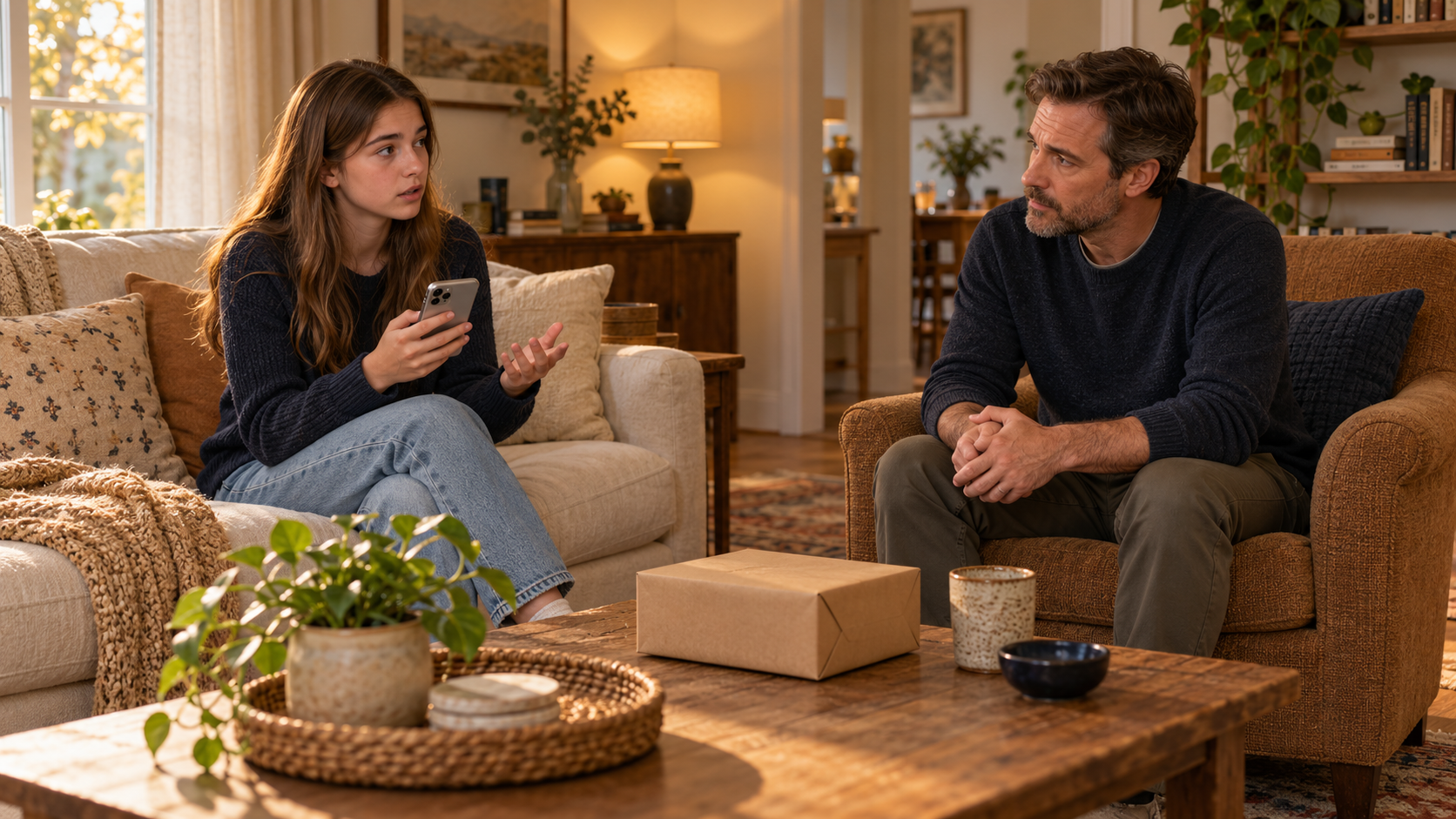
In a fictional family, fifteen-year-old Dasha asks her father to find a delivery address on her phone. He finds it, then reads a conversation with her friend. There is no dangerous plan, but another person's difficulty and Dasha's own rough, angry words. He says responsibility…
Epigraph
when thou hast shut thy door, pray to thy Father which is in secret
Matthew 6:6, King James Version, a selected part of the verse. Matthew 6:1–6 concerns almsgiving and prayer without a display audience. This religious teaching is neither evidence of solitude's benefits, a prohibition on reporting harm nor a rule for parental phone access.
What this article is about
In a fictional family, fifteen-year-old Dasha asks her father to find a delivery address on her phone. He finds it, then reads a conversation with her friend. There is no dangerous plan, but another person's difficulty and Dasha's own rough, angry words. He says responsibility for safety requires knowing everything. Dasha says she will never show anything again. Specific permission, care, a third person's private life and a promise to obtain trust through complete access have become entangled.
This article addresses parents, caring adults and young adults aged 18 and over, with children's experience central. We examine access for a task, what controls actually show and when protection is needed. The earlier UW account of adult relationships cannot become a ready rule for minors: children depend on adults whose duties survive a refusal. Equally, kinship and payment explain no unlimited intrusion. This is no universal legal instruction, app configuration or guarantee of trust. All scenes are invented. The practical aim is a clearer action and limit with actual help preserved.
I. An available object and a permitted action differ
The phone is in the kitchen, unlocked, with a password known to the parent. This explains possible entry, not the task requiring access or the agreement. Finding an address, checking a purchase, setting a restriction and reading all conversations differ. Name the action before judging the child's character. Otherwise the subject becomes unlimited: she hides everything, he respects nothing. Such words may express hurt without identifying the issue.
Dasha permitted finding an address. This does not automatically agree to the archive or forwarding discoveries to relatives. Earlier willingness to show photographs does not settle every present use either. UW R18 supplies this distinction from adult relationships. Its application here is bounded: a parent's protective role requires grounds absent from a partnership. The conversation therefore concerns neither identical roles nor no parental limits. A minor's dependence changes responsibility without turning every piece of accessible information into something automatically needed for a protective task or every disagreement into a complete withdrawal from care.
Accidentally noticing a notification differs from deliberately opening the continuation. The distinction does not require proof that nothing improper lies inside. A relevant warning sign may create a separate protection task; curiosity may be the only reason. Do not call both responsibility. Describe what is known and assumed without examining innocence. Serious risk need not await flawless wording, but suspected risk does not make unknown content established fact. The action can require attention while its precise grounds still need clarification rather than being supplied by a general claim to concern.
Access also has consequences: who keeps information, receives it and for what purpose? One necessary part can be seen without being shown to the entire family. Helping with a message does not create permanent surveillance. Prior discussion is not always possible, especially in immediate danger, but explanation and limits on later disclosure still matter. The article decides no inspection's local legality. It prevents one action becoming every future use merely because information is now visible. Necessary help can have a scope without pretending that all later handling is already justified.
Children need predictability rather than a perfect agreement covering everything. Name a known check and its purpose in understandable words. Explain changed rules instead of claiming they were obvious. New terms need not make the whole previous experience wrong, but convenience does not preserve an old habit forever. Begin with the current task and actual role rather than proving a right over the whole person.
II. Privacy need not prove perfection
Teenagers have unfinished thoughts, drafts and different conversations with different people. An angry rough sentence is not automatically an action plan or the whole truth about a family. This does not make everything written harmless. Content and circumstances matter; every private fragment need not become a final confession. Personal space cannot depend solely on presenting an agreeable, fully explained version of every thought.
Not wanting to show a conversation does not itself prove a threat. Embarrassment, ordinary separateness or a friend's information may be involved. Danger can also be concealed. Neither possibility erases the other. Ask what specific grounds require action now. Adult anxiety deserves attention but establishes no unseen archive's content. Nor does a child owe a dramatic reason for private time. A closed conversation need not justify itself through extraordinary secrets, useful work or another person's suffering. The question of a relevant risk can remain specific without making all privacy suspicious by definition.
CRC article 16 addresses arbitrary or unlawful interference with privacy and correspondence. The same normative text concerns voice, evolving capacities and protection from violence. These are states-party obligations, not ready instructions for every phone. Preserve privacy and adult responsibility together. One norm creates no universal ban on protective action in danger; another authorizes no arbitrary access. The framework distinguishes concerns without deciding all local powers, actual risks or necessary measures in a particular household. An adult must not erase one concern merely because another is also important.
A friend's conversation involves another person, who may have trusted Dasha without accepting family inspection. Showing the entire chat as proof of loyalty affects that life too. Consider whether the actual shared question can be answered without the details. Third-party information is not an absolute prohibition on seeking help, however. Recipient, purpose and relevant scope differ. Public entertainment and an approach to an appropriate person about danger should not be made identical. A necessary account can remain limited rather than making every participant's private history available to everyone involved in the family's disagreement.
Privacy does not cancel responsibility. A promised return-time message or agreed expense remains relevant. A purchase account is not the friend's entire conversation. Answer for a known action without a lifetime examination of fitness for trust. This helps adults too: an actual answer is more useful than many personal details unrelated to whether an agreement was fulfilled. Volume and clarity are different outcomes. A request can therefore remain answerable without requiring unlimited disclosure, while privacy does not become a way to leave a known shared commitment entirely unexplained or unfulfilled.
III. Control needs an understandable protective task
Controls include purchase restrictions, time reports, content selection and observing contacts. Each involves different information and people. There is no need to choose every tool or abandon support. Ask which risk or known breach is being considered, what a tool shows and who acts next. Without those questions, a technical capacity can become a general entitlement to know everything. The unresolved safety question then disappears behind data volume.
eSafety's parental-controls guidance discusses limits and other support strategies. The bounded point used here is that settings are not complete protection. The page also recommends explaining and reviewing controls with children. This Australian framework verifies neither a device nor local legality. Do not promise that transparent discussion must improve trust or transfer described long-term psychological associations into an individual family forecast. The linked research has not been examined for that purpose. Guidance can support a question without establishing what will happen to this child under every possible arrangement.
One task may need less information. An unexplained purchase calls for the payment and terms, not automatically every month's conversation. Less is not always sufficient, however. A specific serious threat may require other action, appropriate authority and help. Children should not organize that alone. Adults answer for grounds and consequences without making reluctance the sole proof of danger or perfect consent a prerequisite to every necessary protective step.
Age, experience and support needs differ. A technically confident teenager can need help with pressure; a younger child can understand a simple rule. The article prescribes no birthday-based control scale or needs assessment from a diagnosis. Check explanation through one action. If another communication form is needed, investigate with relevant support rather than erasing voice because understanding is difficult. Guidance should concern the actual person instead of a convenient maturity table. Differences in capacity can change the form of participation without making the child irrelevant to a decision that affects their own life.
Separate purpose and outcome. Wanting protection is an intention; enabling a feature is action; receiving a report provides information; harmful treatment stopping is another possible outcome requiring checking. No transition is automatic. Good intention does not erase unnecessary disclosure, and limitations do not make every use worthless. Name a specific benefit and remaining uncertainty. Children need not certify total safety because adults spent time or money configuring something. A useful limited tool can be acknowledged without assigning it responsibility for relationships, other people's behaviour and every future risk beyond what it actually does.
IV. Explanation should not disguise an unlimited decision
Ordinary discussion can clarify what is visible, who has access, why, for how long and when it will be reviewed. No lengthy document is necessary. “We check safety” explains little about ongoing transmission of all activity. Name and investigate what the adult does not know. Promise no unchecked technical confidentiality. Children should not discover hidden scope and then prove gratitude for care. A plain explanation needs to describe actual access rather than provide a reassuring label for something neither person fully understands or has verified on the device being used.
In Matthew 6:1–6, meaningful religious action is not for a display audience. The comparison is modest: significance does not always require spectators. It is no secular theory of child privacy, ban on supervision or instruction to conceal harm. The religious ground remains intact. Here ask what is being observed and why. Something unseen can have meaning, while a closed door guarantees neither safety nor right conduct. Neither conclusion supplies a universal device-access rule or replaces consideration of the actual child and adult roles involved.
Asking a child is more than reciting a question before an unchangeable decision. In an ordinary safe area, their answer can alter form or scope. Dasha accepts checking a purchase together but not showing a friend's discussion. Consider this rather than calling it rejection of all help. Participation nevertheless does not transfer every protective duty to the child for approval. Serious danger can require adults to act in their role. Explain what is known and do not expand necessary disclosure without new grounds.
The audience matters too. Necessary information gives no automatic right to use it for humiliation at dinner or in a parents' chat. Public shaming is not protection merely because the material came from a check. Sharing with an appropriate professional or service has a separate purpose, whose limits and availability need clarification. Promise neither absolute secrecy nor full anonymity. Children's dignity and other participants' information remain relevant after access, rather than disappearing with it. A protective action should not quietly turn into an unrelated public performance intended to produce compliance through embarrassment.
A tool may be unsuitable or produce an unclear report on a shared device. Do not silently compensate with ever wider inspection before establishing why. Return to the task, correct a known condition or choose another actual support route. The article recommends neither bypasses nor specific buttons. It separates feature investigation from accusing a child. Technical uncertainty is not an established breach even when admitting an incomplete understanding is difficult.
V. More access cannot purchase trust after a breach
Dasha's father can say, “You asked me to find an address; I opened the conversation further.” This admission requires no immediate additional disclosure. Discuss who received information and what can stop. Guarantee no removal of every circulated copy. Apology, stopping one's distribution, a new rule and the child's trust differ. Accept a limited correction rather than declaring it failed because the teenager remains angry or unwilling to reopen the phone. The adult's acknowledgment can be real without securing the response they wanted, and the child's continuing reluctance does not make the earlier action disappear.
Children can break known agreements too. Clarify the subject: spending, time or someone else's information. Privacy does not erase performance questions. Inspection should not automatically become a permanent price for ordinary respect, however. Consider relevant scope under understandable terms and revise through facts. The article sets no duration or legal process. It does not propose watching until all adult anxiety vanishes, an outcome no kind of access guarantees. Accountability for one act can remain specific without becoming a continuing examination of everything the child might think, say or do in the future.
After a mistake, unknowns remain unknown. A complete archive promises no proof of future honesty; no upsetting discovery establishes no possible harm elsewhere. Adults may struggle with that limit, but children cannot provide final reassurance through transparency. Work with a particular promise and available support. Serious loss of trust may need appropriate help separately from technology. One fictional phone scene establishes no psychological cause or diagnosis.
Notice small improvement. Next week the father sees a notification and does not open the continuation without a relevant task. This fictional action proves no complete recovery, but makes a condition observable rather than merely promised. Dasha may later share more voluntarily without paying for the adult's admission. Her actual shared commitments remain. Specific trust involves more than the quantity disclosed and does not cancel known duties. A limited action can therefore matter while both people still have feelings, questions and separate choices that have not been resolved by one conversation or apology.
Repair should not become another family performance. Children need not certify an adult's goodness before relatives or become permanent parental inspectors. Name one condition and observe ordinary fulfilment. If it fails, acknowledge the event rather than automatically increase monitoring. An unsuccessful first conversation proves neither that teenagers must cope alone nor that all help should cease. Responsibility remains with those whose roles and opportunities can change the action. The next step should address what happened rather than demand a larger audience or a more impressive statement of gratitude to make the previous effort feel successful.
VI. Necessary information is not the entire private life
Families need some information: contact after an activity, an agreed purchase, responsibility for a younger child at a known time. Privacy should not become unexplained disappearance from accepted participation. Yet a return-time question does not require every joke and difficulty shared by friends. Name the task first. Relevant information can then be distinguished from simply expanding the audience. Not every limit on disclosure rejects cooperation; not every information demand has the same caring purpose or scope. This keeps room for responsibility without making access to private contents the only possible proof of taking it seriously.
In the first ordinary case, a delivery address is needed. Find it together or show the selected message without continuing. In the second, spending exceeded an agreement. Relevant purchase information and a manageable next step are needed, not automatically the friend's inner life. These examples decide no universal legal question. They preserve responsibility's subject. If a child caused harm, their account and relevant information may matter; protecting third parties cannot quietly conceal all known action or prevent every appropriate conversation.
Seeking help can limit unnecessary disclosure. In an ordinary safe conversation, roles instead of names, one episode instead of an archive or one's own description instead of forwarding may suffice. These are possibilities, not rules for every professional response. An appropriate recipient may need other relevant details. Children should not determine all legal permissions alone. Adults help separate known, assumed and necessary information without promising complete anonymity from deleting a name. A smaller account can be useful while still requiring care about how its details identify people or travel beyond the original recipient and purpose.
A new recipient changes conditions. Parents' chats, school employees and protection services have different audiences and tasks. Do not call every appeal betrayal of family privacy or every forwarding necessary help. Silence about violence to preserve a family or institution's reputation is especially concerning. Personal space does not become a duty to keep harm secret. Protection can coexist with appropriate reporting, while adults still check actual authority, access and sharing limits. A title cannot establish these alone. The account's purpose matters alongside its contents, particularly when somebody claims that telling anyone is forbidden or that telling everyone is required.
Young adults' support needs different agreement. Kinship, a shared home or paying for contact supplies no automatic answer about entire accounts. Legal questions need local grounds absent here. Discuss known costs or shared tasks without declaring all life common property. Adulthood does not automatically remove financial dependence, which matters to safe refusal. A condition accepted under threat of losing necessities should not casually be called a free trust experiment. Both privacy and material circumstances need attention rather than assuming formal agreement establishes equal power or that resource dependence eliminates every boundary over personal information.
VII. Personal space need not require a separate room
Not every child has a room, device or money for control software. More confident boundary-setting cannot supply them. Explore a small available form: time without conversation in a shared room, a place for a notebook or understood users of a shared device. These need checking and need not fully replace wanted solitude. Adults arrange what they can change. Children need not solve housing and family-resource deficits alone to deserve separateness.
Private time also relates to shared tasks. For a known safe commitment, clarify return without a minute-by-minute inner-life report. Younger children need appropriate supervision; teenagers may need a different presence. No universal quiet hour is prescribed. The question concerns actual possibility and responsibility. A pause need not reject family, and togetherness requires no identical wish to talk every moment. Adult rest creates no permanent child service role either. Each person's needs can be named without making one person's opportunity to withdraw depend indefinitely on another always remaining available to everyone else's requests.
A gentle conversation might be: “I answer for your safety, but that doesn't make every conversation shared. Let's identify the task and information needed. You can suggest less. I'll explain the known next step. With a serious threat, I'll act to protect, not shame you for telling.” Teenagers need not immediately accept the whole formulation. Read one section together, choose a question and return when safe and manageable. The dialogue is an example, not a promise that the adult's tone alone will produce agreement, trust or enough resources to resolve the entire situation.
Children may decline the exercise without losing needed help or automatically proving danger. With an adult who is the threat, this conversation may be unsuitable; another reliable recipient is needed. No correct words guarantee safe refusal in every family. Recognizing limits matters more than an impressive independence speech. In ordinary available conditions, begin with one use of an object. In danger, do not demonstrate a rule change to test whether the child can endure the adult reaction. Support should not turn a principle about privacy into another exposure the child has to manage without protection.
In Quran 24:28, entering a house concerns permission and an occupant's ability not to receive a visitor. The limited comparison concerns an answer's significance. Houses in a religious context are no direct phone regulation or cancellation of child protection. The passage establishes no equal family power. Notice that asking about access should take an answer seriously while retaining adult responsibility under a specific serious risk. Different grounds should not become one universal formula allowing every entry or forbidding every disclosure regardless of the actual task and circumstances.
VIII. When protection replaces the exercise
Threats, violence, extortion and exploitation change the task. Do not await perfect privacy explanations or a child's successful negotiation with danger. Adults arrange immediate safety and suitable help; immediate danger requires available local emergency assistance. The article proposes neither obtaining others' messages, forwarding intimate material nor repeating risk for evidence. A child's mistake, anger or reluctance to show everything does not legitimize coercion. Help is not reserved for those who defended boundaries correctly from the start. The actual constraint on their options matters even when their first response was compliance, silence or a confused account afterwards.
Necessary protection can sometimes require action before full prior agreement. This authorizes no universal inspection or disclosure. Consider actual risk, relevant roles, authority and consequences; local law needs separate checking. Explain what is known, preserve participation where possible and limit excess sharing. Children should not alone decide when adults may act. Voice matters without making an entire protection system a personal duty to organize every connection and persuade every recipient. A child's disagreement deserves consideration, while adult duties cannot simply be handed back as something the child must first authorize and carry out correctly.
An unsafe parent or employee is not the sole recipient. Another reliable adult or available protection service is needed. Promise no absolute secrecy without grounds, but responding does not mean telling everyone. Check who needs information for an action. A received message establishes no help; a title guarantees no independence. Adults investigate these rather than require a flawless dossier before attention. The account can remain incomplete while necessary safety is addressed, and the child can be kept informed without being appointed investigator, public witness or coordinator of all institutional decisions made in response to it.
After intervention, check changes separately: a threat stopped, one's distribution limited, a responsible person available at the next session. Removal guarantees no absence of copies; a promised conversation establishes no safe return. Name a useful partial step and unresolved matters together. Failed first help is not the child's fault or evidence they should disclose more to everybody. Appropriate adult work is needed rather than automatically expanding audience and monitoring to feel active. The next response should follow actual information about what changed or failed, not merely the desire to call the whole matter resolved.
Return to Dasha. Her father can acknowledge expanded inspection and address a known purchase separately. She can answer for her commitment without making her friend inspection material. Real danger calls for protection rather than a bargain for complete transparency. None guarantees trust. The distinctions restore an actual subject: who does what, on which grounds and with what limit. Privacy and help need not destroy each other; a child need not choose between no protection and no separate life. Adults can fulfil their roles while the child's participation, dignity and relevant personal space continue to matter.
What this means in practice
In a safe ordinary situation, choose one area: finding information, a known expense or time without conversation. Name action, purpose, recipient and actual agreement without opening content merely to describe access. Discuss one point verbally; declining the exercise removes no help. The conversation in VII can offer a smaller relevant scope without declaring it already accepted by everyone. One question need not become an inspection of the whole relationship or require both people to settle every future possibility before trying a clear, limited change in the present.
First ordinary case: an address request led to reading an entire chat. Acknowledge the difference, stop unnecessary further use and discuss one understandable condition. Second: an agreed purchase needs explanation. Consider relevant information and action rather than the friend's whole life. Limited resources may mean a time, notebook space or clear shared-device use, not a separate room and paid controls. Children need not call that a complete substitute for desired space. An option can be useful while its limits and the remaining need are still named honestly rather than dismissed.
Boundary case: threats, violence or exploitation. Stop ordinary conversation rehearsal. Adults organize protection, preserve voice and do not require perfect prior agreement for every necessary step. Intervention and sharing still have limits. Afterwards check actual change. This voluntary editorial proposal is no tested programme and guarantees neither safety, trust, family agreement nor legal outcomes. Its task is a clearer access, responsibility and limit to acting alone. The help needed may extend beyond the exercise, and identifying that limit is a valid result rather than proof that the child failed to communicate correctly.
Key quotation
And if it is said to you, "Go back," then go back
Quran 24:28, selected conditional construction from the English text labelled Noor International Center on Quranenc. A footnote marker and continuation after the semicolon are omitted. The verse continues with purity and Allah's knowledge; its religious basis remains part of the context. Visiting a house establishes neither a digital family law nor cancellation of necessary child protection.
Connections between traditions
| Approaches | A substantive connection | Limit |
|---|---|---|
| Matthew 6:1–6; private action | Significance need not depend on a display audience. | Religious teaching is no clinical effect of solitude or duty to conceal harm. |
| Quran 24:28; bounded permission | An answer to an access request matters in its own right. | House visits are no phone instruction or equal adult/child safeguarding responsibility. |
| UW R18; age-specific development | Needed information, an archive and later publication differ. | Adult partners' voluntary agreement cannot be transferred wholesale to dependent children. |
| eSafety; CRC 5/12/16/19 | Tools, voice, privacy and protection need different grounds. | Guidance and international norms verify no device, local law or particular outcome. |
The first three rows apply individual read sources. A developed Matthew6:1–6/Quran24:28comparison has a narrower subject: meaningful action need not be opened to every spectator or visitor. Matthew’s alms/prayer teaching opposes performing for human attention and retains the religious relationship to the Father who sees in secret. Quran24:28directs a visitor to await permission and leave when asked, on a religious ground involving God’s knowledge and purity of conduct. Their connection is limited human audience/access; their difference is the actor’s intention versus a visitor’s conduct at another person’s boundary. This is a bounded contemporary editorial analogy, not one religious privacy law, phone-inspection instruction or reason to conceal violence. The read24:28is not credited with an unread whole27–29passage.
The existing eSafety/CRC pair contributes different things. eSafety discusses parental tools, conversation and review, including limits and possible misuse of control. CRC5/12/16/19provides state-party norms concerning evolving capacities, voice, privacy and protection. Their connection is that adult involvement must not silently become unlimited disposal of a person: practical tools face several rights and duties. Their difference is applied guidance versus rights norms, rather than two instructions for one interface. Neither verifies a particular intervention’s legality/efficacy or local procedure. These are two bounded comparisons alongside individual applications, without an outcome promise.
Sources
- Matthew 6:1–6, King James Version. Six verses read, version/Public Domain label checked. Epigraph: selected part of 6:6. Not the entire New Testament or an empirical solitude theory.
- Quran 24:28, Quranenc. Complete selected verse and footnote 986 read. Observed label: English Translation, Noor International Center. Individual translator and print edition not established; the URL is not used to verify another attribution. Key quotation: conditional construction before the semicolon, footnote marker omitted. Entire 27–29, surah, tafsir and Arabic original not claimed read. Web rights UNKNOWN.
- eSafety Commissioner, Parental controls. Selected core sections 219–301, including web transcript 254–268, and Misuse 453–468 read. Video/audio not watched; linked studies and individual product features not checked. Tool limits, explanation/review and shaming or isolation risks used without individual causal predictions or universal interface instructions.
- Convention on the Rights of the Child, UNICEF text, articles 5, 12, 16 and 19 fully read for 073 in this continuous assignment; context reused. States-party norms, not local advice or confirmed help availability.
- United Wisdom, the article on private space in close relationships,
UW:R18:ru, revision 1, SHA256f40941d620b0513641f01a0ed67f68438ae939b2719f5f1e318d52884347c0a1. Entire Russian text, map and bibliography read. Access/information distinctions reused; age dependence and protection newly developed. Original unchanged. Warren/Brandeis quotation and historical law not transferred without new primary reading.
New readings on 24 October 2026 local time; selected CRC context reused from this assignment. Scenes, dialogue and practice are editorial examples, not family-efficacy research.
Tags
privacy, children, adolescents, parents, caring adults, young adults, controls, trust, access, permission, phones, correspondence, information, third parties, shared tasks, spending, personal space, solitude, voice, safety, protection, explanation, review, mistakes, repair, sharing, help, family agreements, Matthew, Quran, United Wisdom
About the authors
Andrey Zarinsh is the author and founder of United Wisdom. He explores inner transformation, the unity of traditions, intercultural dialogue and contemporary spiritual discipline. Instagram: @andrey.zarinsh.
Maria Evilkut is a co-author of United Wisdom. Alongside her research, she seeks to test these ideas in practice and observe how principles of unity and mutual understanding work in real life between people and cultures. Instagram: @ilkutki.